[:de]Lebensräume verschiedener Chamäleons in Vohimana (Madagaskar)[:en]Habitats and distribution of chameleon species in Vohimana (Madagascar)[:]

[:de]Lebensräume verschiedener Chamäleons in Vohimana (Madagaskar)[:en]Habitats and distribution of chameleon species in Vohimana (Madagascar)[:]

Verbreitung Wissenschaft

[:de]

Eine Studie zur Verbreitung und den Lebensräumen verschiedener Chamäleonarten wurde kürzlich in Vohimana in Madagaskar durchgeführt. Das Reservat Vohimana liegt zwischen 800 und 1000 m Höhe im östlichen Hochland der Insel. Es erstreckt sich über eine Fläche von 15 km², davon 6 km² Primärregenwald, 8,5 km² Sekundärvegetation und etwas über 1 km² Eukalyptusforst. Die Regenzeit reicht von Oktober bis Mai und ist vor allem von vermehrtem Regen gekennzeichnet, wobei die Trockenzeit ebenfalls über verhältnismäßig viele Niederschläge verfügt.

An insgesamt 195 Tagen, davon 158 in der Regenzeit und 37 in der Trockenzeit wurden Chamäleons innerhalb des Reservats entlang der vorhandenen Wege mit dem bloßen Auge gesucht. Dabei liefen verschiedene Personen insgesamt 350 km Strecke. 80% der Datenerhebung fand nachts statt, nur 20% tagsüber. Jedes gefundene Chamäleon wurde fotografiert sowie Temperatur, relative Luftfeuchtigkeit und UV-Index am Fundort gemessen. Die Daten wurden anschließend statistisch ausgewertet.

Während der gesamten Studienzeit konnten 577 Chamäleons dokumentiert werden. Darunter befanden sich ein einziges Calumma brevicorne, sieben Furcifer willsii, zwei Brookesia ramanantsoai, sieben Brookesia thieli, 143 Brookesia superciliaris und Brookesia therezieni (zusammengefasst zu einer Gruppe), 53 Calumma furcifer, 207 kleine Calumma des nasutum-Komplexes (auf Grund von Schwierigkeiten bei der der rein äußerlichen Artbestimmung zu einer Gruppe zusammengefasst), 24 Calumma parsonii, 118 Calumma pinocchio, 11 Furcifer bifidus und 4 Furcifer pardalis.

Am häufigsten in Vohimana waren Brookesia superciliaris und Brookesia therezieni, kleine Chamäleons des Calumma nasutum-Komplex und Calumma pinocchio. Brookesia superciliaris, Brookesia therezieni und Calumma furcifer wurden nur selten außerhalb des Primärwaldes aufgefunden. Calumma pinocchio war am häufigsten in einem kleinen Primärwaldrest im Nordosten des Reservats zu finden. Alle übrigen Arten konnten die Wissenschaftler sowohl in Primärwald als auch in Sekundärvegetation immer wieder entdecken. Calumma parsonii, Calumma pinocchio als auch Arten des nasutum-Komplexes wurden häufig im Bereich von Waldrändern gefunden.

Die Temperaturen der Fundorte lagen in der Regenzeit durchschnittlich bei 24,2°C, in der Trockenzeit dagegen bei durchschnittlich 18,3°C. Während der Regenzeit wurden tagsüber mehr Chamäleons an Orten mit höherem UV-Index gemessen (durchschnittlich 0,5). Die relative Luftfeuchtigkeit war in Vohimana das ganze Jahr über hoch mit einem Durchschnitt über 90% für beide Jahreszeiten. Die Unterschiede zwischen den verschiedenen Chamäleonarten waren eher gering, was die Mikroklimata anging. Einzelne Furcifer pardalis und Furcifer willsii wurde zu den höchsten gemessenen Tages- und Nachttemperaturen (29°C und 27,5° tagsüber, 25°C nachts) gefunden. Diese beiden Arten sonnten auch im höchsten durchschnittlich gemessenen UVI (8,2 für Furcifer pardalis und 7,7 für Furcifer willsii). Die UV-Indizes aller übrigen Arten lagen im Durchschnitt deutlich niedriger.

Diversity, distribution, and microclimatic conditions experienced by the chameleons of the Vohimana Reserve, Madagascar
Olivier Marquis, Marc Gansuana, Sébastian Métrailler
Herpetological Conservation and Biology 21(1), 2026: 101-119
DOI: nicht verfügbar
Kostenloser Download des Artikels
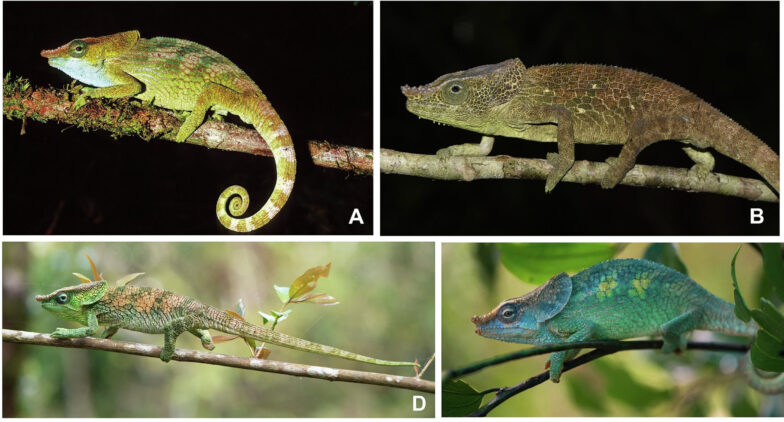
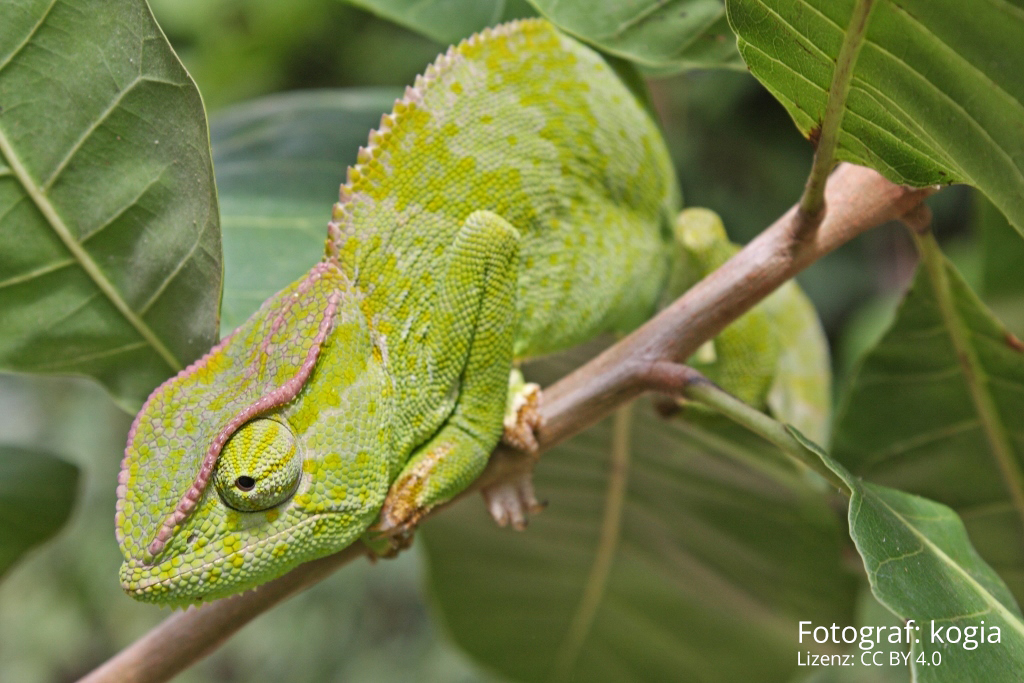
Foto: Calumma pinocchio im Reservat von Vohimana, fotografiert von Alex Negro[:en]

A study on the distribution and habitats of various chameleon species was recently carried out in Vohimana, Madagascar. The Vohimana Reserve is situated at an altitude of between 800 and 1,000 metres in the island’s eastern highlands. It covers an area of 15 km², comprising 6 km² of primary rainforest, 8.5 km² of secondary vegetation and just over 1 km² of eucalyptus forest. The rainy season runs from October to May and is characterised primarily by increased rainfall, although the dry season also sees a relatively high amount of rainfall.

Over a total of 195 days – 158 of which were during the rainy season and 37 during the dry season – chameleons were searched for with the naked eye within the reserve along the existing paths. In the process, various individuals covered a total distance of 350 km. 80% of the data collection took place at night, with only 20% during the day. Every chameleon found was photographed, and the temperature, relative humidity and UV index were measured at the site of discovery. The data was then statistically analysed.

A total of 577 chameleons were recorded during the entire study period. These included a single Calumma brevicorne, seven Furcifer willsii, two Brookesia ramanantsoai, seven Brookesia thieli, 143 Brookesia superciliaris and Brookesia therezieni (grouped together), 53 Calumma furcifer, 207 small Calumma of nasutum-complex (grouped together due to difficulties in identifying them solely on the basis of external characteristics), 24 Calumma parsonii, 118 Calumma pinocchio, 11 Furcifer bifidus and 4 Furcifer pardalis.

The most common species in Vohimana were Brookesia superciliaris and Brookesia therezieni, small chameleons of the Calumma nasutum complex, and Calumma pinocchio. Brookesia superciliaris, Brookesia therezieni and Calumma furcifer were rarely found outside the primary forest. Calumma pinocchio was most commonly found in a small remnant of primary forest in the north-east of the reserve. The scientists repeatedly found all other species in both primary forest and secondary vegetation. Calumma parsonii, Calumma pinocchio and species of the nasutum complex were frequently found along forest edges.

Temperatures at the study sites averaged 24.2°C during the wet season, compared with an average of 18.3°C during the dry season. During the wet season, more chameleons were observed during the day in locations with a higher UV index (averaging 0.5). Relative humidity in Vohimana was high throughout the year, averaging over 90% for both seasons. The differences between the various chameleon species were rather small in terms of microclimates. Individuals of Furcifer pardalis and Furcifer willsii were found at the highest recorded daytime and night-time temperatures (29°C and 27.5°C during the day, 25°C at night). These two species were also basking at the highest average UVI recorded (8.2 for Furcifer pardalis and 7.7 for Furcifer willsii). The UV indices for all other species were, on average, significantly lower.

Diversity, distribution, and microclimatic conditions experienced by the chameleons of the Vohimana Reserve, Madagascar
Olivier Marquis, Marc Gansuana, Sébastian Métrailler
Herpetological Conservation and Biology 21(1), 2026: 101-119
DOI: not available
Free article download

Photo: Calumma pinocchio in the Vohimana Reserve, photographed by Alex Negro[:]

[:de]Eingeschleppte Chamäleons in Subsahara-Afrika[:en]Invasive chameleons in subsaharan Africa[:]

[:de]Eingeschleppte Chamäleons in Subsahara-Afrika[:en]Invasive chameleons in subsaharan Africa[:]

Verbreitung Wissenschaft

[:de]

Ein polnischer Biologe hat kürzlich ausgewertet, wie viele eingeschleppte Reptilien- und Amphibienarten es in Subsahara-Afrika gibt.

Unter den in andere Länder eingeschleppte Arten finden sich auch einige Chamäleons: Das Pantherchamäleon (Furcifer pardalis) wurde bereits vor 1830 in La Réunion eingeführt. Es kommt bis heute auf der Insel vor. Das Kap-Zwergchamäleon (Bradypodion pumilum) wurde in den 1990er Jahren in Namibia ausgesetzt und bildete kleine Populationen in Swakopmund, Walvis Bay, Lüderitz und Windhoek. Alle diese Populationen sind heute jedoch ausgestorben. Das Parsons Chamäleon (Calumma parsonii parsonii) wurde in den 1960er Jahren von Madagaskar nach Mauritius gebracht. Eine überlebensfähige Population wurde daraus jedoch nicht. Das Lappenchamäleon (Chamaeleo dilepis) wurde vor 1978 in die südafrikanische Provinz Freistaat verschleppt, scheint dort aber ebenfalls keine eigenständige Population gebildet zu haben. Und zuletzt wurden verschiedene Zwergchamäleon-Arten (Bradypodion ssp.) im Jahr 1939 in die Provinz Freistaat in Südafrika gebracht. Auch sie erzeugten keine bleibende Population.

Insgesamt sind vor allem Echsen in Subsahara-Afrika in fremde Länder eingeschleppt worden (23 Arten), direkt dahinter kommen Amphibien (21 Arten) und Schlangen (14 Arten). Die meisten eingeschleppten Arten werden in Südafrika beobachtet, außerdem aber auch in Madagaskar, den Maskarenen und umliegenden Inseln. Unklar ist, ob weiter nördlich gelegene afrikanische Länder eingeschleppte Arten geringer beobachten oder dort tatsächlich weniger vorhanden sind. Zwei Drittel der eingeschleppten Arten, die eigene Populationen etablierten konnten, kamen aus anderen Regionen Afrikas oder der umliegenden Inseln sowie dem Orient. Bei den Arten, die sich nach ihrer Verschleppung nicht vermehren konnten, sieht das deutlich anders aus.

Die frühesten Verschleppungen in Subsahara-Afrika sind aus dem 17. Jahrhundert bekannt, darunter der Vierkrallengecko (Gehyra mutilata) und der Maskarenenfrosch (Ptychadena mascareniensis). Mit dem Kolonialismus steigen die Zahlen verschleppter Arten stark an. Ein weiterer Peak liegt ab etwa 2000 mit steigendem internationalem Handel.

Die Gründe für die Verschleppungen sind vielfältig, zumeist aber passiert es unbeabsichtigt. Vor allem Geckos und Frösche werden häufig als blinde Passagiere mit Obsttransporten, Container auf Schiffen oder im Gepäck von Touristen verschleppt. Seltener werden Reptilien und Amphibien absichtlich ausgesetzt, wie im Fall des Kap-Zwerggecko (Lygodactylus capensis), der in einer Gärtnerei ausgesetzt wurde. Das Aussetzen von als Haustieren gehaltenen Reptilien und Amphibien führt meist nicht zur Etablierung von sich vermehrenden Populationen. Zwei Fälle von beabsichtigtem Aussetzen zur biologischen Kontrolle anderer Tierarten sind bekannt, ebenfalls drei beabsichtigte Freilassungen ohne Gründe.

Potenzielle Probleme der eingeschleppten Arten sind vor allem die Verdrängung anderer einheimischer Arten, aber auch das Fressen einheimischer Arten. Die Hybridisierung mit einheimischen Arten findet sehr selten statt. Die Verbreitung von Krankheiten, beispielsweise Parasitosen, ist ein häufiges Problem. Von verschleppten Chamäleons ist bisher keines dieser Probleme bekannt, allerdings gibt es auch vielerorts kaum Studien zum Thema.

Herping the African Continent: Alien Amphibians and Reptiles in Sub-Saharan Africa
Grzegorz Kopij
Biology 2026, 15: 639
DOI: 10.3390/biology15080639
Kostenloser Download des Artikels
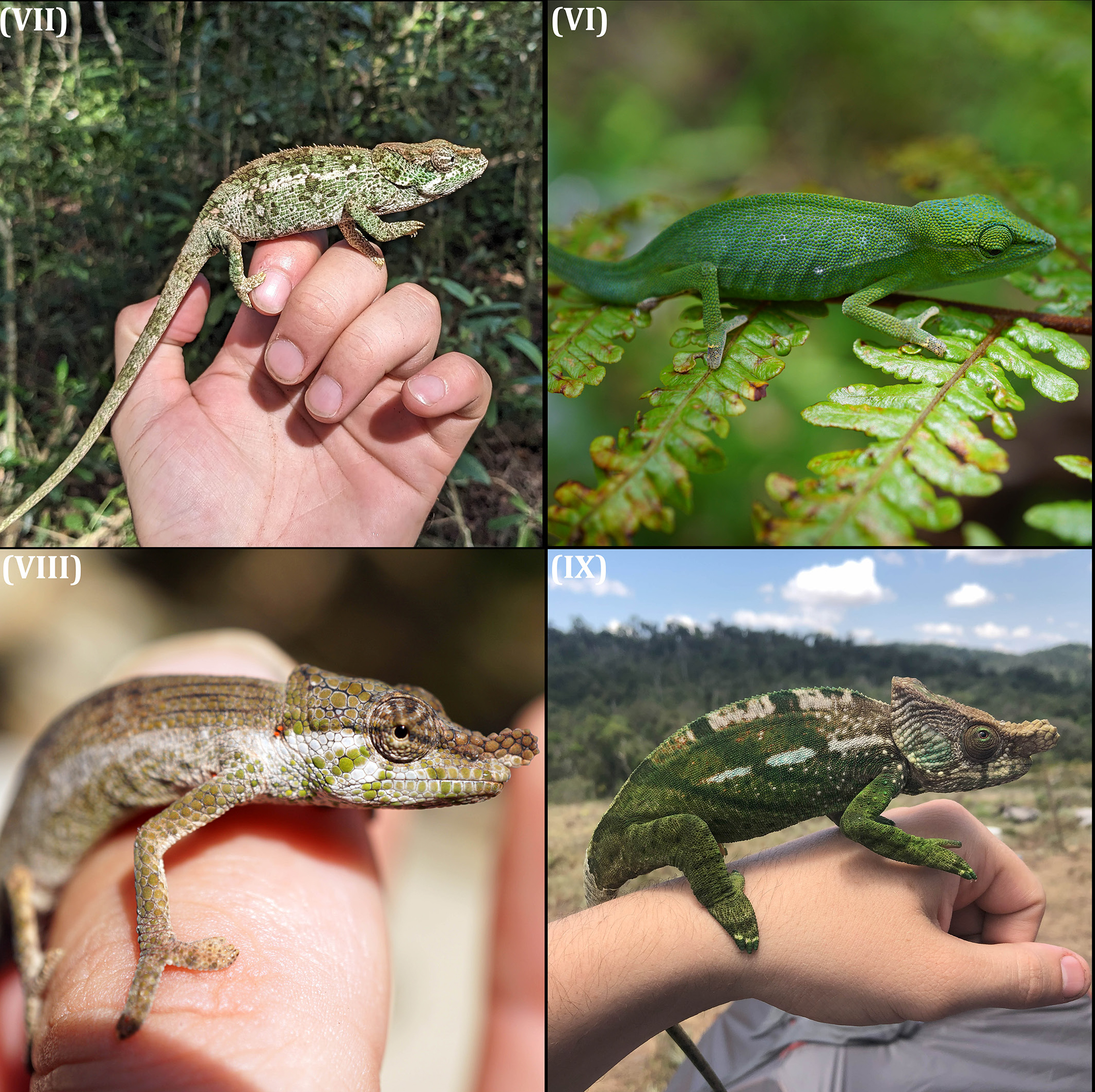
Foto: Ein Furcifer pardalis auf La Réunion, fotografiert von Jason Berger, CC BY 4.0[:en]

A Polish biologist has recently assessed the number of introduced reptile and amphibian species in sub-Saharan Africa.

Among the species introduced into other countries are also a number of chameleons: the panther chameleon (Furcifer pardalis) was introduced to Réunion before 1830. It is still found on the island today. The Cape dwarf chameleon (Bradypodion pumilum) was released in Namibia in the 1990s and established small populations in Swakopmund, Walvis Bay, Lüderitz and Windhoek. However, all these populations are now extinct. The Parsons’ chameleon (Calumma parsonii parsonii) was introduced from Madagascar to Mauritius in the 1960s. However, this did not result in a viable population. The frilled chameleon (Chamaeleo dilepis) was introduced to the South African province of the Free State before 1978, but does not appear to have established a self-sustaining population there either. Finally, various species of dwarf chameleon (Bradypodion ssp.) were introduced to the Free State province in South Africa in 1939. They, too, failed to establish a permanent population.

Overall, lizards have been introduced into non-native countries in sub-Saharan Africa more than any other group (23 species), followed closely by amphibians (21 species) and snakes (14 species). Most introduced species are observed in South Africa, but also in Madagascar, the Mascarene Islands and surrounding islands. It is unclear whether introduced species are observed less frequently in African countries further north, or whether they are actually less prevalent there. Two-thirds of the introduced species that managed to establish their own populations originated from other regions of Africa or the surrounding islands, as well as the Middle East. The situation is quite different for species that were unable to reproduce after being introduced.

The earliest cases of species introduction in sub-Saharan Africa date back to the 17th century, including the four-clawed gecko (Gehyra mutilata) and the Mascarene frog (Ptychadena mascareniensis). With the advent of colonialism, the number of introduced species rose sharply. A further peak occurred from around the year 2000 onwards, coinciding with an increase in international trade.

There are many reasons why animals are transported unintentionally, but in most cases it happens by accident. Geckos and frogs, in particular, are frequently transported as stowaways in fruit shipments, in shipping containers, or in tourists’ luggage. Less commonly, reptiles and amphibians are deliberately released, as in the case of the Cape dwarf gecko (Lygodactylus capensis), which was released at a nursery. The release of reptiles and amphibians kept as pets does not usually lead to the establishment of breeding populations. Two cases of deliberate release for the purpose of biological control of other animal species are known, as are three deliberate releases for no apparent reason. The release of reptiles and amphibians kept as pets does not usually lead to the establishment of breeding populations. Two cases of deliberate release for the purpose of biological control of other animal species are known, as are three deliberate releases for no apparent reason.

The main potential problems posed by introduced species are the displacement of other native species, but also predation on native species. Hybridisation with native species occurs very rarely. The spread of diseases, such as parasitic infections, is a common problem. None of these problems have been reported in relation to introduced chameleons to date; however, there are very few studies on the subject in many places.

Herping the African Continent: Alien Amphibians and Reptiles in Sub-Saharan Africa
Grzegorz Kopij
Biology 2026, 15: 639
DOI: 10.3390/biology15080639
Free article download

Photo: A Furcifer pardalis on Réunion, photographed by Jason Berger, CC BY 4.0[:]

[:de]Vier neue Nadzikambia-Arten in Mosambik[:en]Four new species of Nadzikambia in Mozambique[:]

[:de]Vier neue Nadzikambia-Arten in Mosambik[:en]Four new species of Nadzikambia in Mozambique[:]

Neubeschreibungen Wissenschaft

[:de]

Das South East Africa Montane Archipelago (SEAMA) erstreckt sich quer über den Norden Mosambiks und bis ins südliche Malawi hinein. Es handelt sich dabei um eine Kette rund 30 sogenannter Inselberge, die durch Täler völlig voneinander isoliert liegen. Sie sind seit Längerem bekannt als Hot Spots der Artenvielfalt. Über Jahrzehnte war es auf Grund anhaltender Unruhen schwierig, die Inselberge herpetologisch zu erkunden. Und als schließlich die Möglichkeit wieder bestand, fand man prompt neue Chamäleon-Arten – je eine auf jedem der bisher untersuchten Inselberge. Inzwischen wurden die neuen Arten genetisch und morphologisch untersucht. Vier neue Nadzikambia-Arten wurden dabei beschrieben.

Nadzikambia franklinae erhielt seinen Namen zu Ehren der britischen Biochemikerin Rosalind Franklin. Die Art kommt in den Feuchtwäldern Mahno und Ukalini auf dem Mount Namuli in Mosambik vor. Sie wurde bisher auf Höhen zwischen 1618 und 1632 m gefunden. Die Männchen tragen einen höheren und runderen Helm mit glatteren Schuppenkämmen als andere Nadzikambia-Arten. Die drei verbliebenen Lebensräume der Art sind nur je rund 0,67 km² groß und massiv von der Gewinnung von Flächen für kleinbäuerliche Landwirtschaft, wie Mais- und Kartoffelanbau, bedroht.

Nadzikambia goodallae wurde nach der kürzlich verstorbenen Schimpansenforscherin Jane Goodall benannt. Die Art lebt im Feuchtwald am Westhang des Mount Ribáuè in Mosambik.  Sie wurde bisher auf eng begrenzten Höhen zwischen 1052 und 1142 m entdeckt. Auch diese Art wird sehr stark von Brandrodung und Abholzung ihres Lebensraumes bedroht. Nur noch 4,8 km² Waldfläche sind aktuell übrig. Die Männchen von Nadzikambia goodallae tragen einen flachen, breiten Helm mit rauen Schuppen.

Nadzikambia evanescens wurde benannt nach dem lateinischen Wort für Vergänglichkeit. Es soll auf den extremen Bedrohungsstatus der Art hinweisen. Die Chamäleonart kommt nur noch in einem einzigen Feuchtwaldfragment auf dem Mount Inago in Mosambik vor. Allein seit 2009 wurden 85% der damals vorhandenen Waldfläche gerodet. Aktuell sind gerade einmal 2,3 km² noch vorhanden. Der kleine Lebensraum liegt auf 1235 bis 1281 m. Die Männchen der Art tragen einen hohen, runden Helm mit glatten Schuppenkämmen.

Nadzikambia nubila wurde benannt nach dem lateinischen Wort für Wolken. Ihr Lebensraum, der Mount Chaperone, sorgt für mit seinen umgebenden Wolkenformationen den für das Überleben der Region notwendigen Niederschlag. Von Nadzikambia nubila sind bisher nur Weibchen bekannt, Männchen hat man noch keine gefunden. Die Chamäleons bewohnen Feuchtwald in Höhen zwischen 1017 und 1053 m, wobei sich die vorhandene Waldfläche seit 2009 vor allem durch Brandrodung und Abholzung mehr als halbiert hat. Aktuell sind gerade einmal 7 km² noch vorhanden. Zusätzlich scheinen sich die höchsten Lagen des Mount Chaperone, die weniger von menschlichem Zutun bedroht sind, von geschlossenen Waldflächen zu mehr Granitflächen zu wandeln. Die Autoren vermuten, dass dies auf den Klimawandel zurückgehen könnte.

Die bereits bekannte Art Nadzikambia mlanjensis steht leider in Sachen Bedrohung den neuen Arten in nichts nach. Und das, obwohl sie auf Höhen zwischen 600 und fast 2000 m vorkommt, womit sie deutlich variablere Lebensräume bewohnt. Die vor Jahrzehnten auf dem Mount Mlanje in Malawi geschlossene Waldfläche besteht heute nur noch aus winzigen, voneinander isolierten Waldfragmenten. Insgesamt sind vielleicht noch 12 km² übrig, der Rest wurde bereits abgeholzt. Auch vom Ruo Gorge Forest, dem ersten Fundort der Art, ist nicht mehr viel über. Ob Nadzikambia mlanjensis auch auf dem nahe gelegenen Mount Mchese vorkommt, ist noch ungeklärt.

Etwas besser scheint es noch die sechste und letzte Art der Gattung getroffen zu haben, Nadzikambia baylissi. Die Art kommt in Feuchtwäldern zwischen 1000 und 1400 m auf dem Mount Mabu in Mosambik vor. Hier ist der Wald noch weitestgehend intakt, auch wenn die Waldränder mit Brandrodung zu kämpfen haben. Ob die angenommenen 48 km² Lebensraum für diese Chamäleonart noch aktuell sind, ist jedoch nicht vollständig geklärt.

Sky islands of Mozambique harbour cryptic species of chameleons: Description of four new species of sylvan chameleons (Squamat: Chamaeleonidae: Nadzikambia Tilbury, Tolley & Branch, 2006)
Krystal A. Tolley, Werner Conradie
Vertebrate Zoology 76, 2026: 207-246
DOI: 10.3897/vz.76.e178403
Kostenloser Download des Artikels
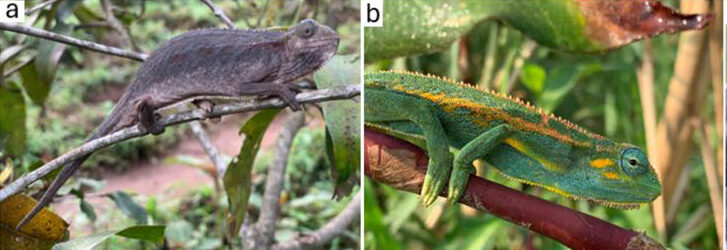
Fotos: Von links oben nach rechts unten Nadzikambia franklinae, Nadzikambia goodallae, Nadzikambia avanescens und Nadzikambia nubila[:en]

The South East Africa Montane Archipelago (SEAMA) stretches across northern Mozambique and into southern Malawi. It consists of a chain of around 30 so-called inselbergs, which are completely isolated from one another by valleys. They have long been recognised as biodiversity hotspots. For decades, ongoing unrest made it difficult to conduct herpetological surveys of the insular mountains. And when the opportunity finally arose again, new species of chameleon were promptly discovered – one on each of the insular mountains surveyed to date. The new species have since been studied genetically and morphologically. Four new species of Nadzikambia were described in the process.

Nadzikambia franklinae was named in honour of the British biochemist Rosalind Franklin. The species is found in the Mahno and Ukalini wet forests on Mount Namuli in Mozambique. It has so far been found at altitudes between 1,618 and 1,632 metres. The males have a taller and rounder casque with smoother crests than other Nadzikambia species. The species’ three remaining habitats are each only around 0.67 km² in size and are under massive pressure from land clearance for small-scale farming, such as maize and potato cultivation.

Nadzikambia goodallae was named after the recently deceased chimpanzee researcher Jane Goodall. The species inhabits the wet forest on the western slope of Mount Ribáuè in Mozambique.  It has so far been found at very specific altitudes between 1,052 and 1,142 metres. This species, too, is under severe threat from slash-and-burn farming and deforestation of its habitat. Only 4.8 km² of forest area currently remains. The males of Nadzikambia goodallae have a flat, broad casque with rough scales.

Nadzikambia evanescens was named after the Latin word for transience. This is intended to highlight the species’ critically endangered status. This chameleon species now survives in just a single fragment of wet forest on Mount Inago in Mozambique. Since 2009 alone, 85% of the forest area that existed at that time has been cleared. Currently, just 2.3 km² remains. The small habitat lies at an altitude of 1,235 to 1,281 m. The males of the species have a tall, round casque with smooth crest scales.

Nadzikambia nubila was named after the Latin word for clouds. Its habitat, Mount Chaperone, provides the rainfall essential for the region’s survival through its surrounding cloud formations. To date, only females of Nadzikambia nubila have been recorded; no males have yet been found. The chameleons inhabit wet forest at altitudes between 1,017 and 1,053 metres, although the existing forest area has more than halved since 2009, mainly due to slash-and-burn farming and illegal logging. Currently, only 7 km² remain. Furthermore, the highest elevations of Mount Chaperone, which are less threatened by human activity, appear to be changing from dense woodland to more exposed granite outcrops. The authors suspect that this may be due to climate change.

Unfortunately, the already known species Nadzikambia mlanjensis is just as threatened as the four new species. And this is despite the fact that it occurs at altitudes ranging from 600 to almost 2,000 metres, meaning it inhabits significantly more varied habitats. The forest area that once covered Mount Mlanje in Malawi decades ago now consists only of tiny, isolated forest fragments. In total, perhaps 12 km² remain; the rest has already been cleared. Nor is much left of Ruo Gorge Forest, the site where the species was first discovered. It is not yet clear whether Nadzikambia mlanjensis also occurs on nearby Mount Mchese.

The sixth and final species of the genus, Nadzikambia baylissi, appears to have fared slightly better. The species is found in wet forests at altitudes of between 1,000 and 1,400 metres on Mount Mabu in Mozambique. Here, the forest is still largely intact, even though the forest edges are struggling with slash-and-burn farming. However, it is not entirely clear whether the estimated 48 km² of habitat for this chameleon species is still accurate.

Sky islands of Mozambique harbour cryptic species of chameleons: Description of four new species of sylvan chameleons (Squamat: Chamaeleonidae: Nadzikambia Tilbury, Tolley & Branch, 2006)
Krystal A. Tolley, Werner Conradie
Vertebrate Zoology 76, 2026: 207-246
DOI: 10.3897/vz.76.e178403
Download the article for free

Photos: From top left to bottom right Nadzikambia franklinae, Nadzikambia goodallae, Nadzikambia avanescens and Nadzikambia nubila[:]

[:de]Frugivorie und Temperatur steuerndes Verhalten des Knysna-Zwergchamäleons[:en]Frugivory and temperature-regulated behaviour in the Knysna dwarf chameleon[:]

[:de]Frugivorie und Temperatur steuerndes Verhalten des Knysna-Zwergchamäleons[:en]Frugivory and temperature-regulated behaviour in the Knysna dwarf chameleon[:]

Beobachtungen Wissenschaft

[:de]

Südafrikanische Wissenschaftler haben sich im Zuge einer Beobachtungsstudie mit dem Verhalten des Knysna-Zwergchamäleons Bradypodion damaranum beschäftigt. Ort der Studie war ein Park in George in der Provinz Westkap. Der Park wird vorwiegend von Fußgängern, Radfahrern und Hundehaltern zur Erholung genutzt, so dass die Chamäleons dort an Menschen in gewissem Rahmen gewöhnt sind.

Sechs adulte Bradypodion damaranum wurden abends im Licht von Taschenlampen gefunden und mit Transmittern versehen. Die Transmitter wurden mit Gewebekleber an die Flanke geklebt. Tagsüber wurde dann je ein Chamäleon von einem Wissenschaftler für bis zu 4,5 h beobachtet, darunter auch unbesenderte Tiere. Anschließend wurden die besenderten Chamäleons aufgesucht und die Sender wieder entfernt.

Insgesamt konnten 30 Chamäleons beobachtet werden, davon sechs besenderte und 24 unbesenderte Tiere. Bei steigenden Temperaturen mit Spitzen zwischen 36 und 40°C um die Mittagszeit konnten insgesamt sechs Bradypodion damaranum dabei beobachtet werden, wie sie sich zügig in schattigere, niedriger gelegenere Bereiche der Vegetation verzogen. Die meisten färbten sich dabei deutlich heller als zuvor. An einem anderen Tag lagen die Temperaturen bei Sonnenaufgang erst bei 8°C. Mehrere Chamäleons wurden dabei beobachtet, wie sie sich sehr langsam zu Sonnenplätzen bewegten. Zwei wurden bei 12°C bei der Futteraufnahme beobachtet.

Zudem wurde zwei Mal verschiedene Bradypodion damaranum bei der Aufnahme reifer Beeren von Fruchtsträuchen (Halleria lucida) gesehen. Frugivorie war bisher von dieser Art nicht bekannt. Ein weiteres Chamäleon wurde dabei beobachtet, wie es die Blüte eines Blitzstrauches (Clutia pulchella) verzehrte. Insgesamt scheint dies aber selten vorzukommen, da es während 142 Stunden Beobachtungszeit nur wenige Male beobachtet werden konnte.

Natural history observation of the Knsysna Dwarf Chameleon, Bradypodion damaranum (Boulenger, 1887): thermal extremes and feeding on flora
Krystal A. Tolley, Jody M. Barends, Wade K. Stanton-Jones, Graham J. Alexander
Herpetology Notes 19, 2026: 219-228.
DOI: nicht verfügbar
Kostenloser Download des Artikels
Foto: Ein Bradypodion damaranum, dass vor den steigenden Temperaturen Zuflucht am Stamm eines Karminroten Zylinderputzers (Callistemon citrinus) gesucht hat, aus der genannten Publikation

[:en]

South African scientists have conducted an observational study into the behaviour of the Knysna dwarf chameleon (Bradypodion damaranum). The study was carried out in a park in George, in the Western Cape province. The park is mainly used by walkers, cyclists and dog owners for recreational purposes, meaning that the chameleons there are, to a certain extent, accustomed to people.

Six adult Bradypodion damaranum were found in the evening by torchlight and fitted with transmitters. The transmitters were attached to their flanks using tissue adhesive. During the day, one chameleon at a time was observed by a researcher for up to 4.5 hours, including those without transmitters. The chameleons fitted with transmitters were then located and the transmitters removed.

A total of 30 chameleons were observed, six of which were tagged and 24 untagged. As temperatures rose, peaking between 36 and 40°C around midday, a total of six Bradypodion damaranum were observed quickly retreating to shadier, lower-lying areas of the vegetation. Most of them turned noticeably paler than before. On another day, temperatures at sunrise were only 8°C. Several chameleons were observed moving very slowly towards sunny spots. Two were observed feeding at 12°C.

In addition, two Bradypodion damaranum were observed feeding on ripe berries from fruit bushes (Halleria lucida). Frugivory had not previously been recorded in this species. Another chameleon was observed consuming the flower of a Clutia pulchella. Overall, however, this appears to be a rare occurrence, as it was observed only a few times during 142 hours of observation.

Natural history observation of the Knsysna Dwarf Chameleon, Bradypodion damaranum (Boulenger, 1887): thermal extremes and feeding on flora
Krystal A. Tolley, Jody M. Barends, Wade K. Stanton-Jones, Graham J. Alexander
Herpetology Notes 19, 2026: 219-228.
DOI: not available
Free article download

Photo: A Bradypodion damaranum that has sought refuge from the rising temperatures on the trunk of a carmine-red bottlebrush (Callistemon citrinus), from the publication mentioned

[:]

[:de]Artbeschreibung von Chamaeleo incognitus für ungültig erklärt[:en]Description of Chamaeleo incognitus has been declared invalid[:]

[:de]Artbeschreibung von Chamaeleo incognitus für ungültig erklärt[:en]Description of Chamaeleo incognitus has been declared invalid[:]

Neubeschreibungen Wissenschaft

[:de]

Der Chamaeleo dilepis-Komplex wirft nach wie vor sehr viele Fragen auf. Eine weite Teile Afrikas übergreifende Untersuchung der Genetik und der Morphologie steht noch aus. 2025 beschrieb Nečas im von ihm selbst veröffentlichten Magazin Archaius die Art Chamaeleo incognitus. Außerdem erhob er die Unterarten Chamaeleo dilepis roperi sowie Chamaeleo dilepis martensi in den Artstatus. Südafrikanische Forscher haben sich nun noch einmal eingehender mit dem Thema beschäftigt und festgestellt, dass sowohl die Neubeschreibung als auch die Artstatusänderungen ungültig sind.

Die Autoren des aktuellen Papers weisen auf mehrere Probleme hin, die dieser Artbeschreibung zugrunde liegen. Einmal geht Nečas davon aus, dass ein konserviertes Chamäleon aus Mombasa (Kenia) das „echte“ Chamaeleo dilepis ist. Die Typuslokalität von Chamaeleo dilepis ist jedoch Gabun, rund 3300 km von den ostafrikanischen Chamaeleo dilepis entfernt. Des Weiteren existieren vom Holotyp, also dem zuerst unter dem Namen Chamaeleo dilepis beschriebenen Tier, gar keine ausführliche Beschreibung der Hemipenes. Lediglich eine Publikation aus 2007 erwähnt die Hemipenes von Chamaeleo dilepis kurz in neun Worten. Trotzdem nutzt Nečas diese paar Worte als feststehende Beschreibung und erklärt, dass die Hemipenes von Chamaeleo incognitus davon abwichen. Was er dann sehr knapp beschreibt, entspricht jedoch den Hemipenes von Chamaeleo dilepis roperi. In den Fotos der Hemipenes von Chamaeleo incognitus erkennen die südafrikanischen Wissenschaftler – nur um die Verwirrung noch zu erhöhen – jedoch die gleichen Merkmale wie die an den Hemipenes der Chamaeleo dilepis aus Mombasa.

Dazu kommt, dass bereits eine Veröffentlichung 2022 mittels genetischer Untersuchungen feststellte, dass die Chamaeleo dilepis Ostafrikas sich deutlich von den Chamaeleo dilepis Westafrikas unterscheiden. Dabei bilden sowohl die Tiefland- als auch die Hochlandarten Ostafrikas eine zusammengehörige Clade. Rein äußerlich sind die Chamaeleo dilepis roperi aus dem Küstengebiet und die aus dem Hochland dabei nicht sicher zu unterscheiden. Würde man also eine der beiden Populationen als eigene Art – hier die im Hochand als Chamaeleo incognitus – beschreiben wollen, bräuchte es dafür genetische Beweise. Diese fehlen in der Veröffentlichung von Nečas. Es bleibt als einziger Artunterschied der unterschiedliche Lebensraum bzw. die Höhenlage – das ist für die südafrikanischen Wissenschaftler nicht ausreichend, um eine eigene Art zu beschreiben. Chamaeleo incognitus ist daher als Synonym zu Chamaeleo dilepis roperi zu sehen.

Die Beschreibung erfolgte außerdem nicht nach den Regeln des ICZN (international code of zoological nomenclature).  Gängige „best practice“-Regeln wie beispielsweise ein Hinweis auf den Interessenskonflikt wurden nicht beachtet. Dazu zählt beispielsweise, einen Artikel ohne Begutachtung durch Fachkundige (sogenanntes Peer Review) im eigenen Magazin zu veröffentlichen.

Chamaeleo incognitus or Chamaeleo ignotus? Questioning the taxonomic validity of a new chameleon species
Devon C. Main, Colin R. Tilbury
African Journal of Herpetology, April 2026
DOI: 0.1080/21564574.2025.2595158
Kostenloser Download des Artikels
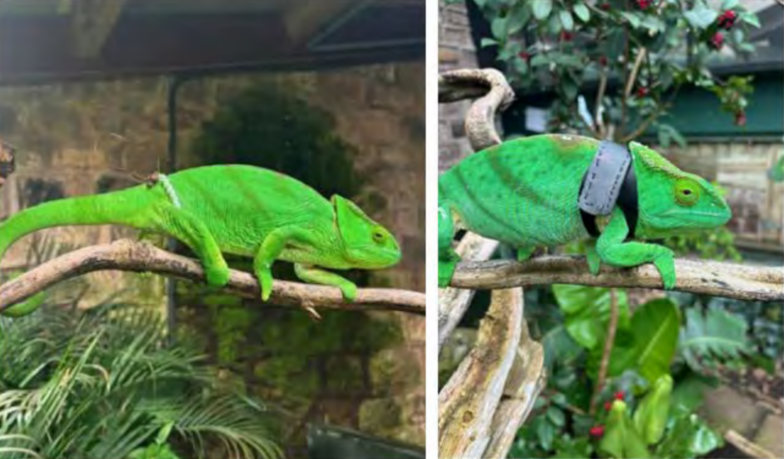
Foto: Chamaeleo dilepis aus Botswana[:en]

The Chamaeleo dilepis complex continues to raise a great many questions. A comprehensive study of its genetics and morphology across large parts of Africa has yet to be carried out. In 2025, Nečas described the species Chamaeleo incognitus in the journal Archaius, which he himself edited, managed and published. He also elevated the subspecies Chamaeleo dilepis roperi and Chamaeleo dilepis martensi to species status. South African researchers have now examined the issue in greater detail and concluded that both the new description and the changes to the species’ status are invalid.

The authors of the current paper highlight several issues underlying this species description. Firstly, Nečas assumes that a preserved chameleon from Mombasa (Kenya) is the ‘true’ Chamaeleo dilepis. However, the type locality of Chamaeleo dilepis is Gabon, some 3,300 km away from the East African Chamaeleo dilepis. Furthermore, there exists no detailed description of the hemipenes from the holotype – that is, the specimen first described under the name Chamaeleo dilepis. Only a publication from 2007 mentions the hemipenes of Chamaeleo dilepis briefly, in nine words. Nevertheless, Nečas uses these few words as an established description and states that the hemipenes of Chamaeleo incognitus differed from them. What he then describes very briefly, corresponds to the hemipenes of Chamaeleo dilepis roperi. In the photographs of the hemipenes of Chamaeleo incognitus, however – just to add to the confusion – the South African scientists recognise the same characteristics as those found on the hemipenes of Chamaeleo dilepis from Mombasa.

Furthermore, a 2022 study using phylogenetic analysis stated that the Chamaeleo dilepis of East Africa differ significantly from those of West Africa. Both the lowland and highland species of East Africa form a single clade. Purely in terms of appearance, it is not possible to reliably distinguish between the Chamaeleo dilepis roperi from the coastal region and those from the highlands. If one were to describe one of the two populations as a separate species – in this case, the one in the highlands as Chamaeleo incognitus – genetic evidence would be required. This is lacking in Nečas’s publication. The only remaining difference between the species is the different habitat or altitude – which is not sufficient for the South African scientists to describe a separate species. Chamaeleo incognitus should therefore be regarded as a synonym of Chamaeleo dilepis roperi.

Furthermore, the description did not comply with the rules of the ICZN (International Code of Zoological Nomenclature). Common ‘best practice’ guidelines, such as disclosing a conflict of interest, were not followed. This includes, for example, publishing an article in one’s own journal without expert review (known as peer review).

Chamaeleo incognitus or Chamaeleo ignotus? Questioning the taxonomic validity of a new chameleon species
Devon C. Main, Colin R. Tilbury
African Journal of Herpetology, April 2026
DOI: 0.1080/21564574.2025.2595158
Free article download

Picture: Chamaeleo dilepis from Botswana[:]

[:de]Nahrung von Zwergchamäleons in unterschiedlichen Lebensräumen[:en]The diet of dwarf chameleons in different habitats[:]

[:de]Nahrung von Zwergchamäleons in unterschiedlichen Lebensräumen[:en]The diet of dwarf chameleons in different habitats[:]

Wissenschaft

[:de]

Zoologen der Universität von Johannesburg haben sich kürzlich damit beschäftigt, welche Futtertiere von Zwergchamäleons in verschiedenen Lebensräumen aufgenommen werden. Dazu sammelten sie jeweils in den Provinzen Westkap und Ostkap in Südafrika Chamäleons  der beiden Arten Bradypodion damaranum und Bradypodion ventrale. Die Tiere wurden für maximal 24 h gehältert, bis Kot abgesetzt wurde. Insgesamt konnten so 22 Kotproben gewonnen werden, elf von jeder Art. Davon stammten jeweils sechs Kotproben aus natürlichen Habitaten und fünf aus städtischem Umfeld.

Die verschiedenen Kotproben wurden mittels DNA-Analysen ausgewertet. Anschließend wurden statistisch untersucht, welche unterschiedlichen Nahrungsbestandteile in den verschiedenen Populationen von Zwergchamäleons gefunden worden waren.

41 verschiedene Arten von Arthropoden sowie eine Art Wurm, vermutlich von einem Mistkäfer, wurden im Kot gefunden. Die Schmeißfliege Stomorhina lunata war am häufigsten als Futtertier vertreten, direkt gefolgt von einer Baumwanze (Glypsus conspicuus) und einer Raubwanze (Rhynocoris kumari). Sowohl Bradypodion damaranum als auch Bradypodion ventrale ernährte sich hauptsächlich von Käfern, Zweiflüglgern, Schmetterlingen und Schnabelkerfen.

Zur Überraschung der Wissenschaftler stellte sich heraus, dass sich die Nahrung der beiden Chamäleonarten in unterschiedlichen Lebensräumen kaum voneinander unterschied. Insgesamt zeigten sich Unterschiede vor allem auf Art- und weniger auf Ordnungsebene. Die Populationen in natürlichen Lebensräumen ernährten sich dabei unter anderem von etwas mehr Fliegen und Spinnentieren, während die im städtischen Umfeld mehr auf Schmetterlinge zurückgriffen. Erstmals als Futtertiere von Bradypodion wurden Netzflügler, Fransenflügler und Köcherfliegen dokumentiert.

Peri-urban sustenance: unexpectedly broad overlap in dwarf chameleon (Bradypodion) diets between natural and transformed habitats
Matthew G. Adair, Peter R. Teske, Krystal A. Tolley
Urban Ecosystems 2026, 29:92.
DOI: nicht verfügbar
Kostenloser Download des Artikels[:en]

Zoologists at the University of Johannesburg have recently investigated which prey items are consumed by dwarf chameleons in different habitats. To this end, they collected chameleons of the two species Bradypodion damaranum and Bradypodion ventrale in the Western Cape and Eastern Cape provinces of South Africa. The animals were kept in captivity for a maximum of 24 hours until faeces were produced. A total of 22 faecal samples were obtained, eleven from each species. Of these, six faecal samples from each species came from natural habitats and five from peri-urban environments.

The various faecal samples were analysed using DNA techniques. Subsequently, statistical analyses were carried out to determine which different food components had been found in the various populations of dwarf chameleons.

41 different species of arthropods, as well as one species of worm, presumably from a dung beetle, were found in the faeces. The blowfly Stomorhina lunata was the most common prey species, closely followed by a tree bug (Glypsus conspicuus) and a predatory bug (Rhynocoris kumari). Both Bradypodion damaranum and Bradypodion ventrale fed mainly on beetles, dipterans, butterflies and leafhoppers.

To the scientists’ surprise, it turned out that the diet of the two chameleon species in different habitats hardly differed from one another. Overall, differences were observed primarily at the species level rather than the order level. Populations in natural habitats fed, among other things, on slightly more flies and arachnids, whilst those in urban environments relied more on butterflies. For the first time, lace-wings, thrips and caddiesflies were documented as prey for Bradypodion.

Peri-urban sustenance: unexpectedly broad overlap in dwarf chameleon (Bradypodion) diets between natural and transformed habitats
Matthew G. Adair, Peter R. Teske, Krystal A. Tolley
Urban Ecosystems 2026, 29:92.
DOI: not available
Download the article for free[:]

[:de]Vorkommen des kleinsten Chamäleons der Welt (Madagaskar)[:en]Abundance of the world’s smallest chameleon (Madagascar)[:]

[:de]Vorkommen des kleinsten Chamäleons der Welt (Madagaskar)[:en]Abundance of the world’s smallest chameleon (Madagascar)[:]

Beobachtungen Wissenschaft

[:de]

Das aktuell kleinste Chamäleon der Welt wurde vor wenigen Jahren in Sorata im Norden Madagaskars entdeckt. Der Wald von Sorata gehört zum Korridor Marojejy-Anjanaharibe Süd-Tsaratanana, einem Gebiet von fragmentierten Waldresten zwischen den genannten großen Nationalparks und dem Réserve Naturelle Intégrale. Er wird derzeit vom WWF in Zusammenarbeit mit einer lokalen Organisation namens Ambodimandresy Miaro ny Ala verwaltet.

Wissenschaftler der Universitäten von Antsiranana und Antananarivo haben nun in Sorata die Bestandsdichte von Brookesia nana untersucht. 14 Tage lang suchten sie während der Regenzeit nachts entlang 14 je 150 m langer Transekte nach den kleinen Chamäleons.

Insgesamt fanden die Wissenschaftler 0,33 Individuen pro 100 m. Konkret bedeutet das, dass auf 2100 m Transekt nur sieben Brookesia nana überhaupt gefunden wurden. Die Weibchen waren etwas größer als die Männchen. Alle Chamäleons wurden auf sehr niedrigen Pflanzen schlafend gefunden, im Schnitt nur 7 cm über dem Boden.

Das niedrige Vorkommen macht weitere Studien in weiteren Wäldern des COMATSA-Korridors notwendig, um die exakte Verbreitung von Brookesia nana herauszufinden. Interessant ist außerdem, dass Brookesia nana offenbar seltene vorzukommen scheint als andere Arten der minima-Gruppe und damit möglicherweise eine höhere Gefährdung der Art vorliegt.

A brief overview of the natural history of the recently described, miniaturised leaf chameleon, Brookesia nana Glaw et al., 2021, from Sorata Forest, northeastern Madagascar
Jeanneney Rabearivony, Andriatsitohaina Ranaivojaona, Asmeralie Willian, Crispin Jaohasy, Moussaïna Jao, Achille P. Raselimanana
Herpetology Notes 19, 2026: 123-128.
DOI: nicht verfügbar
Kostenloser Download des Artikels
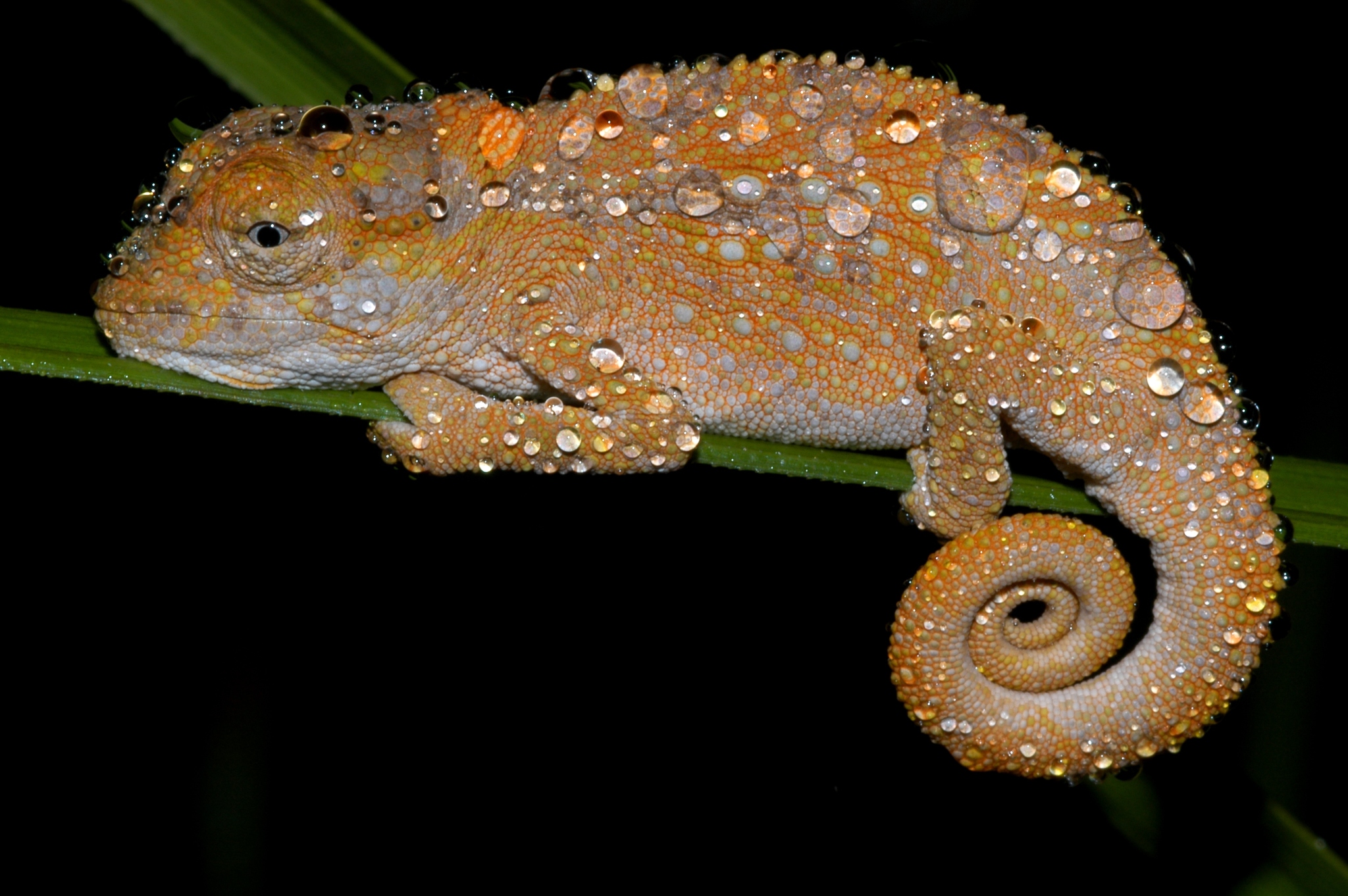
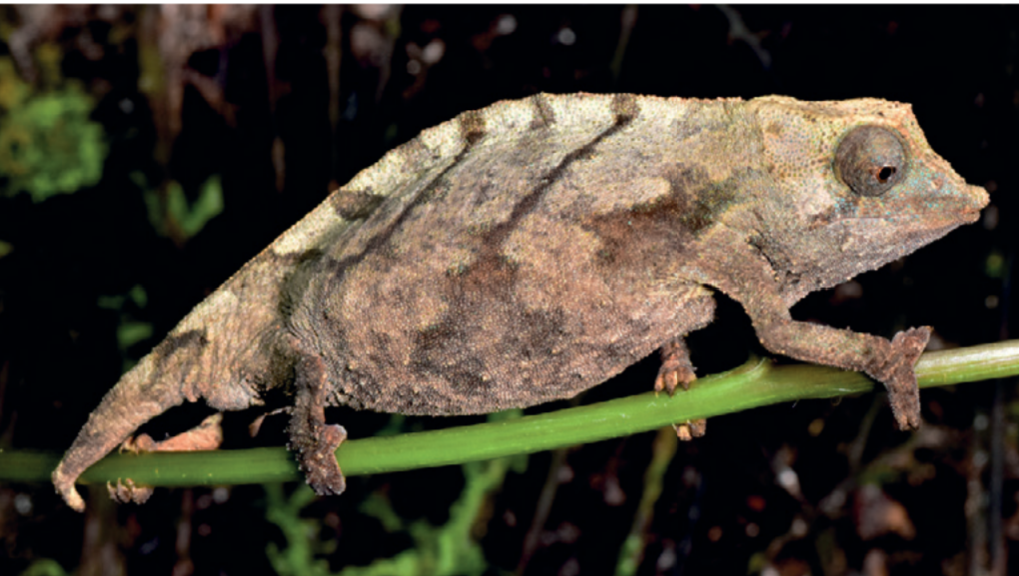
Foto: Brookesia nana, die in der genannten Studie gefunden wurden, fotografiert von Asmeralie William[:en]

The world’s smallest known chameleon was discovered a few years ago in Sorata, in northern Madagascar. The Sorata Forest forms part of the Marojejy-Anjanaharibe-South Tsaratanana corridor (COMATSA), an area of fragmented forest remnants situated between the major national parks mentioned and the Réserve Naturelle Intégrale. It is currently managed by the WWF in collaboration with a local organisation called Ambodimandresy Miaro ny Ala.

Scientists from the universities of Antsiranana and Antananarivo have now investigated the abundance of Brookesia nana in Sorata. For 14 nights during the rainy season, they searched for the tiny chameleons along 14 transects, each 150 metres long.

In total, the scientists found 0.33 individuals per 100 m. In concrete terms, this means that only seven Brookesia nana were found across the 2,100 m of transects. The females were slightly larger than the males. All the chameleons were found sleeping on very low vegetation, on average just 7 cm above the ground.

The low abundance necessitates further studies in other forests of the COMATSA corridor to determine the exact distribution of Brookesia nana. It is also interesting to note that Brookesia nana appears to be rarer than other species of the minima group, suggesting that the species may be at greater risk of extinction.

A brief overview of the natural history of the recently described, miniaturised leaf chameleon, Brookesia nana Glaw et al., 2021, from Sorata Forest, northeastern Madagascar
Jeanneney Rabearivony, Andriatsitohaina Ranaivojaona, Asmeralie Willian, Crispin Jaohasy, Moussaïna Jao, Achille P. Raselimanana
Herpetology Notes 19, 2026: 123-128.
DOI: not available
Free article download

Photo: Brookesia nana, found in the study mentioned, photographed by Asmeralie William[:]

[:de]Chamäleons in Namoroka (Madagaskar)[:en]Chameleons in Namoroka (Madagascar)[:]

[:de]Chamäleons in Namoroka (Madagaskar)[:en]Chameleons in Namoroka (Madagascar)[:]

Verbreitung Wissenschaft

[:de]

Die Tsingy de Namoroka liegen im heißen Westen Madagaskars. Sie bestehen aus nadelspitzem Karstgestein mit Grotten darunter und umgeben von Trockenwaldfragmenten. Obwohl die Tsingy inzwischen ein Nationalpark sind, ist der Zugang mangels jeglicher Infrastruktur und Wegen bisher nur äußerst schwierig und während der Regenzeit sogar überhaupt nicht möglich.

Die Wissenschaftler führten an drei verschiedenen Orten innerhalb des Nationalparks Übersichtsstudien durch. Dazu nutzten sie jeweils drei 1000 bis 1500 m Transektlinien an jedem Ort und Grubenfallen. Zusätzlich wurden spezielle Lebensräume wie Grotten gezielt aufgesucht.

Insgesamt wurden 57 Tierarten in Namoroka nachgewiesen werden, davon 41 Reptilienarten. An allen drei untersuchten Standorten konnten Brookesia brygooi, Furcifer angeli und Furcifer oustaleti nachgewiesen werden. Das in Namoroka endemische Brookesia bonsi dagegen konnte nur an einem einzigen Standort gefunden werden. Es handelt sich dabei um ein 87 m „hoch“ gelegenes Gebiet mit Bäumen zwischen 6 und 15 m Höhe und relativ offenem Blätterdach. Das Gebiet zeichnet sich durch dichtes, nahezu undurchdringbares Unterholz vor allem in feuchten, felsigen Schluchten zwischen den Tsingy aus.

Die Wissenschaftler weisen darauf hin, dass Brandrodung und daraus resultierende, unkontrollierbare Buschfeuer nach wie vor ein großes Risiko für die Lebensräume der Tiere in Namoroka darstellt. Auch Holzschlag sowie das Ernten wilden Honigs, wilden Wurzelknollen und Heilpflanzen sorgt dafür, dass die Lebensräume des Nationalparks gestört werden. Auch Zebus werden zum Weiden in den Nationalpark getrieben. Der tatsächliche Schutz des Gebiets ist auf Grund der ablegenen Lage und der hohen Armut der Bevölkerung vor Ort sehr schwierig.

Aperçu des amphibiens et des reptiles du Parc National de Namoroka: Diversité biologique, intérêt biogéographique et représentativité en matière de conservation
Hajaniaina Rasoloarison, Bernard Ranriamahatantsoa, Nirhy Rabibisoa, Christopher J. Raxworthy
Malagasy Nature 2026, 20: 30-46.
DOI: nicht verfügbar
Kostenloser Download des Artikels

Foto: Brookesia bonsi in Namoroka, aus der genannten Publikation[:en]

The Tsingy de Namoroka are located in the hot west of Madagascar. They consist of needle-sharp karst rock with caves beneath and are surrounded by fragments of dry forest. Although the Tsingy are now a national park, access has so far been extremely difficult due to a complete lack of infrastructure and paths, and is even impossible during the rainy season.

The scientists carried out survey studies at three different locations within the national park. To do this, they used three 1,000 to 1,500 m transect lines at each site, along with pitfall traps. In addition, specific habitats such as caves were specifically targeted.

A total of 57 animal species were recorded in Namoroka, 41 of which were reptiles. Brookesia brygooi, Furcifer angeli and Furcifer oustaleti were recorded at all three sites surveyed. Brookesia bonsi, which is endemic to Namoroka, was found at only one site. This is an area situated at an altitude of 87 m, with trees ranging from 6 to 15 m in height and a relatively open canopy. The area is characterised by dense, virtually impenetrable undergrowth, particularly in the damp, rocky gorges between the Tsingy.

The scientists point out that slash-and-burn farming and the resulting uncontrollable bushfires continue to pose a major risk to the animals’ habitats in Namoroka. Logging, as well as the harvesting of wild honey, wild root tubers and medicinal plants, also ensures that the national park’s habitats are disturbed. Zebus are also driven into the national park to graze. Effective protection of the area is very difficult due to its remote location and the high levels of poverty among the local population.

Aperçu des amphibiens et des reptiles du Parc National de Namoroka: Diversité biologique, intérêt biogéographique et représentativité en matière de conservation
Hajaniaina Rasoloarison, Bernard Ranriamahatantsoa, Nirhy Rabibisoa, Christopher J. Raxworthy
Malagasy Nature 2026, 20: 30-46.
DOI: not available
Free article download

Picture: Brookesia bonsi in Namoroka, from the afore mentioned publication[:]

[:de]Online Vortrag über Herpetologie in Südafrika[:en]Webinar about herpetology in South Africa[:]

[:de]Online Vortrag über Herpetologie in Südafrika[:en]Webinar about herpetology in South Africa[:]

Vorträge Webinare Wissenschaft

[:de]

Am Mittwoch, den 11.02.2026, wird Wade Stanton-Jones einen online Vortrag über seine Forschung in Südafrika halten.

Wade ist der neue Vertreter für Studierende und Nachwuchswissenschaftler der Herpetological Association of Africa (HAA). Er wird über seine bisherigen und aktuelle Forschungsarbeiten sprechen und darüber informieren, was Studierende und Nachwuchswissenschaftler in den nächsten Monaten erwartet. Wade hat bisher vor allem am Riesen-Gürtelschweif Smaug giganteus geforscht. Weitere seiner Arbeiten beschäftigten sich jedoch auch intensiv mit den Zwergchamäleons der Gattung Bradypodion, von denen es in Südafrika mehrere Arten gibt. Bitte meldet euch bei Interesse am Vortrag über diesen Link zur Teilnahme an. Die Teilnahme am Webinar ist kostenlos.

Wade Stanton-Jones A brief journey in African Herpetology: Community, Research, and the road ahead
Online Webinar
Vortragsbeginn 17.00 Uhr (Achtung Zeitverschiebung! In Johannisburg ist es dann 18 Uhr wie in der Vortragsankündigung angegeben.)[:en]

On Wednesday, 11 February 2026, Wade Stanton-Jones will give an online lecture on his research in South Africa.

Wade is the new representative for students and young scientists of the Herpetological Association of Africa (HAA). He will talk about his previous and current research work and provide information on what students and young scientists can expect in the coming months. Wade’s research has primarily focused on the sungazer Smaug giganteus. However, his work has also dealt extensively with the dwarf chameleons of the genus Bradypodion, of which there are several species in South Africa. If you are interested in attending the lecture, please register via this link. Participation in the webinar is free of charge.

Wade Stanton-Jones A brief journey in African Herpetology: Community, Research, and the road ahead
Online webinar
Lecture begins at 5 p.m. (Please note the time difference! In Johannesburg, it will be 6 p.m., as stated in the lecture announcement.)[:]

[:de]Chamaeleo africanus in Griechenland außerhalb Pylos nachgewiesen[:en]Chamaeleo africanus found in Greece outside Pylos[:]

[:de]Chamaeleo africanus in Griechenland außerhalb Pylos nachgewiesen[:en]Chamaeleo africanus found in Greece outside Pylos[:]

Verbreitung Wissenschaft

[:de]

Dass Chamaeleo africanus in der Lagune von Gialova, Region Pylos (Griechenland) vorkommt, ist inzwischen lange bekannt. Es unterscheidet sich nicht nur optisch, sondern auch genetisch von den im südlichen Europa relativ weit verbreiteten Chamaeleo chameleon. Sporadische Berichte von weiteren Vorkommen von Chamaeleo africanus in Griechenland gibt es immer wieder, bisher fehlte jedoch ein wissenschaftlicher Nachweis der Art in anderen Gebieten als Pylos.

Wissenschaftler haben nun eine zweite Population der Art identifiziert. Sie konnten mindestens sieben Individuen der Art rund 130 km nördlich der Gialova-Laguna auf dem Peloponnes finden. Die Chamäleons leben in einem Natura 2000-Gebiet namens Limnothalassa Kalogrias /Dasos Strogylias Kai Elos Lamias. Ein Jungtier wurde per Backenabstrich beprobt, um genetisch die Art Chamaeleo africanus zu bestätigen.

Genetic evidence for the presence of Chamaeleo africanus in Greece outside the Pylos region
Erika Lego, Maria Koutsokali, Michael Valachas
Conservation Genetics Resourecs 18(5), 2026
DOI: 0.1007/s12686-026-01409-w
Kostenlose Vorschau des Artikels

Foto: Chamaeleo africanus, fotografiert von Benny Trapp, CC BY-SA 3.0[:en]

It has long been known that Chamaeleo africanus occurs in the lagoon of Gialova, in the Pylos region (Greece). It differs not only visually but also genetically from Chamaeleo chameleon, which is relatively widespread in southern Europe. There have been sporadic reports of other occurrences of Chamaeleo africanus in Greece, but until now there has been no scientific evidence of the species in areas other than Pylos.

Scientists have now identified a second population of the species. They found at least seven individuals of the species about 130 km north of the Gialova lagoon on the Peloponnese. The chameleons live in a Natura 2000 area called Limnothalassa Kalogrias /Dasos Strogylias Kai Elos Lamias. A young animal was sampled via cheek swab to genetically confirm the species Chamaeleo africanus.

Genetic evidence for the presence of Chamaeleo africanus in Greece outside the Pylos region
Erika Lego, Maria Koutsokali, Michael Valachas
Conservation Genetics Resourecs 18(5), 2026
DOI: 0.1007/s12686-026-01409-w
Free preview of the article

Photo: Chamaeleo africanus, photographed by Benny Trapp, CC BY-SA 3.0[:]