[:de]Vorkommen des kleinsten Chamäleons der Welt (Madagaskar)[:en]Abundance of the world’s smallest chameleon (Madagascar)[:]

[:de]Vorkommen des kleinsten Chamäleons der Welt (Madagaskar)[:en]Abundance of the world’s smallest chameleon (Madagascar)[:]

Beobachtungen Wissenschaft

[:de]

Das aktuell kleinste Chamäleon der Welt wurde vor wenigen Jahren in Sorata im Norden Madagaskars entdeckt. Der Wald von Sorata gehört zum Korridor Marojejy-Anjanaharibe Süd-Tsaratanana, einem Gebiet von fragmentierten Waldresten zwischen den genannten großen Nationalparks und dem Réserve Naturelle Intégrale. Er wird derzeit vom WWF in Zusammenarbeit mit einer lokalen Organisation namens Ambodimandresy Miaro ny Ala verwaltet.

Wissenschaftler der Universitäten von Antsiranana und Antananarivo haben nun in Sorata die Bestandsdichte von Brookesia nana untersucht. 14 Tage lang suchten sie während der Regenzeit nachts entlang 14 je 150 m langer Transekte nach den kleinen Chamäleons.

Insgesamt fanden die Wissenschaftler 0,33 Individuen pro 100 m. Konkret bedeutet das, dass auf 2100 m Transekt nur sieben Brookesia nana überhaupt gefunden wurden. Die Weibchen waren etwas größer als die Männchen. Alle Chamäleons wurden auf sehr niedrigen Pflanzen schlafend gefunden, im Schnitt nur 7 cm über dem Boden.

Das niedrige Vorkommen macht weitere Studien in weiteren Wäldern des COMATSA-Korridors notwendig, um die exakte Verbreitung von Brookesia nana herauszufinden. Interessant ist außerdem, dass Brookesia nana offenbar seltene vorzukommen scheint als andere Arten der minima-Gruppe und damit möglicherweise eine höhere Gefährdung der Art vorliegt.

A brief overview of the natural history of the recently described, miniaturised leaf chameleon, Brookesia nana Glaw et al., 2021, from Sorata Forest, northeastern Madagascar
Jeanneney Rabearivony, Andriatsitohaina Ranaivojaona, Asmeralie Willian, Crispin Jaohasy, Moussaïna Jao, Achille P. Raselimanana
Herpetology Notes 19, 2026: 123-128.
DOI: nicht verfügbar
Kostenloser Download des Artikels

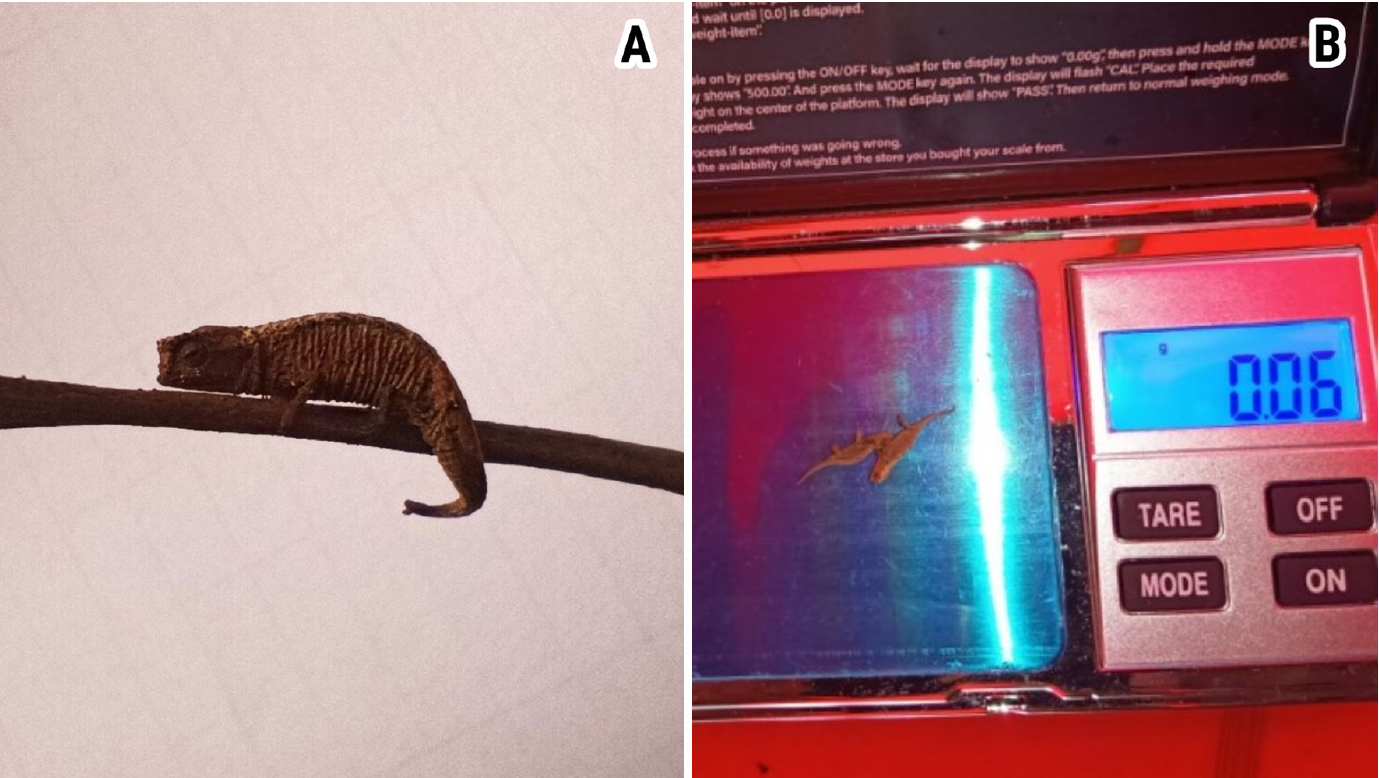
Foto: Brookesia nana, die in der genannten Studie gefunden wurden, fotografiert von Asmeralie William[:en]

The world’s smallest known chameleon was discovered a few years ago in Sorata, in northern Madagascar. The Sorata Forest forms part of the Marojejy-Anjanaharibe-South Tsaratanana corridor (COMATSA), an area of fragmented forest remnants situated between the major national parks mentioned and the Réserve Naturelle Intégrale. It is currently managed by the WWF in collaboration with a local organisation called Ambodimandresy Miaro ny Ala.

Scientists from the universities of Antsiranana and Antananarivo have now investigated the abundance of Brookesia nana in Sorata. For 14 nights during the rainy season, they searched for the tiny chameleons along 14 transects, each 150 metres long.

In total, the scientists found 0.33 individuals per 100 m. In concrete terms, this means that only seven Brookesia nana were found across the 2,100 m of transects. The females were slightly larger than the males. All the chameleons were found sleeping on very low vegetation, on average just 7 cm above the ground.

The low abundance necessitates further studies in other forests of the COMATSA corridor to determine the exact distribution of Brookesia nana. It is also interesting to note that Brookesia nana appears to be rarer than other species of the minima group, suggesting that the species may be at greater risk of extinction.

A brief overview of the natural history of the recently described, miniaturised leaf chameleon, Brookesia nana Glaw et al., 2021, from Sorata Forest, northeastern Madagascar
Jeanneney Rabearivony, Andriatsitohaina Ranaivojaona, Asmeralie Willian, Crispin Jaohasy, Moussaïna Jao, Achille P. Raselimanana
Herpetology Notes 19, 2026: 123-128.
DOI: not available
Free article download

Photo: Brookesia nana, found in the study mentioned, photographed by Asmeralie William[:]

[:de]Neuer Fundort von Calumma vencesi (Madagaskar)[:en]New locality record of Calumma vencesi (Madagascar)[:]

[:de]Neuer Fundort von Calumma vencesi (Madagaskar)[:en]New locality record of Calumma vencesi (Madagascar)[:]

Verbreitung Wissenschaft

[:de]

Calumma vencesi kommt im Norden Madagaskars vor und ist dort bisher von den Fundorten Betaolana, Besariaka und Tsararano bekannt. Ein madagassisches Forscherteam hat die Art nun noch in einem weiteren Regenwald entdecken können: In Sorata. Sorata gehört zum sogenannten COMATSA-Korridor, der vor allem aus den Regenwäldern Marojejy, Anjanaharibe Sud und Tsaratanana besteht. Sorata dagegen liegt noch etwas nördlicher in Richtung Vohémar. Der Regenwald wird derzeit vom WWF zusammen mit dem örtlichen Verein Ambodimandresy Miaro ny Ala (AMA) verwaltet.

Die Wissenschaftler verteilten zufällig 14 Transekte im Regenwald, die aus je drei parallel verlaufenden Linien von 50 m bestanden. Dann suchten sie nachts mit Taschenlampen entlang der Transekte nach schlafenden Chamäleons. Die Häufigkeit der Art pro 100 m wurde berechnet, die genutzten Pflanzen dokumentiert und die Schlafhöhe gemessen.

Insgesamt konnten acht Calumma vencesi gefunden werden. Sie schliefen auf einer durchschnittlichen Asthöhe vvon 1,43 m meist auf Blättern, wenige Individuen auf Ästen. Fünf Chamäleons wurden vertikal schlafend angetroffen, drei eher horizontal. Sieben von acht Calumma vencesi schliefen mit dem Kopf nach oben, nur eines kopfüber.

Das Vorkommen von nur 0,38 Individuen pro 100 m ist erstaunlich gering und unterschreitet sogar das von als vom Aussterben bedroht eingestuften Chamäleonarten wie Calumma tarzan. Bisher war Calumma vencesi außerdem ausschließlich unter 1000 m gefunden worden, das Studiengebiet in Sorata lag jedoch durchschnittlich auf 1326 m. Calumma vencesi kommt damit in Sorata im gleichen Verbreitungsgebiet wie Brookesia nana vor, was die Schutzbedürftigkeit dieses Regenwaldes noch dringender macht. Der Wald Brandrodung und illegalem Holzschlag sowie weidendem Vieh und Vanilleplantagen bedroht.

 A new locality for the endangered Vence’s Chamaeleon, Calumma vencesi Andreone et al., 2001, from Sorata Forest, northeastern Madagascar
Jeanneney Rabearivony, Andriatsitohaina Ranaivojaona, Moussaïna Jao, Achille P. Raselimanana
Herpetology Notes 18, 2025: 817-820.
DOI: nicht vorhanden
Kostenloser Download des Artikels

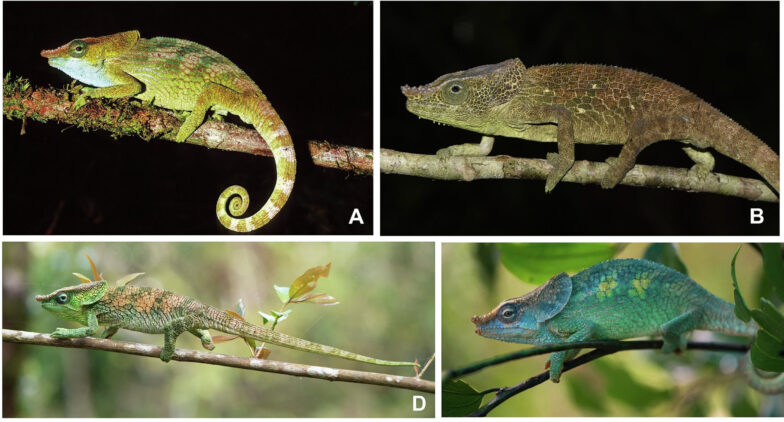
Foto: Calumma vencesi, fotografiert von Asméralie William, aus der genannten Publikation[:en]

Calumma vencesi occurs in northern Madagascar and has so far been found in Betaolana, Besariaka and Tsararano. A Madagascan research team has now discovered the species in another rainforest: Sorata. Sorata is part of the COMATSA corridor, which mainly consists of the Marojejy, Anjanaharibe Sud and Tsaratanana rainforests. Sorata, on the other hand, is located slightly further north towards Vohémar. The rainforest is currently managed by the WWF in collaboration with the local association Ambodimandresy Miaro ny Ala (AMA).

The scientists randomly distributed 14 transects in the rainforest, each consisting of three parallel lines of 50 m. Then, at night, they searched for sleeping chameleons along the transects with flashlights. The frequency of the species per 100 m was calculated, the plants used were documented and the sleeping height was measured.

A total of eight Calumma vencesi were found. They slept at an average branch height of 1.43 m, mostly on leaves, with a few individuals on branches. Five chameleons were found sleeping vertically, three more horizontally. Seven of the eight Calumma vencesi slept with their heads up, only one upside down.

The occurrence of only 0.38 individuals per 100 m is surprisingly low and even falls below that of chameleon species classified as critically endangered, such as Calumma tarzan. Until now, Calumma vencesi had only been found below 1000 m, but the study area in Sorata was at an average altitude of 1326 m. Calumma vencesi occurs in Sorata in the same distribution area as Brookesia nana, which makes the need to protect this rainforest even more urgent. The forest is threatened by slash-and-burn farming, illegal logging, grazing livestock and vanilla plantations.

 A new locality for the endangered Vence’s Chamaeleon, Calumma vencesi Andreone et al., 2001, from Sorata Forest, northeastern Madagascar
Jeanneney Rabearivony, Andriatsitohaina Ranaivojaona, Moussaïna Jao, Achille P. Raselimanana
Herpetology Notes 18, 2025: 817-820.
DOI: not available
Free article download

Photo: Calumma vencesi, photographed by Asméralie William, from the aforementioned publication[:]