
[:de]Chamaeleo africanus in Griechenland außerhalb Pylos nachgewiesen[:en]Chamaeleo africanus found in Greece outside Pylos[:]

[:de]Chamaeleo africanus in Griechenland außerhalb Pylos nachgewiesen[:en]Chamaeleo africanus found in Greece outside Pylos[:]

[:de]

Dass Chamaeleo africanus in der Lagune von Gialova, Region Pylos (Griechenland) vorkommt, ist inzwischen lange bekannt. Es unterscheidet sich nicht nur optisch, sondern auch genetisch von den im südlichen Europa relativ weit verbreiteten Chamaeleo chameleon. Sporadische Berichte von weiteren Vorkommen von Chamaeleo africanus in Griechenland gibt es immer wieder, bisher fehlte jedoch ein wissenschaftlicher Nachweis der Art in anderen Gebieten als Pylos.

Wissenschaftler haben nun eine zweite Population der Art identifiziert. Sie konnten mindestens sieben Individuen der Art rund 130 km nördlich der Gialova-Laguna auf dem Peloponnes finden. Die Chamäleons leben in einem Natura 2000-Gebiet namens Limnothalassa Kalogrias /Dasos Strogylias Kai Elos Lamias. Ein Jungtier wurde per Backenabstrich beprobt, um genetisch die Art Chamaeleo africanus zu bestätigen.

Genetic evidence for the presence of Chamaeleo africanus in Greece outside the Pylos region
Erika Lego, Maria Koutsokali, Michael Valachas
Conservation Genetics Resourecs 18(5), 2026
DOI: 0.1007/s12686-026-01409-w
Kostenlose Vorschau des Artikels

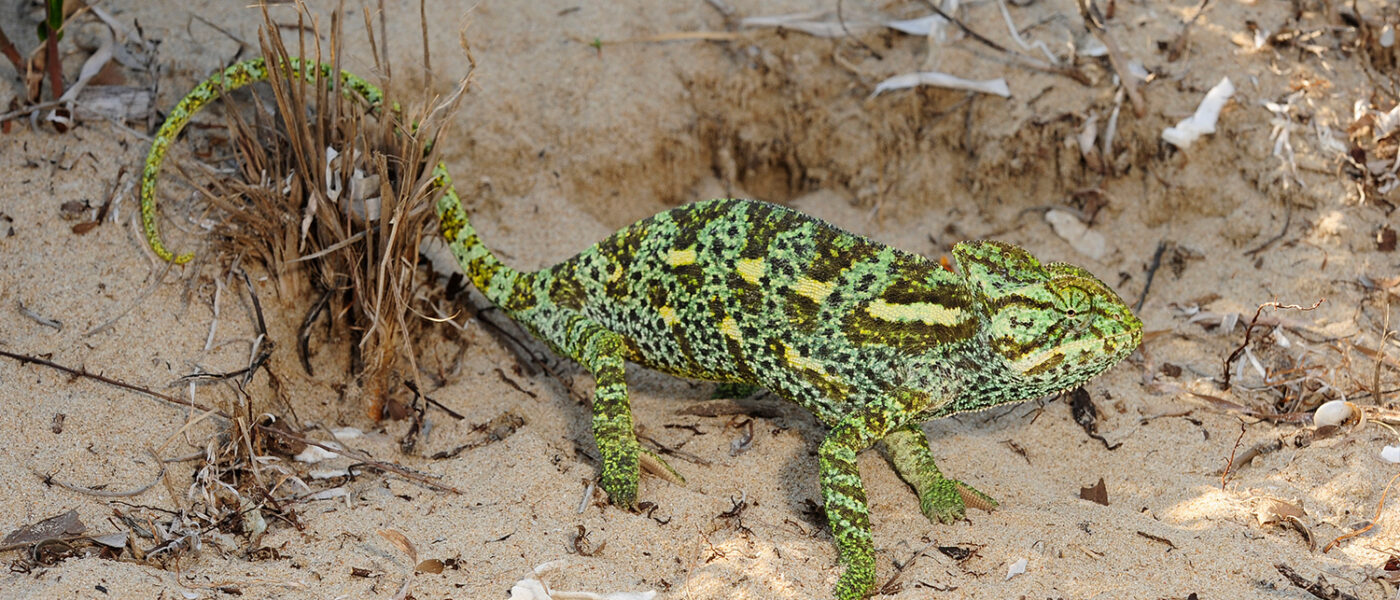
Foto: Chamaeleo africanus, fotografiert von Benny Trapp, CC BY-SA 3.0[:en]

It has long been known that Chamaeleo africanus occurs in the lagoon of Gialova, in the Pylos region (Greece). It differs not only visually but also genetically from Chamaeleo chameleon, which is relatively widespread in southern Europe. There have been sporadic reports of other occurrences of Chamaeleo africanus in Greece, but until now there has been no scientific evidence of the species in areas other than Pylos.

Scientists have now identified a second population of the species. They found at least seven individuals of the species about 130 km north of the Gialova lagoon on the Peloponnese. The chameleons live in a Natura 2000 area called Limnothalassa Kalogrias /Dasos Strogylias Kai Elos Lamias. A young animal was sampled via cheek swab to genetically confirm the species Chamaeleo africanus.

Genetic evidence for the presence of Chamaeleo africanus in Greece outside the Pylos region
Erika Lego, Maria Koutsokali, Michael Valachas
Conservation Genetics Resourecs 18(5), 2026
DOI: 0.1007/s12686-026-01409-w
Free preview of the article

Photo: Chamaeleo africanus, photographed by Benny Trapp, CC BY-SA 3.0[:]

Verbreitung Wissenschaft