[:de]Lebensräume verschiedener Chamäleons in Vohimana (Madagaskar)[:en]Habitats and distribution of chameleon species in Vohimana (Madagascar)[:]

[:de]Lebensräume verschiedener Chamäleons in Vohimana (Madagaskar)[:en]Habitats and distribution of chameleon species in Vohimana (Madagascar)[:]

Verbreitung Wissenschaft

[:de]

Eine Studie zur Verbreitung und den Lebensräumen verschiedener Chamäleonarten wurde kürzlich in Vohimana in Madagaskar durchgeführt. Das Reservat Vohimana liegt zwischen 800 und 1000 m Höhe im östlichen Hochland der Insel. Es erstreckt sich über eine Fläche von 15 km², davon 6 km² Primärregenwald, 8,5 km² Sekundärvegetation und etwas über 1 km² Eukalyptusforst. Die Regenzeit reicht von Oktober bis Mai und ist vor allem von vermehrtem Regen gekennzeichnet, wobei die Trockenzeit ebenfalls über verhältnismäßig viele Niederschläge verfügt.

An insgesamt 195 Tagen, davon 158 in der Regenzeit und 37 in der Trockenzeit wurden Chamäleons innerhalb des Reservats entlang der vorhandenen Wege mit dem bloßen Auge gesucht. Dabei liefen verschiedene Personen insgesamt 350 km Strecke. 80% der Datenerhebung fand nachts statt, nur 20% tagsüber. Jedes gefundene Chamäleon wurde fotografiert sowie Temperatur, relative Luftfeuchtigkeit und UV-Index am Fundort gemessen. Die Daten wurden anschließend statistisch ausgewertet.

Während der gesamten Studienzeit konnten 577 Chamäleons dokumentiert werden. Darunter befanden sich ein einziges Calumma brevicorne, sieben Furcifer willsii, zwei Brookesia ramanantsoai, sieben Brookesia thieli, 143 Brookesia superciliaris und Brookesia therezieni (zusammengefasst zu einer Gruppe), 53 Calumma furcifer, 207 kleine Calumma des nasutum-Komplexes (auf Grund von Schwierigkeiten bei der der rein äußerlichen Artbestimmung zu einer Gruppe zusammengefasst), 24 Calumma parsonii, 118 Calumma pinocchio, 11 Furcifer bifidus und 4 Furcifer pardalis.

Am häufigsten in Vohimana waren Brookesia superciliaris und Brookesia therezieni, kleine Chamäleons des Calumma nasutum-Komplex und Calumma pinocchio. Brookesia superciliaris, Brookesia therezieni und Calumma furcifer wurden nur selten außerhalb des Primärwaldes aufgefunden. Calumma pinocchio war am häufigsten in einem kleinen Primärwaldrest im Nordosten des Reservats zu finden. Alle übrigen Arten konnten die Wissenschaftler sowohl in Primärwald als auch in Sekundärvegetation immer wieder entdecken. Calumma parsonii, Calumma pinocchio als auch Arten des nasutum-Komplexes wurden häufig im Bereich von Waldrändern gefunden.

Die Temperaturen der Fundorte lagen in der Regenzeit durchschnittlich bei 24,2°C, in der Trockenzeit dagegen bei durchschnittlich 18,3°C. Während der Regenzeit wurden tagsüber mehr Chamäleons an Orten mit höherem UV-Index gemessen (durchschnittlich 0,5). Die relative Luftfeuchtigkeit war in Vohimana das ganze Jahr über hoch mit einem Durchschnitt über 90% für beide Jahreszeiten. Die Unterschiede zwischen den verschiedenen Chamäleonarten waren eher gering, was die Mikroklimata anging. Einzelne Furcifer pardalis und Furcifer willsii wurde zu den höchsten gemessenen Tages- und Nachttemperaturen (29°C und 27,5° tagsüber, 25°C nachts) gefunden. Diese beiden Arten sonnten auch im höchsten durchschnittlich gemessenen UVI (8,2 für Furcifer pardalis und 7,7 für Furcifer willsii). Die UV-Indizes aller übrigen Arten lagen im Durchschnitt deutlich niedriger.

Diversity, distribution, and microclimatic conditions experienced by the chameleons of the Vohimana Reserve, Madagascar
Olivier Marquis, Marc Gansuana, Sébastian Métrailler
Herpetological Conservation and Biology 21(1), 2026: 101-119
DOI: nicht verfügbar
Kostenloser Download des Artikels

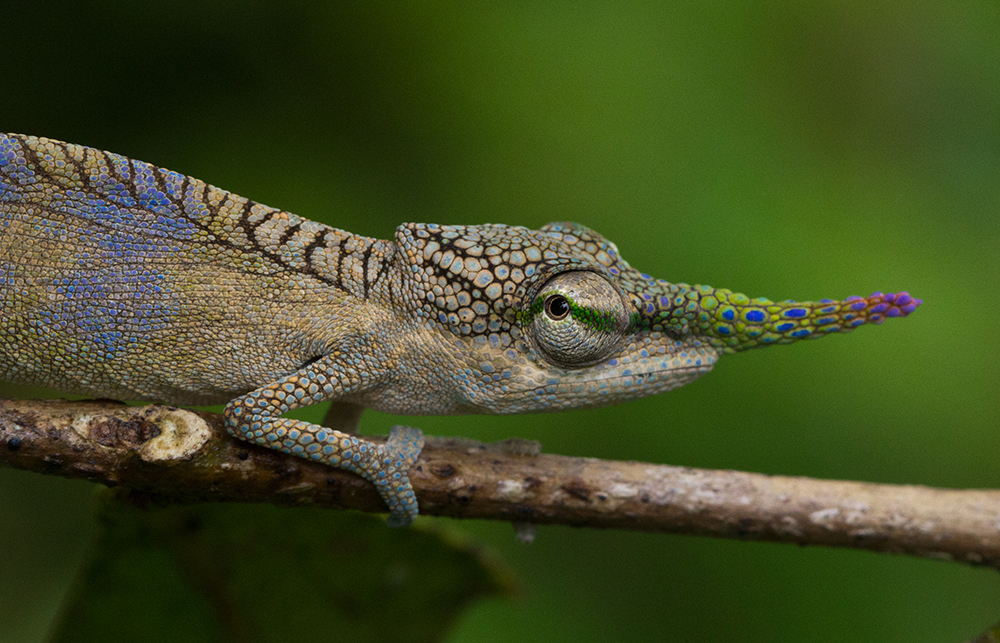
Foto: Calumma pinocchio im Reservat von Vohimana, fotografiert von Alex Negro[:en]

A study on the distribution and habitats of various chameleon species was recently carried out in Vohimana, Madagascar. The Vohimana Reserve is situated at an altitude of between 800 and 1,000 metres in the island’s eastern highlands. It covers an area of 15 km², comprising 6 km² of primary rainforest, 8.5 km² of secondary vegetation and just over 1 km² of eucalyptus forest. The rainy season runs from October to May and is characterised primarily by increased rainfall, although the dry season also sees a relatively high amount of rainfall.

Over a total of 195 days – 158 of which were during the rainy season and 37 during the dry season – chameleons were searched for with the naked eye within the reserve along the existing paths. In the process, various individuals covered a total distance of 350 km. 80% of the data collection took place at night, with only 20% during the day. Every chameleon found was photographed, and the temperature, relative humidity and UV index were measured at the site of discovery. The data was then statistically analysed.

A total of 577 chameleons were recorded during the entire study period. These included a single Calumma brevicorne, seven Furcifer willsii, two Brookesia ramanantsoai, seven Brookesia thieli, 143 Brookesia superciliaris and Brookesia therezieni (grouped together), 53 Calumma furcifer, 207 small Calumma of nasutum-complex (grouped together due to difficulties in identifying them solely on the basis of external characteristics), 24 Calumma parsonii, 118 Calumma pinocchio, 11 Furcifer bifidus and 4 Furcifer pardalis.

The most common species in Vohimana were Brookesia superciliaris and Brookesia therezieni, small chameleons of the Calumma nasutum complex, and Calumma pinocchio. Brookesia superciliaris, Brookesia therezieni and Calumma furcifer were rarely found outside the primary forest. Calumma pinocchio was most commonly found in a small remnant of primary forest in the north-east of the reserve. The scientists repeatedly found all other species in both primary forest and secondary vegetation. Calumma parsonii, Calumma pinocchio and species of the nasutum complex were frequently found along forest edges.

Temperatures at the study sites averaged 24.2°C during the wet season, compared with an average of 18.3°C during the dry season. During the wet season, more chameleons were observed during the day in locations with a higher UV index (averaging 0.5). Relative humidity in Vohimana was high throughout the year, averaging over 90% for both seasons. The differences between the various chameleon species were rather small in terms of microclimates. Individuals of Furcifer pardalis and Furcifer willsii were found at the highest recorded daytime and night-time temperatures (29°C and 27.5°C during the day, 25°C at night). These two species were also basking at the highest average UVI recorded (8.2 for Furcifer pardalis and 7.7 for Furcifer willsii). The UV indices for all other species were, on average, significantly lower.

Diversity, distribution, and microclimatic conditions experienced by the chameleons of the Vohimana Reserve, Madagascar
Olivier Marquis, Marc Gansuana, Sébastian Métrailler
Herpetological Conservation and Biology 21(1), 2026: 101-119
DOI: not available
Free article download

Photo: Calumma pinocchio in the Vohimana Reserve, photographed by Alex Negro[:]

[:de]Calumma-Arten in drei Hochlandwäldern Madagaskars[:en]Calumma species in three highland forests of Madagascar[:]

[:de]Calumma-Arten in drei Hochlandwäldern Madagaskars[:en]Calumma species in three highland forests of Madagascar[:]

Wissenschaft

[:de]

Biologen der Universität Antananarivo haben kürzlich untersucht, wie sich die verschiedenen Lebensräume auf das Vorhandensein von vier Calumma-Arten auf Madagaskar auswirken. Als Studiengebiete wählten sie das Spezialreservat Ambohitantely, verwaltet von Madagascar National Parks, sowie zwei Wälder im Korridor von Anjozorobe-Angavo: Anorana, offiziell nicht als Schutzgebiet deklariert und von lokalen Gemeinschaften verwaltet, und Antsahabe unter der Führung der NGO Fanamby. Die drei Studiengebiete deckten dabei von intaktem Regenwald bis zu Waldfragmenten mit vor allem jungen Bäumen verschiedenste Waldtypen ab, darunter auch Flächen nach Brandrodung. Alle drei Gebiete liegen im nördlichen Hochland Madagaskars.

Innerhalb der Trocken- und Regenzeiten zweier Jahre suchten die Biologen entlang 50 m langer Transekte (pro Ort je 14 Transekte mit je 3 parallel verlaufenden Linien) nach Chamäleons. Die Suchen wurden jeweils zu zweit nachts mit Taschenlampen durchgeführt. Jedes gefundene Chamäleon wurde artbestimmt, vermessen und verschiedene Daten zum Fundort aufgenommen. Zusätzlich wurden 16 botanische Transekte über je 100 m Länge genutzt, um Daten zum umgebenden Lebensraum zu sammeln.

Die Ergebnisse einzelner Transekte mussten aus der Auswertung entfernt werden, da in ihrer Nähe zeitnah zu den Suchnächten Brandrodung erfolgte und ein Einfluss auf die Tiere nicht ausgeschlossen werden konnte. Insgesamt konnten dadurch noch 32 Transekte ausgewertet werden.

Grundlegend wurden erst einmal sowohl Calumma gastrotaenia als auch Calumma globifer, Calumma crypticum und Chamäleons der Calumma nasutum-Gruppe an allen drei Studiengebieten gefunden. Am häufigsten wurde mit weitem Abstand Calumma gastrotaenia entdeckt.  Generell konnten wie erwartet deutlich mehr Chamäleons während der Regenzeit als während der Trockenzeit entdeckt werden, darunter vor allem mehr Schlüpflinge. An allen drei Orten waren zu allen Jahreszeiten mehr Weibchen als Männchen zu finden. In ungestörtem, intaktem Regenwald waren mehr Chamäleons unterwegs als in zerstörten Gebieten. Neben den gesuchten Calumma-Arten konnten auch Brookesia ramanantsoai, Brookesia thieli und Furcifer willsii entdeckt werden.

Zwischen Regen- und Trockenzeit konnten keine Unterschiede in der bevorzugten Höhe der zum Schlafen genutzten Plätze gefunden werden. Insgesamt nutzten die Chamäleons eine sehr hohe Bandbreite an Vegetation zum Schlafen. Schlüpflinge und Jungtiere nutzten allgemein schmalere und höher gelegene Schlafplätze als adulte Chamäleons.

Die höchste Populationsdichte von Calumma globifer fand sich in Anorana mit 88 Individuen pro Hektar. Im Durchschnitt schliefen die Tiere dieser Art zwischen 0,5 und 5 m Höhe und fast 40% saß dabei auf Lianen. Jungtiere konnten ab und an auf Bambus, Drachenbäumen (Dracaena ssp.) und Steineiben (Podocarpus madagascariensis). Calumma gastrotaenia und Calumma globifer bevorzugten Lebensräume mit großen Bäumen und dichterem Bewuchs zwischen 2 und 4 m Höhe. Calumma globifer bewohnte vor allem Lebensräume mit geschlossenem Blätterdach.

Die höchste Populationsdichte von Calumma gastrotaenia fand sich in Ambohitantely mit 60 Individuen pro Hektar. Die Art war vor allem in Unterholz mit Bambus, Farnen, Pflanzen mit länglichen Blättern und Gräsern vertreten. Dabei fiel auf, dass über 30% der Schlafplätze Bambus waren. Insgesamt schien die Art besser als die anderen mit zerstörtem Lebensraum zurecht zu kommen.

Die höchste Populationsdichte der Calumma nasutum-Gruppe fand sich in Ambohitantely mit 61 Individuen pro Hektar. Sie kamen vergleichsweise häufig auch während der Trockenzeit in Ambohitantely und Antsahabe vor. Die Art bevorzugte vor allem die Enden kleiner, dünner Äste und Kletterpflanzen zum Schlafen. Sie saßen meist zwischen 0,3 und 6 m Höhe. Über die Hälfte der gefundenen Tiere der Calumma nasutum-Gruppe waren auf den Ästen von Sträuchern und Blättern, die andere Hälfte fand sich auf Lianen und kletterndem Bambus (Nastus ssp.).

Calumma crypticum zeigte eine im Gegensatz zu den anderen Arten sehr viel geringere Populationsdichte in den untersuchten Wäldern, mit maximal 9 Individuen pro Hektar in Antsahabe. Calumma crypticum war während der Regenzeit als einzige Art höher zu finden als während der Trockenzeit, auf durchschnittlich 4 bis 6 m. Die Art zeigte aber auch allgemein eine hohe Variation in der Höhe der Schlafplätze, ein Chamäleon wurde auf nur 0,5 m Höhe entdeckt. Die Art bevorzugte vor allem dickere Äste. Sowohl Calumma crypticum als auch Chamäleons der Calumma nasutum-Gruppe bevorzugten offene Lebensräume, die trotzdem reich an Ästen waren. Unklar bleibt, ob insgesamt nur sieben im gesamten Studiengebiet aufgefundene Calumma brevicorne tatsächlich dieser Art zuzurechnen sind oder es sich hierbei um nicht zur fast 150 Jahre alten Originalbeschreibung passenden Individuen handelt.

Schlussendlich bestätigte sich, dass die Vegetationstruktur eines Lebensraums die Populationsdichte der untersuchten Calumma-Arten stark beeinflusst. Der von den Wissenschaftlern am als besten für Calumma-Arten geeignet beschriebenes Habitat boten die Wälder von Antsahabe und Anorana, beide befinden sich im Anjozorobe-Angavo-Korridor. In letzterem fanden sich auch die maximale Gesamtzahl an Calumma gastrotaenia und Calumma globifer. Das Reservat Ambohitantely dagegen fiel vor allem wegen sehr viel zerstörtem Waldgebiet auf. Allein in zwei Jahren während der Studie hatten mehrere große Feuer nach Brandrodung zu massivem Baumverlust geführt. Ambohitantely ist der Ort, von dem die Erstbeschreibung von Calumma crypticum stammt – dabei war genau diese Art in den Studiengebieten am geringsten vertreten.

Habitat use, selection, and population density of chameleon communities (Calumma spp.) in the fragmented central highland forests of Madagascar
Fandresena Raktoroarimalala, Arianna L. Kuhn, Achille P. Raselimanana, A. Tahinarivovny Jacquis, Sara Ruane
MBC Ecology and Evolution 25: 137.
DOI: 10.1186/s12862-025-02479-4
Kostenloser Download des Artikels

Foto: Calumma globifer in Maintsoanala, fotografiert von Alex Negro[:en]

Biologists from the University of Antananarivo recently investigated how different habitats affect the presence of four Calumma species in Madagascar. They chose the Ambohitantely Special Reserve, managed by Madagascar National Parks, and two forests in the Anjozorobe-Angavo corridor as their study areas: Anorana, not officially declared a protected area and managed by local communities, and Antsahabe, managed by the NGO Fanamby. The three study areas covered a wide variety of forest types, from intact rainforest to forest fragments with mainly young trees, including areas that had been cleared by burning. All three areas are located in the northern highlands of Madagascar.

During the dry and rainy seasons of two years, biologists searched for chameleons along 50-metre-long transects (14 transects per location, each with three parallel lines). The searches were carried out in pairs at night using torches. Each chameleon found was identified, measured and various data on the location of the find was recorded. In addition, 16 botanical transects, each 100 m long, were used to collect data on the surrounding habitat.

The results of individual transects had to be removed from the evaluation because slash-and-burn farming had taken place in their vicinity shortly before the search nights and an impact on the animals could not be ruled out. A total of 32 transects could still be evaluated.

Basically, Calumma gastrotaenia, Calumma globifer, Calumma crypticum and chameleons of the Calumma nasutum group were found in all three study areas. Calumma gastrotaenia was by far the most frequently discovered species. As expected, significantly more chameleons were discovered during the rainy season than during the dry season, including more hatchlings in particular. At all three locations, more females than males were found in all seasons. More chameleons were found in undisturbed, intact rainforest than in destroyed areas. In addition to the Calumma species sought, Brookesia ramanantsoai, Brookesia thieli and Furcifer willsii were also discovered.

No differences in the preferred height of sleeping places were found between the rainy and dry seasons. Overall, the chameleons used a very wide range of vegetation for sleeping. Hatchlings and juveniles generally used narrower and higher sleeping places than adult chameleons.

The highest population density of Calumma globifer was found in Anorana, with 88 individuals per hectare. On average, the animals of this species slept at heights between 0.5 and 5 m, with almost 40% sitting on lianas. Juveniles were occasionally found on bamboo, dragon trees (Dracaena ssp.) and stone pines (Podocarpus madagascariensis). Calumma gastrotaenia and Calumma globifer preferred habitats with large trees and denser vegetation between 2 and 4 m in height. Calumma globifer mainly inhabited habitats with a closed canopy.

The highest population density of Calumma gastrotaenia was found in Ambohitantely with 60 individuals per hectare. The species was mainly found in undergrowth with bamboo, ferns, plants with elongated leaves and grasses. It was noticeable that over 30% of the roosting sites were bamboo. Overall, the species seemed to cope better than the others with destroyed habitat.

The highest population density of the Calumma nasutum group was found in Ambohitantely, with 61 individuals per hectare. They were also relatively common during the dry season in Ambohitantely and Antsahabe. The species preferred the ends of small, thin branches and climbing plants for sleeping. They usually sat at a height of between 0.3 and 6 m. More than half of the animals found in the Calumma nasutum group were on the branches of shrubs and leaves, while the other half were found on lianas and climbing bamboo (Nastus ssp.).

In contrast to the other species, Calumma crypticum showed a much lower population density in the forests studied, with a maximum of 9 individuals per hectare in Antsahabe. Calumma crypticum was the only species found higher during the rainy season than during the dry season, at an average of 4 to 6 m. However, the species also showed a high variation in the height of its roosting places, with one chameleon discovered at a height of only 0.5 m. The species preferred thicker branches in particular. Both Calumma crypticum and chameleons of the Calumma nasutum group preferred open habitats that were nevertheless rich in branches. It remains unclear whether the seven Calumma brevicorne found in the entire study area can actually be attributed to this species or whether these are individuals that do not match the original description, which is almost 150 years old.

Ultimately, it was confirmed that the vegetation structure of a habitat has a significant influence on the population density of the Calumma species studied. The habitat described by the scientists as most suitable for Calumma species was found in the forests of Antsahabe and Anorana, both located in the Anjozorobe-Angavo corridor. The latter also had the highest total number of Calumma gastrotaenia and Calumma globifer. The Ambohitantely reserve, on the other hand, was notable mainly for its heavily destroyed forest area. In just two years during the study, several large fires following slash-and-burn practices had led to massive tree loss. Ambohitantely is the place where Calumma crypticum was first described – yet this species was the least represented in the study areas.

Habitat use, selection, and population density of chameleon communities (Calumma spp.) in the fragmented central highland forests of Madagascar
Fandresena Raktoroarimalala, Arianna L. Kuhn, Achille P. Raselimanana, A. Tahinarivovny Jacquis, Sara Ruane
MBC Ecology and Evolution 25: 137.
DOI: 10.1186/s12862-025-02479-4
Kostenloser Download des Artikels

Picture: Calumma globifer in Maintsoanala, photographed by Alex Negro[:]

[:de]Zwei „neue alte“ Chamäleonarten aus Madagaskar[:en]Two „new old“ chameleon species from Madagascar[:]

[:de]Zwei „neue alte“ Chamäleonarten aus Madagaskar[:en]Two „new old“ chameleon species from Madagascar[:]

Neubeschreibungen Wissenschaft

[:de]

Schon länger weiß man, dass es sich bei Calumma gallus aus dem Osten Madagaskars eher nicht nur um eine Art handelt, sondern um einen ganzen Art-Komplex. Wissenschaftler haben sich nun näher mit dem Komplex beschäftigt und neue genetische Untersuchungen veranlasst – und dabei einige Arten völlig über den Haufen geworfen.

Die Kurzfassung:

Das, was man bisher für Calumma nasutum aus Andasibe, Anosibe An’Ala und Tarzanville hielt, heißt jetzt Calumma hofreiteri. Die Weibchen sind nach wie vor nicht sicher von Calumma emelinae zu unterscheiden. Das „echte“ Calumma nasutum kommt in Regenwäldern nahe Ranomafana und Mananjary vor. Die Männchen von Calumma nasutum tragen einen deutlich größeren Nasenfortsatz, der häufig gelb gefärbt ist während die Weibchen nur eine rote Stupsnase haben. Calumma nasutum gehört übrigens zum gallus-Komplex.

Das, was man bisher für Calumma gallus hielt und im Schutzgebiet Vohimana und Umgebung vorkommt, heißt nun Calumma pinocchio. Das „echte“ Calumma gallus kommt in einem Waldfragment nahe Tarzanville, in Tsinjoarivo und mehreren kleinen Gebieten nahe Toamasina an der Ostküste Madagaskars vor. Sein Nasenfortsatz ist oben gezahnt, während der Nasenfortsatz von Calumma pinocchio glatt ist.

Towards a revision of the Malagasy chameleons of the Calumma gallus complex: Redefinition of Calumma nasutum based on a museomics approach and descriptions of two new species
Frank Glaw, Stefanie Agne, David Prötzel, Philip-Sebastian Gehring, Jörn Köhler, Michaela Preick, Fanomezana M. Ratsoavina, Nicolas Straube, Katharina Wollenberg Valero, Angelica Crottini, Miguel Vences
Salamandra 61(4): 442-466, 2025.
DOI: nicht verfügbar
Kostenloser Download des Artikels

Foto: aus der oben genannten Veröffentlichung, Calumma nasutum [:en]

It has long been known that Calumma gallus from eastern Madagascar is not just one species, but rather an entire species complex. Scientists have now taken a closer look at the complex and conducted new genetic studies – completely overturning some species classifications in the process.

The short version:

What was previously thought to be Calumma nasutum from Andasibe, Anosibe An’Ala and Tarzanville is now called Calumma hofreiteri. The females still cannot be reliably distinguished from Calumma emelinae. The ‘real’ Calumma nasutum occurs in rainforests near Ranomafana and Mananjary. The males of Calumma nasutum have a significantly larger rostral appendage, which is often yellow in colour, while the females only have a red snub nose. Calumma nasutum belongs to the gallus complex.

What was previously thought to be Calumma gallus and occurs in the Vohimana reserve and surrounding area is now called Calumma pinocchio. The ‘real’ Calumma gallus occurs in a forest fragment near Tarzanville, in Tsinjoarivo and several small areas near Toamasina on the east coast of Madagascar. Its rostral appendage is serrated at the top, while the rostral appendage of Calumma pinocchio is smooth.

Towards a revision of the Malagasy chameleons of the Calumma gallus complex: Redefinition of Calumma nasutum based on a museomics approach and descriptions of two new species
Frank Glaw, Stefanie Agne, David Prötzel, Philip-Sebastian Gehring, Jörn Köhler, Michaela Preick, Fanomezana M. Ratsoavina, Nicolas Straube, Katharina Wollenberg Valero, Angelica Crottini, Miguel Vences
Salamandra 61(4): 442-466, 2025.
DOI: not available
Free download of the article

Photo: from the above publication, Calumma nasutum [:]

[:de]Einfluss von Landwirtschaft auf Chamäleons in Madagaskar[:en]Impact of agriculture on chameleons in Madagascar[:]

[:de]Einfluss von Landwirtschaft auf Chamäleons in Madagaskar[:en]Impact of agriculture on chameleons in Madagascar[:]

Wissenschaft

[:de]

In Madagaskars östlichem Hochland wird Ackerland für Reisfelder hauptsächlich durch Brandrodung von Primärwäldern oder Sekundärvegetation gewonnen. Die Reisfelder werden nur eine Saison verwendet, im anschließenden Jahr wird das Feld für Wurzelgemüse genutzt. Bereits nach einer Ernte liegt das Land dann bis zu fünf Jahre brach, bevor es erneut brandgerodet wird, um wieder Reis anzubauen. Schon fünf dieser Zyklen können fruchtbares Land in nicht mehr nutzbaren Boden wandeln. In den letzten Jahrzehnten sind brachliegende Flächen in immer kürzeren Abständen gerodet worden. Diese Praxis hat dafür gesorgt, dass invasive, nicht-einheimische Pflanzenarten sich ausbreiten konnten, während auf Primärwald angewiesene madagassische Pflanzen verschwanden. Madagassische Wissenschaftler haben nun erforscht, welchen Einfluss diese Form der Landwirtschaft auf Chamäleons an der Ostküste Madagaskars hat.

Als Studienobjekt wurde der Regenwaldkorridor von Ankeniheny-Zahamena im östlichen Hochland genutzt. Er verläuft an der Ostküste Madagaskars über eine Fläche von rund 5000 km², die teils nur durch sehr schmale Waldfragmente miteinander verbunden sind. Insgesamt während der Regenzeit 44 Orte wurden untersucht, die in fünf Habitattypen eingeteilt wurden: Zehn Orte mit geschlossenen Regenwäldern, acht mit Baumbrachen, elf mit Strauchbrachen, zehn Orte nach mindestens fünf Brandrodungszyklen und fünf Orte, an denen Wiederaufforstung betrieben wurde. Chamäleons wurden mehrheitlich nachts entlang vorgegebener Transekte (je drei bis vier parallele Linien von 50 m Länge) gesucht, bestimmt und vermessen.

Insgesamt konnten 15 Chamäleonarten der Gattungen Brookesia, Furcifer und Calumma gefunden werden, wobei je drei Arten nicht exakt bestimmt werden konnten (es handelt sich hier, soweit erkennbar, um Tiere aus dem Calumma nasutum/emelinae-Komplex). Die meisten Chamäleons bevorzugten geschlossenen Regenwald, wohingegen nach Brandrodung deutlich weniger Tiere und Arten zu finden waren. In Waldstücken mit Aufforstungsbemühungen war die Zahl der Chamäleons wieder deutlich höher. Beides unterstreicht sowohl den notwendigen Schutz noch vorhander Regenwälder als auch die Relevanz der Wiederaufforstung auf Madagaskar.

Sechs Arten (darunter Calumma cf. vencesi, Brookesia superciliaris, Brookesia therezieni, Calumma parsonii) zeigten sich deutlich sensibler gegenüber Landwirtschaft und können wahrscheinlich nur sehr eingeschränkt außerhalb von Primärwald überleben. Nur drei Arten kamen überhaupt noch auf intensiv landwirtschaftlich genutzter Fläche vor, davon war lediglich Furcifer lateralis am häufigsten dort zu finden.

Effects of shwidden agriculture on chameleon diversity and abundance in eastern tropical rainforest in Madagascar
Rodlis Raphali Andriantsimanarilafy, Joseph Christian Randrianantoandro, Josué Rakotoarioa, Alain Jean Victorien Rakotondrina, Ruth Kelly, Alison Cameron
Sustainability and biodiversity conservation 3(2): 99-118.
DOI: 10.5281/zenodo.13861065


Foto: Teppichchamäleon am Rande eines Reisfeldes in Madagaskar, fotografiert von Alex Negro[:en]

In Madagascar’s eastern highlands, farmland for rice fields is mainly obtained by slashing and burning primary forests or secondary vegetation. The rice fields are only used for one season. The following year the field is used for root vegetables. After just one harvest, the land lies fallow for up to five years before it is slash-and-burned again to grow rice again. Just five of these cycles can turn fertile land into degraded. In recent decades, fallow land has been cleared at ever shorter intervals. This practice has allowed invasive, non-native plant species to spread, while Malagasy plants that depend on primary forest have disappeared. Malagasy scientists have now investigated the impact of this form of agriculture on chameleons on the east coast of Madagascar.

The Ankeniheny-Zahamena rainforest corridor in the eastern highlands was used as the object of study. It runs along the east coast of Madagascar over an area of around 5000 km², some of which are only connected by very narrow forest fragments. A total of 44 sites were investigated during the rainy season, which were categorised into five habitat types: Ten sites with closed canopy rainforests, eight with tree fallows, eleven with shrub fallows, ten sites after at least five slash-and-burn cycles (degraded land) and five sites where reforestation was practised. The majority of chameleons were searched for, identified and measured at night along predefined transects (three to four parallel lines each 50 metres long).

A total of 15 chameleon species of the genera Brookesia, Furcifer and Calumma were found, although three species could not be precisely identified (as far as recognisable, these are animals from the Calumma nasutum/emelinae complex). Most chameleons favoured closed rainforest, whereas significantly fewer animals and species were found after slash-and-burn clearing. In forest areas with reforestation efforts, the number of chameleons was significantly higher than in degraded areas. Both emphasise the need to protect remaining rainforests as well as the relevance of reforestation in Madagascar.

Six species (including Calumma cf. vencesi, Brookesia superciliaris, Brookesia therezieni, Calumma parsonii) were clearly more sensitive to agriculture and can probably only survive to a very limited extent outside primary forest. Only three species were found on intensively farmed land, of which only Furcifer lateralis was most frequently found there.

Effects of shwidden agriculture on chameleon diversity and abundance in eastern tropical rainforest in Madagascar
Rodlis Raphali Andriantsimanarilafy, Joseph Christian Randrianantoandro, Josué Rakotoarioa, Alain Jean Victorien Rakotondrina, Ruth Kelly, Alison Cameron
Sustainability and biodiversity conservation 3(2): 99-118.
DOI: 10.5281/zenodo.13861065

Photo: Carpet chameleon at the edge of a rice field in Madagascar, photographed by Alex Negro[:]