
[:de]Lebensräume verschiedener Chamäleons in Vohimana (Madagaskar)[:en]Habitats and distribution of chameleon species in Vohimana (Madagascar)[:]

[:de]Lebensräume verschiedener Chamäleons in Vohimana (Madagaskar)[:en]Habitats and distribution of chameleon species in Vohimana (Madagascar)[:]

Verbreitung Wissenschaft

[:de]

Eine Studie zur Verbreitung und den Lebensräumen verschiedener Chamäleonarten wurde kürzlich in Vohimana in Madagaskar durchgeführt. Das Reservat Vohimana liegt zwischen 800 und 1000 m Höhe im östlichen Hochland der Insel. Es erstreckt sich über eine Fläche von 15 km², davon 6 km² Primärregenwald, 8,5 km² Sekundärvegetation und etwas über 1 km² Eukalyptusforst. Die Regenzeit reicht von Oktober bis Mai und ist vor allem von vermehrtem Regen gekennzeichnet, wobei die Trockenzeit ebenfalls über verhältnismäßig viele Niederschläge verfügt.

An insgesamt 195 Tagen, davon 158 in der Regenzeit und 37 in der Trockenzeit wurden Chamäleons innerhalb des Reservats entlang der vorhandenen Wege mit dem bloßen Auge gesucht. Dabei liefen verschiedene Personen insgesamt 350 km Strecke. 80% der Datenerhebung fand nachts statt, nur 20% tagsüber. Jedes gefundene Chamäleon wurde fotografiert sowie Temperatur, relative Luftfeuchtigkeit und UV-Index am Fundort gemessen. Die Daten wurden anschließend statistisch ausgewertet.

Während der gesamten Studienzeit konnten 577 Chamäleons dokumentiert werden. Darunter befanden sich ein einziges Calumma brevicorne, sieben Furcifer willsii, zwei Brookesia ramanantsoai, sieben Brookesia thieli, 143 Brookesia superciliaris und Brookesia therezieni (zusammengefasst zu einer Gruppe), 53 Calumma furcifer, 207 kleine Calumma des nasutum-Komplexes (auf Grund von Schwierigkeiten bei der der rein äußerlichen Artbestimmung zu einer Gruppe zusammengefasst), 24 Calumma parsonii, 118 Calumma pinocchio, 11 Furcifer bifidus und 4 Furcifer pardalis.

Am häufigsten in Vohimana waren Brookesia superciliaris und Brookesia therezieni, kleine Chamäleons des Calumma nasutum-Komplex und Calumma pinocchio. Brookesia superciliaris, Brookesia therezieni und Calumma furcifer wurden nur selten außerhalb des Primärwaldes aufgefunden. Calumma pinocchio war am häufigsten in einem kleinen Primärwaldrest im Nordosten des Reservats zu finden. Alle übrigen Arten konnten die Wissenschaftler sowohl in Primärwald als auch in Sekundärvegetation immer wieder entdecken. Calumma parsonii, Calumma pinocchio als auch Arten des nasutum-Komplexes wurden häufig im Bereich von Waldrändern gefunden.

Die Temperaturen der Fundorte lagen in der Regenzeit durchschnittlich bei 24,2°C, in der Trockenzeit dagegen bei durchschnittlich 18,3°C. Während der Regenzeit wurden tagsüber mehr Chamäleons an Orten mit höherem UV-Index gemessen (durchschnittlich 0,5). Die relative Luftfeuchtigkeit war in Vohimana das ganze Jahr über hoch mit einem Durchschnitt über 90% für beide Jahreszeiten. Die Unterschiede zwischen den verschiedenen Chamäleonarten waren eher gering, was die Mikroklimata anging. Einzelne Furcifer pardalis und Furcifer willsii wurde zu den höchsten gemessenen Tages- und Nachttemperaturen (29°C und 27,5° tagsüber, 25°C nachts) gefunden. Diese beiden Arten sonnten auch im höchsten durchschnittlich gemessenen UVI (8,2 für Furcifer pardalis und 7,7 für Furcifer willsii). Die UV-Indizes aller übrigen Arten lagen im Durchschnitt deutlich niedriger.

Diversity, distribution, and microclimatic conditions experienced by the chameleons of the Vohimana Reserve, Madagascar
Olivier Marquis, Marc Gansuana, Sébastian Métrailler
Herpetological Conservation and Biology 21(1), 2026: 101-119
DOI: nicht verfügbar
Kostenloser Download des Artikels

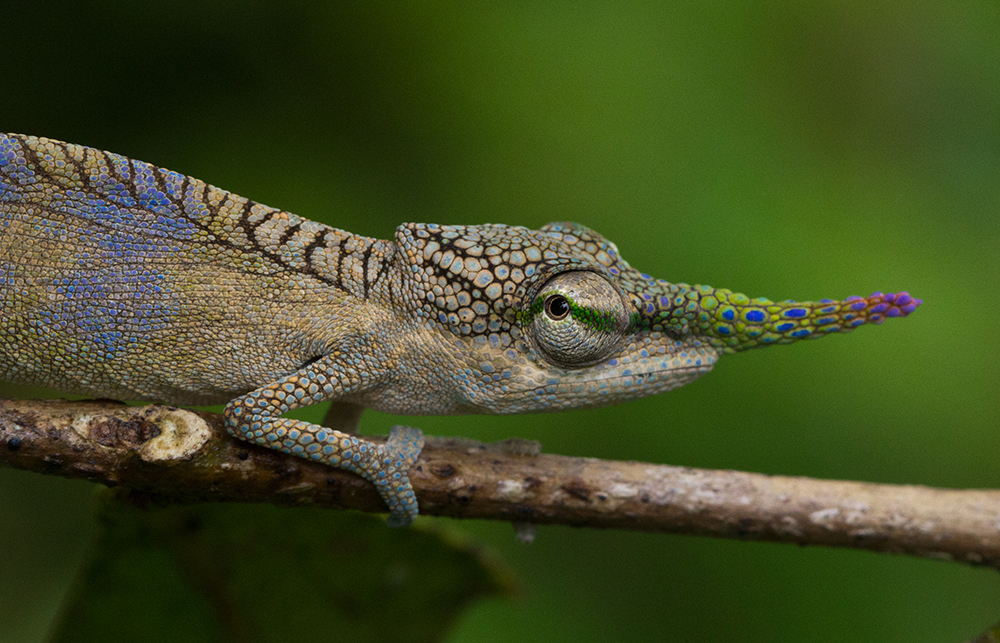
Foto: Calumma pinocchio im Reservat von Vohimana, fotografiert von Alex Negro[:en]

A study on the distribution and habitats of various chameleon species was recently carried out in Vohimana, Madagascar. The Vohimana Reserve is situated at an altitude of between 800 and 1,000 metres in the island’s eastern highlands. It covers an area of 15 km², comprising 6 km² of primary rainforest, 8.5 km² of secondary vegetation and just over 1 km² of eucalyptus forest. The rainy season runs from October to May and is characterised primarily by increased rainfall, although the dry season also sees a relatively high amount of rainfall.

Over a total of 195 days – 158 of which were during the rainy season and 37 during the dry season – chameleons were searched for with the naked eye within the reserve along the existing paths. In the process, various individuals covered a total distance of 350 km. 80% of the data collection took place at night, with only 20% during the day. Every chameleon found was photographed, and the temperature, relative humidity and UV index were measured at the site of discovery. The data was then statistically analysed.

A total of 577 chameleons were recorded during the entire study period. These included a single Calumma brevicorne, seven Furcifer willsii, two Brookesia ramanantsoai, seven Brookesia thieli, 143 Brookesia superciliaris and Brookesia therezieni (grouped together), 53 Calumma furcifer, 207 small Calumma of nasutum-complex (grouped together due to difficulties in identifying them solely on the basis of external characteristics), 24 Calumma parsonii, 118 Calumma pinocchio, 11 Furcifer bifidus and 4 Furcifer pardalis.

The most common species in Vohimana were Brookesia superciliaris and Brookesia therezieni, small chameleons of the Calumma nasutum complex, and Calumma pinocchio. Brookesia superciliaris, Brookesia therezieni and Calumma furcifer were rarely found outside the primary forest. Calumma pinocchio was most commonly found in a small remnant of primary forest in the north-east of the reserve. The scientists repeatedly found all other species in both primary forest and secondary vegetation. Calumma parsonii, Calumma pinocchio and species of the nasutum complex were frequently found along forest edges.

Temperatures at the study sites averaged 24.2°C during the wet season, compared with an average of 18.3°C during the dry season. During the wet season, more chameleons were observed during the day in locations with a higher UV index (averaging 0.5). Relative humidity in Vohimana was high throughout the year, averaging over 90% for both seasons. The differences between the various chameleon species were rather small in terms of microclimates. Individuals of Furcifer pardalis and Furcifer willsii were found at the highest recorded daytime and night-time temperatures (29°C and 27.5°C during the day, 25°C at night). These two species were also basking at the highest average UVI recorded (8.2 for Furcifer pardalis and 7.7 for Furcifer willsii). The UV indices for all other species were, on average, significantly lower.

Diversity, distribution, and microclimatic conditions experienced by the chameleons of the Vohimana Reserve, Madagascar
Olivier Marquis, Marc Gansuana, Sébastian Métrailler
Herpetological Conservation and Biology 21(1), 2026: 101-119
DOI: not available
Free article download

Photo: Calumma pinocchio in the Vohimana Reserve, photographed by Alex Negro[:]

[:de]Einfluss von UV-B aufs Wachstum[:en]Influence of UV-B on growth[:]

[:de]Einfluss von UV-B aufs Wachstum[:en]Influence of UV-B on growth[:]

Kurzmitteilungen Wissenschaft

[:de]

In einer Kurzmitteilung in der Herpetological Review wurde eine interessante Haltererfahrung aus den USA vorgestellt. Zwölf Teppichchamäleon-Schlüpflinge (Furcifer lateralis) aus dem gleichen Gelege wurden in vier Gruppen zu je drei Tieren aufgeteilt. Während den ersten zehn Wochen nach Schlupf wurden zwei Gruppen täglich 12 h lang ein UV-Index bis 3 zur Verfügung gestellt, den anderen beiden Gruppen ein UV-Index bis 7. Um die verschiedenen UV-Indizes zu erreichen, wurden Reptisun 5.0 verwendet. Gemessen wurde mit dem Solarmeter 6.5. Die Chamäleons hatten Ausweichmöglichkeiten bis UVI 0. Nach sechs, acht und zehn Wochen wurden die Teppichchamäleons vermessen und gewogen. Dabei fiel auf, dass in Woche 6 und 10 jeweils die Gruppen mit dem niedrigeren UV-Index bis zu 25% schwerer waren als die Vergleichsgruppen.

Die beiden Autoren ziehen daraus den Schluss, dass höhere UV-Indizes während der Aufzucht in den ersten Wochen bei Teppichchamäleons zu langsameren Wachstumsraten führen könnten. Das würde der Beobachtung in der Natur entsprechen, dass Jungtiere eher selten „sonnenbaden“ und sich versteckter im Gebüsch aufhalten. Auf Grund der kleinen Probandengruppe und gemischter Gruppen statt Einzelhaltung muss man mit Rückschlüssen hier noch vorsichtig sein. Dazu kommt, dass leider noch weitestgehend unerforscht ist, ob und wie Chamäleons ihre Vitamin D3-Regulation im Kunstlicht im Vergleich zu natürlichem Sonnenlicht regeln können. Nichtsdestotrotz ist es ein sehr interessanter Ansatz, der sich weiterzuverfolgen sicher lohnt.

Furcifer lateralis (carpet chameleon): Impact of Ultraviolet Light on growth
Michael J. Nash, Christopher V. Anderson
Herpetological Review 52 (2), 2022[:en]

An interesting husbandry experience from the USA was presented in a short note in the Herpetological Review. Twelve carpet chameleon hatchlings (Furcifer lateralis) from the same clutch were divided into four groups of three animals each. During the first ten weeks after hatching, two groups were provided with a daily UV index of up to 3 for 12 h, the other two groups with a UV index of up to 7. Reptisun 5.0 was used to achieve the different UV indices. Measurements were taken with the Solarmeter 6.5. The chameleons were allowed to avoid UVI up to 0. After six, eight and ten weeks, the carpet chameleons were measured and weighed. It was noticed that in weeks 6 and 10, the groups with the lower UV index were up to 25% heavier than the comparison groups.

The two authors conclude that higher UV indices during rearing in the first weeks could lead to slower growth rates in carpet chameleons. This would correspond to the observation in nature that young animals „sunbathe“ rather rarely and stay more hidden in the bushes. Due to the small group of test subjects and mixed groups instead of individual keeping, you must still be cautious with conclusions here. In addition, it is unfortunately still largely unexplored whether and how chameleons can regulate their vitamin D3 regulation in artificial light compared to natural sunlight. Nevertheless, it is a very interesting approach that is certainly worth pursuing.

Furcifer lateralis (carpet chameleon): Impact of Ultraviolet Light on growth
Michael J. Nash, Christopher V. Anderson
Herpetological Review 52 (2), 2022[:]