[:de]
In den letzten 15 Jahren hat sich die Zahl der bekannten Rhampholeon-Arten verdoppelt – nicht zuletzt, weil sich in einigen Artkomplexe zahlreiche unbeschriebene Arten „versteckten“. Genau einen solchen Fall beleuchteten nun Wissenschaftler aus Großbritannien, Tansania und Südafrika: Den Rhampholeon uluguruensis/moyeri-Komplex. Die Erdchamäleons aus diesem Komplex bewohnen verschiedenen Lebensräume in den Eastern Arc Mountains, einer 600 km langen Gebirgskette, die von Kenia bis nach Tansania reicht. Bei der Gattung Rhampholeon ist bisher vor allem auffällig, dass die beschriebenen Arten sich äußerlich nur wenig unterscheiden, jedoch in eng begrenzten, voneinander meist völlig isolierten Lebensräumen vorkommen. Die Autoren untersuchten Erdchamäleons von sieben verschiedenen Orten in Tansania. Dabei konnten sie mittels genetischer Untersuchungen gleich sechs neue Rhampholeon-Arten ausmachen.
Rhampholeon colemani wurde benannt nach dem Artenschützer Carter Coleman. Die Art kommt im Kitolomero-Tal auf rund 1200 m üNN vor. Das Tal liegt im Uzungwa Scarp Nature Reserve in den Udzungwa Bergen mitten in Tansania, rund 350 km südöstlich der Hauptstadt Dodoma. Besonders an diesem Verbreitungsgebiet ist, dass in diesem Reservat ebenfalls das schon bekannte Rhampholeon moyeri vorkommt. Unklar ist noch, ob die beiden Arten möglicherweise auf unterschiedlichen Höhenstufen leben. Rhampholeon colemani wird bis zu 44 mm (TL) groß und ist damit das zweitkleinste der bisher beschriebenen Rhampholeon-Arten. Die Hemipenes der Männchen dieser Arten konnten ausführlich beschrieben werden. Ein charakteristisches Merkmal von Rhampholeon colemani ist der Nasenfortsatz, der in einem Winkel von bis zu 59°C zur Schnauze steht bzw. etwas nach unten zeigt. Bei allen anderen Erdchamäleons der Gattung ist der Winkel deutlich geringer, der Nasenfortsatz steht also eher gerade ab.
Rhampholeon sabini erhielt seinen Namen zu Ehren Andy Sabin für finanzielle Unterstützung und weltweitem Engagement im Umweltschutz. Die Art lebt in Tansania im submontanen Regenwald zweier benachbarter Reservate, die im Nordosten des Landes rund 250 km von der Küstenstadt Daressalaam liegen. Einer der Lebensräume ist das Nguu North Forest Reserve, das andere das Kilindi Forest Reserve, beide auf gut 1200 m üNN. Rhampholeon sabini wird bis zu 54 mm groß, wobei die relative Größe von Kopf und Schwanz im Verhältnis zum übrigen Körper größer als bei den anderen Arten erscheinen.
Rhampholeon rubeho kommt auf den gleichnamigen Bergen, den Rubeho Mountains, auf rund 1870 m üNN vor, die sich rund 150 km östlich der Hauptstadt Dodoma befinden. Der von dieser Art bewohnte Regenwald liegt vorwiegend im Mafwomero Forest Reserve. Rhampholeon rubeho wird bis zu 63 mm lang. Zusätzlich zählen die Wissenschaftler derzeit eine Population von Erdchamäleons im Ilole Forest Reserve in 50 km Entfernung, am südlichen Ausläufer der Rubeho Mountains, zu dieser Art. Diese Population ist jedoch genetisch noch nicht untersucht.
Rhampholeon nicolai wurde benannt nach dem verstorbenen Nicola Colangelo, einem Unternehmer aus Tansania, der sich für den Artenschutz und nachhaltige Ressourcennutzung einsetzte. Rhampholeon nicolai wird bis zu 60 mm lang, wobei ähnlich wie bei R. sabini die relative Größe von Kopf und Schwanz im Verhältnis zum übrigen Körper größer als bei den anderen Arten erscheint. Rhampholeon nicolai lebt auf den Ukaguru Mountains, die sich nur wenig nördlich der Rubeho Mountains befinden. Es wurde in den drei aneinander liegenden Schutzgebieten Mamiwa Kisara North Forest Reserve, Mamiwa Kisara South Forest Reserve und dem Ikwamba Forest Reserve auf 1970 m Höhe nachgewiesen. Eine Population von Erdchamäleons im nahen Mikuvi Forest wird zunächst zur Art gezählt, ihr genauer Status muss jedoch noch untersucht werden.
Rhampholeon waynelotteri bekam seinen Namen zu Ehren des ermordeten südafrikanischen Naturschutzaktivisten Wayne Lotter, der sich vor allem im Kampf gegen die Wilderei von Elefanten engagierte. Dieses Erdchamäleon wird bis zu 55 m groß. Es bewohnt den Mount Kanga, etwa 120 km von der Küste des Indischen Ozeans entfernt. Mount Kanga zählt zu den Nguru Mountains, obwohl der Berg vom Hauptmassiv durch einen 8 km breiten Tieflandkorridor und einen Fluss getrennt ist. Rhampholeon waynelotteri ist vom Kanga Forest Reserve auf etwa 1280 m Höhe sowie de Mkingu Nature Reserve beschrieben. Im Letzteren kommt es gemeinsam mit Rhampholeon acuminatus vor, von dem es aber durch seinen anders geformten Nasenfortsatz sowie kleine Fortsätze über den Augen gut unterschieden werden kann. Eine Erdchamäleon-Population auf dem Mount Nguru wurde zunächst Rhampholeon waynelotteri zugeschrieben, weitere Forschung steht jedoch noch aus.
Rhampholeon princeeai wurde benannt nach dem amerikanischen Künstler und YouTuber Prince Ea. Rhampholein princeeai lebt auf Höhen von 1870 m im Mkingu Nature Reserve auf den Nguru Bergen. Dort kommen auch Rhampholeon waynelotteri und Rhampholeon acuminatus vor. Die Art wird bis zu 46 mm lang und hat eine Besonderheit: Der Nasenfortsatz weist, von oben betrachtet, eine dreieckige Form auf. Außerdem hat die Art eine kleine Vertiefung in der Leistengegend, die die anderen bisher untersuchten Arten nicht aufweisen.
Die bereits bekannte Art Rhampholeon uluguruensis wurde ausschließlich im namensgebenden Uluguru Nature Reserve und dem Mkungwe Forest Reserve gefunden. Rhampholeon moyeri kommt lediglich im Uzungwa Scarp Nature Reserve in den Udzungwa Bergen vor. Rhampholeon beraduccii ist auf das Sali Forest Reserve in den Mahenge Bergen begrenzt und Rhampholeon acuminatus, wie schon vorweggenommen, lebt ausschließlich im Mingu Nature Reserve in den Nguru Bergen.
Cryptic diversity in pygmy chameleons (Chamaeleonidae: Rhampholeon) of the Eastern Arc Mountains of Tanzania, with description of six new species
Michelle Menegon, John V. Lyakurwa, Simon P. Loader, Krystal A. Tolley
Acta Herpetologica 17 (2): 85-113, 2022
DOI: 10.36253/a_h-12978
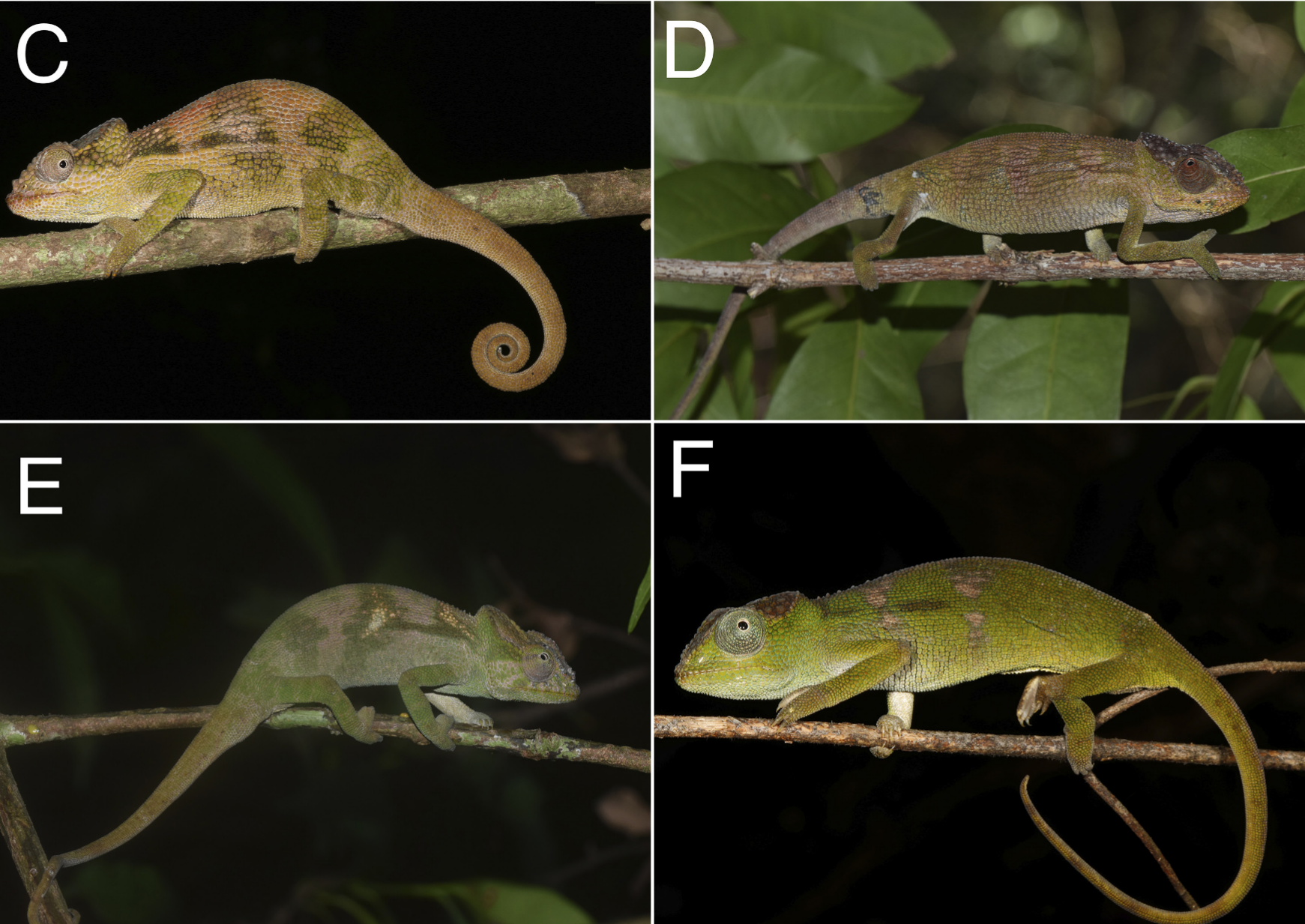
Foto: Rhampholeon rubeho, aus der oben genannten Publikation[:en]
In the last 15 years, the number of known Rhampholeon species has doubled – not least because some species complexes „hid“ numerous undescribed species. Scientists from Great Britain, Tanzania, and South Africa have now shed light on exactly such a case: the Rhampholeon uluguruensis/moyeri complex. The pygmy chameleons from this complex inhabit different habitats in the Eastern Arc Mountains, a 600 km long mountain range stretching from Kenya to Tanzania. The most striking feature of the genus Rhampholeon so far is that the described species differ only slightly in appearance, but occur in narrowly defined habitats that are usually completely isolated from each other. The authors studied pygmy chameleons from seven different locations in Tanzania. In the process, they were able to identify six new Rhampholeon species by means of genetic studies.
Rhampholeon colemani was named after the conservationist Carter Coleman. The species occurs in the Kitolomero Valley at about 1200 m a.s.l.. The valley is located in the Uzungwa Scarp Nature Reserve in the Udzungwa Mountains in the middle of Tanzania, about 350 km south-east of the capital Dodoma. What is special about this distribution area is that the already-known Rhampholeon moyeri also occurs in this reserve. It is still unclear whether the two species possibly live at different altitudes. Rhampholeon colemani grows up to 44 mm (TL) and is thus the second smallest of the Rhampholeon species described so far. The hemipenes of the males of these species could be described in detail. A characteristic feature of Rhampholeon colemani is the rostral appendage, which is at an angle of up to 59° to the snout or points slightly downwards. In all other terrestrial chameleons of the genus, the angle is much smaller, so the rostral appendage is rather straightforward.
Rhampholeon sabini was named in honour of Andy Sabin for his financial support and worldwide commitment to conservation. The species lives in Tanzania in the sub-montane rainforest of two neighbouring reserves, which are located in the north-east of the country about 250 km from the coastal city of Dar es Salaam. One of the habitats is the Nguu North Forest Reserve, the other the Kilindi Forest Reserve, both at an altitude of just over 1200 m above sea level. Rhampholeon sabini grows up to 54 mm, with the relative size of the head and tail appearing larger in relation to the rest of the body than in the other species.
Rhampholeon rubeho occurs on the mountains of the same name, the Rubeho Mountains, at about 1870 m a.s.l., located about 150 km east of the capital Dodoma. The rainforest inhabited by this species is mainly in the Mafwomero Forest Reserve. Rhampholeon rubeho grows up to 63 mm long. In addition, scientists currently count a population of earth chameleons in the Ilole Forest Reserve 50 km away, on the southern foothills of the Rubeho Mountains, as belonging to this species. However, this population has not yet been genetically studied.
Rhampholeon nicolai was named after the late Nicola Colangelo, a Tanzanian entrepreneur who promoted species conservation and sustainable resource use. Rhampholeon nicolai grows up to 60 mm long, and similar to R. sabini, the relative size of the head and tail in relation to the rest of the body appears larger than in the other species. Rhampholeon nicolai lives in the Ukaguru Mountains, just north of the Rubeho Mountains. It has been recorded in the three contiguous protected areas of Mamiwa Kisara North Forest Reserve, Mamiwa Kisara South Forest Reserve and the Ikwamba Forest Reserve at 1970 m altitude. A population of ground chameleons in nearby Mikuvi Forest is initially counted as part of the species, but its exact status has yet to be investigated.
Rhampholeon waynelotteri was given its name in honour of the murdered South African conservation activist Wayne Lotter, who was particularly active in the fight against elephant poaching. This pgymy chameleon grows up to 55 m tall. It inhabits Mount Kanga, about 120 km from the Indian Ocean coast. Mount Kanga is part of the Nguru Mountains, although the mountain is separated from the main massif by an 8 km wide lowland corridor and a river. Rhampholeon waynelotteri is described from the Kanga Forest Reserve at about 1280 m as well as de Mkingu Nature Reserve. In the latter, it occurs together with Rhampholeon acuminatus, from which it can be easily distinguished by its differently shaped rostral appendage and small appendages above the eyes. A pygmy chameleon population on Mount Nguru was initially attributed to Rhampholeon waynelotteri, but further research is pending.
Rhampholeon princeeai was named after the American artist and YouTuber Prince Ea. Rhampholeon princeeai lives at altitudes of 1870 m in the Mkingu Nature Reserve on the Nguru Mountains. Rhampholeon waynelotteri and Rhampholeon acuminatus also occur there. The species grows up to 46 mm long and has a special feature: the rostral appendage has a triangular shape when viewed from above. In addition, the species has a small depression in the inguinal region, which the other species studied so far do not have.
The already known species Rhampholeon uluguruensis was found exclusively in the Uluguru Nature Reserve and the Mkungwe Forest Reserve. Rhampholeon moyeri is found only in the Uzungwa Scarp Nature Reserve in the Udzungwa Mountains. Rhampholeon beraduccii is restricted to the Sali Forest Reserve in the Mahenge Mountains and Rhampholeon acuminatus, as anticipated, lives exclusively in the Mingu Nature Reserve in the Nguru Mountains.
Cryptic diversity in pygmy chameleons (Chamaeleonidae: Rhampholeon) of the Eastern Arc Mountains of Tanzania, with description of six new species
Michelle Menegon, John V. Lyakurwa, Simon P. Loader, Krystal A. Tolley
Acta Herpetologica 17 (2): 85-113, 2022
DOI: 10.36253/a_h-12978
Photo: Rhampholeon rubeho, from the above-mentioned publication[:]


![[:de]Neues Erdchamäleon aus Madagaskar beschrieben[:en]New leaf chameleon in Madagascar[:]](https://www.agchamaeleons.de/wp-content/uploads/2024/09/Brookesia-nofy-2016-1.jpg "[:de]Neues Erdchamäleon aus Madagaskar beschrieben[:en]New leaf chameleon in Madagascar[:]")
![[:de]Sechs neue Rhampholeon-Arten in Tansania[:en]Six new Rhampholeon species in Tanzania[:]](https://www.agchamaeleons.de/wp-content/uploads/2022/12/Rhampholeon-rubeho-784x785.jpg "[:de]Sechs neue Rhampholeon-Arten in Tansania[:en]Six new Rhampholeon species in Tanzania[:]")