[:de]Gencodierung bei Chamäleonzähnen[:en]Gene evolution in chameleon teeth[:]

[:de]Gencodierung bei Chamäleonzähnen[:en]Gene evolution in chameleon teeth[:]

Wissenschaft

[:de]

Chamäleons verfügen über akrodonte, das heißt dem Knochen direkt aufsitzende, Zähne. Säuger dagegen haben sogenannte Alveolen, in denen die Zähne sitzen. Wissenschaftler aus Michigan (USA) haben nun die genetische evolutionäre Entwicklung der Zahnstrukturen im Vergleich von Säugetieren zu akrodonten Reptilien untersucht.

Dazu verglichen sie die Genome von 24 akrodonten Reptilien und 12 Säugetierarten. Unter den akrodonten Reptilien befanden sich unter anderem die Chamäleonarten Furcifer pardalis, Trioceros harennae und Chamaeleo calyptratus sowie nicht auf Artebene bestimmte Chamäleons der Gattungen Chamaeleo, Bradypodion und Trioceros.  Die Gene für Aminosäuren, aus denen bestimmte Eiweiße des Zahnschmelzes gebaut werden, wurden mittels verschiedener Berechnungen und Analysen verglichen.

Dabei kam heraus, dass der Verlust des Zahnwechsels bei akrodonten Reptilien tatsächlich zu Veränderungen in den Genen für die Zahnschmelzbildung führte.

Reduction of tooth replacement disproportionately affects the evolution of enamel matrix proteins

John Abramyan, Gengxin Li, Hannah Khansa
Journal of Molecular Evolution 93, 2025: 494-510.
DOI: 10.1007/s00239-025-10258-4
Kostenloser Download des Artikels

Foto: Präparat eines Pantherchamäleon-Schädels mit akrodonten Zähnen, fotografiert von Alex Negro[:en]

Chameleons have acrodont teeth, which means that their teeth are directly attached to the bone. Mammals, on the other hand, have so-called alveoli in which the teeth are seated. Scientists from Michigan (USA) have now investigated the genetic evolutionary development of tooth structures by comparing mammals with acrodont reptiles.

To do this, they compared the genomes of 24 acrodont reptiles and 12 mammal species. The acrodont reptiles included the chameleon species Furcifer pardalis, Trioceros harennae and Chamaeleo calyptratus, as well as chameleons of the genera Chamaeleo, Bradypodion and Trioceros that were not identified at the species level. The genes for amino acids, from which certain proteins in tooth enamel are built, were compared using various calculations and analyses.

The results showed that the loss of tooth replacement in acrodont reptiles did indeed lead to changes in the genes responsible for tooth enamel formation.

Reduction of tooth replacement disproportionately affects the evolution of enamel matrix proteins
John Abramyan, Gengxin Li, Hannah Khansa
Journal of Molecular Evolution 93, 2025: 494-510.
DOI: 10.1007/s00239-025-10258-4
Kostenloser Download des Artikels

Photo: Specimen of a panther chameleon skull with acrodont teeth, photographed by Alex Negro[:]

[:de]Neue Genome von sechs Chamäleonarten aus Äthiopien[:en]New genomes of six chameleon species from Ethiopia[:]

[:de]Neue Genome von sechs Chamäleonarten aus Äthiopien[:en]New genomes of six chameleon species from Ethiopia[:]

Wissenschaft

[:de]

Eine sehr kurz gefasste Veröffentlichung dreier Wissenschaftler beschäftigt sich mit den Genomsequenzen von Reptilien. Wildlebende Reptilien von insgesamt 101 verschiedenen Arten wurden in Äthiopien, Guyana, Mexiko und in den USA beprobt. Wie genau die Beprobung ablief und ob ganze Tiere oder nur Gewebeproben entnommen wurden, geben die Autoren leider nicht an. DNA wurde mittels Qiagen DNAeasy Kit extrahiert, zur Sequenzierung wurden Illumina TruSeq Kits genutzt.

Alle Genome wurden bei Genbank hinterlegt. Genome von jeweils einem Chamaeleo dilepis (JBHLFC000000000), einem Chamaeleo laevigatus (JBIELG000000000), einem Trioceros affinis (JBHUPM000000000), einem Trioceros balebicornutus (JBHZFU000000000), einem Trioceros harennae (JBHRFO000000000) sowie einem Chamaeleo gracilis (JBINKK000000000) wurde hinterlegt. Von diesen Arten existierten bereits zuvor mehrere Einträge bei GenBank.

The complete genome sequences of 101 species of reptiles
Timothy J. Colston, Stacy Pirro, R. Alexander Pyron
Biodiversity Genomes, 2025
DOI: 10.56179/001c.129597

Foto: Chamaeleo laevigatus, fotografiert von John Lyakurwa, Creative Commons Attribution 4.0 International[:en]

A very brief publication by three scientists deals with the genome sequences of reptiles. Wild reptiles from a total of 101 different species were sampled in Ethiopia, Guyana, Mexico and the USA. Unfortunately, the authors do not state exactly how the sampling was carried out and whether whole animals or only tissue samples were taken. DNA was extracted using the Qiagen DNAeasy Kit and Illumina TruSeq kits were used for sequencing.

All genomes were deposited at Genbank. Genomes of one Chamaeleo dilepis (JBHLFC00000000000), one Chamaeleo laevigatus (JBIELG00000000000), one Trioceros affinis (JBHUPM00000000000), one Trioceros balebicornutus (JBHZFU00000000000), one Trioceros harennae (JBHRFO00000000000) and one Chamaeleo gracilis (JBINKK00000000000) were deposited. Several entries of these species already existed in GenBank.

The complete genome sequences of 101 species of reptiles
Timothy J. Colston, Stacy Pirro, R. Alexander Pyron
Biodiversity Genomes, 2025
DOI: 10.56179/001c.129597

Picture: Chamaeleo laevigatus, photographed by John Lyakurwa, Creative Commons Attribution 4.0 International[:]

[:de]Karyogramme fünf madagassischer Chamäleons beschrieben[:en]Karyograms of five Malagasy chameleons described[:]

[:de]Karyogramme fünf madagassischer Chamäleons beschrieben[:en]Karyograms of five Malagasy chameleons described[:]

Wissenschaft

[:de]

Dass das Geschlecht bei Chamäleons genetisch festgelegt wird, ist schon viele Jahre bekannt. Die Karyogramme vieler Arten, also die Chromsomeneigenschaften, sind jedoch noch nicht von allen Arten bekannt. Italienische Wissenschaftler haben sich nun mit den Karyogrammen fünf madagassischer Chamäleonarten beschäftigt.

Zur Untersuchung genutzt wurde bereits vorhandene, konservierte Chamäleons. Je ein Weibchen der Arten Furcifer balteatus, Furcifer petteri, Furcifer major und Furcifer minor wurden beprobt. Ein männliches und ein weibliches Brookesia superciliaris wurden ebenfalls für die Studie herangezogen. Alle Proben wurden einer DNA-Barcoding-Analyse unterzogen, als Marker genutzt wurde das mitochondriale Genfragment COI. Die extrahierte DNA wurde per PCR vervielfacht und dann sequenziert, um für jedes Tier ein Karyogramm zu erstellen.

Das Karyogramm von Brookesia superciliaris lautet 2 n = 34 für beide Geschlechter. Von den 34 Chromsomen sind sechs Makrochromosomenpaare, elf Mikrochromosomenpaare. Alle Makrochromosomen sind metazentrisch. Morphologisch unterscheiden sich die Chromosomen nicht voneinander, so dass bisher unklar bleibt, welche die Geschlechtschromosomen sein könnten.

Furcifer balteatus verfügt über ein sehr spezielles Karyogramm, was eigentlich besser zu denen der Gattungen Brookesia und Palleon als zur Gattung Furcifer passt. Das Karyogramm lautet 2n = 34, was die höchste Chromosomenzahl unter den Chamäleons darstellt. Von den 34 Chromosomen sind sechs Makrochromosomenpaare und elf Mikrochromosomenpaare. Die ersteren sind alle metazentrisch. Zwischen den Chromosomenpaare sind keine morphologischen Unterschiede zu erkennen, so dass das Geschlechtschromosom bisher nicht festgestellt werden konnte.

Das Karyogramm von Furcifer major ist 2n = 24. Neun der Chromosomenpaare sind Makrochromosomen-, drei Mikrochromosomenpaare. Sieben der Makrochromosomenpaare sind metazentrisch, nur die Paare zwei und drei sind submetazentrisch. Das elfte Chromosomenpaar, ein Mikrochromosomenpaar, codiert für das Geschlechtschromosom W.

Furcifer minor verfügt über ein Karyogramm von 2n = 22 Chromosomen. Davon sind je acht Paare Makro-, drei Mikrochromosomenpaare. Unter den Makrochromosomen sind die ersten fünf Paare metazentrisch, während die übrigen drei Paare akrozentrischsind. Ein Anteil des sechsten Chromosomenpaars war fast vollständig heterochromatisch und stellt vermutlich das Geschlechtschromosom W dar.

Das Karyogramm von Furcifer petteri ist ebenfalls 2n = 22. Acht Chromosomenpaare davon sind Makro-, drei Mikrochromosomen. Sieben Paare der Makrochromosomen sind metazentrisch, lediglich das fünfte Paar ist submetazentrisch. Das Geschlechtschromosom W ist Teil des siebten Makrochromosomenpaar.

Alle neu beschriebenen Karyogramme sind bei GenBank unter der Nummer PQ272538-4 hinterlegt. Die Gattung Furcifer zeigte sich auch in dieser Studie als die mit der höchsten Vielfalt in den Karyogrammen. Sie scheint auch die einzige Gattung unter allen Wirbeltieren zu sein, die alle Varianten der Diversifikation der Geschlechtschromosomen aufweist.

New insights on Chromosome Diversification in Malagasy Chameleons
Marcello Mezzasalma, Gaetano Odierna, Rachele Macirella, Elvira Brunelli
Animals 2024, 14: 2818
DOI: 10.3390/ani14192818

Grafik: Karyogramme von Brookesia superciliaris und Furcifer balteatus aus der genannten Studie[:en]

It has been known for many years that the sex of chameleons is genetically determined. However, the karyograms of many species, i.e. the chromosome characteristics, are not yet known for all species. Italian scientists have now analysed the karyograms of five Madagascan chameleon species.

Existing, preserved chameleons were used for the study. One female each of the species Furcifer balteatus, Furcifer petteri, Furcifer major and Furcifer minor were sampled. One male and one female Brookesia superciliaris were also used for the study. All samples were subjected to DNA barcoding analysis using the mitochondrial gene fragment COI as a marker. The extracted DNA was amplified by PCR and then sequenced to create a karyogram for each animal.

The karyogram of Brookesia superciliaris is 2 n = 34 for both sexes. Of the 34 chromosomes, six are macrochromosome pairs and eleven are microchromosome pairs. All macrochromosomes are metacentric. Morphologically, the chromosomes do not differ from each other, so that it remains unclear which could be the sex chromosomes.

Furcifer balteatus has a very special karyogram, which actually fits better with those of the genera Brookesia and Palleon than with the genus Furcifer. The karyogram is 2n = 34, which is the highest number of chromosomes among the chameleons. Of the 34 chromosomes, six are macrochromosome pairs and eleven are microchromosome pairs. The former are all metacentric. There are no morphological differences between the chromosome pairs, so that the sex chromosome has not yet been determined.

The karyogram of Furcifer major is 2n = 24. Nine of the chromosome pairs are macrochromosome pairs and three are microchromosome pairs. Seven of the macrochromosome pairs are metacentric, only pairs two and three are submetacentric. The eleventh chromosome pair, a microchromosome pair, codes for the sex chromosome W.

Furcifer minor has a karyogram of 2n = 22 chromosomes. Of these, eight pairs are macrochromosome pairs and three are microchromosome pairs. Among the macrochromosomes, the first five pairs are metacentric, while the remaining three pairs are acrocentric. A portion of the sixth pair of chromosomes was almost completely heterochromatic and probably represents the sex chromosome W.

The karyogram of Furcifer petteri is also 2n = 22, of which eight pairs of chromosomes are macrochromosomes and three microchromosomes. Seven pairs of macrochromosomes are metacentric, only the fifth pair is submetacentric. The sex chromosome W is part of the seventh pair of macrochromosomes.

All newly described karyograms are deposited in GenBank under the number PQ272538-4. In this study, the genus Furcifer was also found to have the highest diversity in the karyograms. It also appears to be the only genus among all vertebrates that shows all variants of sex chromosome diversification.

New insights on Chromosome Diversification in Malagasy Chameleons
Marcello Mezzasalma, Gaetano Odierna, Rachele Macirella, Elvira Brunelli
Animals 2024, 14: 2818
DOI: 10.3390/ani14192818

Graphic: Karyograms of Brookesia superciliaris and Furcifer balteatus from the above-mentioned study[:]

[:de]Fünf neue Rhampholeon-Arten[:en]Five new Rhampholeon species[:]

[:de]Fünf neue Rhampholeon-Arten[:en]Five new Rhampholeon species[:]

Neubeschreibungen Wissenschaft

[:de]

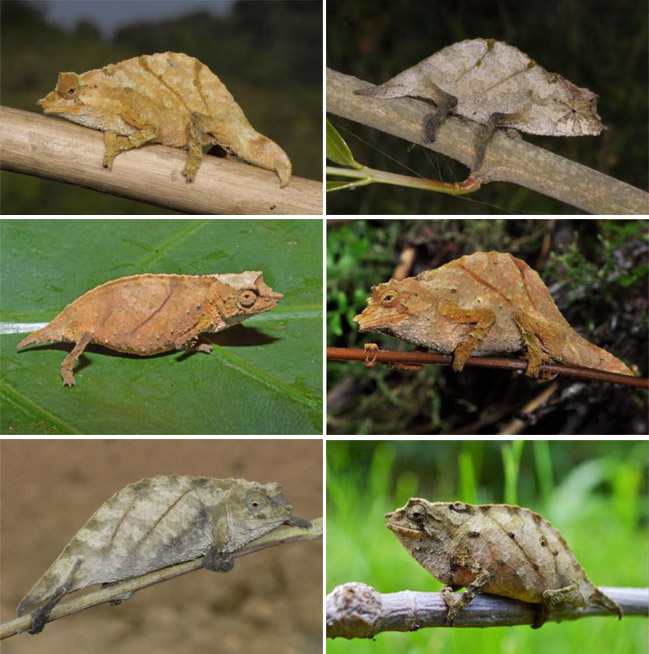
Bei den kleinen, braunen Erdchamäleons auf dem Festland Afrikas gibt es noch einiges zu entdecken. Nachdem vor zwei Jahren im Rhampholeon uluguruensis/moyeri-Komplex in Tansania neue Arten entdeckt werden konnten, haben internationale Wissenschaftler nun den Rhampholeon boulengeri Komplex genauer unter die Lupe genommen. Und wie erwartet tauchten auch dabei neue Arten auf!

Die Erdchamäleons aus diesem Komplex bewohnen verschiedenen Lebensräume entlang des Großen Afrikanischen Grabenbruchs (englisch Albertine Rift). Diese 6000 km lange Kette aus Gebirgen und Gräben reicht vom Albert-See in Uganda bis zum See Tanganyika. Dabei kreuzt sie die Demokratische Republik Kongo, Ruanda, Burundi und Tansania. In der Gattung Rhampholeon unterscheiden sich die Arten äußerlich kaum, leben jedoch oft in sehr unterschiedlichen Lebensräumen oder sind genetisch gut voneinander abzugrenzen. Die Autoren untersuchten über 130 Erdchamäleons von mehr als 20 verschiedenen Orten sowie die Lectotypen (den Holotypus gibt es nicht mehr) der Art Rhampholeon boulengeri. Dabei konnten sie mittels genetischer Untersuchungen gleich fünf neue Rhampholeon-Arten ausmachen.

Die bereits bekannte Art Rhampholeon boulengeri, beschrieben 1908 von Grauer, kommt nach den aktuellen Daten ausschließlich in seiner Typuslokalität vor. Diese ist das Itombwe Plateau in der Demokratischen Republik Kongo, auf Höhen zwischen 2100 und 2470 m.

Rhampholeon plumptrei erhielt seinen Namen zu Ehren des englischen Zoologen Andrew Plumptre. Er setzt sich seit fast 20 Jahren als Vorsitzender der Wildlife Conservation Society für den Artenschutz entlang des Afrikanischen Grabenbruchs ein. Die Art lebt in montanem und submontanem Regenwald auf Höhen von 1203-2269 m, wobei sie am häufigsten auf 1200 bis 1700 m zu finden sind. Die Verbreitung reicht dabei vom Osten der Demokratischen Republik Kongo mit dem Kahuzi-Biega Nationalpark bis in den Westen Kenias zum Kakamega Forest Nationalreservat. Dazwischen kommt Rhampoleon plumptrei im Bwindi Impenetrable Nationalpark, im Mabira sowie im Kalinzu Central Forest Reserve im Westen Ugandas vor. Es trägt einen deutlich sichtbaren Nasenfortsatz und einen nur etwas kürzeren Schwanz als Rhampholeon boulengeri.  Rhampholeon plumptrei wird bis zu 60 mm groß. Die Männchen tragen eine weiße Färbung an Kehle und Bauch und einen oder zwei diagonal verlaufende dunklen Streifen auf dem Körper. Die meisten Chamäleons dieser Art tragen einen dunkel gefärbten Tuberkel im Nacken.

Rhampholeon nalubaale wurde nach dem Luganda Wort für „Göttin“ benannt, das auch der einheimische Name des Viktoriasees ist, dem größten See Afrikas. Von dieser Art kennt man bisher nur die Weibchen, Männchen wurden noch nicht gefunden. Rhampholeon nalubaale kommt in submontanem Regenwald auf Höhen von 513 bis 1506 m vor. Am häufigsten ist es im Kibale Nationalpark in Uganda, man kann es aber auch im Budungo Central Forest Reserve im gleichen Land und im Kahuzi-Biega Nationalpark sowie dem Itombwe Natural Reserve in der Demokratischen Republik Kongo finden. Rhampholeon nalubaale wird bis zu 56 mm lang. Eins der aufgefundenen Tiere wurde mit UV-Licht angestrahlt und einige der Tuberkel im Gesicht fluoreszierten daraufhin blau, wie das schon von anderen Chamäleons bekannt ist – für die Gattung Rhampholeon ist es jedoch neu. Die Art kommt zusammen mit Trioceros johnstoni und Kinyongia tolleyae vor.

Rhampholeon bombayi wurde nach dem waYao Forscher Sidi Mubarak Bombay benannt. Er wurde 1820 auf der Grenze von Tansania zu Mosambik geboren und früh als Sklave nach Indien verkauft. Später kehrte er nach Afrika zurück und machte sich auf Expeditionen britischer Forscher in Ostafrika einen Namen. Rhampholeon bombayi wird bis zu 55 mm lang. Rhampholeon bombayi lebt in Montanwäldern auf Höhen von 1450 bis 2330 m in Ruanda und der Demokratischen Republik Kongo. Es wurde bisher im Kahuzi-Biega Nationalpark, im Kabobo Natural Reserve, im Itombwe Natural Reserve und dem Nyungwe Forest Nationalpark nachgewiesen. Im gleichen Wald leben ebenfalls Trioceros johnstoni und Trioceros schoutedeni. Die Tiere tragen zwei oder drei dunkle Linien diagonal auf dem Körper, Schwanz und Extremitäten sind häufig dunkler braun als der Körperstamm.

Rhampholeon msitugrabensis wurde nach dem großen Afrikanischen Grabenbruch benannt. Das Swahili Wort für Wald, msitu, und das deutsche Wort Graben wurden dabei kombiniert. Dieses Erdchamäleon wird bis zu 49 mm groß. Es bewohnt Waldränder bei Mpishi nahe dem Kibira Nationalpark in Burundi. Rhampholeon msitugrabensis ist außerdem vom Mount Bigugu im Nyungwe Forest Nationalpark in Ruanda beschrieben, so dass sein Vorkommen sich von 1986 bis 2699 m zieht. Im Nyungwe Forest kommt Rhampholeon msitugrabensis allopatrisch mit Rhampholeon bombayi vor, genauer im Kamiranzovu Sumpfgebiet auf 2000 bis 2330 m Höhe. Andere Chamäleons, die mit Rhampholeon msitugrabensis einen Lebensraum teilen, sind Trioceros ellioti, Chamaeleo dilepis und Kinyongia rugegensis.

Rhampholeon monteslunae wurde nach seinem Lebensraum benannt, dem Ruwenzori-Gebirge auf der Grenze der Demokratischen Republik Kongo und Uganda. Bereits 150 nach Christus wurde diese Gebirgskette, in der der Nil entspringt, von Ptolemäus als „Lunae Montes“, zu deutsch Mondberge beschrieben. Rhampholeon monteslunae kommt auf Höhen von 1655 bis 2360 m vor und ist am häufigsten im Ruwenzori Mountains Nationalpark nahe dem Nyakalengija-Eingang. Eine weitere Population findet sich im Bururi Forest Nature Reserve in Burundi. Dieses Erdchamäleon wird bis zu 47 mm lang. In den gleichen Wäldern kommen unter anderem Kinyongia carpenteri, Kinyongia xenorhina, Kinyongia tolleyae, Trioceros ellioti, Trioceros johnstoni und Trioceros rudis vor.


Taxonomy of the Rhampholeon boulengeri Complex (Sauria: Chamaeleonidae): Five new species from central Africa’s Albertine Rift
Daniel F. Hughes, Mathias Behangana, Wilber Lukwago, Michele Menegon, J. Maximilian Dehling, Philipp Wagner, Colin R. Tilbury, Trisan South, Chifundera Kusamba, Eli Greenbaum
Zootaxa Vol. 5458 4, 2024, pp. 451-494
DOI: 10.11646/zootaxa.5458.4.1

Foto: Von links oben nach rechts unten Rhampholeon boulengeri, Rhampholeon plumptrei, Rhampholeon nalubaale, Rhampholeon bombayi, Rhampholeon msitugrabensis und Rhampholeon monteslunae aus der oben genannten Publikation

[:en]

There is still a lot to discover about the small, brown pygmy chameleons on the African mainland. After new species were discovered in the Rhampholeon uluguruensis/moyeri complex in Tanzania two years ago, international scientists have now taken a closer look at the Rhampholeon boulengeri complex. And as expected, new species have been discovered!

The pygmy chameleons from this complex inhabit various habitats along the Albertine Rif). This 6000 km long chain of mountains and rifts stretches from Lake Albert in Uganda to Lake Tanganyika. It crosses the Democratic Republic of Congo, Rwanda, Burundi and Tanzania. In the genus Rhampholeon, the species hardly differ externally, but often live in very different habitats or can be easily distinguished from each other genetically. The authors analysed over 130 pygmy chameleons from more than 20 different locations as well as the lectotypes (the holotype no longer exists) of the species Rhampholeon boulengeri. Using genetic analyses, they were able to identify five new Rhampholeon species.

The already known species Rhampholeon boulengeri, described by Grauer in 1908, occurs exclusively in its type locality according to the current data. This is the Itombwe Plateau in the Democratic Republic of Congo, at altitudes between 2100 and 2470 metres.

Rhampholeon plumptrei was named in honour of the English zoologist Andrew Plumptre. As chairman of the Wildlife Conservation Society, he has been campaigning for species conservation along the African Rift Valley for almost 20 years. The species lives in montane and submontane rainforest at altitudes of 1203-2269 metres, although they are most commonly found at 1200 to 1700 metres. The distribution ranges from the east of the Democratic Republic of Congo with the Kahuzi-Biega National Park to the west of Kenya to the Kakamega Forest National Reserve. In between, Rhampoleon plumptrei can be found in Bwindi Impenetrable National Park, in Mabira and in Kalinzu Central Forest Reserve in western Uganda. It has a clearly visible nasal appendage and a slightly shorter tail than Rhampholeon boulengeri. Rhampholeon plumptrei grows up to 60 mm in size. The males have a white colouration on the throat and belly and one or two diagonal dark stripes on the body. Most chameleons of this species have a dark-coloured tubercle on the back of the neck.

Rhampholeon nalubaale was named after the Luganda word for ‘goddess’, which is also the native name of Lake Victoria, the largest lake in Africa. So far, only the females of this species are known, males have not yet been found. Rhampholeon nalubaale occurs in submontane rainforest at altitudes of 513 to 1506 metres. It is most common in the Kibale National Park in Uganda, but can also be found in the Budungo Central Forest Reserve in the same country and in the Kahuzi-Biega National Park and the Itombwe Natural Reserve in the Democratic Republic of Congo. Rhampholeon nalubaale grows up to 56 mm long. One of the animals found was illuminated with UV light and some of the tubercles in the face fluoresced blue, as is already known from other chameleons – but this is new for the genus Rhampholeon. The species occurs together with Trioceros johnstoni and Kinyongia tolleyae.

Rhampholeon bombayi was named after the waYao explorer Sidi Mubarak Bombay. He was born in 1820 on the border between Tanzania and Mozambique and was sold to India as a slave at an early age. He later returned to Africa and made a name for himself on expeditions by British explorers in East Africa. Rhampholeon bombayi grows up to 55 mm long. It lives in montane forests at altitudes of 1450 to 2330 metres in Rwanda and the Democratic Republic of Congo. It has so far been recorded in Kahuzi-Biega National Park, Kabobo Natural Reserve, Itombwe Natural Reserve and Nyungwe Forest National Park. Trioceros johnstoni and Trioceros schoutedeni also live in the same forest. The animals have two or three dark lines diagonally on the body, the tail and extremities are often darker brown than the trunk.

Rhampholeon msitugrabensis was named after the Albertine Rift. The Swahili word for forest, msitu, and the German word for rift, Graben, were combined. This ground chameleon grows up to 49 mm in size. It inhabits forest edges near Mpishi close to Kibira National Park in Burundi. Rhampholeon msitugrabensis is also described from Mount Bigugu in Nyungwe Forest National Park in Rwanda, so that its occurrence extends from 1986 to 2699 metres. In the Nyungwe Forest, Rhampholeon msitugrabensis occurs allopatrically with Rhampholeon bombayi, more precisely in the Kamiranzovu swamp area at 2000 to 2330 m altitude. Other chameleons that share a habitat with Rhampholeon msitugrabensis are Trioceros ellioti, Chamaeleo dilepis and Kinyongia rugegensis.

Rhampholeon monteslunae was named after its habitat, the Rwenzori Mountains on the border of the Democratic Republic of the Congo and Uganda. This mountain range, where the Nile rises, was described by Ptolemy as ‘Lunae Montes’ as early as 150 AD. Rhampholeon monteslunae occurs at altitudes of 1655 to 2360 metres and is most common in the Rwenzori Mountains National Park near the entrance to Nyakalengija. Another population can be found in the Bururi Forest Nature Reserve in Burundi. This ground chameleon grows up to 47 mm long. Kinyongia carpenteri, Kinyongia xenorhina, Kinyongia tolleyae, Trioceros ellioti, Trioceros johnstoni and Trioceros rudis are also found in the same forests.

Taxonomy of the Rhampholeon boulengeri Complex (Sauria: Chamaeleonidae): Five new species from central Africa’s Albertine Rift
Daniel F. Hughes, Mathias Behangana, Wilber Lukwago, Michele Menegon, J. Maximilian Dehling, Philipp Wagner, Colin R. Tilbury, Trisan South, Chifundera Kusamba, Eli Greenbaum
Zootaxa Vol. 5458 4, 2024, pp. 451-494
DOI: 10.11646/zootaxa.5458.4.1

Photo: From top left to bottom right Rhampholeon boulengeri, Rhampholeon plumptrei, Rhampholeon nalubaale, Rhampholeon bombayi, Rhampholeon msitugrabensis und Rhampholeon monteslunae from the mentioned publication[:]

[:de]Was Farbmuster bei Chamäleons beeinflusst[:en]What influences colour patterns in chameleons[:]

[:de]Was Farbmuster bei Chamäleons beeinflusst[:en]What influences colour patterns in chameleons[:]

Wissenschaft

[:de]

Chamäleons sind bekannt wegen ihrer Fähigkeit zum Farbwechsel. Was genau verschiedene Farbmuster in verschiedenen Populationen beeinflusst, haben jetzt internationale Wissenschaftler untersucht. Sie wollen wissen, inwiefern der Lebensraum selbst, die Entfernung zu anderen Populationen oder soziale Interaktionen den Farbwechsel beeinflussten.

Als Probanden wurden zum einen Europäische Chamäleons (Chamaeleo chamaeleon) in La Herradura und Sanlúcar in Spanien gefangen. Die beiden Regionen liegen rund 230 km voneinander entfernt. Weitere Chamaeleo chameleon wurden in der nördwestlichen Negev und an der Carmel Küste in Israel entnommen (rund 180 km voneinander getrennt). Zum anderen wurden Lappenchamäleons (Chamaeleo dilepis) in Simbithi, Zulu Falls und Maduma Boma in Südafrika gefangen. Die drei Orte liegen zwischen 100 und 550 km voneinander entfernt.

Jedes Chamäleon wurde zwei Experimenten unterzogen. Im ersten ließen die Wissenschaftler das Chamäleon zwei Meter auf einem horizontalen Stock, der in der Sonne rund einen Meter über dem Boden aufgestellt wurde, laufen. Im zweiten Experiment wurde auf den gleichen Stock 50 cm entfernt vom ersten Chamäleon ein zweites der gleichen Art gesetzt. Die Farbmuster, die das Tier während der Experimente zeigte, sowie das Verhalten wurden 20 Minuten lang aufgezeichnet. Anschließend wurden die Daten mittels Computerprogrammen ausgewertet. Blut wurde allen Chamäleons aus einer abgeschnittenen Kralle entnommen und genetisch untersucht. Die Lebensräume und Bodengegebenheiten wurden auf verschiedene Weisen zusätzlich untersucht und statistisch ausgewertet. Die eingefangenen Tiere wurden maximal 12 h in belüfteten Plastikkäfigen gehalten und nach den Untersuchungen wieder freigelassen. Wie viele Chamäleons insgesamt gefangen und freigelassen wurden, wird leider in der Studie nicht erwähnt.

Wie erwartet stellte sich heraus, dass die einzelnen Populationen sich sowohl beim Europäischen als auch beim Lappenchamäleon genetisch voneinander unterschieden. Dabei wiesen die Populationen von Chamaeleo dilepis signifikant unterschiedliche Haplotypen auf.

Beim Lappenchamäleon waren die Weibchen an zwei Orten deutlich größer als die Männchen, lediglich in Simbithi nicht. Außerdem stellten die Wissenschaftler fest, dass sich die Farbmuster der drei untersuchten Populationen klar voneinander unterscheiden ließen. Sie schlossen aus den Ergebnissen, dass die Farbmuster bei Chamaeleo dilepis vor allem von genetischer Isolation abhängig sind. Das Habitat selbst und die Größe der Chamäleons hatten keinen Einfluss auf die Farbmuster.

Beim Europäischen Chamäleon sah das jedoch anders aus: Die Körpergröße und die genetische Distanz zu anderen Populationen sagten die Farbmuster bei Männchen sehr gut voraus. Dafür waren die Farbmuster unabhängig vom Ort, an dem die Tiere gefunden worden waren. Boden- oder Vegetationsfarben hatten nur bei Weibchen einen geringen Einfluss auf die Farbe.

Genetic and behavioural factors affecting interpopulation colour pattern variation in two congeneric chameleon species
Tammy Keren-Rotem, Devon C. Main, Adi Barocas, David Donaire-Barroso, Michal Haddas-Sasson, Carles Vila, Tal Shaharabany, Lior Wolf, Krystal A. Tolley, Eli Geffen
Royal Society Open Science 11: 231554
DOI:  0.1098/rsos.231554

[:en]

Chameleons are known for their ability to change colour. International scientists have now investigated what exactly influences different colour patterns in different populations. They want to know to what extent the habitat itself, the distance to other populations or social interactions influence the colour change.

The test subjects were European chameleons (Chamaeleo chamaeleon) caught in La Herradura and Sanlúcar in Spain. The two regions are around 230 kilometres apart. Other Chamaeleo chameleon were collected in the north-western Negev and on the Carmel coast in Israel (around 180 km apart). On the other hand, flap-necked chameleons (Chamaeleo dilepis) were captured in Simbithi, Zulu Falls and Maduma Boma in South Africa. The three locations are between 100 and 550 kilometres apart.

Each chameleon was subjected to two experiments. In the first, the scientists let the chameleon walk two metres on a horizontal stick, which was placed in the sun about one metre above the ground. In the second experiment, a second chameleon of the same species was placed on the same stick 50 cm away from the first. The colour patterns shown by the animal during the experiments and its behaviour were recorded for 20 minutes. The data was then analysed using computer programs. Blood was taken from a cut claw of all chameleons and genetically analysed. The habitats and soil conditions were also analysed in various ways and statistically evaluated. The captured animals were kept in ventilated plastic cages for a maximum of 12 hours and released after the analyses. Unfortunately, the study does not mention how many chameleons were caught and released in total.

As expected, it turned out that the individual populations of both the European and the flap-necked chameleon differed genetically from each other. The populations of Chamaeleo dilepis had significantly different haplotypes.

In the flap-necked chameleon, the females were significantly larger than the males in two locations, but not in Simbithi. The scientists also found that the colour patterns of the three populations studied could be clearly distinguished from each other. They concluded from the results that the colour patterns in Chamaeleo dilepis are primarily dependent on genetic isolation. The habitat itself and the size of the chameleons did not influence the colour patterns.

In the European chameleon, however, the situation was different: Body size and genetic distance to other populations predicted colour patterns in males very well. However, the colour patterns were independent of the location where the animals were found. Soil or vegetation colours only had a minor influence on the colour of females.

Genetic and behavioural factors affecting interpopulation colour pattern variation in two congeneric chameleon species
Tammy Keren-Rotem, Devon C. Main, Adi Barocas, David Donaire-Barroso, Michal Haddas-Sasson, Carles Vila, Tal Shaharabany, Lior Wolf, Krystal A. Tolley, Eli Geffen
Royal Society Open Science 11: 231554
DOI:  0.1098/rsos.231554[:]

[:de]Genom des Pantherchamäleons entschlüsselt[:en]Genome of the panther chameleon decoded[:]

[:de]Genom des Pantherchamäleons entschlüsselt[:en]Genome of the panther chameleon decoded[:]

Wissenschaft

[:de]

In den letzten Jahrzehnten hat die Genforschung sich rasant entwickelt. Seit 2009 steht für die Sequenzierung von Genomen das sogenannte high fidelity (HiFi) Pacbio Sequenzierungs-Verfahren zur Verfügung. Trotzdem tut sich gerade im Reptilienbereich relativ wenig. Sogenannte Referenzgenome gibt es für Reptilien nur rund hundert, von Chamäleons gibt es gar keine. Wissenschaftler aus China haben nun ein Referenzgenom für das Pantherchamäleon (Furcifer pardalis) veröffentlicht.

Für die Analyse wurde ein 5 Jahre altes, männliches Pantherchamäleon mittels Isofluran getötet und anschließend seziert. Verschiedene Gewebe wurden in flüssigem Stickstoff eingefroren. Für die Kurzsequenzierung der Genom-DNA und die HI-C-Sequenzierung wurde Skelettmuskel verwendet. Für die HiFi-Sequenzierung wurde Leber genutzt. RNA aus Herz, Leber, Milz, Hoden, Lunge, Nieren und Haut wurden für die Transkriptom-Sequenzierung verwendet.

Die Genomgröße des Pantherchamäleons aus der K-mer-Analyse liegt bei 1,61 Gigabasenpaaren (Gbp), wobei es nur 22 sogenannte contigs, Sätze überlappender DNA, enthält. Der Karyotyp enthält 11 Chromosome, das aus jeweils ein bis vier contigs besteht. Zehn von elf Chromosomen weisen Repeatsequenzen auf (TAACCC). Die BUSCO-Analyse wies eine hohe Vollständigkeit des Genoms nach. Das Genom kann im NCBI BioProjekt unter der Nummer PRJNA974816 sowie in der ScienceDataBank eingesehen werden.

Efficient and highly continuous chromosome-level genome assembly of the first chameleon genome
Hongxin Xie, Zixuan Chen, Shuai Pang, Weiguo Du
Genome Biology and Evolution 131, 2023
DOI: 10.1093/gbe/evad131


Foto: Alex Laube[:en]

In recent decades, genetic research has developed rapidly. Since 2009, the so-called high fidelity (HiFi) Pacbio sequencing method has been available for sequencing genomes. Nevertheless, relatively little is being done in the reptile field. There are only about a hundred so-called reference genomes for reptiles, and none at all for chameleons. Scientists from China have now published a reference genome for the panther chameleon (Furcifer pardalis).

For the analysis, a 5-year-old male captive panther chameleon was killed using isoflurane and then dissected. Different tissues were frozen in liquid nitrogen. Skeletal muscle was used for short genome DNA sequencing and HI-C sequencing. Liver was used for HiFi sequencing. RNA from heart, liver, spleen, testis, lung, kidney, and skin were used for transcriptome sequencing.

The genome size of the panther chameleon from the K-mer analysis is 1.61 gigabase pairs (Gbp), containing only 22 so-called contigs, sets of overlapping DNA. The karyotype contains 11 chromosomes, each consisting of one to four contigs. Ten out of eleven chromosomes have repeat sequences (TAACCC). BUSCO analysis demonstrated a high completeness of the genome. The genome can be viewed in the NCBI BioProject under the number PRJNA974816 and in ScienceDataBank.

Efficient and highly continuous chromosome-level genome assembly of the first chameleon genome
Hongxin Xie, Zixuan Chen, Shuai Pang, Weiguo Du
Genome Biology and Evolution 131, 2023
DOI: 10.1093/gbe/evad131


Picture: Alex Laube[:]

[:de]Karyotypen bei Chamäleons[:en]Karyotypes in chameleons[:]

[:de]Karyotypen bei Chamäleons[:en]Karyotypes in chameleons[:]

Wissenschaft

[:de]

Wissenschaftler aus Großbritannien und Italien haben sich jetzt mit den Chromosomen verschiedener Chamäleonarten beschäftigt. Sie untersuchten den Karyotyp von insgesamt 83 verschiedenen Chamäleon-Arten. Darunter befanden sich 57 madagassische Chamäleonarten, von denen 32 Karyotypen zum ersten Mal überhaupt beschrieben wurden. Für Calumma brevicorne, Calumma fallax, Calumma parsonii und Furcifer verrucosus waren sogar jeweils mehrere Tiere zur Untersuchung vorhanden. Die Wissenschaftler fanden heraus, dass vermutlich die Verschmelzung (Fusion) von Chromosomen die Gesamtzahl von Chromosomen im Laufe der Evolution bei Chamäleons verringert hat. Vermutlich fusionierten dabei vor allem Mikrochromosomen (besonders kleine Chromosomen).

Microchromosome fusions underpin convergent evolution of chameleon karyotypes
Marcello Mezzasalma, Jeffrey W Streicher, Fabio M Guarino, Marc E H Jones, Simon P Loader, Gaetano Odierna, Natalie Cooper
Evolution, Juni 2023
DOI: 10.1093/evolut/qpad097[:en]

Scientists from Great Britain and Italy have now studied the chromosomes of different chameleon species. They examined the karyotype of a total of 83 different chameleon species. Among them were 57 Madagascan chameleon species, of which 32 karyotypes were described for the first time ever. For Calumma brevicorne, Calumma fallax, Calumma parsonii and Furcifer verrucosus, there were even several animals each available for examination. The scientists found out that presumably the fusion of chromosomes has reduced the total number of chromosomes in the course of evolution in chameleons. Presumably, it was mainly microchromosomes (particularly small chromosomes) that fused.

Microchromosome fusions underpin convergent evolution of chameleon karyotypes
Marcello Mezzasalma, Jeffrey W Streicher, Fabio M Guarino, Marc E H Jones, Simon P Loader, Gaetano Odierna, Natalie Cooper
Evolution, Juni 2023
DOI: 10.1093/evolut/qpad097

 [:]

[:de]Chamäleons auf unterschiedlichen Höhenstufen des Montagne d’Ambre (Madagaskar)[:en]Chameleons at different altitudes of the Amber Mountain (Madagascar)[:]

[:de]Chamäleons auf unterschiedlichen Höhenstufen des Montagne d’Ambre (Madagaskar)[:en]Chameleons at different altitudes of the Amber Mountain (Madagascar)[:]

Wissenschaft

[:de]

Internationale Wissenschaftler haben sich intensiv mit den unterschiedlichen Höhenlagen des Montagne d’Ambre und den dort vorkommenden Amphibien und Reptilien beschäftigt. Der Montagne d’Ambre ist ein ehemaliges Vulkanmassiv im Norden Madagaskars. Der bis zu 1475 m hohe Berg ist vor allem von Regenwald bedeckt, der dem gleichnamigen Nationalpark angehört. Im Norden des Berges liegt ein Trockenwald, der zum Forêt d’Ambre Special Reserve gehört. Die Nordwestflanke des Berges ist bisher nicht geschützt.

In der vorliegenden Arbeit wurden Amphibien und Reptilien über 12 km zwischen 700 und 1470 Höhenmeter beobachtet und beprobt. In die Studie wurde auch erstmals der Westhang des Montagne d’Ambre auf Höhen zwischen 770 und 1290 m eingeschlossen. Zusätzlich wurden Tiere im Forêt d’Ambre ab einer Höhe von 470 m beprobt. Alle gefundenen Tiere wurden vermessen. Es wurden sowohl Wangentupfer, Schuppen als auch lebende Tiere, die euthanasiert wurden, entnommen und genetisch untersucht. Insgesamt kam es zu 2631 Beobachtungen von 34 Arten Amphibien und 48 Arten von Reptilien. Wie erwartet kamen auf unterschiedlichen Höhenlagen unterschiedliche Tiere vor. Der Artenreichtum des Montagne d’Ambre war dabei auf rund 1000 m üNN mit 41 verschiedenen Arten am größten. Über 1100 m waren rund ein Drittel der vorgefundenen Arten lokal endemisch.

Beim Erdchamäleon Brookesia tuberculata konnten zwei genetische Cluster identifiziert werden. Gruppe 1 lebt auf an der Ostflanke des Montagne d’Ambre auf Höhen von 887 bis 1170 m, Gruppe 2 auf 1260 bis 1455 m an der Ostflanke sowie auf 956 bis 1150 m am Westhang des Montagne d’Ambre. Bei Gruppe 1 fielen besonders viele mitochondriale Haplotypen auf, während Gruppe 2 lediglich einen einzigen Haplotyp aufwies. Die Wissenschaftler vermuten, dass die Art wegen ihrer geringen Körpergröße und hohen Standorttreue eher zu isolierten Gruppen neigt als Baum bewohnende Chamäleons, die natürliche Barrieren leichter überwinden und sich damit in einem wesentlich größerem Umgebungsradius fortbewegen können.

Bei Calumma linotum waren die genetischen Unterschiede zwischen drei Gruppen auf unterschiedlichen Höhen eher gering ausgeprägt. Auch die Messdaten verschiedener Körpermaße zeigten bei dieser Art auf den unterschiedlichen Höhenlagen keinen eindeutigen Trend. Zwar schienen Calumma linotum auf niedrigeren Höhen etwas kleiner zu sein, das könnte aber auch an als Weibchen fehlidentifizierten subadulten Individuen gelegen haben. Bei Calumma amber und Calumma ambreense sank die Körpergröße, je höher im Montagne d’Ambre die Chamäleons gefunden wurden. Möglicherweise hängt dies mit den kühleren Temperaturen in höheren Lagen zusammen, die zu einem langsameren Wachstum beitragen. Es könnte aber auch sein, dass schlicht mehr jüngere Tiere vermessen wurden.

Die Studie bringt interessante Anpassungen verschiedener Chamäleonarten an die Höhenunterschiede des Montagne d’Ambre zu Tage. Möglicherweise handelt es sich dabei bereits um erste Hinweise auf ein frühes Stadium von Artbildung. Die Arbeit verdeutlicht außerdem, wie wichtig die unterschiedlichen Höhenstufen für die Artenvielfalt sind.

Repeated divergence of amphibians and reptiles across an elevational gradient in northern Madagascar
Mark D. Scherz, Robin Schmidt, Jason L. Brown, Julian Glos, Ella Z. Lattenkamp, Zafimahery Rakotomalala, Andolalao Rakotoarison, Ricky T. Rakotonindrina, Onja Randriamalala, Achille P. Raselimanana, Safidy M. Rasolonjatovo, Fanomezana M. Ratsoavina, Jary H. Razafindraibe, Frank Glaw, Miguel Vences
Ecology and Evolution 13 (3)
DOI: 10.1002/ece3.9914[:en]

International scientists have intensively studied the different altitudes of the Amber Mountain and the amphibians and reptiles found there. The Amber Mountain (French Montagne d’Ambre) is a former volcanic massif in northern Madagascar. The mountain, which is up to 1475 m high, is mainly covered by rainforest, which belongs to the national park of the same name. To the north of the mountain is a dry forest that belongs to the Forêt d’Ambre Special Reserve. The north-western flank of the mountain has not yet been protected.

In the present work, amphibians and reptiles were observed and sampled over 12 km between 700 and 1470 metres altitude. The western slope of the Montagne d’Ambre at altitudes between 770 and 1290 m was also included in the study for the first time. In addition, animals were sampled in the Forêt d’Ambre from 470 m altitude. All animals found were measured. Cheek swabs, scales as well as live animals that had been euthanised were collected and genetically analysed. A total of 2631 observations of 34 species of amphibians and 48 species of reptiles were made. As expected, different animals occurred at different altitudes. The species richness of the Montagne d’Ambre was greatest at around 1000 m a.s.l. with 41 different species. Above 1100 m, about one third of the species found were locally endemic.

Two genetic clusters of the earth chameleon Brookesia tuberculata have been identified. Group 1 lives on the eastern flank of the Montagne d’Ambre at altitudes of 887 to 1170 m, group 2 at 1260 to 1455 m on the eastern flank and at 956 to 1150 m on the western slope of the Montagne d’Ambre. Group 1 showed a particularly high number of mitochondrial haplotypes, while group 2 had only one haplotype. The scientists assume that due to their small body size and high site fidelity, the species tends to form isolated groups rather than tree-inhabiting chameleons, which can overcome natural barriers more easily and thus move within a much larger environmental radius.

In Calumma linotum, the genetic differences between three groups at different altitudes were rather small. The measurement data of various body dimensions also showed no clear trend for this species at the different altitudes. Although Calumma linotum appeared to be slightly smaller at lower altitudes, this could have been due to subadult individuals misidentified as females. For Calumma amber and Calumma ambreense, body size decreased the higher the chameleons were found in the Montagne d’Ambre. This may be related to the cooler temperatures at higher altitudes, which contribute to slower growth. But it could also be that more younger animals were simply measured.

The study reveals interesting adaptations of different chameleon species to the altitudinal differences of the Montagne d’Ambre. It is possible that these are already the first indications of an early stage of speciation. The work also illustrates how important the different altitudinal levels are for species diversity.

Repeated divergence of amphibians and reptiles across an elevational gradient in northern Madagascar
Mark D. Scherz, Robin Schmidt, Jason L. Brown, Julian Glos, Ella Z. Lattenkamp, Zafimahery Rakotomalala, Andolalao Rakotoarison, Ricky T. Rakotonindrina, Onja Randriamalala, Achille P. Raselimanana, Safidy M. Rasolonjatovo, Fanomezana M. Ratsoavina, Jary H. Razafindraibe, Frank Glaw, Miguel Vences
Ecology and Evolution 13 (3)
DOI: 10.1002/ece3.9914[:]

[:de]Genetik: Karyotyp beim Jemenchamäleon[:en]Genetics: Karyotype in the Veiled Chameleon[:]

[:de]Genetik: Karyotyp beim Jemenchamäleon[:en]Genetics: Karyotype in the Veiled Chameleon[:]

Wissenschaft

[:de]

Dass das Geschlecht beim Jemenchamäleon (Chamaeleo calyptratus) genetisch festgelegt wird, ist schon länger bekannt. Die Art verfügt über ein XX-/XY-System. Wissenschaftler aus Russland, Großbritannien, Italien und Thailand haben sich nun mit dem Karyotyp der Art beschäftigt, also den Eigenschaften der Chromosomen.

Der wahrscheinlich ursprünglichste Karyotyp aller Chamäleons ist 2n= 36. Dabei hatte dieses „Urchamäleon“ sechs Paare metazentrischer Makrochromosomen und zwölf Paare Mikrochromosomen, besonders kleine Chromosomen. Das Jemenchamäleon dagegen hat eine geringere Chromosomenzahl, nämlich nur 2n=24. Mittels verschiedener genetischer Untersuchungsmethoden fanden die Forscher in der vorliegenden Studie heraus, dass dieser Karyotyp wahrscheinlich durch Fusionen entstand. Dabei verschmolzen offenbar zwei Mal Mikrochromosomen miteinander, und gleich vier Mal fusionierten Mikro- und Makrochromosomen. Letzteres, die sogenannte heterogene Fusion zwischen unterschiedlich großen Chromosomen, ist ungewöhnlich für Wirbeltiere. Normalerweise liegen Makro- und Mikrochromosomen an verschiedenen Plätzen im Zellkern und werden unterschiedlich schnell transkribiert und repliziert. Das Phänomen ist aber schon von Alligatoren und Schildkröten bekannt – für Chamäleons ist es neu.

Unklar war bisher auch, welches Chromosomenpaar beim Jemenchamäleon eigentlich für das Geschlecht zuständig ist. Bei Chamaeleo chamaeleon codiert das zweitgrößte Chromosomenpaar für das Geschlecht. Erste Mutmaßungen legen jedoch nahe, dass beim Jemenchamäleon stattdessen das fünfte Chromosomenpaar (CCA5) das Geschlechtschromosomenpaar sein könnte. Die Vermutung muss durch weitere Forschung noch validiert werden. Es steht außerdem noch zur Diskussion, welches Gen eigentlich vorwiegend für die Entwicklung der Geschlechtsorgane im Embryo verantwortlich ist – die Forschere identifizierten mindestens drei in Frage kommende Gene auf CCA5.

Identification of Iguania ancestral syntenic blocks and putative sex chromosomes in the Veiled Chameleon (Chamaeleo calyptratus, Chamaeleonidae, Iguania)
Katerina V. Tishakova, Dmitry Yu. Prokopov, Guzel I. Davletshina, Alexander V. Rumyantsev, Patricia C. M. O’Brien, Malcolm A. Ferguson-Smith, Massimo Giovannotti, Artem P. Lisachov, Vladimir A. Trifonov
International Journal of Molecular Sciences 23, Dezember 2022
DOI: 10.3390/ijms232415838

 [:en]

It has been known for some time that the sex of the Veiled chameleon (Chamaeleo calyptratus) is genetically determined. The species has an XX/XY system. Scientists from Russia, Great Britain, Italy, and Thailand have now studied the karyotype of the species, i.e. the characteristics of the chromosomes.

The probably most original karyotype of all chameleons is 2n= 36. This „primal chameleon“ had six pairs of metacentric macrochromosomes and twelve pairs of microchromosomes, particularly small chromosomes. The Veiled chameleon, on the other hand, has a smaller number of chromosomes, namely only 2n=24. Using various genetic investigation methods, the researchers in the present study found that this karyotype probably arose through fusions. Microchromosomes apparently fused with each other twice, and micro- and macrochromosomes fused no less than four times. The latter, the so-called heterogeneous fusion between chromosomes of different sizes, is unusual for vertebrates. Normally, macro- and microchromosomes are located at different locations in the cell nucleus and are transcribed and replicated at different rates. However, this phenomenon is already known from alligators and turtles – for chameleons it is new.

Until now, it was also unclear which pair of chromosomes in the Veiled chameleon is actually responsible for the sex. In Chamaeleo chamaeleon, the second largest chromosome pair codes for sex. However, initial speculation suggests that in the Veiled chameleon the fifth chromosome pair (CCA5) may instead be the sex chromosome pair. The conjecture still needs to be validated by further research. It is also still up for discussion which gene is actually predominantly responsible for the development of the sex organs in the embryo – the researchers identified at least three possible genes on CCA5.

Identification of Iguania ancestral syntenic blocks and putative sex chromosomes in the Veiled Chameleon (Chamaeleo calyptratus, Chamaeleonidae, Iguania)
Katerina V. Tishakova, Dmitry Yu. Prokopov, Guzel I. Davletshina, Alexander V. Rumyantsev, Patricia C. M. O’Brien, Malcolm A. Ferguson-Smith, Massimo Giovannotti, Artem P. Lisachov, Vladimir A. Trifonov
International Journal of Molecular Sciences 23, December 2022
DOI: 10.3390/ijms232415838[:]

[:de]Rhampholeon spectrum – nicht nur eine Art?[:en]Rhampholeon spectrum – not just one species?[:]

[:de]Rhampholeon spectrum – nicht nur eine Art?[:en]Rhampholeon spectrum – not just one species?[:]

Wissenschaft

[:de]

Die Erdchamäleon-Gattung Rhampholeon kommt vor allem in Ostafrika vor. Rhampholeon viridis, Rhampholeon spinosus und Rhampholeon temporalis leben dabei jeweils in klar begrenzten und voneinander isolierten Gebieten Tansanias. Rhampholeon spectrum scheint jedoch bisher das völlige Gegenteil zu sein: Die Art verfügt über ein enormes Verbreitungsgebiet im Westen Afrikas. Es reicht von der Elfenbeinküste über Ghana, Togo, Benin nach Nigeria und bis an die Randgebiete von Niger und Chad, dann weiter über Kamerun, Äquatorialguinea und Gabun bis hinein in die zentralafrikanische Republik sowie in die demokratische Republik Kongo und die Republik Kongo (Kongo-Brazzaville). Forscher aus den USA und Kamerun haben nun genetisch untersucht, was hinter der weiten Verbreitung steckt.

Untersucht wurden Proben von einer Insel am nördlichsten Zipfel Äquatorialguineas, mehreren Bergen in Kamerun sowie Proben aus zwei Gebieten in Gabun. Zum Erstaunen der Forscher stellte sich heraus, dass Rhampoleon spectrum keineswegs überall genetisch gleich ist. Aus den Proben konnten zwei Kladen identifiziert werden: Eine im Tiefland und eine montane, bei denen die Chamäleons ausschließlich über 700 m üNN vorkommen. Insgesamt fünf genetisch verschiedene Populationen wurden identifiziert, von denen mehrere möglicherweise neue, noch unbeschriebene Chamäleonarten darstellen könnten.

Zur Tiefland-Klade gehört zum einen die Population in Gabun, beprobt wurden hier Chamäleons aus dem Ivindo Nationalpark und Tiere in einem Gebiet nahe der Stadt Mekambo. Die zweite Population der Tiefland-Klade kommt auf niedrigen Höhen des Mount Korup vor, einem Berg vulkanischen Ursprungs Der Mount Korup liegt im gleichnamigen geschützten Nationalpark in Kamerun an der Grenze zu Nigeria.

Zur Montan-Klade von Rhampholeon spectrum zählen drei Populationen. Eine Population kommt auf dem Mount Biao auf der Insel Bioko vor, die zu Äquatorialguinea gehört. Eine zweite Population findet sich auf dem Mount Cameroon, einem aktiven Vulkan im Westen Kameruns unweit des Golfes von Guinea. Vom Mount Cameroon stammt das Typusexemplar von Rhampholeon spectrum. Der bei der Erstbeschreibung genannte Fundort, Mapanja, liegt dabei nur wenige Kilometer von einem der Orte entfernt, an denen in der vorliegenden Studie Individuen entnommen wurden. Es handelt sich bei dieser Population also wahrscheinlich um die „echten“ Rhampholeon spectrum, die sogenannte topotypische Gruppe. Die dritte Population der Montanklade ist auf drei benachbarten Bergen in Kamerun beheimatet: Dem Mount Kupe, dem Mount Mangengouba und dem Mount Nlonako. Alle drei gehören mit dem Mount Cameroon und dem Mount Biao zur sogenannten Kamerunlinie, einer Gebirgskette vulkanischen Urpsrungs, die sich an der Grenze zwischen Kamerun und Nigera vom Meer bis zum Tschadsee erstreckt.    

Die Forscher beschäftigen sich außerdem mit der Frage, wie sich die verschiedenen Populationen entwickelt haben könnten. Die Trennung zwischen Rhampoleon spectrum und den Erdchamäleons in Tansania lässt sich ins späte Eozän vor rund 40 Millionen Jahren datieren. In dieser Zeit lösten sich die bis dahin zusammenhängenden Regenwälder in West-, Zentral- und Ostafrika in kleinere, teils isolierte Fragmente auf. Die Rhampoleon spectrum Klade teilte sich dann im Miozän vor rund 11,1 Millionen Jahre in die Tiefland- und Montanpopulationen. Im Miozän führten tektonische Bewegungen zur Erhebung einer niedrigen Gebirgskette, die von Südkamerun bis in den Süden der Republik Kongo reichte. Flüsse, Wüsten und andere geografische Barrieren veränderten sich. Etwas später, vor rund 9,3 Millionen Jahren, spaltete sich die Population auf der Insel Bioko ab. Die Erdchamäleons der Insel sind damit älter als die Insel selbst – die Forscher erklären dieses Phänomen damit, dass die Insel früher über eine Landbrücke mit dem Festland Afrikas verbunden gewesen sein muss. Die Chamäleons hätten also die Insel kolonialisiert, hätten eine Heimat auf dem Berg gefunden und wären erst dann vom Festland isoliert worden. Die genetisch identische Population auf dem Festland konnte allerdings nicht gefunden werden – die Forscher halten sie für ausgestorben. Im späten Miozän, vor rund 6,9 Millionen Jahren, entstanden die Populationen auf Mount Korup und in Gabun. Erst am Übergang vom Miozän ins Pleistozän, vor 5,2 Millionen Jahren, entstanden dann die Populationen auf dem Mount Cameroon und Mount Kupe.

Weiterführende Forschung zu diesem Thema wird zeigen, ob sich tatsächlich neue Arten unter dem Namen Rhampholeon spectrum verstecken – die Chancen dafür stehen gut. Interessant wären auch Untersuchungen zu Populationen der Art, die in dieser Studie keine Erwähnung finden. Denn natürlich könnten auch die Rhampholeon spectrum aus Süd- und Ostkamerun, kontinentalem Äquatorialguinea, Südgabun und dem Kongo weitere, eigenständige Populationen sein. Es bleibt also spannend!

Diversification and historical demography of Rhampholeon spectrum in West-Central Africa
Walter Paulin, Tapondjou Nkonmeneck, Kaitlin E. Allen, Paul M. Hime, Kristen N. Knipp, Marina M. Kameni, Arnaud M. Tchassem, LeGrand N. Gonwouo, Rafe M. Brown
PLOS One, Dezember 2022
DOI: 10.1371/journal.pone.0277107[:en]

The pygmy chameleon genus Rhampholeon is mainly found in East Africa. Rhampholeon viridis, Rhampholeon spinosus, and Rhampholeon temporalis each live in clearly defined and isolated areas of Tanzania. Rhampholeon spectrum, however, seems to be the complete opposite so far: The species has an enormous range in western Africa. It extends from Côte d’Ivoire through Ghana, Togo, and Benin to Nigeria and the outskirts of Niger and Chad, then on through Cameroon, Equatorial Guinea, and Gabon into the Central African Republic as well as the Democratic Republic of Congo and the Republic of Congo. Researchers from the USA and Cameroon have now investigated genetically what is behind the wide distribution.

Samples from an island at the northernmost tip of Equatorial Guinea, several mountains in Cameroon, and samples from two areas in Gabon were examined. To the researchers‘ astonishment, it turned out that Rhampoleon spectrum is by no means genetically identical everywhere. Two clades could be identified from the samples: One in the lowlands and one in the montane forest, where the chameleons are found exclusively above 700 m a.s.l. A total of five genetically distinct populations were identified, several of which may represent new, as yet undescribed chameleon species.

The lowland clade includes the population in Gabon, where chameleons were sampled from Ivindo National Park and animals in an area near the town of Mekambo. The second population of the lowland clade occurs at low altitudes on Mount Korup, a mountain of volcanic origin. Mount Korup is located in the protected national park of the same name in Cameroon on the border with Nigeria.

The montane clade of the Rhampholeon spectrum includes three populations. One population occurs on Mount Biao on the island of Bioko, which belongs to Equatorial Guinea. A second population is found on Mount Cameroon, an active volcano in western Cameroon not far from the Gulf of Guinea. The type specimen of Rhampholeon spectrum comes from Mount Cameroon. The locality mentioned in the first description, Mapanja, is only a few kilometres away from one of the places where individuals were collected in the present study. This population is therefore probably the „true“ Rhampholeon spectrum, the so-called topotypic group. The third population of the montane clade is found on three neighbouring mountains in Cameroon: Mount Kupe, Mount Mangengouba, and Mount Nlonako. Together with Mount Cameroon and Mount Biao, all three belong to the so-called Cameroon Line, a mountain range of volcanic origin that stretches along the border between Cameroon and Nigeria from the sea to Lake Chad.

The researchers are also looking into the question of how the different populations might have evolved. The separation between Rhampoleon spectrum and the pygmy chameleons in Tanzania can be dated to the late Eocene around 40 million years ago. During this time, the previously continuous rainforests in West, Central, and East Africa broke up into smaller, sometimes isolated fragments. The Rhampoleon spectrum clade then split into lowland and montane populations in the Miocene around 11.1 million years ago. In the Miocene, tectonic movements led to the uplift of a low mountain range that extended from southern Cameroon to the south of the Republic of Congo. Rivers, deserts, and other geographical barriers changed. Somewhat later, about 9.3 million years ago, the population on Bioko Island split off. The island’s pygmy chameleons are thus older than the island itself – the researchers explain this phenomenon by the fact that the island must have been connected to mainland Africa via a land bridge in the past. The chameleons would therefore have colonised the island, found a home on the mountain, and only then became isolated from the mainland. However, the genetically identical population on the mainland could not be found – researchers consider it extinct. In the late Miocene, around 6.9 million years ago, the populations on Mount Korup and in Gabon emerged. Only at the transition from the Miocene to the Pleistocene, 5.2 million years ago, did the populations on Mount Cameroon and Mount Kupe emerge.

Further research on this topic will show whether new species are actually hiding under the name Rhampholeon spectrum – chances are good. It would also be interesting to investigate populations of the species that are not mentioned in this study. Because, of course, the Rhampholeon spectrum from southern and eastern Cameroon, continental Equatorial Guinea, southern Gabon, and the Congo could also be further, independent populations. Science remains exciting!

Diversification and historical demography of Rhampholeon spectrum in West-Central Africa
Walter Paulin, Tapondjou Nkonmeneck, Kaitlin E. Allen, Paul M. Hime, Kristen N. Knipp, Marina M. Kameni, Arnaud M. Tchassem, LeGrand N. Gonwouo, Rafe M. Brown
PLOS One, December 2022
DOI: 10.1371/journal.pone.0277107[:]