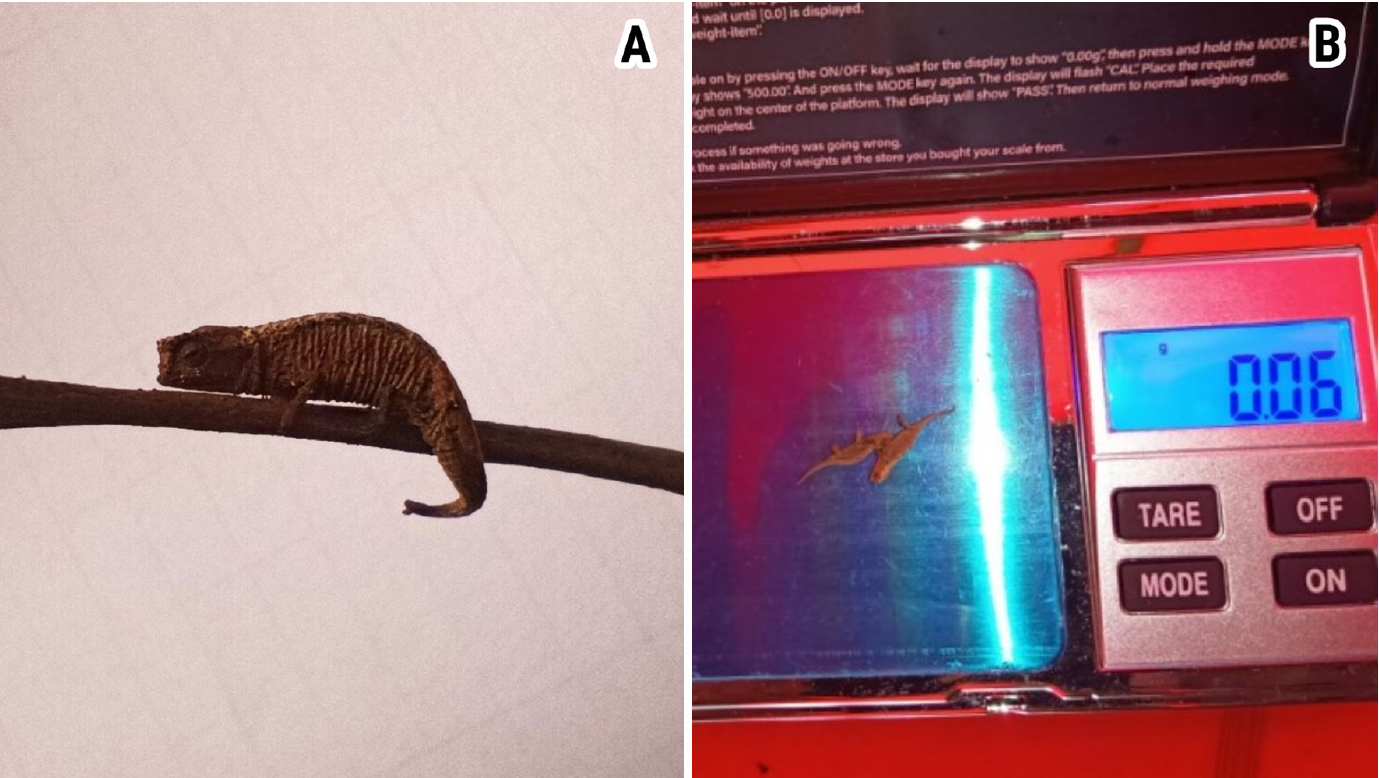
Das aktuell kleinste Chamäleon der Welt wurde vor wenigen Jahren in Sorata im Norden Madagaskars entdeckt. Der Wald von Sorata gehört zum Korridor Marojejy-Anjanaharibe Süd-Tsaratanana, einem Gebiet von fragmentierten Waldresten zwischen den genannten großen Nationalparks und dem Réserve Naturelle Intégrale. Er wird derzeit vom WWF in Zusammenarbeit mit einer lokalen Organisation namens Ambodimandresy Miaro ny Ala verwaltet.
Wissenschaftler der Universitäten von Antsiranana und Antananarivo haben nun in Sorata die Bestandsdichte von Brookesia nana untersucht. 14 Tage lang suchten sie während der Regenzeit nachts entlang 14 je 150 m langer Transekte nach den kleinen Chamäleons.
Insgesamt fanden die Wissenschaftler 0,33 Individuen pro 100 m. Konkret bedeutet das, dass auf 2100 m Transekt nur sieben Brookesia nana überhaupt gefunden wurden. Die Weibchen waren etwas größer als die Männchen. Alle Chamäleons wurden auf sehr niedrigen Pflanzen schlafend gefunden, im Schnitt nur 7 cm über dem Boden.
Das niedrige Vorkommen macht weitere Studien in weiteren Wäldern des COMATSA-Korridors notwendig, um die exakte Verbreitung von Brookesia nana herauszufinden. Interessant ist außerdem, dass Brookesia nana offenbar seltene vorzukommen scheint als andere Arten der minima-Gruppe und damit möglicherweise eine höhere Gefährdung der Art vorliegt.
A brief overview of the natural history of the recently described, miniaturised leaf chameleon, Brookesia nana Glaw et al., 2021, from Sorata Forest, northeastern Madagascar Jeanneney Rabearivony, Andriatsitohaina Ranaivojaona, Asmeralie Willian, Crispin Jaohasy, Moussaïna Jao, Achille P. Raselimanana
Herpetology Notes 19, 2026: 123-128.
DOI: nicht verfügbar Kostenloser Download des Artikels
Foto: Brookesia nana, die in der genannten Studie gefunden wurden, fotografiert von Asmeralie William
Das kleinste Chamäleon der Welt ist zeitgleich auch der kleinste Amniot der Welt. Es heißt Brookesia nana – Nano-Chamäleon – und wurde erst 2021 entdeckt. Das ist bei seiner Größe auch gar nicht weiter verwunderlich – es wird nur 22 mm lang! Dabei ist das Männchen sogar noch etwas kleiner als das Weibchen, das mit 29 mm Gesamtlänge aber wahrlich auch kein Riese ist. Seine Heimat ist die Insel Madagaskar im Indischen Ozean, genauer im Sorata-Massif im Norden Madagaskars. Es lebt in Laubschichten am Fuße großer Bäume. Spannend ist auch noch eine andere Eigenschaft: Im Verhältnis zu seiner Körpergröße hat das Männchen dieser Art unglaublich große Hemipenes! Ja, Chamäleons haben zwei Penes statt einem einzigen Penis – praktisch, wenn mal einer kaputt geht. Aber beim Nano-Chamäleon betragen die Hemipenes 18,5% der gesamten Körperlänge. Das wäre beim Mensch so, als wäre der Penis bei einem 1,80 m großen Mann 33 cm lang.
Aber zurück zum Nano-Chamäleon selbst. Trotz seiner winzigen Größe pflanzt es sich wie viele andere Chamäleonarten über Eier fort, die im Laub abgelegt werden. Daraus schlüpfen noch winzigere Jungtiere, die sich von kleinsten Mikroinsekten am Boden ernähren. Insgesamt dürften die Winzlinge es jedoch relativ schwer im Regenwald haben, denn selbst jede Spinne ist größer als sie und sieht ein kleines Chamäleon sicher als willkommene Abwechslung auf dem Speiseplan.Tatsächlich ist die Hautpbedrohung für die kleinen Chamäleons aber der Mensch. Das Nano-Chamäleon ist vermutlich schon vor seiner Entdeckung vom Aussterben bedroht gewesen.
Die Entdeckung war damals ein ziemlich großes Ding. Überall wurde berichtet, zum Beispiel in Die Welt, auf National Geographic, bei Scinexx, im GoodNews Magazin oder bei der Frankfurter Allgemeine Zeitung. Die Original-Veröffentlichung findest du übrigens hier kostenlos zum Download. Und was wir bis heute noch nicht wissen: Gibt es vielleicht sogar noch ein kleineres Chamäleon? Nach Brookesia minima, Brookesia micra und Brookesia nana fehlt eigentlich nur noch Brookesia pika. Madagaskar hat ja schon einige Überraschungen bereit gehalten…vielleicht auch diese noch?
#show your colours #internationalchameleonday #chameleonday #chameleondayMay9 #agchamaeleons
The world’s smallest chameleon is also the world’s smallest amniote. It is called Brookesia nana – Nano chameleon – and was only discovered in 2021. Given its size, this is hardly surprising – it is only 22 mm long! The male is even a little smaller than the female, which at 29 mm in total length is no giant either. Its home is the island of Madagascar in the Indian Ocean, more precisely in the Sorata Massif in northern Madagascar. It lives in layers of foliage at the foot of large trees. There is another exciting feature: in relation to its body size, the male of this species has incredibly large hemipenes! Yes, chameleons have two penes instead of a single penis – handy if one breaks. But in the nano chameleon, the hemipenes make up 18.5% of the total body length. In humans, that would be the same as if the penis of a 1.80 metre tall man were 33 cm long.
But back to the nano chameleon itself. Despite its tiny size, like many other chameleon species it reproduces by laying eggs in the foliage. These hatch into even tinier young, which feed on the smallest micro-insects on the ground. Overall, however, the tiny creatures are likely to have a relatively hard time in the rainforest, as even any spider is bigger than them and certainly sees a small chameleon as a welcome change on the menu, but in fact the main threat to the small chameleons is humans. The nano-chameleon was probably already threatened with extinction before it was discovered.
The discovery was a pretty big deal at the time. It was reported everywhere, for example in Die Welt, auf National Geographic, bei Scinexx, im GoodNews Magazin oder bei der Frankfurter Allgemeine Zeitung. You can download the original publication for free here. And what we still don’t know: Is there perhaps even a smaller chameleon? After Brookesia minima, Brookesia micra and Brookesia nana, the only thing missing is Brookesia pika. Madagascar has already had a few surprises in store… maybe this one too?
#show your colours #internationalchameleonday #chameleonday #chameleondayMay9 #agchamaeleons
[:de]Wir benötigen deine Zustimmung! [:en]We need your consent![:]
[:de]Um dir eine optimale Website präsentieren zu können, verwenden wir Cookies und vergleichbare Technologien. Cookies sorgen für eine bessere Performance der Website und sind für die Nutzung sozialer Medien notwendig. Um den vollen Funktionsumfang der Website zu erhalten, empfehlen wir, alle Cookies zu akzeptieren. Alternativ kannst du deine Cookie-Einstellungen selbst konfigurieren und auswählen, welche Cookies du akzeptieren möchtest und welche nicht. [:en]
In order to present you with an optimal website, we use cookies and similar technologies. Cookies ensure better performance of the website and are necessary for the use of social media. To get the full functionality of the website, we recommend that you accept all cookies. Alternatively, you can configure your cookie settings yourself by clicking on "cookie settings". [:]
[:de]Informationen zu Cookies[:en]Privay overview[:]
[:de]Diese Website verwendet Cookies, um die Website möglichst benutzerfreundlich zu machen. "Funktionale Cookies" werden in Deinem Browser gespeichert, da ohne sie die Website nicht nutzbar ist. Wir verwenden auch Cookies von Dritten, die uns helfen zu analysieren und zu verstehen, wie Du diese Website nutzt. Diese Cookies werden nur mit Deiner Zustimmung in Deinem Browser gespeichert.[:en]This website uses cookies to improve your experience while you navigate through the website. Out of these, the cookies that are categorized as necessary are stored on your browser as they are essential for the working of basic functionalities of the website. We also use third-party cookies that help us analyze and understand how you use this website. These cookies will be stored in your browser only with your consent. You also have the option to opt-out of these cookies. But opting out of some of these cookies may affect your browsing experience.[:]
Functional cookies help to perform certain functionalities like sharing the content of the website on social media platforms, collect feedbacks, and other third-party features.
Cookie
Dauer
Beschreibung
Cookie Consent
[:de]ein Jahr[:en]one year[:]
[:de]Dieser Cookie merkt sich, was du in deinen Cookie-Einstellungen auswählst.[:en]Records the default button state of the corresponding category & the status of CCPA. It works only in coordination with the primary cookie.[:]
qTranslate-X
[:de]ein Jahr[:en]one year[:]
[:de]Dieses Plugin ist notwendig, damit die Seite in mehreren Sprachen gelesen werden kann. Schaltest du dieses Plugin aus, bekommst du alle Sprachen nebeneinander angezeigt. Damit wird die Website unlesbar.[:en]This plugin is necessary so that the page can be read in several languages. If you switch off this plugin, all languages will be displayed next to each other. This makes the website unreadable.[:]
Analytical cookies are used to understand how visitors interact with the website. These cookies help provide information on metrics the number of visitors, bounce rate, traffic source, etc.
[:de]Diese Cookies wurden noch keiner Kategorie zugewiesen.
[:en]Other uncategorized cookies are those that are being analyzed and have not been classified into a category as yet.
[:]