
[:de]Lebensräume verschiedener Chamäleons in Vohimana (Madagaskar)[:en]Habitats and distribution of chameleon species in Vohimana (Madagascar)[:]

[:de]Lebensräume verschiedener Chamäleons in Vohimana (Madagaskar)[:en]Habitats and distribution of chameleon species in Vohimana (Madagascar)[:]

Verbreitung Wissenschaft

[:de]

Eine Studie zur Verbreitung und den Lebensräumen verschiedener Chamäleonarten wurde kürzlich in Vohimana in Madagaskar durchgeführt. Das Reservat Vohimana liegt zwischen 800 und 1000 m Höhe im östlichen Hochland der Insel. Es erstreckt sich über eine Fläche von 15 km², davon 6 km² Primärregenwald, 8,5 km² Sekundärvegetation und etwas über 1 km² Eukalyptusforst. Die Regenzeit reicht von Oktober bis Mai und ist vor allem von vermehrtem Regen gekennzeichnet, wobei die Trockenzeit ebenfalls über verhältnismäßig viele Niederschläge verfügt.

An insgesamt 195 Tagen, davon 158 in der Regenzeit und 37 in der Trockenzeit wurden Chamäleons innerhalb des Reservats entlang der vorhandenen Wege mit dem bloßen Auge gesucht. Dabei liefen verschiedene Personen insgesamt 350 km Strecke. 80% der Datenerhebung fand nachts statt, nur 20% tagsüber. Jedes gefundene Chamäleon wurde fotografiert sowie Temperatur, relative Luftfeuchtigkeit und UV-Index am Fundort gemessen. Die Daten wurden anschließend statistisch ausgewertet.

Während der gesamten Studienzeit konnten 577 Chamäleons dokumentiert werden. Darunter befanden sich ein einziges Calumma brevicorne, sieben Furcifer willsii, zwei Brookesia ramanantsoai, sieben Brookesia thieli, 143 Brookesia superciliaris und Brookesia therezieni (zusammengefasst zu einer Gruppe), 53 Calumma furcifer, 207 kleine Calumma des nasutum-Komplexes (auf Grund von Schwierigkeiten bei der der rein äußerlichen Artbestimmung zu einer Gruppe zusammengefasst), 24 Calumma parsonii, 118 Calumma pinocchio, 11 Furcifer bifidus und 4 Furcifer pardalis.

Am häufigsten in Vohimana waren Brookesia superciliaris und Brookesia therezieni, kleine Chamäleons des Calumma nasutum-Komplex und Calumma pinocchio. Brookesia superciliaris, Brookesia therezieni und Calumma furcifer wurden nur selten außerhalb des Primärwaldes aufgefunden. Calumma pinocchio war am häufigsten in einem kleinen Primärwaldrest im Nordosten des Reservats zu finden. Alle übrigen Arten konnten die Wissenschaftler sowohl in Primärwald als auch in Sekundärvegetation immer wieder entdecken. Calumma parsonii, Calumma pinocchio als auch Arten des nasutum-Komplexes wurden häufig im Bereich von Waldrändern gefunden.

Die Temperaturen der Fundorte lagen in der Regenzeit durchschnittlich bei 24,2°C, in der Trockenzeit dagegen bei durchschnittlich 18,3°C. Während der Regenzeit wurden tagsüber mehr Chamäleons an Orten mit höherem UV-Index gemessen (durchschnittlich 0,5). Die relative Luftfeuchtigkeit war in Vohimana das ganze Jahr über hoch mit einem Durchschnitt über 90% für beide Jahreszeiten. Die Unterschiede zwischen den verschiedenen Chamäleonarten waren eher gering, was die Mikroklimata anging. Einzelne Furcifer pardalis und Furcifer willsii wurde zu den höchsten gemessenen Tages- und Nachttemperaturen (29°C und 27,5° tagsüber, 25°C nachts) gefunden. Diese beiden Arten sonnten auch im höchsten durchschnittlich gemessenen UVI (8,2 für Furcifer pardalis und 7,7 für Furcifer willsii). Die UV-Indizes aller übrigen Arten lagen im Durchschnitt deutlich niedriger.

Diversity, distribution, and microclimatic conditions experienced by the chameleons of the Vohimana Reserve, Madagascar
Olivier Marquis, Marc Gansuana, Sébastian Métrailler
Herpetological Conservation and Biology 21(1), 2026: 101-119
DOI: nicht verfügbar
Kostenloser Download des Artikels

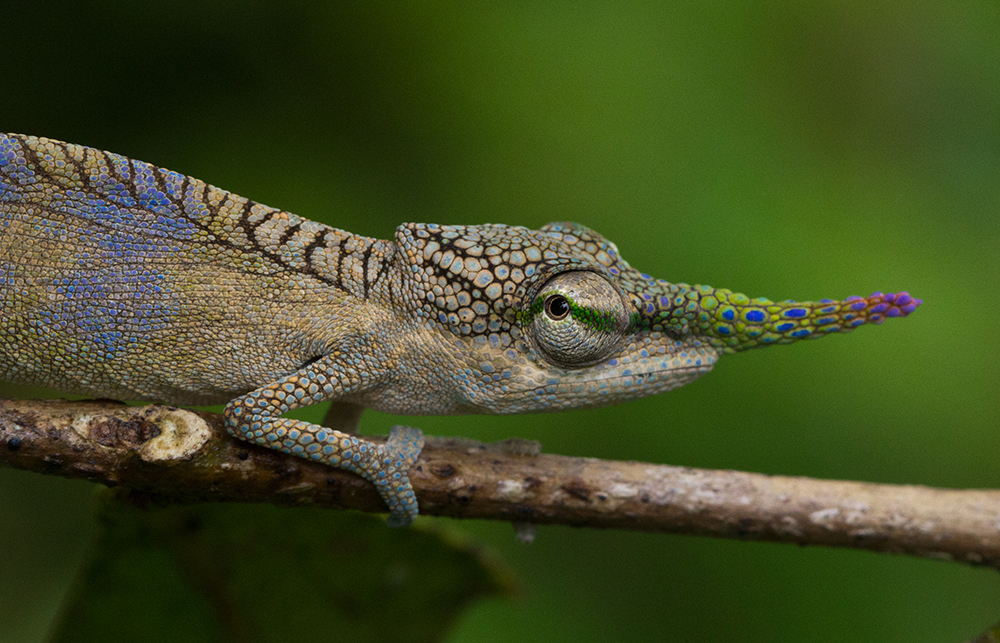
Foto: Calumma pinocchio im Reservat von Vohimana, fotografiert von Alex Negro[:en]

A study on the distribution and habitats of various chameleon species was recently carried out in Vohimana, Madagascar. The Vohimana Reserve is situated at an altitude of between 800 and 1,000 metres in the island’s eastern highlands. It covers an area of 15 km², comprising 6 km² of primary rainforest, 8.5 km² of secondary vegetation and just over 1 km² of eucalyptus forest. The rainy season runs from October to May and is characterised primarily by increased rainfall, although the dry season also sees a relatively high amount of rainfall.

Over a total of 195 days – 158 of which were during the rainy season and 37 during the dry season – chameleons were searched for with the naked eye within the reserve along the existing paths. In the process, various individuals covered a total distance of 350 km. 80% of the data collection took place at night, with only 20% during the day. Every chameleon found was photographed, and the temperature, relative humidity and UV index were measured at the site of discovery. The data was then statistically analysed.

A total of 577 chameleons were recorded during the entire study period. These included a single Calumma brevicorne, seven Furcifer willsii, two Brookesia ramanantsoai, seven Brookesia thieli, 143 Brookesia superciliaris and Brookesia therezieni (grouped together), 53 Calumma furcifer, 207 small Calumma of nasutum-complex (grouped together due to difficulties in identifying them solely on the basis of external characteristics), 24 Calumma parsonii, 118 Calumma pinocchio, 11 Furcifer bifidus and 4 Furcifer pardalis.

The most common species in Vohimana were Brookesia superciliaris and Brookesia therezieni, small chameleons of the Calumma nasutum complex, and Calumma pinocchio. Brookesia superciliaris, Brookesia therezieni and Calumma furcifer were rarely found outside the primary forest. Calumma pinocchio was most commonly found in a small remnant of primary forest in the north-east of the reserve. The scientists repeatedly found all other species in both primary forest and secondary vegetation. Calumma parsonii, Calumma pinocchio and species of the nasutum complex were frequently found along forest edges.

Temperatures at the study sites averaged 24.2°C during the wet season, compared with an average of 18.3°C during the dry season. During the wet season, more chameleons were observed during the day in locations with a higher UV index (averaging 0.5). Relative humidity in Vohimana was high throughout the year, averaging over 90% for both seasons. The differences between the various chameleon species were rather small in terms of microclimates. Individuals of Furcifer pardalis and Furcifer willsii were found at the highest recorded daytime and night-time temperatures (29°C and 27.5°C during the day, 25°C at night). These two species were also basking at the highest average UVI recorded (8.2 for Furcifer pardalis and 7.7 for Furcifer willsii). The UV indices for all other species were, on average, significantly lower.

Diversity, distribution, and microclimatic conditions experienced by the chameleons of the Vohimana Reserve, Madagascar
Olivier Marquis, Marc Gansuana, Sébastian Métrailler
Herpetological Conservation and Biology 21(1), 2026: 101-119
DOI: not available
Free article download

Photo: Calumma pinocchio in the Vohimana Reserve, photographed by Alex Negro[:]

[:de]Der Sehnerv von Chamäleons ist hoch spezialisiert[:en]The optic nerve of chameleons is highly specialised[:]

[:de]Der Sehnerv von Chamäleons ist hoch spezialisiert[:en]The optic nerve of chameleons is highly specialised[:]

Tiermedizin Wissenschaft

[:de]

Dass Chamäleons sehr spezielle Augen haben, ist schon lange bekannt. Besonders faszinierend ist, dass sie ihre Augen unabhängig voneinander in nahezu alle Richtungen bewegen können. Ein Team von US-amerikanischen Wissenschaftlern hat nun herausgefunden, dass auch der Sehnerv bei Chamäleons extrem spezialisiert ist.

Sie untersuchten adulte Schuppenkriechtiere 34 verschiedener Arten an Hand von CT-Modellen. Brookesia superciliaris, Rieppeleon brevicaudatus und Chamaeleo calyptratus repräsentierten dabei die Familie der Chamäleons. Dabei stellten sie fest, dass bei allen drei Chamäleon-Arten der Sehnerv quasi aufgerollt war. Diese anatomische Besonderheit führt dazu, dass der Nervus opticus bei Chamäleons insgesamt wesentlich länger ist, als es bei einem ruhig geradeaus schauendem Auge nötig wäre. Er ermöglicht den Tieren wahrscheinlich ihre extrem beweglichen Augen, ohne dabei Einschränkungen der Sehfähigkeit hinnehmen zu müssen. Vereinfacht erklärt funktioniert der Sehnerv also ein bisschen wie eine Flexileine: Bewegt sich das Auge stark, wird ein Teil des Sehnervs „ausgerollt“. Bewegt das Auge sich zurück, schnellt der Sehnerv zurück an seine ursprüngliche Position, ohne dass die Nervenfasern dabei überdehnt wurden.

A new twist in the evolution of chameleons uncovers an extremely specialized optic nerve morphology
Emily Collins, Aaron M. Bauer, Raul E. Diaz Junior, Alexandra Herrera-Martínez, Esteban Lavilla, Edward L. Stanley, Monte L. Thies, Juan D. Daza
Scientific Reports 15, 2025: 38270.
DOI: 10.1038/s41598-025-20357-3
Kostenloser Download des Artikels

Foto: Portrait von Brookesia superciliaris, fotografiert von Alex Negro[:en]

It has long been known that chameleons have very special eyes. What is particularly fascinating is that they can move their eyes independently of each other in almost any direction. A team of US scientists has now discovered that the optic nerve in chameleons is also extremely specialised.

They examined adult reptiles of 34 different species using CT models. Brookesia superciliaris, Rieppeleon brevicaudatus and Chamaeleo calyptratus represented the chameleon family. They found that in all three chameleon species, the optic nerve was extremely curled. This anatomical feature means that the optic nerve in chameleons is much longer than would be necessary for an eye looking straight ahead. It probably enables the animals to have extremely mobile eyes without compromising their vision. Put simply, the optic nerve functions a bit like a flexi leash: when the eye moves sharply, part of the optic nerve is ‘unrolled’. When the eye moves back, the optic nerve curls back to its original position without overstretching the nerve fibres.

A new twist in the evolution of chameleons uncovers an extremely specialized optic nerve morphology
Emily Collins, Aaron M. Bauer, Raul E. Diaz Junior, Alexandra Herrera-Martínez, Esteban Lavilla, Edward L. Stanley, Monte L. Thies, Juan D. Daza
Scientific Reports 15, 2025: 38270.
DOI: 10.1038/s41598-025-20357-3
Download the article for free

Photo: Portrait of Brookesia superciliaris, photographed by Alex Negro[:]

[:de]Einfluss von Landwirtschaft auf Chamäleons in Madagaskar[:en]Impact of agriculture on chameleons in Madagascar[:]

[:de]Einfluss von Landwirtschaft auf Chamäleons in Madagaskar[:en]Impact of agriculture on chameleons in Madagascar[:]

Wissenschaft

[:de]

In Madagaskars östlichem Hochland wird Ackerland für Reisfelder hauptsächlich durch Brandrodung von Primärwäldern oder Sekundärvegetation gewonnen. Die Reisfelder werden nur eine Saison verwendet, im anschließenden Jahr wird das Feld für Wurzelgemüse genutzt. Bereits nach einer Ernte liegt das Land dann bis zu fünf Jahre brach, bevor es erneut brandgerodet wird, um wieder Reis anzubauen. Schon fünf dieser Zyklen können fruchtbares Land in nicht mehr nutzbaren Boden wandeln. In den letzten Jahrzehnten sind brachliegende Flächen in immer kürzeren Abständen gerodet worden. Diese Praxis hat dafür gesorgt, dass invasive, nicht-einheimische Pflanzenarten sich ausbreiten konnten, während auf Primärwald angewiesene madagassische Pflanzen verschwanden. Madagassische Wissenschaftler haben nun erforscht, welchen Einfluss diese Form der Landwirtschaft auf Chamäleons an der Ostküste Madagaskars hat.

Als Studienobjekt wurde der Regenwaldkorridor von Ankeniheny-Zahamena im östlichen Hochland genutzt. Er verläuft an der Ostküste Madagaskars über eine Fläche von rund 5000 km², die teils nur durch sehr schmale Waldfragmente miteinander verbunden sind. Insgesamt während der Regenzeit 44 Orte wurden untersucht, die in fünf Habitattypen eingeteilt wurden: Zehn Orte mit geschlossenen Regenwäldern, acht mit Baumbrachen, elf mit Strauchbrachen, zehn Orte nach mindestens fünf Brandrodungszyklen und fünf Orte, an denen Wiederaufforstung betrieben wurde. Chamäleons wurden mehrheitlich nachts entlang vorgegebener Transekte (je drei bis vier parallele Linien von 50 m Länge) gesucht, bestimmt und vermessen.

Insgesamt konnten 15 Chamäleonarten der Gattungen Brookesia, Furcifer und Calumma gefunden werden, wobei je drei Arten nicht exakt bestimmt werden konnten (es handelt sich hier, soweit erkennbar, um Tiere aus dem Calumma nasutum/emelinae-Komplex). Die meisten Chamäleons bevorzugten geschlossenen Regenwald, wohingegen nach Brandrodung deutlich weniger Tiere und Arten zu finden waren. In Waldstücken mit Aufforstungsbemühungen war die Zahl der Chamäleons wieder deutlich höher. Beides unterstreicht sowohl den notwendigen Schutz noch vorhander Regenwälder als auch die Relevanz der Wiederaufforstung auf Madagaskar.

Sechs Arten (darunter Calumma cf. vencesi, Brookesia superciliaris, Brookesia therezieni, Calumma parsonii) zeigten sich deutlich sensibler gegenüber Landwirtschaft und können wahrscheinlich nur sehr eingeschränkt außerhalb von Primärwald überleben. Nur drei Arten kamen überhaupt noch auf intensiv landwirtschaftlich genutzter Fläche vor, davon war lediglich Furcifer lateralis am häufigsten dort zu finden.

Effects of shwidden agriculture on chameleon diversity and abundance in eastern tropical rainforest in Madagascar
Rodlis Raphali Andriantsimanarilafy, Joseph Christian Randrianantoandro, Josué Rakotoarioa, Alain Jean Victorien Rakotondrina, Ruth Kelly, Alison Cameron
Sustainability and biodiversity conservation 3(2): 99-118.
DOI: 10.5281/zenodo.13861065


Foto: Teppichchamäleon am Rande eines Reisfeldes in Madagaskar, fotografiert von Alex Negro[:en]

In Madagascar’s eastern highlands, farmland for rice fields is mainly obtained by slashing and burning primary forests or secondary vegetation. The rice fields are only used for one season. The following year the field is used for root vegetables. After just one harvest, the land lies fallow for up to five years before it is slash-and-burned again to grow rice again. Just five of these cycles can turn fertile land into degraded. In recent decades, fallow land has been cleared at ever shorter intervals. This practice has allowed invasive, non-native plant species to spread, while Malagasy plants that depend on primary forest have disappeared. Malagasy scientists have now investigated the impact of this form of agriculture on chameleons on the east coast of Madagascar.

The Ankeniheny-Zahamena rainforest corridor in the eastern highlands was used as the object of study. It runs along the east coast of Madagascar over an area of around 5000 km², some of which are only connected by very narrow forest fragments. A total of 44 sites were investigated during the rainy season, which were categorised into five habitat types: Ten sites with closed canopy rainforests, eight with tree fallows, eleven with shrub fallows, ten sites after at least five slash-and-burn cycles (degraded land) and five sites where reforestation was practised. The majority of chameleons were searched for, identified and measured at night along predefined transects (three to four parallel lines each 50 metres long).

A total of 15 chameleon species of the genera Brookesia, Furcifer and Calumma were found, although three species could not be precisely identified (as far as recognisable, these are animals from the Calumma nasutum/emelinae complex). Most chameleons favoured closed rainforest, whereas significantly fewer animals and species were found after slash-and-burn clearing. In forest areas with reforestation efforts, the number of chameleons was significantly higher than in degraded areas. Both emphasise the need to protect remaining rainforests as well as the relevance of reforestation in Madagascar.

Six species (including Calumma cf. vencesi, Brookesia superciliaris, Brookesia therezieni, Calumma parsonii) were clearly more sensitive to agriculture and can probably only survive to a very limited extent outside primary forest. Only three species were found on intensively farmed land, of which only Furcifer lateralis was most frequently found there.

Effects of shwidden agriculture on chameleon diversity and abundance in eastern tropical rainforest in Madagascar
Rodlis Raphali Andriantsimanarilafy, Joseph Christian Randrianantoandro, Josué Rakotoarioa, Alain Jean Victorien Rakotondrina, Ruth Kelly, Alison Cameron
Sustainability and biodiversity conservation 3(2): 99-118.
DOI: 10.5281/zenodo.13861065

Photo: Carpet chameleon at the edge of a rice field in Madagascar, photographed by Alex Negro[:]

[:de]Karyogramme fünf madagassischer Chamäleons beschrieben[:en]Karyograms of five Malagasy chameleons described[:]

[:de]Karyogramme fünf madagassischer Chamäleons beschrieben[:en]Karyograms of five Malagasy chameleons described[:]

Wissenschaft

[:de]

Dass das Geschlecht bei Chamäleons genetisch festgelegt wird, ist schon viele Jahre bekannt. Die Karyogramme vieler Arten, also die Chromsomeneigenschaften, sind jedoch noch nicht von allen Arten bekannt. Italienische Wissenschaftler haben sich nun mit den Karyogrammen fünf madagassischer Chamäleonarten beschäftigt.

Zur Untersuchung genutzt wurde bereits vorhandene, konservierte Chamäleons. Je ein Weibchen der Arten Furcifer balteatus, Furcifer petteri, Furcifer major und Furcifer minor wurden beprobt. Ein männliches und ein weibliches Brookesia superciliaris wurden ebenfalls für die Studie herangezogen. Alle Proben wurden einer DNA-Barcoding-Analyse unterzogen, als Marker genutzt wurde das mitochondriale Genfragment COI. Die extrahierte DNA wurde per PCR vervielfacht und dann sequenziert, um für jedes Tier ein Karyogramm zu erstellen.

Das Karyogramm von Brookesia superciliaris lautet 2 n = 34 für beide Geschlechter. Von den 34 Chromsomen sind sechs Makrochromosomenpaare, elf Mikrochromosomenpaare. Alle Makrochromosomen sind metazentrisch. Morphologisch unterscheiden sich die Chromosomen nicht voneinander, so dass bisher unklar bleibt, welche die Geschlechtschromosomen sein könnten.

Furcifer balteatus verfügt über ein sehr spezielles Karyogramm, was eigentlich besser zu denen der Gattungen Brookesia und Palleon als zur Gattung Furcifer passt. Das Karyogramm lautet 2n = 34, was die höchste Chromosomenzahl unter den Chamäleons darstellt. Von den 34 Chromosomen sind sechs Makrochromosomenpaare und elf Mikrochromosomenpaare. Die ersteren sind alle metazentrisch. Zwischen den Chromosomenpaare sind keine morphologischen Unterschiede zu erkennen, so dass das Geschlechtschromosom bisher nicht festgestellt werden konnte.

Das Karyogramm von Furcifer major ist 2n = 24. Neun der Chromosomenpaare sind Makrochromosomen-, drei Mikrochromosomenpaare. Sieben der Makrochromosomenpaare sind metazentrisch, nur die Paare zwei und drei sind submetazentrisch. Das elfte Chromosomenpaar, ein Mikrochromosomenpaar, codiert für das Geschlechtschromosom W.

Furcifer minor verfügt über ein Karyogramm von 2n = 22 Chromosomen. Davon sind je acht Paare Makro-, drei Mikrochromosomenpaare. Unter den Makrochromosomen sind die ersten fünf Paare metazentrisch, während die übrigen drei Paare akrozentrischsind. Ein Anteil des sechsten Chromosomenpaars war fast vollständig heterochromatisch und stellt vermutlich das Geschlechtschromosom W dar.

Das Karyogramm von Furcifer petteri ist ebenfalls 2n = 22. Acht Chromosomenpaare davon sind Makro-, drei Mikrochromosomen. Sieben Paare der Makrochromosomen sind metazentrisch, lediglich das fünfte Paar ist submetazentrisch. Das Geschlechtschromosom W ist Teil des siebten Makrochromosomenpaar.

Alle neu beschriebenen Karyogramme sind bei GenBank unter der Nummer PQ272538-4 hinterlegt. Die Gattung Furcifer zeigte sich auch in dieser Studie als die mit der höchsten Vielfalt in den Karyogrammen. Sie scheint auch die einzige Gattung unter allen Wirbeltieren zu sein, die alle Varianten der Diversifikation der Geschlechtschromosomen aufweist.

New insights on Chromosome Diversification in Malagasy Chameleons
Marcello Mezzasalma, Gaetano Odierna, Rachele Macirella, Elvira Brunelli
Animals 2024, 14: 2818
DOI: 10.3390/ani14192818

Grafik: Karyogramme von Brookesia superciliaris und Furcifer balteatus aus der genannten Studie[:en]

It has been known for many years that the sex of chameleons is genetically determined. However, the karyograms of many species, i.e. the chromosome characteristics, are not yet known for all species. Italian scientists have now analysed the karyograms of five Madagascan chameleon species.

Existing, preserved chameleons were used for the study. One female each of the species Furcifer balteatus, Furcifer petteri, Furcifer major and Furcifer minor were sampled. One male and one female Brookesia superciliaris were also used for the study. All samples were subjected to DNA barcoding analysis using the mitochondrial gene fragment COI as a marker. The extracted DNA was amplified by PCR and then sequenced to create a karyogram for each animal.

The karyogram of Brookesia superciliaris is 2 n = 34 for both sexes. Of the 34 chromosomes, six are macrochromosome pairs and eleven are microchromosome pairs. All macrochromosomes are metacentric. Morphologically, the chromosomes do not differ from each other, so that it remains unclear which could be the sex chromosomes.

Furcifer balteatus has a very special karyogram, which actually fits better with those of the genera Brookesia and Palleon than with the genus Furcifer. The karyogram is 2n = 34, which is the highest number of chromosomes among the chameleons. Of the 34 chromosomes, six are macrochromosome pairs and eleven are microchromosome pairs. The former are all metacentric. There are no morphological differences between the chromosome pairs, so that the sex chromosome has not yet been determined.

The karyogram of Furcifer major is 2n = 24. Nine of the chromosome pairs are macrochromosome pairs and three are microchromosome pairs. Seven of the macrochromosome pairs are metacentric, only pairs two and three are submetacentric. The eleventh chromosome pair, a microchromosome pair, codes for the sex chromosome W.

Furcifer minor has a karyogram of 2n = 22 chromosomes. Of these, eight pairs are macrochromosome pairs and three are microchromosome pairs. Among the macrochromosomes, the first five pairs are metacentric, while the remaining three pairs are acrocentric. A portion of the sixth pair of chromosomes was almost completely heterochromatic and probably represents the sex chromosome W.

The karyogram of Furcifer petteri is also 2n = 22, of which eight pairs of chromosomes are macrochromosomes and three microchromosomes. Seven pairs of macrochromosomes are metacentric, only the fifth pair is submetacentric. The sex chromosome W is part of the seventh pair of macrochromosomes.

All newly described karyograms are deposited in GenBank under the number PQ272538-4. In this study, the genus Furcifer was also found to have the highest diversity in the karyograms. It also appears to be the only genus among all vertebrates that shows all variants of sex chromosome diversification.

New insights on Chromosome Diversification in Malagasy Chameleons
Marcello Mezzasalma, Gaetano Odierna, Rachele Macirella, Elvira Brunelli
Animals 2024, 14: 2818
DOI: 10.3390/ani14192818

Graphic: Karyograms of Brookesia superciliaris and Furcifer balteatus from the above-mentioned study[:]

[:de]Bewegungsmuster von Brookesia superciliaris[:en]Movement pattern of Brookesia superciliaris[:]

[:de]Bewegungsmuster von Brookesia superciliaris[:en]Movement pattern of Brookesia superciliaris[:]

Wissenschaft

[:de]

Bisher wurden Bewegungsmuster bei Chamäleons vor allem an Baum bewohnenden Arten erforscht. Die vorwiegend Boden bewohnenden Gattungen wie Brookesia, Rhampholeon, Palleon und Rieppeleon, die immerhin rund ein Drittel aller aktuell bekannten Chamäleons darstellen, wurden nur selten beachtet. Eine Gruppe von US-amerikanischen Forschern hat nun das Erdchamäleon Brookesia superciliaris genauer angeschaut.

Dabei wurde die Bewegung lebender Brookesia superciliaris auf verschiedenen Untergründen vermessen und Vergleiche mit Baum bewohnenden Chamäleons und anderen anderen Echsen angestellt. Erstaunlicherweise wiesen die Erdhamäleons Bewegungsmerkmale sowohl Baum bewohnender als auch Boden bewohnender Tiere auf. Auf Ästen bewegte sich Brookesia superciliaris langsamer als auf einen Boden imitierendem Substrat. Die Ganggeschwindigkeit wurde hauptsächlich durch die Schrittfrequenz und nicht durch die Schrittlänge reguliert. Obwohl zu Beginn eines Schrittes der Oberarm stark gestreckt wird, ein typisches Merkmal einer aborealen Fortbewegung, sind Schulter- und Hüftbewegungen auf Ästen geringer als für Baumbewohner üblich. Das könnte auf eine vorwiegend terrestrische Lebensweise hindeuten. Bewegt sich Brookesia superciliaris sehr langsam, nutzt es häufig eine sehr ungewöhnliche Schrittfolge und verfällt in einen Passgang. Brookesia superciliaris könnte wegen seiner frühen evolutionären Abspaltung von der Entwicklungslinie anderer Chamäleons als Beispiel für ein Zwischenstadium zwischen Boden- und Baumbewohner gelten.

Locomotor characteristics of the ground-walking chameleon Brookesia superciliaris
Chukwuyem Ekhator, Arnavi Varshney, Melody W. Young, Daniel Tanis, Michael C. Granatosky, Raul E. Diaz, Julia L. Molnar
Journal of Experimental Zoology Part A 339 (4), 2023
DOI: 10.1002/jez.2703[:en]

Until now, movement patterns in chameleons have mainly been studied in tree-dwelling species. The predominantly ground-dwelling genera such as Brookesia, Rhampholeon, Palleon and Rieppeleon, which represent about a third of all currently known chameleons, have only rarely been considered. A group of US researchers has now taken a closer look at the terrestrial chameleon Brookesia superciliaris.

The movement of living Brookesia superciliaris on different surfaces was measured and comparisons made with tree-dwelling chameleons and other lizards. Surprisingly, the terrestrial chameleons showed movement characteristics of both tree-dwelling and ground-dwelling animals. Brookesia superciliaris moved slower on branches than on substrate imitating soil. The gait speed was mainly regulated by the step frequency and not by the step length. Although at the beginning of a step the upper arm is strongly extended, a typical feature of aboreal locomotion, shoulder and hip movements on branches are less than usual for arboreal dwellers. This could indicate a predominantly terrestrial lifestyle. When Brookesia superciliaris moves very slowly, it often uses a very unusual step sequence and lapses into a passing gait. Brookesia superciliaris could be considered an example of an intermediate stage between ground and arboreal dwellers because of its early evolutionary split from the developmental lineage of other chameleons.

Locomotor characteristics of the ground-walking chameleon Brookesia superciliaris
Chukwuyem Ekhator, Arnavi Varshney, Melody W. Young, Daniel Tanis, Michael C. Granatosky, Raul E. Diaz, Julia L. Molnar
Journal of Experimental Zoology Part A 339 (4), 2023
DOI: 10.1002/jez.2703[:]