
[:de]Chamäleons in Namoroka (Madagaskar)[:en]Chameleons in Namoroka (Madagascar)[:]

[:de]Chamäleons in Namoroka (Madagaskar)[:en]Chameleons in Namoroka (Madagascar)[:]

Verbreitung Wissenschaft

[:de]

Die Tsingy de Namoroka liegen im heißen Westen Madagaskars. Sie bestehen aus nadelspitzem Karstgestein mit Grotten darunter und umgeben von Trockenwaldfragmenten. Obwohl die Tsingy inzwischen ein Nationalpark sind, ist der Zugang mangels jeglicher Infrastruktur und Wegen bisher nur äußerst schwierig und während der Regenzeit sogar überhaupt nicht möglich.

Die Wissenschaftler führten an drei verschiedenen Orten innerhalb des Nationalparks Übersichtsstudien durch. Dazu nutzten sie jeweils drei 1000 bis 1500 m Transektlinien an jedem Ort und Grubenfallen. Zusätzlich wurden spezielle Lebensräume wie Grotten gezielt aufgesucht.

Insgesamt wurden 57 Tierarten in Namoroka nachgewiesen werden, davon 41 Reptilienarten. An allen drei untersuchten Standorten konnten Brookesia brygooi, Furcifer angeli und Furcifer oustaleti nachgewiesen werden. Das in Namoroka endemische Brookesia bonsi dagegen konnte nur an einem einzigen Standort gefunden werden. Es handelt sich dabei um ein 87 m „hoch“ gelegenes Gebiet mit Bäumen zwischen 6 und 15 m Höhe und relativ offenem Blätterdach. Das Gebiet zeichnet sich durch dichtes, nahezu undurchdringbares Unterholz vor allem in feuchten, felsigen Schluchten zwischen den Tsingy aus.

Die Wissenschaftler weisen darauf hin, dass Brandrodung und daraus resultierende, unkontrollierbare Buschfeuer nach wie vor ein großes Risiko für die Lebensräume der Tiere in Namoroka darstellt. Auch Holzschlag sowie das Ernten wilden Honigs, wilden Wurzelknollen und Heilpflanzen sorgt dafür, dass die Lebensräume des Nationalparks gestört werden. Auch Zebus werden zum Weiden in den Nationalpark getrieben. Der tatsächliche Schutz des Gebiets ist auf Grund der ablegenen Lage und der hohen Armut der Bevölkerung vor Ort sehr schwierig.

Aperçu des amphibiens et des reptiles du Parc National de Namoroka: Diversité biologique, intérêt biogéographique et représentativité en matière de conservation
Hajaniaina Rasoloarison, Bernard Ranriamahatantsoa, Nirhy Rabibisoa, Christopher J. Raxworthy
Malagasy Nature 2026, 20: 30-46.
DOI: nicht verfügbar
Kostenloser Download des Artikels

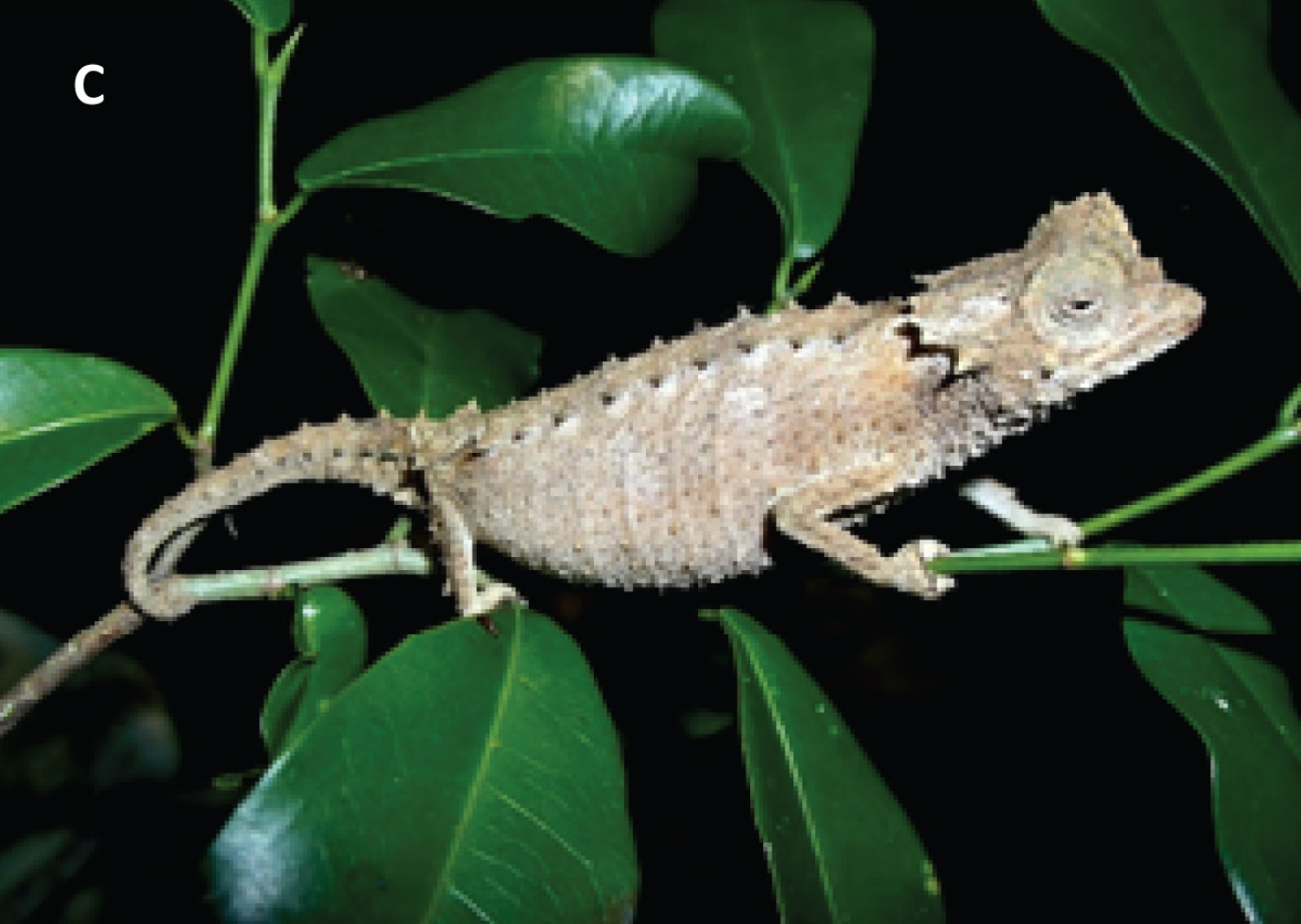
Foto: Brookesia bonsi in Namoroka, aus der genannten Publikation[:en]

The Tsingy de Namoroka are located in the hot west of Madagascar. They consist of needle-sharp karst rock with caves beneath and are surrounded by fragments of dry forest. Although the Tsingy are now a national park, access has so far been extremely difficult due to a complete lack of infrastructure and paths, and is even impossible during the rainy season.

The scientists carried out survey studies at three different locations within the national park. To do this, they used three 1,000 to 1,500 m transect lines at each site, along with pitfall traps. In addition, specific habitats such as caves were specifically targeted.

A total of 57 animal species were recorded in Namoroka, 41 of which were reptiles. Brookesia brygooi, Furcifer angeli and Furcifer oustaleti were recorded at all three sites surveyed. Brookesia bonsi, which is endemic to Namoroka, was found at only one site. This is an area situated at an altitude of 87 m, with trees ranging from 6 to 15 m in height and a relatively open canopy. The area is characterised by dense, virtually impenetrable undergrowth, particularly in the damp, rocky gorges between the Tsingy.

The scientists point out that slash-and-burn farming and the resulting uncontrollable bushfires continue to pose a major risk to the animals’ habitats in Namoroka. Logging, as well as the harvesting of wild honey, wild root tubers and medicinal plants, also ensures that the national park’s habitats are disturbed. Zebus are also driven into the national park to graze. Effective protection of the area is very difficult due to its remote location and the high levels of poverty among the local population.

Aperçu des amphibiens et des reptiles du Parc National de Namoroka: Diversité biologique, intérêt biogéographique et représentativité en matière de conservation
Hajaniaina Rasoloarison, Bernard Ranriamahatantsoa, Nirhy Rabibisoa, Christopher J. Raxworthy
Malagasy Nature 2026, 20: 30-46.
DOI: not available
Free article download

Picture: Brookesia bonsi in Namoroka, from the afore mentioned publication[:]

[:de]Unerwartete genetische Vielfalt bei Erdchamäleons im Westen Madagaskars[:en]Unexpected genetic diversity in leaf chameleons in western Madagascar[:]

[:de]Unerwartete genetische Vielfalt bei Erdchamäleons im Westen Madagaskars[:en]Unexpected genetic diversity in leaf chameleons in western Madagascar[:]

Wissenschaft

[:de]

Bisher dachte man, dass das Erdchamäleon Brookesia bonsi ausschließlich in den Tsingy von Namoroka im Westen Madagaskars vorkommt. Deutsche und madagassische Forscher haben jetzt herausgefunden, dass gut 150 km weiter nördlich unweit der Küstenstadt Mahajanga sehr nahe Verwandte der Art leben. Die Erdchamäleons aus einem Wald bei Antsanitia sehen zwar äußerlich eher Brookesia decaryi ähnlich, genetisch sind sie aber näher verwandt mit Brookesia bonsi. Dagegen scheinen die echten Brookesia decaryi aus Ankarafantsika, 80 km östlich von Mahajanga, ausschließlich auf dieses Vorkommen beschränkt und nicht weiter verbreitet zu sein, wie man ursprünglich angenommen hatte. In den gleichen Untersuchungen stellten die Wissenschaftler fest, dass eine weitere Population Erdchamäleons aus dem UNESCO Weltnanturerbe Tsingy de Bemaraha ebenfalls nahe verwandt mit Brookesia bonsi ist. Die Erdchamäleons der dort vorkommenden Population hatte man rein optisch bisher eher Brookesia brygooi zugeordnet.

Weitere Arbeiten sind nun notwendig, um die genaue genetische Identität der Brookesia aff. bonsi zu klären. Sind es eigene Arten oder lediglich lokal isolierte Populationen von Brookesia bonsi? Eins jedoch ist schon jetzt sicher: Der Lebensraum nahe Mahajanga sollte dringend unter Schutz gestellt werden. Die Erdchamäleons müssen geschützt werden, damit sie überhaupt weiter erforscht werden können. Nach der aktuellen Datenlage könnten sie bereits jetzt vom Aussterben bedroht (IUCN: critically endangered) sein. Und die weitere Forschung könnte noch sehr spannend werden!

New records of threatened leaf chameleons highlight unexpected genetic diversity of the Brookesia decaryi / B. bonsi species complex in western Madagascar
Frank Glaw, Njaratiana A. Raharinoro, Rojo N. Ravelojaona, David Prötzel und Miguel Vences
Der Zoologische Garten 90, 2022 (1)
DOI 10.53188/zg003[:en]

Until now, it was thought that the earth chameleon Brookesia bonsi occurs exclusively in the Tsingy of Namoroka in western Madagascar. German and Malagasy researchers have now discovered that very close relatives of the species live a good 150 km further north, not far from the coastal town of Mahajanga. The earth chameleons from a forest near Antsanitia look more like Brookesia decaryi on the outside, but genetically they are more closely related to Brookesia bonsi. In contrast, the true Brookesia decaryi from Ankarafantsika, 80 km east of Mahajanga, seems to be exclusively restricted to this occurrence and not more widespread, as originally assumed. In the same studies, the scientists found that another population of leaf chameleons from the UNESCO World Heritage Site Tsingy de Bemaraha is also closely related to Brookesia bonsi. The leaf chameleons of the population found there had previously been assigned to Brookesia brygooi on a purely visual basis.

Further work is now necessary to clarify the exact genetic identity of Brookesia aff. bonsi. Are they separate species or merely locally isolated populations of Brookesia bonsi? One thing, however, is already certain: the habitat near Mahajanga should urgently be placed under protection. The leaf chameleons must be protected so that they can be studied further. According to current data, they could already be critically endangered (IUCN). And further research could still be very exciting!

New records of threatened leaf chameleons highlight unexpected genetic diversity of the Brookesia decaryi / B. bonsi species complex in western Madagascar
Frank Glaw, Njaratiana A. Raharinoro, Rojo N. Ravelojaona, David Prötzel und Miguel Vences
Der Zoologische Garten 90, 2022 (1)
DOI 10.53188/zg003[:]