[:de]Lebensräume verschiedener Chamäleons in Vohimana (Madagaskar)[:en]Habitats and distribution of chameleon species in Vohimana (Madagascar)[:]

[:de]Lebensräume verschiedener Chamäleons in Vohimana (Madagaskar)[:en]Habitats and distribution of chameleon species in Vohimana (Madagascar)[:]

Verbreitung Wissenschaft

[:de]

Eine Studie zur Verbreitung und den Lebensräumen verschiedener Chamäleonarten wurde kürzlich in Vohimana in Madagaskar durchgeführt. Das Reservat Vohimana liegt zwischen 800 und 1000 m Höhe im östlichen Hochland der Insel. Es erstreckt sich über eine Fläche von 15 km², davon 6 km² Primärregenwald, 8,5 km² Sekundärvegetation und etwas über 1 km² Eukalyptusforst. Die Regenzeit reicht von Oktober bis Mai und ist vor allem von vermehrtem Regen gekennzeichnet, wobei die Trockenzeit ebenfalls über verhältnismäßig viele Niederschläge verfügt.

An insgesamt 195 Tagen, davon 158 in der Regenzeit und 37 in der Trockenzeit wurden Chamäleons innerhalb des Reservats entlang der vorhandenen Wege mit dem bloßen Auge gesucht. Dabei liefen verschiedene Personen insgesamt 350 km Strecke. 80% der Datenerhebung fand nachts statt, nur 20% tagsüber. Jedes gefundene Chamäleon wurde fotografiert sowie Temperatur, relative Luftfeuchtigkeit und UV-Index am Fundort gemessen. Die Daten wurden anschließend statistisch ausgewertet.

Während der gesamten Studienzeit konnten 577 Chamäleons dokumentiert werden. Darunter befanden sich ein einziges Calumma brevicorne, sieben Furcifer willsii, zwei Brookesia ramanantsoai, sieben Brookesia thieli, 143 Brookesia superciliaris und Brookesia therezieni (zusammengefasst zu einer Gruppe), 53 Calumma furcifer, 207 kleine Calumma des nasutum-Komplexes (auf Grund von Schwierigkeiten bei der der rein äußerlichen Artbestimmung zu einer Gruppe zusammengefasst), 24 Calumma parsonii, 118 Calumma pinocchio, 11 Furcifer bifidus und 4 Furcifer pardalis.

Am häufigsten in Vohimana waren Brookesia superciliaris und Brookesia therezieni, kleine Chamäleons des Calumma nasutum-Komplex und Calumma pinocchio. Brookesia superciliaris, Brookesia therezieni und Calumma furcifer wurden nur selten außerhalb des Primärwaldes aufgefunden. Calumma pinocchio war am häufigsten in einem kleinen Primärwaldrest im Nordosten des Reservats zu finden. Alle übrigen Arten konnten die Wissenschaftler sowohl in Primärwald als auch in Sekundärvegetation immer wieder entdecken. Calumma parsonii, Calumma pinocchio als auch Arten des nasutum-Komplexes wurden häufig im Bereich von Waldrändern gefunden.

Die Temperaturen der Fundorte lagen in der Regenzeit durchschnittlich bei 24,2°C, in der Trockenzeit dagegen bei durchschnittlich 18,3°C. Während der Regenzeit wurden tagsüber mehr Chamäleons an Orten mit höherem UV-Index gemessen (durchschnittlich 0,5). Die relative Luftfeuchtigkeit war in Vohimana das ganze Jahr über hoch mit einem Durchschnitt über 90% für beide Jahreszeiten. Die Unterschiede zwischen den verschiedenen Chamäleonarten waren eher gering, was die Mikroklimata anging. Einzelne Furcifer pardalis und Furcifer willsii wurde zu den höchsten gemessenen Tages- und Nachttemperaturen (29°C und 27,5° tagsüber, 25°C nachts) gefunden. Diese beiden Arten sonnten auch im höchsten durchschnittlich gemessenen UVI (8,2 für Furcifer pardalis und 7,7 für Furcifer willsii). Die UV-Indizes aller übrigen Arten lagen im Durchschnitt deutlich niedriger.

Diversity, distribution, and microclimatic conditions experienced by the chameleons of the Vohimana Reserve, Madagascar
Olivier Marquis, Marc Gansuana, Sébastian Métrailler
Herpetological Conservation and Biology 21(1), 2026: 101-119
DOI: nicht verfügbar
Kostenloser Download des Artikels

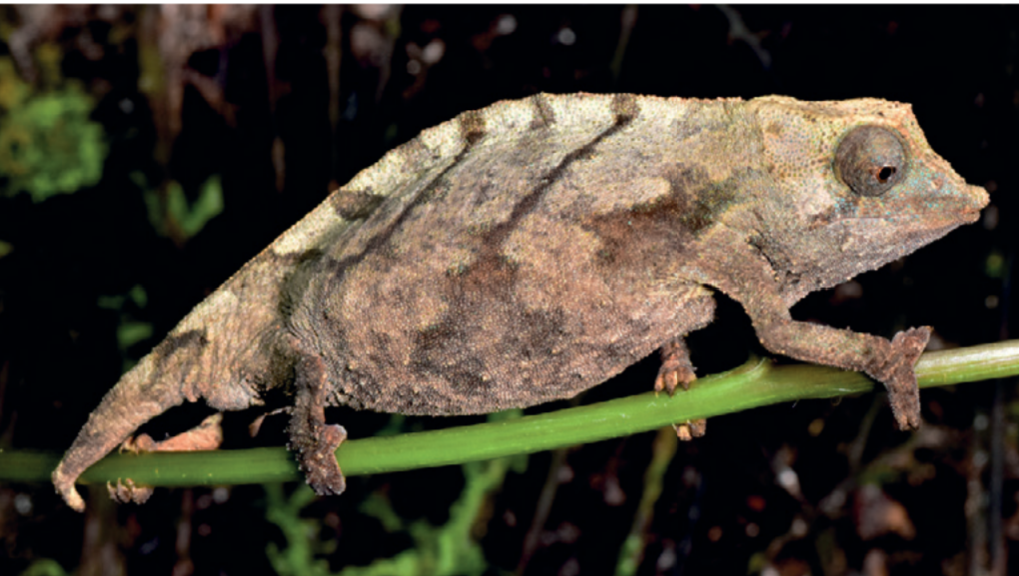
Foto: Calumma pinocchio im Reservat von Vohimana, fotografiert von Alex Negro[:en]

A study on the distribution and habitats of various chameleon species was recently carried out in Vohimana, Madagascar. The Vohimana Reserve is situated at an altitude of between 800 and 1,000 metres in the island’s eastern highlands. It covers an area of 15 km², comprising 6 km² of primary rainforest, 8.5 km² of secondary vegetation and just over 1 km² of eucalyptus forest. The rainy season runs from October to May and is characterised primarily by increased rainfall, although the dry season also sees a relatively high amount of rainfall.

Over a total of 195 days – 158 of which were during the rainy season and 37 during the dry season – chameleons were searched for with the naked eye within the reserve along the existing paths. In the process, various individuals covered a total distance of 350 km. 80% of the data collection took place at night, with only 20% during the day. Every chameleon found was photographed, and the temperature, relative humidity and UV index were measured at the site of discovery. The data was then statistically analysed.

A total of 577 chameleons were recorded during the entire study period. These included a single Calumma brevicorne, seven Furcifer willsii, two Brookesia ramanantsoai, seven Brookesia thieli, 143 Brookesia superciliaris and Brookesia therezieni (grouped together), 53 Calumma furcifer, 207 small Calumma of nasutum-complex (grouped together due to difficulties in identifying them solely on the basis of external characteristics), 24 Calumma parsonii, 118 Calumma pinocchio, 11 Furcifer bifidus and 4 Furcifer pardalis.

The most common species in Vohimana were Brookesia superciliaris and Brookesia therezieni, small chameleons of the Calumma nasutum complex, and Calumma pinocchio. Brookesia superciliaris, Brookesia therezieni and Calumma furcifer were rarely found outside the primary forest. Calumma pinocchio was most commonly found in a small remnant of primary forest in the north-east of the reserve. The scientists repeatedly found all other species in both primary forest and secondary vegetation. Calumma parsonii, Calumma pinocchio and species of the nasutum complex were frequently found along forest edges.

Temperatures at the study sites averaged 24.2°C during the wet season, compared with an average of 18.3°C during the dry season. During the wet season, more chameleons were observed during the day in locations with a higher UV index (averaging 0.5). Relative humidity in Vohimana was high throughout the year, averaging over 90% for both seasons. The differences between the various chameleon species were rather small in terms of microclimates. Individuals of Furcifer pardalis and Furcifer willsii were found at the highest recorded daytime and night-time temperatures (29°C and 27.5°C during the day, 25°C at night). These two species were also basking at the highest average UVI recorded (8.2 for Furcifer pardalis and 7.7 for Furcifer willsii). The UV indices for all other species were, on average, significantly lower.

Diversity, distribution, and microclimatic conditions experienced by the chameleons of the Vohimana Reserve, Madagascar
Olivier Marquis, Marc Gansuana, Sébastian Métrailler
Herpetological Conservation and Biology 21(1), 2026: 101-119
DOI: not available
Free article download

Photo: Calumma pinocchio in the Vohimana Reserve, photographed by Alex Negro[:]

[:de]Chamaeleo africanus in Griechenland außerhalb Pylos nachgewiesen[:en]Chamaeleo africanus found in Greece outside Pylos[:]

[:de]Chamaeleo africanus in Griechenland außerhalb Pylos nachgewiesen[:en]Chamaeleo africanus found in Greece outside Pylos[:]

Verbreitung Wissenschaft

[:de]

Dass Chamaeleo africanus in der Lagune von Gialova, Region Pylos (Griechenland) vorkommt, ist inzwischen lange bekannt. Es unterscheidet sich nicht nur optisch, sondern auch genetisch von den im südlichen Europa relativ weit verbreiteten Chamaeleo chameleon. Sporadische Berichte von weiteren Vorkommen von Chamaeleo africanus in Griechenland gibt es immer wieder, bisher fehlte jedoch ein wissenschaftlicher Nachweis der Art in anderen Gebieten als Pylos.

Wissenschaftler haben nun eine zweite Population der Art identifiziert. Sie konnten mindestens sieben Individuen der Art rund 130 km nördlich der Gialova-Laguna auf dem Peloponnes finden. Die Chamäleons leben in einem Natura 2000-Gebiet namens Limnothalassa Kalogrias /Dasos Strogylias Kai Elos Lamias. Ein Jungtier wurde per Backenabstrich beprobt, um genetisch die Art Chamaeleo africanus zu bestätigen.

Genetic evidence for the presence of Chamaeleo africanus in Greece outside the Pylos region
Erika Lego, Maria Koutsokali, Michael Valachas
Conservation Genetics Resourecs 18(5), 2026
DOI: 0.1007/s12686-026-01409-w
Kostenlose Vorschau des Artikels

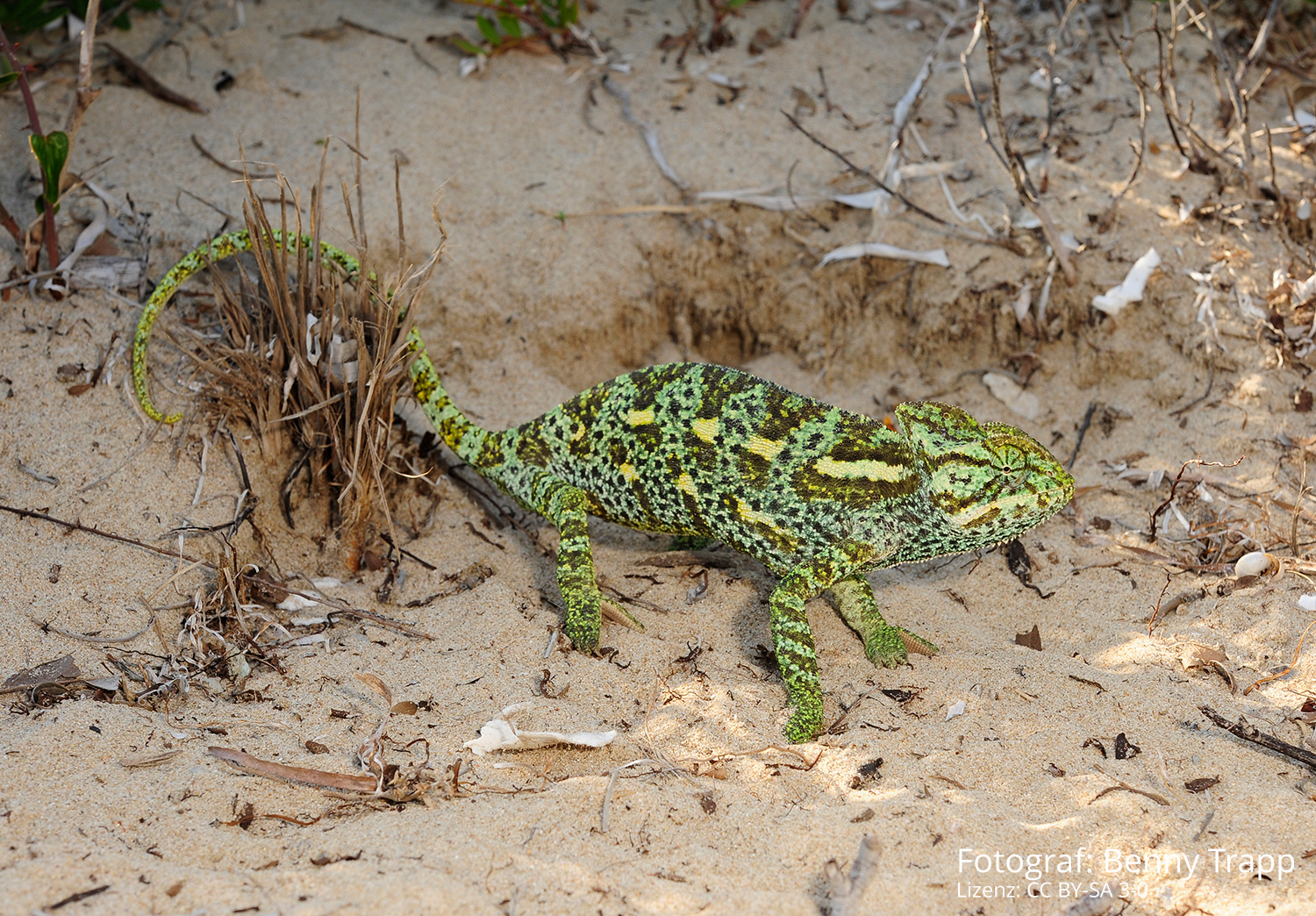
Foto: Chamaeleo africanus, fotografiert von Benny Trapp, CC BY-SA 3.0[:en]

It has long been known that Chamaeleo africanus occurs in the lagoon of Gialova, in the Pylos region (Greece). It differs not only visually but also genetically from Chamaeleo chameleon, which is relatively widespread in southern Europe. There have been sporadic reports of other occurrences of Chamaeleo africanus in Greece, but until now there has been no scientific evidence of the species in areas other than Pylos.

Scientists have now identified a second population of the species. They found at least seven individuals of the species about 130 km north of the Gialova lagoon on the Peloponnese. The chameleons live in a Natura 2000 area called Limnothalassa Kalogrias /Dasos Strogylias Kai Elos Lamias. A young animal was sampled via cheek swab to genetically confirm the species Chamaeleo africanus.

Genetic evidence for the presence of Chamaeleo africanus in Greece outside the Pylos region
Erika Lego, Maria Koutsokali, Michael Valachas
Conservation Genetics Resourecs 18(5), 2026
DOI: 0.1007/s12686-026-01409-w
Free preview of the article

Photo: Chamaeleo africanus, photographed by Benny Trapp, CC BY-SA 3.0[:]

[:de]Lappenchamäleons in Cabinda (Angola)[:en]Flap-necked chameleons in Cabinda (Angola)[:]

[:de]Lappenchamäleons in Cabinda (Angola)[:en]Flap-necked chameleons in Cabinda (Angola)[:]

Verbreitung Wissenschaft

[:de]

Die Provinz Cabinda, ein zu Angola gehörendes, 7064 km² großes Gebiet zwischen der Demokratischen Republik Kongo und der Republik Kongo, gehört zu den herpetologisch am wenigsten erforschten Gebieten Afrikas. Die Enklave liegt rund 50 km nördlich des übrigen Staatsgebietes Angola direkt an der Küste des Atlantiks. Sowohl ihr Enklavenstatus als auch die schwere Zugänglichkeit der vorhandenen Waldgebiete haben bisher dazu beigetragen, dass nur wenig Informationen über die hiesige Herpetofauna existieren. Der Nationalpark Mayombe macht rund ein Drittel des Gebiets von Cabinda aus. Mayombe teilt sich in einen höher gelegen Parkanteil mit Regenwald zwischen 500 und 900 m sowie einen niedrigen gelegenen Teil zwischen den Flüssen Inhuca und Chiloango. Daran an schließt sich eine Küstenebene mit Tälern und trockenere Vegetation direkt an der Küste.

Während zehn Expeditionen zwischen 2018 und 2024 wurden tageweise mittels Reptilien und Amphibien gesucht. Insgesamt wurden dabei 17 verschiedene Orte abgedeckt, wovon 10 innerhalb des Mayombe Nationalpark lagen. Fotos von allen Tieren wurden gemacht und Proben entnommen, um genetische Identifikationen zu ermöglichen.

Chamaeleo dilepis, das in Angola weit verbreitet ist, wurde in Mbongo Zimune im Mayombe Nationalpark in Flussnähe in einer Plantage von eingeschlepptem Bambus entdeckt. Die Bambusplantagen liegen auf rund 324 m ü.N.N. Außerdem wurde die Art in Nganzi auf 107 m in den Tälern gefunden, wo man die Art laut anderer Literatur häufiger antrifft. In den trockeneren Küstengebieten, wo Chamaeleo dilepis ebenfalls oft vorkommen soll, konnte in der vorliegenden Studie kein Chamäleon nachgewiesen werden.

Insgesamt konnten 76 verschiedene Arten nachgewiesen werden, davon 48 Amphibien- und 28 Reptilienarten. 33 in früherer Literatur erwähnte Amphibien- und Reptilienarten konnten nicht wiedergefunden werden.

Filling the gaps: herpetological checklist of Mayombe National Park and Cabinda Province (Angola) shed light on one of the most unexplored corners of tropical Central Africa
Javier Lobón-Rovira, Ninda L. Baptista, Tyron Clark, Luke Verburgt, Gregory F.M. Jongsma, Werner Conradie, Luis Verissimo, Pedro Vaz Pinto
African Journal of Herpetology 74(1): 1-59
DOI: 10.1080/21564574.2024.2421007[:en]

The province of Cabinda, a 7064 km² area belonging to Angola between the Democratic Republic of the Congo and the Republic of the Congo, is one of the least explored herpetological areas in Africa. The enclave is located around 50 kilometres north of the rest of Angola, directly on the Atlantic coast. Both its enclave status and the difficult accessibility of the existing forest areas have contributed to the fact that little information exists on the local herpetofauna. The Mayombe National Park makes up around a third of Cabinda’s territory. Mayombe is divided into a higher part of the park with rainforest between 500 and 900 metres and a lower part between the Inhuca and Chiloango rivers. This is followed by a coastal plain with valleys and drier vegetation directly on the coast.

During ten expeditions between 2018 and 2024, reptiles and amphibians were searched for on a daily basis. A total of 17 different locations were covered, 10 of which were within Mayombe National Park. Photos were taken of all animals and samples were taken to enable genetic identification.

Chamaeleo dilepis, which is widespread in Angola, was discovered in Mbongo Zimune in Mayombe National Park near the river in a plantation of introduced bamboo. The bamboo plantations are located at around 324 metres above sea level. The species was also found in Nganzi at 107 m in the valleys, where it is more common according to other literature. In the drier coastal areas, where Chamaeleo dilepis is also said to occur frequently, no chameleon could be detected in the present study.

A total of 76 different species were recorded, including 48 amphibian and 28 reptile species. 33 amphibian and reptile species mentioned in earlier literature could not be found again.

Filling the gaps: herpetological checklist of Mayombe National Park and Cabinda Province (Angola) shed light on one of the most unexplored corners of tropical Central Africa
Javier Lobón-Rovira, Ninda L. Baptista, Tyron Clark, Luke Verburgt, Gregory F.M. Jongsma, Werner Conradie, Luis Verissimo, Pedro Vaz Pinto
African Journal of Herpetology 74(1): 1-59
DOI: 10.1080/21564574.2024.2421007[:]

[:de]Chamäleons in Marsa El Brega (Libyen)[:en]Chameleons in Marsa El Brega (Lybia)[:]

[:de]Chamäleons in Marsa El Brega (Libyen)[:en]Chameleons in Marsa El Brega (Lybia)[:]

Verbreitung Wissenschaft

[:de]

Während andere Gebiete Afrikas regelmäßig Gegenstand von Publikationen und Expeditionen sind, ist die Herpetofauna Libyens nicht vollständig erforscht. Speziell über die Reptilien der Küstenregion Marsa El Brega ist kaum etwas bekannt. Marsa El Brega liegt im Norden Libyens direkt am Mittelmeer und verfügt dementsprechend über ein mediterranes Klima. Die Vegetation besteht vorwiegend aus wüstenartigen Landschaft mit niedrigen Sträuchern wie Nitraria retusa und kleinen Dattelpalm-Oasen dazwischen.

Ein ungarischer Herpetologe hat während zweier Expeditionen die Reptilienvorkommen in Marsa El Brega untersucht. Das genaue Vorgehen zum Auffinden von Tieren wird leider nicht im Artikel erwähnt. Alle aufgefundenen Tiere wurden fotografiert und Arten nach vorhandenen Field Guides phänotypisch bestimmt.

Insgesamt fand der Autor 25 Reptilienarten in der Region Marsa El Brega, darunter zwei Chamaeleo chameleon, je eines im Abstand von zwei Tagen. Die angegebenen Koordianten zum Fundort liegen im Außenbereich der Stadt Brega, direkt neben dem Garten eines Bed’n’Breakfast in Richtung Strand. Der Autor gibt vor allem streunende Hunde und Katzen als potenziell größte Gefahr für die lokale Herpetofauna an. Außerdem war der untersuchte Küstenbereich massiv vermüllt.

Some reptiles from Marsa El Brega, Libya (Reptilia: Chamaeleonidae, Gekkonidae, Phyllodactylidae, Lacertidae and Scincidae)
Attila Haris
Natura Somogyiensis 45: 17-26, 2025
DOI: 10.24394/NatSom.2025.45.17[:en]

While other areas of Africa are regularly the subject of publications and expeditions, the herpetofauna of Libya has not been fully researched. Little is known about the reptiles of the coastal region of Marsa El Brega in particular. Marsa El Brega is located in the north of Libya directly on the Mediterranean Sea and therefore has a Mediterranean climate. The vegetation consists mainly of a desert-like landscape with low shrubs such as Nitraria retusa and small date palm oases in between.

A Hungarian herpetologist has investigated the reptile populations in Marsa El Brega during two expeditions. Unfortunately, the exact procedure for finding animals is not mentioned in the article. All animals found were photographed and species phenotyped according to existing field guides.

The author found a total of 25 reptile species in the Marsa El Brega region, including two Chamaeleo chameleons, one each two days apart. The coordinates given for the find site are in the outskirts of the town of Brega, right next to the garden of a bed’n’breakfast facing the beach. The author cites stray dogs and cats as the greatest potential threat to the local herpetofauna. In addition, the coastal area investigated was heavily littered.

Some reptiles from Marsa El Brega, Libya (Reptilia: Chamaeleonidae, Gekkonidae, Phyllodactylidae, Lacertidae and Scincidae)
Attila Haris
Natura Somogyiensis 45: 17-26, 2025
DOI: 10.24394/NatSom.2025.45.17[:]

[:de]Chamaeleo gracilis in Nechisar (Äthiopien)[:en]Chamaeleo gracilis in Nechisar (Ethiopia)[:]

[:de]Chamaeleo gracilis in Nechisar (Äthiopien)[:en]Chamaeleo gracilis in Nechisar (Ethiopia)[:]

Verbreitung Wissenschaft

[:de]

Innerhalb der letzten hundert Jahre hat der Mensch den Wald Äthiopiens von etwa 40% der Fläche auf nur noch 2,36% reduziert. Trotzdem ist über die herpetologische Fauna des Landes immer noch stellenweise wenig bekannt. Wissenschaftler aus Ägypten, den USA und Äthiopien haben kürzlich eine Übersichsstudie in einem Nationalpark durchgeführt.

Der Nationalpark Nechisar liegt im Südwesten Äthiopiens auf der Linie des Großen Afrikanischen Grabenbruchs, über 500 km südlich der Hauptstadt Addis Abeba. Necisar verfügt über eine Fläche von 514 km², die im Norden und Süden von zwei Seen, im Osten vom Amaraogebirge und im Westen von der Stadt Arbaminch begrenzt wird. In Nechisar ist es das ganze Jahr über sehr heiß mit nur wenig Niederschlag.

Insgesamt zwei Expeditionen während der Regen- und zwei während der Trockenzeit wurden durchgeführt. Dabei wurden Transekte mit einer Gesamtlänge von 290 km bei neun Metern Breite abgelaufen, 230 km davon in Graslandschaft und steinigem Gelände, 60 km im Wald und entlang der Seeufer. Neben manueller Suche mit dem bloßen Auge wurden kleine Fallgruben und Abdeckbleche genutzt.

Insgesamt konnten 34 Arten von Reptilien gefunden werden, darunter auch Chamaeleo gracilis. Die Art wurde zwei Mal entdeckt. Beide Chamäleons befanden sich bei Fund in der Nähe verschiedener Flüsse, eines im Buschland und eines im Wald.

Survey of reptiles in Nechisar National Park, Southern Ethiopia
Samy A. Saber, Fikirte Gebresenbet, Afework Bekele, Eman N. Salama
Russian Journal of Herpetology 31(5): 291-301
DOI: 10.30906/1026-2296-2024-31-5-293-301[:en]

Over the last hundred years, humans have reduced Ethiopia’s forest cover from around 40% to just 2.36%. Despite this, little is still known about the country’s herpetological fauna in some places. Scientists from Egypt, the USA and Ethiopia recently carried out a survey study in a national park.

Necisar National Park is located in south-west Ethiopia on the line of the Great Rift Valley, more than 500 kilometres south of the capital Addis Ababa. Necisar covers an area of 514 square kilometres, bordered to the north and south by two lakes, to the east by the Amarao Mountains and to the west by the town of Arbaminch. Nechisar is very hot all year round with very little rainfall.

A total of two expeditions were carried out during the rainy season and two during the dry season. Transects with a total length of 290 km and a width of nine metres were covered, 230 km of which were in grassland and stony terrain, 60 km in the forest and along the lakeshore. In addition to manual searches with the naked eye, small pitfall traps and cover plates were used.

A total of 34 species of reptiles were found, including Chamaeleo gracilis. The species was discovered twice. Both chameleons were found near different rivers, one in the scrubland and one in the forest.

Survey of reptiles in Nechisar National Park, Southern Ethiopia
Samy A. Saber, Fikirte Gebresenbet, Afework Bekele, Eman N. Salama
Russian Journal of Herpetology 31(5): 291-301
DOI: 10.30906/1026-2296-2024-31-5-293-301[:]

[:de]Neuer Fundort von Kinyongia magomberae[:en]New distribution record for Kinyongia magomberae[:]

[:de]Neuer Fundort von Kinyongia magomberae[:en]New distribution record for Kinyongia magomberae[:]

Verbreitung Wissenschaft

[:de]

Wissenschaftler aus Tansania und England führten kürzlich eine Übersichsstudie zur Herpetofauna im Wald von Kimboza durch. Kimboza liegt im Osten Tansanias am Rande der Eastern Arc Mountains, einer 600 km langen Gebirgskette. Im Westen Kimbozas befinden sich die Uluguru-Berge, im Osten das Ruvu Reservat. Kimboza ist eines der kleinsten Reservate Tansanias mit einer Fläche von nur 4 km². Es reicht über Höhen von 170 bis 480 m.

Zum Nachweis von Reptilien und Amphibien wurden in zwei Nächten im Dezember und Januar sowie elf Monate am Stück zwischen Dezember und Juni zeitlich begrenzt manuell gesucht. Außerdem wurden entlang zweier Linien Eimerfallen in den Boden gesetzt, insgesamt zwischen 11 und 20 Eimer in je 5 m Entfernung zueinander. Die gefundenen Tiere wurden morphologich an Hand vorhandener Field Guides identifiziert. Von 12 Funden wurden Proben entnommen, um die Artidentifikation genetisch abzusichern.

Insgesamt konnten 42 verschiedene Reptilienarten sowie 29 Amphibienarten in Kimboza nachgewiesen werden. Unter den bekannten Chamäleons des Waldes waren wie erwartet Trioceros melleri, Rieppeleon brevicaudatus und Chamaeleo dilepis. Die Studie brachte aber auch Erstaunliches zu Tage: Kinyongia magomberae, eigentlich bekannt aus dem Wald von Magombera und aus dem Tiefland des Udzungwa Mountains Nationalpark, wurde dort gefunden. Das entspricht einer Erweiterung des Verbreitungsgebietes dieser Art von 128 km. In einer Studie von 1994 wird bereits einmal Kinyongia oxyrhina in Kimboza erwähnt. Bereits dabei könnte es sich um eine Verwechslung und eigentlich ein Kinyongia magomberae gehandelt haben. Die Art war früher möglicherweise viel weiter verbreitet als heute. Da die Tieflandregenwälder Tansanias jedoch seit vielen Jahrzehnten extensiv abgeholzt werden, hat sich der Lebensraum der Chamäleons stark verkleinert – und könnte zur Verbreitung einer Art in heute gar nicht mehr zusammenhängenden Waldgebieten geführt haben.

Kimboza, a small lowland forest with an outstanding herpetofauna diversity in east Africa
John V. Lyakurwa, Simon P. Loader, Wilirk Ngalason, Rikki Gumbs, Caleb Ofori-Boateng, H. Christoph Liedtke
Nature Notes 14(10), 2024
DOI: 10.1002/ece3.70406

Foto: Kinyongia magomberae, fotografiert von Andrew R Marshall im Wald von Mwanihana, Creative Commons Attribution 3.0 Unported[:en]

Scientists from Tanzania and England recently carried out a survey study of the herpetofauna in the Kimboza forest. Kimboza is located in eastern Tanzania on the edge of the Eastern Arc Mountains, a 600 km long mountain range. To the west of Kimboza are the Uluguru Mountains, to the east the Ruvu Reserve. Kimboza is one of the smallest reserves in Tanzania with an area of only 4 km². It ranges in altitude from 170 to 480 metres.

To detect reptiles and amphibians, manual searches were carried out on two nights in December and January and for eleven consecutive months between December and June. In addition, bucket traps were placed in the ground along two lines, a total of between 11 and 20 buckets at a distance of 5 metres from each other. The animals found were identified morphologically using existing field guides. Samples were taken from 12 finds in order to genetically confirm the species identification.

A total of 42 different reptile species and 29 amphibian species were recorded in Kimboza. As expected, Trioceros melleri, Rieppeleon brevicaudatus and Chamaeleo dilepis were among the known chameleons of the forest. However, the study also revealed something astonishing: Kinyongia magomberae, actually known from the forest of Magombera and from the lowlands of the Udzungwa Mountains National Park, was found there. This corresponds to an extension of the distribution area of this species of 128 km. In a study from 1994, Kinyongia oxyrhina is already mentioned once in Kimboza. Even then it could have been a case of confusion and actually a Kinyongia magomberae. The species may have been much more widespread in the past than it is today. However, as the lowland rainforests of Tanzania have been extensively deforested for many decades, the chameleon’s habitat has been greatly reduced – and could have led to the spread of a species in forest areas that are no longer contiguous today.

Kimboza, a small lowland forest with an outstanding herpetofauna diversity in east Africa
John V. Lyakurwa, Simon P. Loader, Wilirk Ngalason, Rikki Gumbs, Caleb Ofori-Boateng, H. Christoph Liedtke
Nature Notes 14(10), 2024
DOI: 10.1002/ece3.70406

Picture: Kinyongia magomberae, photographed by Andrew R Marshall in Mwanihana forest, Creative Commons Attribution 3.0 Unported[:]

[:de]Vorkommen des Europäischen Chamäleons in Tlemcen (Algerien)[:en]Occurrence of the European chameleon in Tlemcen (Algeria)[:]

[:de]Vorkommen des Europäischen Chamäleons in Tlemcen (Algerien)[:en]Occurrence of the European chameleon in Tlemcen (Algeria)[:]

Verbreitung Wissenschaft

[:de]

Das 21,6 km² große Tlemcen Hunting Reserve liegt im Norden Algeriens, in der gleichnamigen Provinz. Das Klima ist mediterran, die Provinz grenzt an das Alborán-Meer (den westlichsten Teil des Mittelmeers) und liegt direkt gegenüber dem Südosten Spaniens. Das Reservat liegt rund 26 km südwestlich der Stadt Tlemcen, der zweitgrößten Stadt Algeriens, und überspannt die höchsten Gebiete der Tlemcenberge.

Ein Tierarzt und eine Biologin vor Ort haben kürzlich eine Übersichtsstudie durchgeführt, welche Tiere aktuell im Reservat vorkommen. Um die Herpetofauna zu untersuchen, wurde entlang abgemessener Transekte manuell gesucht oder Fallen gestellt. Chamaeleo chamaeleon wurde mehrfach während der Studie vorgefunden.

Inventory of wildlife in the Tlemcen Hunting Reserve
Rafiq Rahmouni, Louiza Derouiche
Genetics and Biodiversity Journal 8(2), 2024
DOI: nicht vorhanden

Foto: Chamaeleo chameleon, fotografiert von Peter A. Mansfeld, Lizenz Creative Commons Attribution 3.0 Unported[:en]

The 21.6 km² Tlemcen Hunting Reserve is located in the north of Algeria, in the province of the same name. The climate is Mediterranean, the province borders the Alborán Sea (the westernmost part of the Mediterranean Sea) and lies directly opposite south-east Spain. The reserve is located around 26 kilometres southwest of the city of Tlemcen, the second largest city in Algeria, and spans the highest areas of the Tlemcen Mountains.

A local veterinarian and biologist recently carried out a survey study of the animals currently found in the reserve. In order to investigate the herpetofauna, manual searches or traps were set along measured transects. Chamaeleo chamaeleon was found several times during the study.

Inventory of wildlife in the Tlemcen Hunting Reserve
Rafiq Rahmouni, Louiza Derouiche
Genetics and Biodiversity Journal 8(2), 2024
DOI: not available

Picture: Chamaeleo chameleon, photographed by Peter A. Mansfeld, licence Creative Commons Attribution 3.0 Unported[:]

[:de]Potenzielle neue Verbreitungsgebiete des Europäischen Chamäleons[:en]Potential new distribution areas of the European chameleon[:]

[:de]Potenzielle neue Verbreitungsgebiete des Europäischen Chamäleons[:en]Potential new distribution areas of the European chameleon[:]

Verbreitung Wissenschaft

[:de]

Das europäische Chamäleon (Chamaeleo chameleon) kam historisch in einigen kleinen Gebieten des Mittelmeerraums und in Mittelasien vor. Heute jedoch ist es viel weiter verbreitet. Man geht heute davon aus, dass die Tiere durch Menschen in ihre neuen Verbreitungsgebiete gebracht wurden und sich dort auf Grund der günstigen klimatischen Verhältnisse weiter vermehren konnten. Wissenschaftler haben sich nun damit beschäftigt, wo es weitere geeignete Habitate für das europäische Chamäleon gibt und wie die vorhandenen Populationen sich in den nächsten 50 Jahren entwickeln könnten.

Untersucht wurden die drei Unterarten Chamaeleo chamaeleon chamaeleon, Chamaeleo chamaeleon musae und Chamaeleo chamaeleon reticrista. Erstere ist bisher vom südlichen Rand Portguals und Spaniens sowie aus Süditalien, Algerien, Ägypten, Libyen, Malta, Marokko, Tunesien, der westlichen Sahara und aus dem Jemen bekannt. Zweitere Unterart kommt aktuell im Jordan, Israel und Ägypten vor. Die dritte Unterart kommt zwischen Griechenland und der Türkei vor, auf Zypern, in Israel, im Libanon und Syrien, ist aber eigentlich beheimatet im Norden Afrikas und im Mittleren Osten. Sie wurde wohl von Menschen im Süden Spaniens und Portguals eingeführt, wird dort heute aber als native species angesehen.

Zur Studie wurden die bisher vorhandene Literatur durchforstet, Beprobungen durch den Autor selbst, OpenStreetMaps und Informationen der Global Biodiversity Information Facility (GBIF) herangezogen und statistisch aufbereitet sowie ausgewertet. Klima, Topographie, Habitat der Fundorte und Verbindungen der bestehenden Poplationen wurden für Vorhersagen zu potenziell geeigneten neuen Lebensräumen genutzt.

Insgesamt flossen 553 Funde von Chamaeleo chamaeleon in die Studie ein. 22% der Funde konnten Stadtgebieten zugeordnet werden, 21% Buschland und 18% fielen auf landwirtschaftlich genutzten Grund. Die meisten Funde wurden auf Höhen von 0 bis 100 m üNN gemacht. Nicht verwunderlich war, dass die aktuell von Chamaeleo chamaeleon besiedelten Gebiete sich als sehr geeignetes Habitat erwiesen. Potenzielle gut geeignete, neue Verbreitungsgebiete in der Zukunft könnten die Iberische Insel zwischen Murcia und der Algarve in Portugal sein, Sizilien, Kalabrien, Apulien und Sardinien in Italien, Marokko, Tunesien, Libyen, die Region zwischen Israel und dem Libanon im Mittleren Osten, Zypern sowie alle Küsten und Inseln des Ägäischen Meeres sein. Insgesamt wird für die nächsten 50 Jahre eine progressive Zunahme an allen schon vorhandenen Habitaten des europäischen Chamäleons vermutet. Davon ausgenommen sind wahrscheinlich lediglich einige Regionen in Tunesien sowie der Türkei. Weitere Habitatsverluste werden an der Ägäischen Küste in der Türkei und Israel angenommen. In Spanien und Portgual könnte das Verbreitungsgebiet sich nach Westen verschieben.

Habitat suitability and connectivity modelling predict a latitudinal-driven expansion in the Mediterranean basin for a historically introduced reptile
Davide Serva, Viviana Cittadino, Ilaria Bernabò, Maurizio Biondi, Mattia Iannella
European Journal of Wildlife Resarch 70 (27), 2024
DOI: 10.1007/s10344-024-01780-9

Die beiden Grafiken stammen beide aus der genannten Veröffentlichung.[:en]

The European chameleon (Chamaeleo chameleon) was historically found in some small areas of the Mediterranean and Central Asia. Today, however, it is much more widespread. It is now assumed that the animals were brought to their new distribution areas by humans and were able to reproduce there due to the favourable climatic conditions. Scientists have now investigated where there are further suitable habitats for the European chameleon and how the existing populations could develop over the next 50 years.

The three subspecies studied were Chamaeleo chamaeleon chamaeleon, Chamaeleo chamaeleon musae and Chamaeleo chamaeleon reticrista. The former is known from the southern edge of Portgual and Spain as well as from southern Italy, Algeria, Egypt, Libya, Malta, Morocco, Tunisia, the western Sahara and Yemen. The second subspecies is currently found in Jordan, Israel and Egypt. The third subspecies occurs between Greece and Turkey, in Cyprus, Israel, Lebanon and Syria, but is actually native to northern Africa and the Middle East. It was probably introduced by people in southern Spain and Portgual, but is now considered a native species there.

For the study, the existing literature, sampling by the author himself, OpenStreetMaps and information from the Global Biodiversity Information Facility (GBIF) were used, statistically processed and analysed. Climate, topography, habitat of the sites and connections of existing populations were used to predict potentially suitable new habitats.

A total of 553 Chamaeleo chamaeleon findings were included in the study. 22% of the finds could be assigned to urban areas, 21% to scrubland and 18% to agricultural land. Most of the finds were made at altitudes of 0 to 100 metres above sea level. Not surprisingly, the areas currently colonised by Chamaeleo chamaeleon proved to be very suitable habitat. Potential well-suited new distribution areas in the future could be the Iberian Islands between Murcia and the Algarve in Portugal, Sicily, Calabria, Apulia and Sardinia in Italy, Morocco, Tunisia, Libya, the region between Israel and Lebanon in the Middle East, Cyprus and all coasts and islands of the Aegean Sea. Overall, a progressive increase in all existing habitats of the European chameleon is expected over the next 50 years. The only exceptions to this are probably some regions in Tunisia and Turkey. Further habitat losses are assumed on the Aegean coast in Turkey and Israel. In Spain and Portgual, the distribution area could shift westwards.

Habitat suitability and connectivity modelling predict a latitudinal-driven expansion in the Mediterranean basin for a historically introduced reptile
Davide Serva, Viviana Cittadino, Ilaria Bernabò, Maurizio Biondi, Mattia Iannella
European Journal of Wildlife Resarch 70 (27), 2024
DOI: 10.1007/s10344-024-01780-9

The two graphics are both from the publication mentioned.[:]
[:de]Neue Hoffnung für das Tarzan-Chamäleon[:en]New hope for Calumma tarzan[:]

[:de]Neue Hoffnung für das Tarzan-Chamäleon[:en]New hope for Calumma tarzan[:]

Verbreitung Wissenschaft

[:de]

Calumma tarzan, das Tarzan-Chamäleon, wurde erst 2010 beschrieben. Es wurde damals benannt nach seinem Fundort Tarzanville, einem kleinen Dorf in der Region Anosibe An’Ala im zentralen Osten Madagaskars. Auf Grund des bis dahin angenommenen sehr kleinem Verbreitungsgebiet wurde die Art auf der roten Liste der IUCN direkt als „vom Aussterben bedroht“ (critically endangered) eingestuft.

In den Jahren 2020 und 2021 haben madagassische Wissenschaftler an vielen weiteren Orten im Osten Madagaskars nach der Art gesucht – und sind prompt fündig geworden, wie eine aktuelle Publikation berichtet. Dazu suchten sie 46 Transekte von je einem Kilometer Länge in 23 verschiedenen Waldfragmenten ab. Weitere 28 Transekte von je 200 Meter Länge wurden untersucht, um die Populationsdichte einschätzen zu können.

Calumma tarzan konnte in 14 von 23 untersuchten Waldfragmenten gefunden werden. Keines dieser Vorkommen davon war zuvor bekannt. Die Art kam auf Höhen von 604 bis 1048 m vor. Die Populationsdichtenschätzung fiel sehr unterschiedlich aus. In einigen Gebieten leben nur 25 Chamäleons pro Hektar, in anderen mehr als dreimal so viele, nämlich 78.

Aktuell sind nur wenige der Waldfragmente geschützt. Die vorliegende Arbeit unterstreicht daher, wie dringend es ist, weitere Schutzgebiete in den östlichen Regenwäldern Madagaskars zu errichten. Nur so kann das Tarzan-Chamäleon noch gerettet werden.

New distribution records and population density of the critically endangered Tarzan chameleon (Calumma tarzan), eastern Madagascar
Alain J.V. Rakotondrina, Raphali R. Andriantsimanarilafy, Hanta J. Razafimanahaka, Achille P. Raselimanana, Rikki Gumbs, Caleb Ofori-Boateng, Jody M. Taft, Fanomezana M. Ratsoavina
African Journal of Herpetology, 2024
DOI: 10.1080/21564574.2023.2291358[:en]

Calumma tarzan, the Tarzan chameleon, was only described in 2010. It was named after the place where it was found, Tarzanville, a small village in the Anosibe An’Ala region in the centre-east of Madagascar. Due to the previously assumed very small distribution area, the species was immediately classified as „critically endangered“ on the IUCN Red List.

In 2020 and 2021, Malagasy scientists searched for the species in many other places in eastern Madagascar – and promptly found it, as a recent publication reports. They searched 46 transects, each one kilometre long, in 23 different forest fragments. A further 28 transects, each 200 metres long, were examined in order to assess the population density. Calumma tarzan was found in 14 of the 23 forest fragments analysed. None of these occurrences were previously known. The species occurred at altitudes of 604 to 1048 metres. Population density estimates varied greatly. In some areas there are only 25 chameleons per hectare, in others more than three times as many, namely 78.

Only a few of the forest fragments are currently protected. This study therefore emphasises how urgent it is to establish further protected areas in Madagascar’s eastern rainforests. This is the only way to save the Tarzan chameleon.

New distribution records and population density of the critically endangered Tarzan chameleon (Calumma tarzan), eastern Madagascar
Alain J.V. Rakotondrina, Raphali R. Andriantsimanarilafy, Hanta J. Razafimanahaka, Achille P. Raselimanana, Rikki Gumbs, Caleb Ofori-Boateng, Jody M. Taft, Fanomezana M. Ratsoavina
African Journal of Herpetology, 2024
DOI: 10.1080/21564574.2023.2291358[:]

[:de]Chamäleons in Bobaomby (Madagaskar)[:en]Chameleons in Bobaomby (Madagascar)[:]

[:de]Chamäleons in Bobaomby (Madagaskar)[:en]Chameleons in Bobaomby (Madagascar)[:]

Verbreitung Wissenschaft

[:de]

Der Bobaomby-Komplex liegt am nördlichsten Zipfel Madagaskars, nördlich und westlich der größten Küstenstadt des Nordens, Antsiranana (französisch Diego Suarez). Er besteht aus Trockenwald auf Meeresniveau bis maximal 200 m üNN sowie ausgedehnten Savannen auf Karstgestein und verschiedenen Felsformationen. Bisher unterliegt die Gegend keinerlei Schutz.

Wissenschaftler aus Madagaskar führten 2018 Zählungen von Reptilien im Bobaomby Komplex durch. Gezählt wurde im Februar und März, also während der Regenzeit. Fünf verschiedene Orte wurden untersucht: Beantely, Antsisikala und Ambanililabe als Beispiele unterschiedlich stark zerstörten Trockenwalds, Anjiabe wegen seines intakten Trockenwalds und Ampombofofo mit relativ intaktem Wald. Um Tiere zu finden, wurde an 25 Tagen zum einen mit dem bloßen Auge tagsüber und nachts in ausgewählten Transekten gesucht, teils gezielt in geeignet erscheinenden Habitaten wie Blattachseln oder unter toten Baumstämmen, zum anderen wurden Fallgruben entlang aufgestellter Zäune genutzt.

Insgesamt wurden 42 Reptilienarten nachgewiesen. Alle davon, ausgenommen eine Gecko-Art, kommen ursprünglich nur auf Madagaskar vor, zwei weitere Gecko-Arten findet man inzwischen auch auf benachbarten Inseln. Bei den Chamäleons gibt es eine kleine Neuerung: Erstmals konnte das Erdchamäleon Brookesia ebenaui in Bobaomby, genauer in Beantely, nachgewiesen werden. Brookesia stumpffi und Furcifer petteri wurde in Beantely, Anjiabe und Ampombofofo gefunden. Furcifer pardalis und Furcifer oustaleti kamen wie erwartet im gesamten Bobaomby-Komplex vor.

Die Autoren schlagen vor, den Bobaomby-Komplex – insbesondere aber die drei Wälder, in denen die meisten Reptilien gefunden wurden, unter Schutz zu stellen, um die dortige Herpetofauna zu erhalten.

Overview of reptile diversity from Bobaomby complex, northern tip of Madagascar
Randriamialisoa, Raphali R. Andriantsimanarilafy, Alain J. Rakotondrina, Josué A. Rakotoarisoa, Nasaina T. Ranaivoson, Jeanneney Rabearivony, Achille P. Raselimanana
Animals 13: 3396, 2023
DOI:  10.3390/ani13213396

Foto: Furcifer petteri, männlich, im Norden Madagaskars, fotografiert von Alex Laube[:en]

The Bobaomby complex is located at the northernmost tip of Madagascar, north and west of the largest coastal town in the north, Antsiranana (Diego Suarez in French). It consists of dry forest at sea level up to a maximum of 200 metres above sea level as well as extensive savannahs on karst rock and various rock formations. The area has not been protected to date.

Scientists from Madagascar conducted reptile counts in the Bobaomby complex in 2018. The counts were carried out in February and March, i.e. during the rainy season. Five different locations were analysed: Beantely, Antsisikala and Ambanililabe as examples of varying degrees of degraded dry forest, Anjiabe for its intact dry forest and Ampombofofo with relatively intact forest. To find animals, the visual survey was used on 25 days during the day and at night in selected transects, sometimes specifically in suitable habitats such as leaf axils or under dead tree trunks, and pitfall traps along erected fences were also used.

A total of 42 reptile species have been recorded. All of them, except one gecko species, originally only occur on Madagascar, while two other gecko species are now also found on neighbouring islands. There is a small novelty among the chameleons: the leaf chameleon Brookesia ebenaui was recorded for the first time in Bobaomby, more precisely in Beantely. Brookesia stumpffi and Furcifer petteri were found in Beantely, Anjiabe and Ampombofofo. Furcifer pardalis and Furcifer oustaleti occurred as expected throughout the whole Bobaomby complex.

The authors suggest that the Bobaomby complex – especially the three forests where most of the reptiles were found – should be protected to preserve the local herpetofauna.

Overview of reptile diversity from Bobaomby complex, northern tip of Madagascar
Randriamialisoa, Raphali R. Andriantsimanarilafy, Alain J. Rakotondrina, Josué A. Rakotoarisoa, Nasaina T. Ranaivoson, Jeanneney Rabearivony, Achille P. Raselimanana
Animals 13: 3396, 2023
DOI:  10.3390/ani13213396

Photo: Furcifer petteri, male, in the north of Madagascar, photographed by Alex Laube[:]