
[:de]Lebensräume verschiedener Chamäleons in Vohimana (Madagaskar)[:en]Habitats and distribution of chameleon species in Vohimana (Madagascar)[:]

[:de]Lebensräume verschiedener Chamäleons in Vohimana (Madagaskar)[:en]Habitats and distribution of chameleon species in Vohimana (Madagascar)[:]

Verbreitung Wissenschaft

[:de]

Eine Studie zur Verbreitung und den Lebensräumen verschiedener Chamäleonarten wurde kürzlich in Vohimana in Madagaskar durchgeführt. Das Reservat Vohimana liegt zwischen 800 und 1000 m Höhe im östlichen Hochland der Insel. Es erstreckt sich über eine Fläche von 15 km², davon 6 km² Primärregenwald, 8,5 km² Sekundärvegetation und etwas über 1 km² Eukalyptusforst. Die Regenzeit reicht von Oktober bis Mai und ist vor allem von vermehrtem Regen gekennzeichnet, wobei die Trockenzeit ebenfalls über verhältnismäßig viele Niederschläge verfügt.

An insgesamt 195 Tagen, davon 158 in der Regenzeit und 37 in der Trockenzeit wurden Chamäleons innerhalb des Reservats entlang der vorhandenen Wege mit dem bloßen Auge gesucht. Dabei liefen verschiedene Personen insgesamt 350 km Strecke. 80% der Datenerhebung fand nachts statt, nur 20% tagsüber. Jedes gefundene Chamäleon wurde fotografiert sowie Temperatur, relative Luftfeuchtigkeit und UV-Index am Fundort gemessen. Die Daten wurden anschließend statistisch ausgewertet.

Während der gesamten Studienzeit konnten 577 Chamäleons dokumentiert werden. Darunter befanden sich ein einziges Calumma brevicorne, sieben Furcifer willsii, zwei Brookesia ramanantsoai, sieben Brookesia thieli, 143 Brookesia superciliaris und Brookesia therezieni (zusammengefasst zu einer Gruppe), 53 Calumma furcifer, 207 kleine Calumma des nasutum-Komplexes (auf Grund von Schwierigkeiten bei der der rein äußerlichen Artbestimmung zu einer Gruppe zusammengefasst), 24 Calumma parsonii, 118 Calumma pinocchio, 11 Furcifer bifidus und 4 Furcifer pardalis.

Am häufigsten in Vohimana waren Brookesia superciliaris und Brookesia therezieni, kleine Chamäleons des Calumma nasutum-Komplex und Calumma pinocchio. Brookesia superciliaris, Brookesia therezieni und Calumma furcifer wurden nur selten außerhalb des Primärwaldes aufgefunden. Calumma pinocchio war am häufigsten in einem kleinen Primärwaldrest im Nordosten des Reservats zu finden. Alle übrigen Arten konnten die Wissenschaftler sowohl in Primärwald als auch in Sekundärvegetation immer wieder entdecken. Calumma parsonii, Calumma pinocchio als auch Arten des nasutum-Komplexes wurden häufig im Bereich von Waldrändern gefunden.

Die Temperaturen der Fundorte lagen in der Regenzeit durchschnittlich bei 24,2°C, in der Trockenzeit dagegen bei durchschnittlich 18,3°C. Während der Regenzeit wurden tagsüber mehr Chamäleons an Orten mit höherem UV-Index gemessen (durchschnittlich 0,5). Die relative Luftfeuchtigkeit war in Vohimana das ganze Jahr über hoch mit einem Durchschnitt über 90% für beide Jahreszeiten. Die Unterschiede zwischen den verschiedenen Chamäleonarten waren eher gering, was die Mikroklimata anging. Einzelne Furcifer pardalis und Furcifer willsii wurde zu den höchsten gemessenen Tages- und Nachttemperaturen (29°C und 27,5° tagsüber, 25°C nachts) gefunden. Diese beiden Arten sonnten auch im höchsten durchschnittlich gemessenen UVI (8,2 für Furcifer pardalis und 7,7 für Furcifer willsii). Die UV-Indizes aller übrigen Arten lagen im Durchschnitt deutlich niedriger.

Diversity, distribution, and microclimatic conditions experienced by the chameleons of the Vohimana Reserve, Madagascar
Olivier Marquis, Marc Gansuana, Sébastian Métrailler
Herpetological Conservation and Biology 21(1), 2026: 101-119
DOI: nicht verfügbar
Kostenloser Download des Artikels

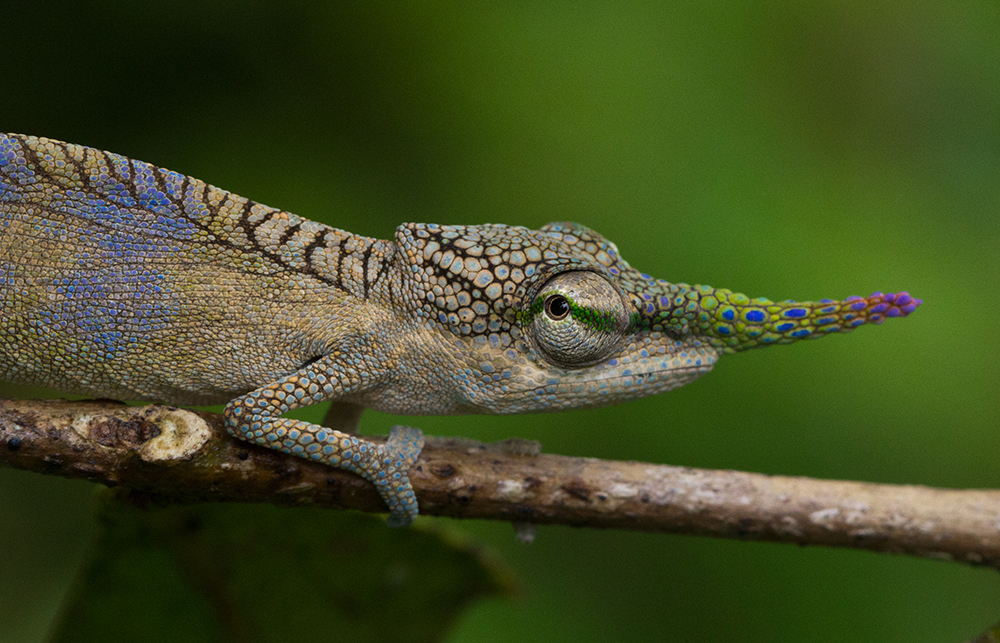
Foto: Calumma pinocchio im Reservat von Vohimana, fotografiert von Alex Negro[:en]

A study on the distribution and habitats of various chameleon species was recently carried out in Vohimana, Madagascar. The Vohimana Reserve is situated at an altitude of between 800 and 1,000 metres in the island’s eastern highlands. It covers an area of 15 km², comprising 6 km² of primary rainforest, 8.5 km² of secondary vegetation and just over 1 km² of eucalyptus forest. The rainy season runs from October to May and is characterised primarily by increased rainfall, although the dry season also sees a relatively high amount of rainfall.

Over a total of 195 days – 158 of which were during the rainy season and 37 during the dry season – chameleons were searched for with the naked eye within the reserve along the existing paths. In the process, various individuals covered a total distance of 350 km. 80% of the data collection took place at night, with only 20% during the day. Every chameleon found was photographed, and the temperature, relative humidity and UV index were measured at the site of discovery. The data was then statistically analysed.

A total of 577 chameleons were recorded during the entire study period. These included a single Calumma brevicorne, seven Furcifer willsii, two Brookesia ramanantsoai, seven Brookesia thieli, 143 Brookesia superciliaris and Brookesia therezieni (grouped together), 53 Calumma furcifer, 207 small Calumma of nasutum-complex (grouped together due to difficulties in identifying them solely on the basis of external characteristics), 24 Calumma parsonii, 118 Calumma pinocchio, 11 Furcifer bifidus and 4 Furcifer pardalis.

The most common species in Vohimana were Brookesia superciliaris and Brookesia therezieni, small chameleons of the Calumma nasutum complex, and Calumma pinocchio. Brookesia superciliaris, Brookesia therezieni and Calumma furcifer were rarely found outside the primary forest. Calumma pinocchio was most commonly found in a small remnant of primary forest in the north-east of the reserve. The scientists repeatedly found all other species in both primary forest and secondary vegetation. Calumma parsonii, Calumma pinocchio and species of the nasutum complex were frequently found along forest edges.

Temperatures at the study sites averaged 24.2°C during the wet season, compared with an average of 18.3°C during the dry season. During the wet season, more chameleons were observed during the day in locations with a higher UV index (averaging 0.5). Relative humidity in Vohimana was high throughout the year, averaging over 90% for both seasons. The differences between the various chameleon species were rather small in terms of microclimates. Individuals of Furcifer pardalis and Furcifer willsii were found at the highest recorded daytime and night-time temperatures (29°C and 27.5°C during the day, 25°C at night). These two species were also basking at the highest average UVI recorded (8.2 for Furcifer pardalis and 7.7 for Furcifer willsii). The UV indices for all other species were, on average, significantly lower.

Diversity, distribution, and microclimatic conditions experienced by the chameleons of the Vohimana Reserve, Madagascar
Olivier Marquis, Marc Gansuana, Sébastian Métrailler
Herpetological Conservation and Biology 21(1), 2026: 101-119
DOI: not available
Free article download

Photo: Calumma pinocchio in the Vohimana Reserve, photographed by Alex Negro[:]

[:de]Woran sterben Chamäleons in Zoos?[:en]What kills chameleons in zoos?[:]

[:de]Woran sterben Chamäleons in Zoos?[:en]What kills chameleons in zoos?[:]

Tiermedizin Wissenschaft

[:de]

Wissenschaftler der Veterinärmedizinischen Universität Montréal (Frankreich) haben kürzlich die Todesursachen bei in Zoos gehaltenen Chamäleons zwischen 2011 und 2022 untersucht. Über das Zoological Information Management System (ZIMS) wurden Zoos gesucht, die aktuell Chamäleons halten oder seit 2011 hielten. Fragebögen wurden an insgesamt 245 Zoos verschickt. In den Fragebögen wurde die Zahl, Art und Geschlecht gehaltener Chamäleons abgefragt, außerdem ausgesuchte Haltungsbedingungen (kühlste und wärmste Temperaturen, Luftfeuchtigkeit, Fütterung) und Sektionsergebnisse.

Rund 1000 Chamäleons 36 verschiedener Arten werden derzeit in Zoos weltweit gehalten. 65 der befragten Zoos nahmen an der Studie teil, wovon immerhin 48 regelmäßig Sektionen an Chamäleons durchführten. Jedoch konnten nur 29 der teilnehmenden Zoos Sektionsergebnisse vorlegen. Insgesamt wurden 412 Pathologiebefunde von 14 verschiedenen Chamäleonarten ausgewertet. Unter den gehaltenen Arten waren Brookesia stumpffi, Brookesia superciliaris, Chamäleons des Genus Brookesia ohne Artangabe, Calumma parsonii, Chamaeleo calyptratus, Chamaeleo chamaeleon, Furcifer lateralis, Furcifer oustaleti, Furcifer pardalis, Rieppeleon brevicaudatus, Trioceros melleri, Trioceros montium und Trioceros quadricornis. Am häufigsten wurden Pantherchamäleons gehalten (226 Tiere).

Die statistische Auswertung ergab, dass mit 46,8% die meisten Chamäleons in den teilnehmenden Zoos an infektiösen Erkrankungen starben. Zu den infektiösen Erkrankungen wurden dabei Septikämien, aber auch Entzündungen von Maulhöhle, Lunge, Leber und Nieren sowie Darm gezählt. Fast 20% der infektiösen Erkrankungen fielen auf den Bereich der Maulhöhle. Bei den Bakterien kamen Enterococcus und Pseudomonas am häufigsten vor. Bei den Pilzen waren Nannizziopsis einschließlich CANV, Fusarium und Metarhizium vertreten. Gut ein Drittel der Sektionsberichte gab zusätzlich Parasitosen an, wobei diese sowohl als Todesursache als auch als Zufallsbefund vorkamen. Kokzidien und Trematoden sowie diverse Nematoden waren hier oft vorhanden. Als zweithäufigste Todesursache in den teilnehmenden Zoos wurden mit 11,4% nichtinfektiöse Nierenerkrankungen angegeben. Nur knapp dahinter rangierten mit 10,7% der Fälle Erkrankungen des Reproduktionstraktes, darunter Legenot und Eidottercoelomitis.

Entgegen der ersten Annahme der Autoren zeigte sich kein Zusammenhang zwischen den abgefragten Haltungsparametern im Terrarium und dem Vorkommen von Nierenerkrankungen. Grundlegend gab es eine Tendenz zu vermehrten Nierenerkrankungen in Ländern, in denen die durchschnittliche Luftfeuchtigkeit generell niedriger lag.

Evaluation of mortality causes and prevalence of renal lesions in zoo-housed chameleons: 2011-2022
Amélie Aduriz, Isabelle Lanthier, Stéphane Lair, Claire Vergnau-Grosset
Journal of Zoo and Wildlife Medicine 55(2), 2024
DOI: 10.1638/2023-0023

Foto: Pantherchamäleon auf Madagaskar, fotografiert von Alex Negro[:en]

Scientists at the University of Veterinary Medicine Montréal (France) recently analysed the causes of death in chameleons kept in zoos between 2011 and 2022. The Zoological Information Management System (ZIMS) was used to search for zoos that currently keep chameleons or have kept them since 2011. Questionnaires were sent to a total of 245 zoos. The questionnaires asked about the number, species and sex of chameleons kept, as well as selected husbandry conditions (coolest and warmest temperatures, humidity, feeding) and dissection results.

Around 1000 chameleons of 36 different species are currently kept in zoos worldwide. 65 of the zoos surveyed took part in the study, 48 of which regularly carried out dissections on chameleons. However, only 29 of the participating zoos were able to provide dissection results. A total of 412 pathological findings from 14 different chameleon species were analysed. Among the species kept were Brookesia stumpffi, Brookesia superciliaris, chameleons of the genus Brookesia without species identification, Calumma parsonii, Chamaeleo calyptratus, Chamaeleo chamaeleon, Furcifer lateralis, Furcifer oustaleti, Furcifer pardalis, Rieppeleon brevicaudatus, Trioceros melleri, Trioceros montium and Trioceros quadricornis. Panther chameleons were kept most frequently (226 specimens).

The statistical analysis showed that most of the chameleons in the participating zoos died of infectious diseases (46.8%). Infectious diseases included septicaemia, but also inflammation of the oral cavity, lungs, liver, kidneys and intestines. Almost 20% of the infectious diseases were in the area of the oral cavity. The most common bacteria were Enterococcus and Pseudomonas. Among the fungi, Nannizziopsis including CANV, Fusarium and Metarhizium were represented. A good third of the necropsy reports also indicated parasitoses, with these occurring both as a cause of death and as an incidental finding. Coccidia and trematodes as well as various nematodes were often present. The second most common cause of death in the participating zoos was non-infectious kidney diseases (11.4%). This was closely followed by diseases of the reproductive tract, including egg loss and egg yolk coelomitis, which accounted for 10.7% of cases.

Contrary to the authors‘ initial assumption, there was no correlation between the surveyed husbandry parameters in the cages and the incidence of kidney disease. Basically, there was a tendency towards an increased incidence of kidney disease in countries where the average humidity was generally lower.

Evaluation of mortality causes and prevalence of renal lesions in zoo-housed chameleons: 2011-2022
Amélie Aduriz, Isabelle Lanthier, Stéphane Lair, Claire Vergnau-Grosset
Journal of Zoo and Wildlife Medicine 55(2), 2024
DOI: 10.1638/2023-0023

Photo: Panther chameleon in Madagascar, photographed by Alex Negro[:]