[:de]Frugivorie und Temperatur steuerndes Verhalten des Knysna-Zwergchamäleons[:en]Frugivory and temperature-regulated behaviour in the Knysna dwarf chameleon[:]

[:de]Frugivorie und Temperatur steuerndes Verhalten des Knysna-Zwergchamäleons[:en]Frugivory and temperature-regulated behaviour in the Knysna dwarf chameleon[:]

Beobachtungen Wissenschaft

[:de]

Südafrikanische Wissenschaftler haben sich im Zuge einer Beobachtungsstudie mit dem Verhalten des Knysna-Zwergchamäleons Bradypodion damaranum beschäftigt. Ort der Studie war ein Park in George in der Provinz Westkap. Der Park wird vorwiegend von Fußgängern, Radfahrern und Hundehaltern zur Erholung genutzt, so dass die Chamäleons dort an Menschen in gewissem Rahmen gewöhnt sind.

Sechs adulte Bradypodion damaranum wurden abends im Licht von Taschenlampen gefunden und mit Transmittern versehen. Die Transmitter wurden mit Gewebekleber an die Flanke geklebt. Tagsüber wurde dann je ein Chamäleon von einem Wissenschaftler für bis zu 4,5 h beobachtet, darunter auch unbesenderte Tiere. Anschließend wurden die besenderten Chamäleons aufgesucht und die Sender wieder entfernt.

Insgesamt konnten 30 Chamäleons beobachtet werden, davon sechs besenderte und 24 unbesenderte Tiere. Bei steigenden Temperaturen mit Spitzen zwischen 36 und 40°C um die Mittagszeit konnten insgesamt sechs Bradypodion damaranum dabei beobachtet werden, wie sie sich zügig in schattigere, niedriger gelegenere Bereiche der Vegetation verzogen. Die meisten färbten sich dabei deutlich heller als zuvor. An einem anderen Tag lagen die Temperaturen bei Sonnenaufgang erst bei 8°C. Mehrere Chamäleons wurden dabei beobachtet, wie sie sich sehr langsam zu Sonnenplätzen bewegten. Zwei wurden bei 12°C bei der Futteraufnahme beobachtet.

Zudem wurde zwei Mal verschiedene Bradypodion damaranum bei der Aufnahme reifer Beeren von Fruchtsträuchen (Halleria lucida) gesehen. Frugivorie war bisher von dieser Art nicht bekannt. Ein weiteres Chamäleon wurde dabei beobachtet, wie es die Blüte eines Blitzstrauches (Clutia pulchella) verzehrte. Insgesamt scheint dies aber selten vorzukommen, da es während 142 Stunden Beobachtungszeit nur wenige Male beobachtet werden konnte.

Natural history observation of the Knsysna Dwarf Chameleon, Bradypodion damaranum (Boulenger, 1887): thermal extremes and feeding on flora
Krystal A. Tolley, Jody M. Barends, Wade K. Stanton-Jones, Graham J. Alexander
Herpetology Notes 19, 2026: 219-228.
DOI: nicht verfügbar
Kostenloser Download des Artikels

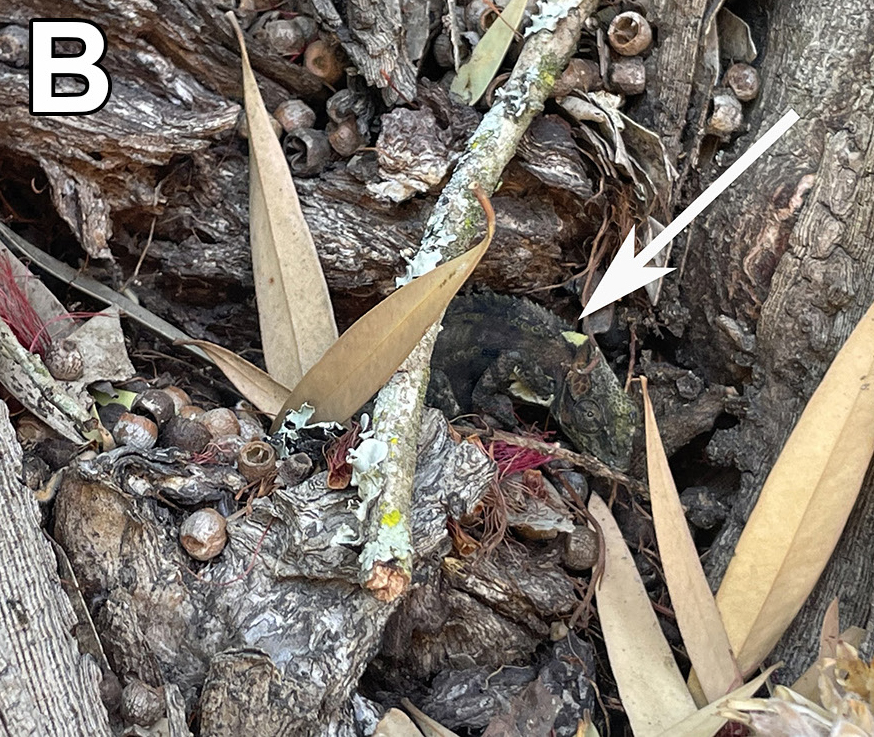
Foto: Ein Bradypodion damaranum, dass vor den steigenden Temperaturen Zuflucht am Stamm eines Karminroten Zylinderputzers (Callistemon citrinus) gesucht hat, aus der genannten Publikation


[:en]

South African scientists have conducted an observational study into the behaviour of the Knysna dwarf chameleon (Bradypodion damaranum). The study was carried out in a park in George, in the Western Cape province. The park is mainly used by walkers, cyclists and dog owners for recreational purposes, meaning that the chameleons there are, to a certain extent, accustomed to people.

Six adult Bradypodion damaranum were found in the evening by torchlight and fitted with transmitters. The transmitters were attached to their flanks using tissue adhesive. During the day, one chameleon at a time was observed by a researcher for up to 4.5 hours, including those without transmitters. The chameleons fitted with transmitters were then located and the transmitters removed.

A total of 30 chameleons were observed, six of which were tagged and 24 untagged. As temperatures rose, peaking between 36 and 40°C around midday, a total of six Bradypodion damaranum were observed quickly retreating to shadier, lower-lying areas of the vegetation. Most of them turned noticeably paler than before. On another day, temperatures at sunrise were only 8°C. Several chameleons were observed moving very slowly towards sunny spots. Two were observed feeding at 12°C.

In addition, two Bradypodion damaranum were observed feeding on ripe berries from fruit bushes (Halleria lucida). Frugivory had not previously been recorded in this species. Another chameleon was observed consuming the flower of a Clutia pulchella. Overall, however, this appears to be a rare occurrence, as it was observed only a few times during 142 hours of observation.

Natural history observation of the Knsysna Dwarf Chameleon, Bradypodion damaranum (Boulenger, 1887): thermal extremes and feeding on flora
Krystal A. Tolley, Jody M. Barends, Wade K. Stanton-Jones, Graham J. Alexander
Herpetology Notes 19, 2026: 219-228.
DOI: not available
Free article download

Photo: A Bradypodion damaranum that has sought refuge from the rising temperatures on the trunk of a carmine-red bottlebrush (Callistemon citrinus), from the publication mentioned

[:]

[:de]Artbeschreibung von Chamaeleo incognitus für ungültig erklärt[:en]Description of Chamaeleo incognitus has been declared invalid[:]

[:de]Artbeschreibung von Chamaeleo incognitus für ungültig erklärt[:en]Description of Chamaeleo incognitus has been declared invalid[:]

Neubeschreibungen Wissenschaft

[:de]

Der Chamaeleo dilepis-Komplex wirft nach wie vor sehr viele Fragen auf. Eine weite Teile Afrikas übergreifende Untersuchung der Genetik und der Morphologie steht noch aus. 2025 beschrieb Nečas im von ihm selbst veröffentlichten Magazin Archaius die Art Chamaeleo incognitus. Außerdem erhob er die Unterarten Chamaeleo dilepis roperi sowie Chamaeleo dilepis martensi in den Artstatus. Südafrikanische Forscher haben sich nun noch einmal eingehender mit dem Thema beschäftigt und festgestellt, dass sowohl die Neubeschreibung als auch die Artstatusänderungen ungültig sind.

Die Autoren des aktuellen Papers weisen auf mehrere Probleme hin, die dieser Artbeschreibung zugrunde liegen. Einmal geht Nečas davon aus, dass ein konserviertes Chamäleon aus Mombasa (Kenia) das „echte“ Chamaeleo dilepis ist. Die Typuslokalität von Chamaeleo dilepis ist jedoch Gabun, rund 3300 km von den ostafrikanischen Chamaeleo dilepis entfernt. Des Weiteren existieren vom Holotyp, also dem zuerst unter dem Namen Chamaeleo dilepis beschriebenen Tier, gar keine ausführliche Beschreibung der Hemipenes. Lediglich eine Publikation aus 2007 erwähnt die Hemipenes von Chamaeleo dilepis kurz in neun Worten. Trotzdem nutzt Nečas diese paar Worte als feststehende Beschreibung und erklärt, dass die Hemipenes von Chamaeleo incognitus davon abwichen. Was er dann sehr knapp beschreibt, entspricht jedoch den Hemipenes von Chamaeleo dilepis roperi. In den Fotos der Hemipenes von Chamaeleo incognitus erkennen die südafrikanischen Wissenschaftler – nur um die Verwirrung noch zu erhöhen – jedoch die gleichen Merkmale wie die an den Hemipenes der Chamaeleo dilepis aus Mombasa.

Dazu kommt, dass bereits eine Veröffentlichung 2022 mittels genetischer Untersuchungen feststellte, dass die Chamaeleo dilepis Ostafrikas sich deutlich von den Chamaeleo dilepis Westafrikas unterscheiden. Dabei bilden sowohl die Tiefland- als auch die Hochlandarten Ostafrikas eine zusammengehörige Clade. Rein äußerlich sind die Chamaeleo dilepis roperi aus dem Küstengebiet und die aus dem Hochland dabei nicht sicher zu unterscheiden. Würde man also eine der beiden Populationen als eigene Art – hier die im Hochand als Chamaeleo incognitus – beschreiben wollen, bräuchte es dafür genetische Beweise. Diese fehlen in der Veröffentlichung von Nečas. Es bleibt als einziger Artunterschied der unterschiedliche Lebensraum bzw. die Höhenlage – das ist für die südafrikanischen Wissenschaftler nicht ausreichend, um eine eigene Art zu beschreiben. Chamaeleo incognitus ist daher als Synonym zu Chamaeleo dilepis roperi zu sehen.

Die Beschreibung erfolgte außerdem nicht nach den Regeln des ICZN (international code of zoological nomenclature).  Gängige „best practice“-Regeln wie beispielsweise ein Hinweis auf den Interessenskonflikt wurden nicht beachtet. Dazu zählt beispielsweise, einen Artikel ohne Begutachtung durch Fachkundige (sogenanntes Peer Review) im eigenen Magazin zu veröffentlichen.

Chamaeleo incognitus or Chamaeleo ignotus? Questioning the taxonomic validity of a new chameleon species
Devon C. Main, Colin R. Tilbury
African Journal of Herpetology, April 2026
DOI: 0.1080/21564574.2025.2595158
Kostenloser Download des Artikels

Foto: Chamaeleo dilepis aus Botswana[:en]

The Chamaeleo dilepis complex continues to raise a great many questions. A comprehensive study of its genetics and morphology across large parts of Africa has yet to be carried out. In 2025, Nečas described the species Chamaeleo incognitus in the journal Archaius, which he himself edited, managed and published. He also elevated the subspecies Chamaeleo dilepis roperi and Chamaeleo dilepis martensi to species status. South African researchers have now examined the issue in greater detail and concluded that both the new description and the changes to the species’ status are invalid.

The authors of the current paper highlight several issues underlying this species description. Firstly, Nečas assumes that a preserved chameleon from Mombasa (Kenya) is the ‘true’ Chamaeleo dilepis. However, the type locality of Chamaeleo dilepis is Gabon, some 3,300 km away from the East African Chamaeleo dilepis. Furthermore, there exists no detailed description of the hemipenes from the holotype – that is, the specimen first described under the name Chamaeleo dilepis. Only a publication from 2007 mentions the hemipenes of Chamaeleo dilepis briefly, in nine words. Nevertheless, Nečas uses these few words as an established description and states that the hemipenes of Chamaeleo incognitus differed from them. What he then describes very briefly, corresponds to the hemipenes of Chamaeleo dilepis roperi. In the photographs of the hemipenes of Chamaeleo incognitus, however – just to add to the confusion – the South African scientists recognise the same characteristics as those found on the hemipenes of Chamaeleo dilepis from Mombasa.

Furthermore, a 2022 study using phylogenetic analysis stated that the Chamaeleo dilepis of East Africa differ significantly from those of West Africa. Both the lowland and highland species of East Africa form a single clade. Purely in terms of appearance, it is not possible to reliably distinguish between the Chamaeleo dilepis roperi from the coastal region and those from the highlands. If one were to describe one of the two populations as a separate species – in this case, the one in the highlands as Chamaeleo incognitus – genetic evidence would be required. This is lacking in Nečas’s publication. The only remaining difference between the species is the different habitat or altitude – which is not sufficient for the South African scientists to describe a separate species. Chamaeleo incognitus should therefore be regarded as a synonym of Chamaeleo dilepis roperi.

Furthermore, the description did not comply with the rules of the ICZN (International Code of Zoological Nomenclature). Common ‘best practice’ guidelines, such as disclosing a conflict of interest, were not followed. This includes, for example, publishing an article in one’s own journal without expert review (known as peer review).

Chamaeleo incognitus or Chamaeleo ignotus? Questioning the taxonomic validity of a new chameleon species
Devon C. Main, Colin R. Tilbury
African Journal of Herpetology, April 2026
DOI: 0.1080/21564574.2025.2595158
Free article download

Picture: Chamaeleo dilepis from Botswana[:]