[:de]Vier neue Nadzikambia-Arten in Mosambik[:en]Four new species of Nadzikambia in Mozambique[:]

[:de]Vier neue Nadzikambia-Arten in Mosambik[:en]Four new species of Nadzikambia in Mozambique[:]

Neubeschreibungen Wissenschaft

[:de]

Das South East Africa Montane Archipelago (SEAMA) erstreckt sich quer über den Norden Mosambiks und bis ins südliche Malawi hinein. Es handelt sich dabei um eine Kette rund 30 sogenannter Inselberge, die durch Täler völlig voneinander isoliert liegen. Sie sind seit Längerem bekannt als Hot Spots der Artenvielfalt. Über Jahrzehnte war es auf Grund anhaltender Unruhen schwierig, die Inselberge herpetologisch zu erkunden. Und als schließlich die Möglichkeit wieder bestand, fand man prompt neue Chamäleon-Arten – je eine auf jedem der bisher untersuchten Inselberge. Inzwischen wurden die neuen Arten genetisch und morphologisch untersucht. Vier neue Nadzikambia-Arten wurden dabei beschrieben.

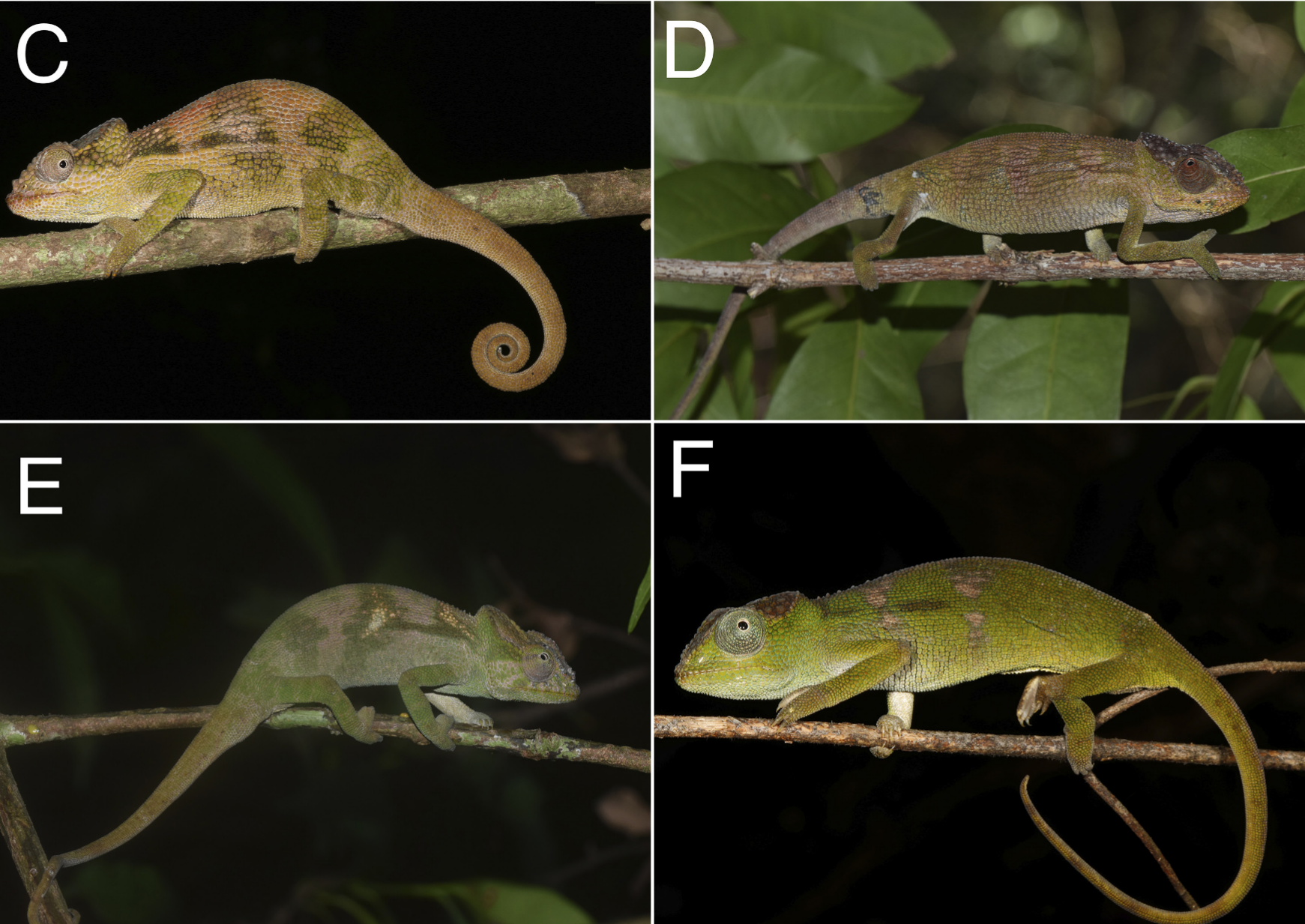
Nadzikambia franklinae erhielt seinen Namen zu Ehren der britischen Biochemikerin Rosalind Franklin. Die Art kommt in den Feuchtwäldern Mahno und Ukalini auf dem Mount Namuli in Mosambik vor. Sie wurde bisher auf Höhen zwischen 1618 und 1632 m gefunden. Die Männchen tragen einen höheren und runderen Helm mit glatteren Schuppenkämmen als andere Nadzikambia-Arten. Die drei verbliebenen Lebensräume der Art sind nur je rund 0,67 km² groß und massiv von der Gewinnung von Flächen für kleinbäuerliche Landwirtschaft, wie Mais- und Kartoffelanbau, bedroht.

Nadzikambia goodallae wurde nach der kürzlich verstorbenen Schimpansenforscherin Jane Goodall benannt. Die Art lebt im Feuchtwald am Westhang des Mount Ribáuè in Mosambik.  Sie wurde bisher auf eng begrenzten Höhen zwischen 1052 und 1142 m entdeckt. Auch diese Art wird sehr stark von Brandrodung und Abholzung ihres Lebensraumes bedroht. Nur noch 4,8 km² Waldfläche sind aktuell übrig. Die Männchen von Nadzikambia goodallae tragen einen flachen, breiten Helm mit rauen Schuppen.

Nadzikambia evanescens wurde benannt nach dem lateinischen Wort für Vergänglichkeit. Es soll auf den extremen Bedrohungsstatus der Art hinweisen. Die Chamäleonart kommt nur noch in einem einzigen Feuchtwaldfragment auf dem Mount Inago in Mosambik vor. Allein seit 2009 wurden 85% der damals vorhandenen Waldfläche gerodet. Aktuell sind gerade einmal 2,3 km² noch vorhanden. Der kleine Lebensraum liegt auf 1235 bis 1281 m. Die Männchen der Art tragen einen hohen, runden Helm mit glatten Schuppenkämmen.

Nadzikambia nubila wurde benannt nach dem lateinischen Wort für Wolken. Ihr Lebensraum, der Mount Chaperone, sorgt für mit seinen umgebenden Wolkenformationen den für das Überleben der Region notwendigen Niederschlag. Von Nadzikambia nubila sind bisher nur Weibchen bekannt, Männchen hat man noch keine gefunden. Die Chamäleons bewohnen Feuchtwald in Höhen zwischen 1017 und 1053 m, wobei sich die vorhandene Waldfläche seit 2009 vor allem durch Brandrodung und Abholzung mehr als halbiert hat. Aktuell sind gerade einmal 7 km² noch vorhanden. Zusätzlich scheinen sich die höchsten Lagen des Mount Chaperone, die weniger von menschlichem Zutun bedroht sind, von geschlossenen Waldflächen zu mehr Granitflächen zu wandeln. Die Autoren vermuten, dass dies auf den Klimawandel zurückgehen könnte.

Die bereits bekannte Art Nadzikambia mlanjensis steht leider in Sachen Bedrohung den neuen Arten in nichts nach. Und das, obwohl sie auf Höhen zwischen 600 und fast 2000 m vorkommt, womit sie deutlich variablere Lebensräume bewohnt. Die vor Jahrzehnten auf dem Mount Mlanje in Malawi geschlossene Waldfläche besteht heute nur noch aus winzigen, voneinander isolierten Waldfragmenten. Insgesamt sind vielleicht noch 12 km² übrig, der Rest wurde bereits abgeholzt. Auch vom Ruo Gorge Forest, dem ersten Fundort der Art, ist nicht mehr viel über. Ob Nadzikambia mlanjensis auch auf dem nahe gelegenen Mount Mchese vorkommt, ist noch ungeklärt.

Etwas besser scheint es noch die sechste und letzte Art der Gattung getroffen zu haben, Nadzikambia baylissi. Die Art kommt in Feuchtwäldern zwischen 1000 und 1400 m auf dem Mount Mabu in Mosambik vor. Hier ist der Wald noch weitestgehend intakt, auch wenn die Waldränder mit Brandrodung zu kämpfen haben. Ob die angenommenen 48 km² Lebensraum für diese Chamäleonart noch aktuell sind, ist jedoch nicht vollständig geklärt.

Sky islands of Mozambique harbour cryptic species of chameleons: Description of four new species of sylvan chameleons (Squamat: Chamaeleonidae: Nadzikambia Tilbury, Tolley & Branch, 2006)
Krystal A. Tolley, Werner Conradie
Vertebrate Zoology 76, 2026: 207-246
DOI: 10.3897/vz.76.e178403
Kostenloser Download des Artikels

Fotos: Von links oben nach rechts unten Nadzikambia franklinae, Nadzikambia goodallae, Nadzikambia avanescens und Nadzikambia nubila[:en]

The South East Africa Montane Archipelago (SEAMA) stretches across northern Mozambique and into southern Malawi. It consists of a chain of around 30 so-called inselbergs, which are completely isolated from one another by valleys. They have long been recognised as biodiversity hotspots. For decades, ongoing unrest made it difficult to conduct herpetological surveys of the insular mountains. And when the opportunity finally arose again, new species of chameleon were promptly discovered – one on each of the insular mountains surveyed to date. The new species have since been studied genetically and morphologically. Four new species of Nadzikambia were described in the process.

Nadzikambia franklinae was named in honour of the British biochemist Rosalind Franklin. The species is found in the Mahno and Ukalini wet forests on Mount Namuli in Mozambique. It has so far been found at altitudes between 1,618 and 1,632 metres. The males have a taller and rounder casque with smoother crests than other Nadzikambia species. The species’ three remaining habitats are each only around 0.67 km² in size and are under massive pressure from land clearance for small-scale farming, such as maize and potato cultivation.

Nadzikambia goodallae was named after the recently deceased chimpanzee researcher Jane Goodall. The species inhabits the wet forest on the western slope of Mount Ribáuè in Mozambique.  It has so far been found at very specific altitudes between 1,052 and 1,142 metres. This species, too, is under severe threat from slash-and-burn farming and deforestation of its habitat. Only 4.8 km² of forest area currently remains. The males of Nadzikambia goodallae have a flat, broad casque with rough scales.

Nadzikambia evanescens was named after the Latin word for transience. This is intended to highlight the species’ critically endangered status. This chameleon species now survives in just a single fragment of wet forest on Mount Inago in Mozambique. Since 2009 alone, 85% of the forest area that existed at that time has been cleared. Currently, just 2.3 km² remains. The small habitat lies at an altitude of 1,235 to 1,281 m. The males of the species have a tall, round casque with smooth crest scales.

Nadzikambia nubila was named after the Latin word for clouds. Its habitat, Mount Chaperone, provides the rainfall essential for the region’s survival through its surrounding cloud formations. To date, only females of Nadzikambia nubila have been recorded; no males have yet been found. The chameleons inhabit wet forest at altitudes between 1,017 and 1,053 metres, although the existing forest area has more than halved since 2009, mainly due to slash-and-burn farming and illegal logging. Currently, only 7 km² remain. Furthermore, the highest elevations of Mount Chaperone, which are less threatened by human activity, appear to be changing from dense woodland to more exposed granite outcrops. The authors suspect that this may be due to climate change.

Unfortunately, the already known species Nadzikambia mlanjensis is just as threatened as the four new species. And this is despite the fact that it occurs at altitudes ranging from 600 to almost 2,000 metres, meaning it inhabits significantly more varied habitats. The forest area that once covered Mount Mlanje in Malawi decades ago now consists only of tiny, isolated forest fragments. In total, perhaps 12 km² remain; the rest has already been cleared. Nor is much left of Ruo Gorge Forest, the site where the species was first discovered. It is not yet clear whether Nadzikambia mlanjensis also occurs on nearby Mount Mchese.

The sixth and final species of the genus, Nadzikambia baylissi, appears to have fared slightly better. The species is found in wet forests at altitudes of between 1,000 and 1,400 metres on Mount Mabu in Mozambique. Here, the forest is still largely intact, even though the forest edges are struggling with slash-and-burn farming. However, it is not entirely clear whether the estimated 48 km² of habitat for this chameleon species is still accurate.

Sky islands of Mozambique harbour cryptic species of chameleons: Description of four new species of sylvan chameleons (Squamat: Chamaeleonidae: Nadzikambia Tilbury, Tolley & Branch, 2006)
Krystal A. Tolley, Werner Conradie
Vertebrate Zoology 76, 2026: 207-246
DOI: 10.3897/vz.76.e178403
Download the article for free

Photos: From top left to bottom right Nadzikambia franklinae, Nadzikambia goodallae, Nadzikambia avanescens and Nadzikambia nubila[:]

[:de]Neue Verbreitungsdaten zu Rieppeleon brachyurus in Mosambik[:en]New distribution data of Rieppeleon brachyurus in Mozambique[:]

[:de]Neue Verbreitungsdaten zu Rieppeleon brachyurus in Mosambik[:en]New distribution data of Rieppeleon brachyurus in Mozambique[:]

Beobachtungen Verbreitung Wissenschaft

[:de]

Rieppeleon brachyurus ist eine kleine Stummelschwanzchamäleon-Art, deren Erstbeschreibung vom Ende des 19. Jahhunderts von den Shire Highlands südlich des See Malawi berichtet. Die Art wurde seitdem in Malawi, Tansania und Mosambik gefunden. In Mosambik war sie bisher von Regen- und Galeriewäldern, sogenannten Miombo-Wäldern, bekannt. Bei Miombo-Wäldern handelt es sich um sehr offenenTrockenwälder, deren Boden nur spärlich von Gras bedeckt ist und daher einen eher savannenartigen Eindruck macht (daher auch der Begriff „Waldsavanne“). Der quer durch Mosambik verlaufende Fluss Sambesi galt bisher als natürliche Grenze für das Vorkommen von Rieppeleon brachyurus.

Herpetologen haben nun festgestellt, dass die Art auch südlich des Flusses vorkommt. Sie fanden zwei juvenile Individuen und zwei adulte Weibchen der Art in Coutada 11, einer 5000 km² großen Jagdkonzession im Herzen Mosambiks. Die Tiere wurden dort in einem Sandwald, einem seltenen tropischen Waldtyp auf Sanddünen, direkt neben einem flachen Feuchtgebiet. Diese Beobachtungen erweitern das bisher bekannte Verbreitungsgebiet der Art um rund 250 km weiter nach Süden.

Die Autoren berichten außerdem von zwei weiteren, neuen Fundorten von Rieppeleon brachyurus in Taratibu und Montepuez Rubi Mining Concession, wobei diese beiden Orte nördlich des Sambesi liegen. Bei beiden Beobachtungen wurden die Erdchamäleons in Miombo-Wald auf Höhen zwischen 250 und 400 m gefunden.

Rieppeleon brachyurus (Günther, 1893) Beardless Pygmy Chameleon First records south of the Zambezi River
W. Conradie, D. Botma, C. Nanvonnamuquitxo
African Herp News 88, 2025: 28-33
DOI: nicht verfügbar
Kostenloser Download des Artikels

Foto: Juveniles Rieppeleon brachyurus in Mosambik, fotografiert von Delport Botma, aus der oben genannten Publikation[:en]

Rieppeleon brachyurus is a small stump-tailed chameleon species, first described at the end of the 19th century from the Shire Highlands south of Lake Malawi. The species has since been found in Malawi, Tanzania and Mozambique. In Mozambique, it was previously known from rainforests and gallery forests, known as miombo forests. Miombo forests are very open dry forests with sparse grass cover, giving them a savannah-like appearance (hence the term ‘forest savannah’). The Zambezi River, which runs across Mozambique, was previously considered the natural boundary for the occurrence of Rieppeleon brachyurus.

Herpetologists have now discovered that the species also occurs south of the river. They found two juvenile individuals and two adult females of the species in Coutada 11, a 5000 km² hunting concession in the heart of Mozambique. The animals were found there in a sand forest, a rare type of tropical forest on sand dunes, right next to a shallow wetland. These observations extend the previously known range of the species by about 250 km further south.

The authors also report two further new locations where Rieppeleon brachyurus has been found, in Taratibu and Montepuez Rubi Mining Concession, both of which are located north of the Zambezi River. In both observations, the ground chameleons were found in miombo forest at altitudes between 250 and 400 m.

Rieppeleon brachyurus (Günther, 1893) Beardless Pygmy Chameleon First records south of the Zambezi River
W. Conradie, D. Botma, C. Nanvonnamuquitxo
African Herp News 88, 2025: 28-33
DOI: not available
Free download of the article

Photo: Juvenile Rieppeleon brachyurus in Mozambique, photographed by Delport Botma, from the above-mentioned publication[:]

[:de]Das größte Chamäleon der Welt[:en]The largest chameleon[:]

[:de]Das größte Chamäleon der Welt[:en]The largest chameleon[:]

Internationaler Chamäleontag

[:de]

Das größte Chamäleon der Welt – naja, eigentlich streiten sich mehrere Arten um den Titel. Drei Anwärter gibt es: Das Mellers Chamäleon (Trioceros melleri) aus Festland-Afrika, das Parsons Chamäleon (Calumma parsonii parsonii) aus Madagaskar und das Madagaskar-Riesenchamäleon (Furcifer oustaleti).

Das Mellers Chamäleon kommt in den Bergen Tansanias, Nord-Mosambiks und Malawis vor. Als Hauptverbreitungsgebiet ist der Berg Zomba bekannt. Das größte bisher vermessene Chamäleons dieser Art soll 76 cm von der Nasen- bis zur Schwanzspitze gemessen und 600 g gewogen haben. Das Parsons Chamäleon dagegen kommt an verschiedenen Orten der zentralen und südlichen Ostküste Madagaskars vor. Hier soll das größte bisher gemessene Chamäleon 72 cm gehabt haben, aber beim Gewicht gibt es sogar Messungen über 700 g. Schwerer ist das Parsons Chamäleon also auf jeden Fall, die Größe kommt bei einigen Tieren gut an das Mellers Chamäleon heran. Bleibt noch das Madagaskar-Riesenchamäleon. Es kommt auf fast 70 cm und gewichtstechnisch bleibt es trotz teils beeindruckenden Größen fast immer unter 500 g. Es muss sich trotz seines Namens also wohl mit Platz drei begnügen.

#show your colours #internationalchameleonday #chameleonday #chameleondayMay9 #agchamaeleons

Fotos:
Trioceros melleri
Creative Commons Attribution 4.0 International, fotografiert von John Lyakurwa
Calumma parsonii parsonii, Creative Commons Attribution-Share Alike 4.0 International, fotografiert von Jialiang Gao
Furcifer oustaleti, Creative Commons Attribution-Share Alike 4.0 International, fotografiert von Sharp Photography

[:en]

The largest chameleon in the world – well, actually several species are fighting for the title. There are three contenders: the Meller’s chameleon (Trioceros melleri) from mainland Africa, the Parson’s Chameleon (Calumma parsonii parsonii) from Madagascar and the Madagascar giant chameleon (Furcifer oustaleti).

The Meller’s chameleon is found in the mountains of Tanzania, northern Mozambique and Malawi. The main distribution area is known to be Mount Zomba. The largest chameleon of this species measured to date is said to have measured 76 cm from the tip of its nose to the tip of its tail and weighed 600 g. The Parson’s chameleon, on the other hand, is found in various places on the central and southern east coast of Madagascar. Here, the largest chameleon measured so far is said to have been 72 cm long, but there are even measurements of over 700 g in weight. The Parson’s Chameleon is therefore definitely heavier, and the size of some animals comes close to that of the Meller’s chameleon. That leaves the Madagascar Giant Chameleon. It reaches almost 70 cm and, despite its sometimes impressive size, it almost always weighs less than 500 g. So despite its name, it will probably have to make do with third place.

#show your colours #internationalchameleonday #chameleonday #chameleondayMay9 #agchamaeleons

Pictures:
Trioceros melleri
Creative Commons Attribution 4.0 International, photographed by John Lyakurwa
Calumma parsonii parsonii, Creative Commons Attribution-Share Alike 4.0 International, photographed by von Jialiang Gao
Furcifer oustaleti, Creative Commons Attribution-Share Alike 4.0 International, photographed by Sharp Photography[:]