Ein polnischer Biologe hat kürzlich ausgewertet, wie viele eingeschleppte Reptilien- und Amphibienarten es in Subsahara-Afrika gibt.
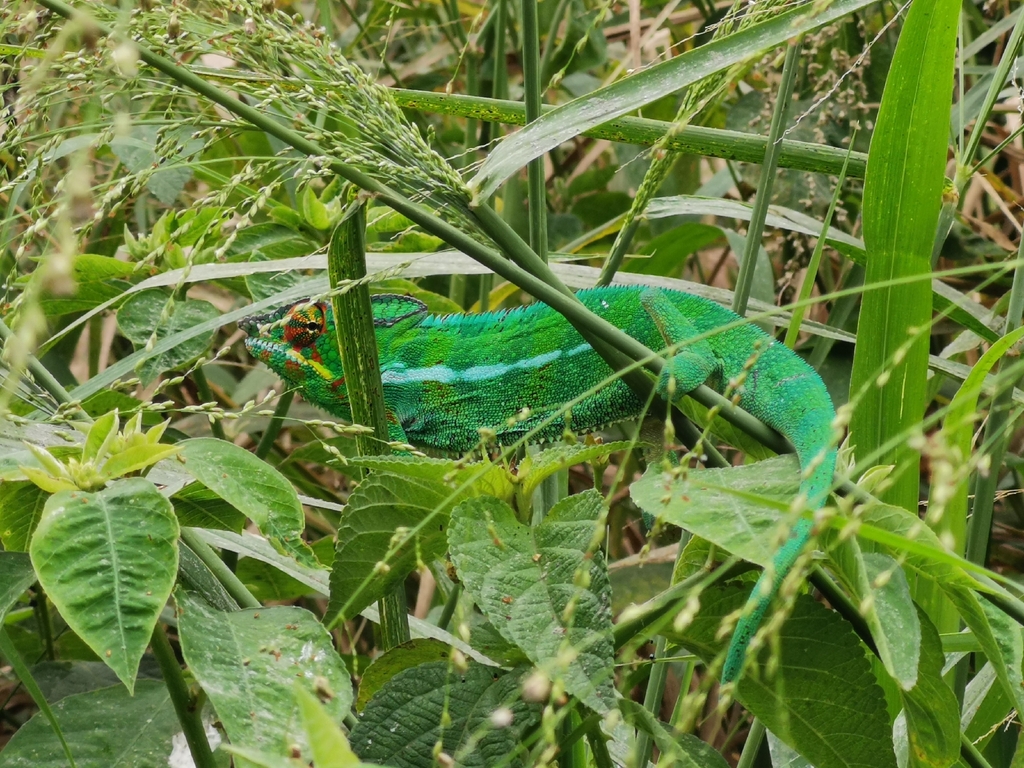
Unter den in andere Länder eingeschleppte Arten finden sich auch einige Chamäleons: Das Pantherchamäleon (Furcifer pardalis) wurde bereits vor 1830 in La Réunion eingeführt. Es kommt bis heute auf der Insel vor. Das Kap-Zwergchamäleon (Bradypodion pumilum) wurde in den 1990er Jahren in Namibia ausgesetzt und bildete kleine Populationen in Swakopmund, Walvis Bay, Lüderitz und Windhoek. Alle diese Populationen sind heute jedoch ausgestorben. Das Parsons Chamäleon (Calumma parsonii parsonii) wurde in den 1960er Jahren von Madagaskar nach Mauritius gebracht. Eine überlebensfähige Population wurde daraus jedoch nicht. Das Lappenchamäleon (Chamaeleo dilepis) wurde vor 1978 in die südafrikanische Provinz Freistaat verschleppt, scheint dort aber ebenfalls keine eigenständige Population gebildet zu haben. Und zuletzt wurden verschiedene Zwergchamäleon-Arten (Bradypodion ssp.) im Jahr 1939 in die Provinz Freistaat in Südafrika gebracht. Auch sie erzeugten keine bleibende Population.
Insgesamt sind vor allem Echsen in Subsahara-Afrika in fremde Länder eingeschleppt worden (23 Arten), direkt dahinter kommen Amphibien (21 Arten) und Schlangen (14 Arten). Die meisten eingeschleppten Arten werden in Südafrika beobachtet, außerdem aber auch in Madagaskar, den Maskarenen und umliegenden Inseln. Unklar ist, ob weiter nördlich gelegene afrikanische Länder eingeschleppte Arten geringer beobachten oder dort tatsächlich weniger vorhanden sind. Zwei Drittel der eingeschleppten Arten, die eigene Populationen etablierten konnten, kamen aus anderen Regionen Afrikas oder der umliegenden Inseln sowie dem Orient. Bei den Arten, die sich nach ihrer Verschleppung nicht vermehren konnten, sieht das deutlich anders aus.
Die frühesten Verschleppungen in Subsahara-Afrika sind aus dem 17. Jahrhundert bekannt, darunter der Vierkrallengecko (Gehyra mutilata) und der Maskarenenfrosch (Ptychadena mascareniensis). Mit dem Kolonialismus steigen die Zahlen verschleppter Arten stark an. Ein weiterer Peak liegt ab etwa 2000 mit steigendem internationalem Handel.
Die Gründe für die Verschleppungen sind vielfältig, zumeist aber passiert es unbeabsichtigt. Vor allem Geckos und Frösche werden häufig als blinde Passagiere mit Obsttransporten, Container auf Schiffen oder im Gepäck von Touristen verschleppt. Seltener werden Reptilien und Amphibien absichtlich ausgesetzt, wie im Fall des Kap-Zwerggecko (Lygodactylus capensis), der in einer Gärtnerei ausgesetzt wurde. Das Aussetzen von als Haustieren gehaltenen Reptilien und Amphibien führt meist nicht zur Etablierung von sich vermehrenden Populationen. Zwei Fälle von beabsichtigtem Aussetzen zur biologischen Kontrolle anderer Tierarten sind bekannt, ebenfalls drei beabsichtigte Freilassungen ohne Gründe.
Potenzielle Probleme der eingeschleppten Arten sind vor allem die Verdrängung anderer einheimischer Arten, aber auch das Fressen einheimischer Arten. Die Hybridisierung mit einheimischen Arten findet sehr selten statt. Die Verbreitung von Krankheiten, beispielsweise Parasitosen, ist ein häufiges Problem. Von verschleppten Chamäleons ist bisher keines dieser Probleme bekannt, allerdings gibt es auch vielerorts kaum Studien zum Thema.
Herping the African Continent: Alien Amphibians and Reptiles in Sub-Saharan Africa
Grzegorz Kopij
Biology 2026, 15: 639
DOI: 10.3390/biology15080639
Kostenloser Download des Artikels
Foto: Ein Furcifer pardalis auf La Réunion, fotografiert von Jason Berger, CC BY 4.0

![[:de]Vortrag in Frankfurt über Madagaskar[:en]Presentation in Frankfurt about Madagascar[:]](https://www.agchamaeleons.de/wp-content/uploads/2024/09/Rainer-Dolch-MA-Okt-22.jpg "[:de]Vortrag in Frankfurt über Madagaskar[:en]Presentation in Frankfurt about Madagascar[:]")
![[:de]Vortrag in Dortmund über Namibia[:en]Presentation in Dortmund about Namibia[:]](https://www.agchamaeleons.de/wp-content/uploads/2024/07/WhatsApp-Bild-2024-06-27-um-12.39.36_5586183a.jpg "[:de]Vortrag in Dortmund über Namibia[:en]Presentation in Dortmund about Namibia[:]")
![[:de]Vortrag in Hamburg über Namibia[:en]Presentation in Hamburg about Namibia[:]](https://www.agchamaeleons.de/wp-content/uploads/2023/03/Vortrag-Ruediger-Schlepper-Namibia.jpg "[:de]Vortrag in Hamburg über Namibia[:en]Presentation in Hamburg about Namibia[:]")