
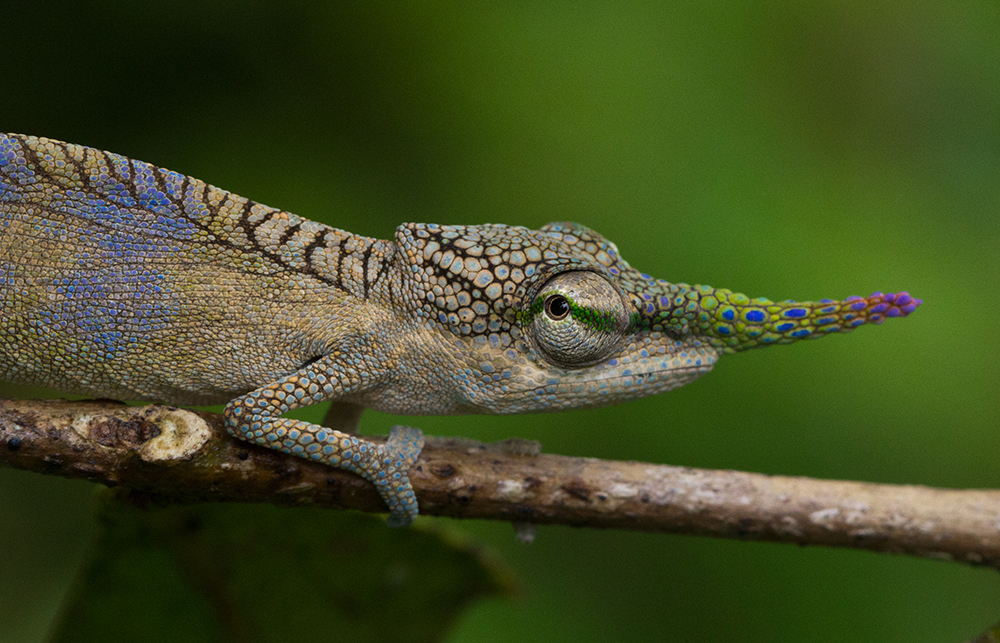
[:de]Lebensräume verschiedener Chamäleons in Vohimana (Madagaskar)[:en]Habitats and distribution of chameleon species in Vohimana (Madagascar)[:]

[:de]Lebensräume verschiedener Chamäleons in Vohimana (Madagaskar)[:en]Habitats and distribution of chameleon species in Vohimana (Madagascar)[:]

Verbreitung Wissenschaft

[:de]

Eine Studie zur Verbreitung und den Lebensräumen verschiedener Chamäleonarten wurde kürzlich in Vohimana in Madagaskar durchgeführt. Das Reservat Vohimana liegt zwischen 800 und 1000 m Höhe im östlichen Hochland der Insel. Es erstreckt sich über eine Fläche von 15 km², davon 6 km² Primärregenwald, 8,5 km² Sekundärvegetation und etwas über 1 km² Eukalyptusforst. Die Regenzeit reicht von Oktober bis Mai und ist vor allem von vermehrtem Regen gekennzeichnet, wobei die Trockenzeit ebenfalls über verhältnismäßig viele Niederschläge verfügt.

An insgesamt 195 Tagen, davon 158 in der Regenzeit und 37 in der Trockenzeit wurden Chamäleons innerhalb des Reservats entlang der vorhandenen Wege mit dem bloßen Auge gesucht. Dabei liefen verschiedene Personen insgesamt 350 km Strecke. 80% der Datenerhebung fand nachts statt, nur 20% tagsüber. Jedes gefundene Chamäleon wurde fotografiert sowie Temperatur, relative Luftfeuchtigkeit und UV-Index am Fundort gemessen. Die Daten wurden anschließend statistisch ausgewertet.

Während der gesamten Studienzeit konnten 577 Chamäleons dokumentiert werden. Darunter befanden sich ein einziges Calumma brevicorne, sieben Furcifer willsii, zwei Brookesia ramanantsoai, sieben Brookesia thieli, 143 Brookesia superciliaris und Brookesia therezieni (zusammengefasst zu einer Gruppe), 53 Calumma furcifer, 207 kleine Calumma des nasutum-Komplexes (auf Grund von Schwierigkeiten bei der der rein äußerlichen Artbestimmung zu einer Gruppe zusammengefasst), 24 Calumma parsonii, 118 Calumma pinocchio, 11 Furcifer bifidus und 4 Furcifer pardalis.

Am häufigsten in Vohimana waren Brookesia superciliaris und Brookesia therezieni, kleine Chamäleons des Calumma nasutum-Komplex und Calumma pinocchio. Brookesia superciliaris, Brookesia therezieni und Calumma furcifer wurden nur selten außerhalb des Primärwaldes aufgefunden. Calumma pinocchio war am häufigsten in einem kleinen Primärwaldrest im Nordosten des Reservats zu finden. Alle übrigen Arten konnten die Wissenschaftler sowohl in Primärwald als auch in Sekundärvegetation immer wieder entdecken. Calumma parsonii, Calumma pinocchio als auch Arten des nasutum-Komplexes wurden häufig im Bereich von Waldrändern gefunden.

Die Temperaturen der Fundorte lagen in der Regenzeit durchschnittlich bei 24,2°C, in der Trockenzeit dagegen bei durchschnittlich 18,3°C. Während der Regenzeit wurden tagsüber mehr Chamäleons an Orten mit höherem UV-Index gemessen (durchschnittlich 0,5). Die relative Luftfeuchtigkeit war in Vohimana das ganze Jahr über hoch mit einem Durchschnitt über 90% für beide Jahreszeiten. Die Unterschiede zwischen den verschiedenen Chamäleonarten waren eher gering, was die Mikroklimata anging. Einzelne Furcifer pardalis und Furcifer willsii wurde zu den höchsten gemessenen Tages- und Nachttemperaturen (29°C und 27,5° tagsüber, 25°C nachts) gefunden. Diese beiden Arten sonnten auch im höchsten durchschnittlich gemessenen UVI (8,2 für Furcifer pardalis und 7,7 für Furcifer willsii). Die UV-Indizes aller übrigen Arten lagen im Durchschnitt deutlich niedriger.

Diversity, distribution, and microclimatic conditions experienced by the chameleons of the Vohimana Reserve, Madagascar
Olivier Marquis, Marc Gansuana, Sébastian Métrailler
Herpetological Conservation and Biology 21(1), 2026: 101-119
DOI: nicht verfügbar
Kostenloser Download des Artikels

Foto: Calumma pinocchio im Reservat von Vohimana, fotografiert von Alex Negro[:en]

A study on the distribution and habitats of various chameleon species was recently carried out in Vohimana, Madagascar. The Vohimana Reserve is situated at an altitude of between 800 and 1,000 metres in the island’s eastern highlands. It covers an area of 15 km², comprising 6 km² of primary rainforest, 8.5 km² of secondary vegetation and just over 1 km² of eucalyptus forest. The rainy season runs from October to May and is characterised primarily by increased rainfall, although the dry season also sees a relatively high amount of rainfall.

Over a total of 195 days – 158 of which were during the rainy season and 37 during the dry season – chameleons were searched for with the naked eye within the reserve along the existing paths. In the process, various individuals covered a total distance of 350 km. 80% of the data collection took place at night, with only 20% during the day. Every chameleon found was photographed, and the temperature, relative humidity and UV index were measured at the site of discovery. The data was then statistically analysed.

A total of 577 chameleons were recorded during the entire study period. These included a single Calumma brevicorne, seven Furcifer willsii, two Brookesia ramanantsoai, seven Brookesia thieli, 143 Brookesia superciliaris and Brookesia therezieni (grouped together), 53 Calumma furcifer, 207 small Calumma of nasutum-complex (grouped together due to difficulties in identifying them solely on the basis of external characteristics), 24 Calumma parsonii, 118 Calumma pinocchio, 11 Furcifer bifidus and 4 Furcifer pardalis.

The most common species in Vohimana were Brookesia superciliaris and Brookesia therezieni, small chameleons of the Calumma nasutum complex, and Calumma pinocchio. Brookesia superciliaris, Brookesia therezieni and Calumma furcifer were rarely found outside the primary forest. Calumma pinocchio was most commonly found in a small remnant of primary forest in the north-east of the reserve. The scientists repeatedly found all other species in both primary forest and secondary vegetation. Calumma parsonii, Calumma pinocchio and species of the nasutum complex were frequently found along forest edges.

Temperatures at the study sites averaged 24.2°C during the wet season, compared with an average of 18.3°C during the dry season. During the wet season, more chameleons were observed during the day in locations with a higher UV index (averaging 0.5). Relative humidity in Vohimana was high throughout the year, averaging over 90% for both seasons. The differences between the various chameleon species were rather small in terms of microclimates. Individuals of Furcifer pardalis and Furcifer willsii were found at the highest recorded daytime and night-time temperatures (29°C and 27.5°C during the day, 25°C at night). These two species were also basking at the highest average UVI recorded (8.2 for Furcifer pardalis and 7.7 for Furcifer willsii). The UV indices for all other species were, on average, significantly lower.

Diversity, distribution, and microclimatic conditions experienced by the chameleons of the Vohimana Reserve, Madagascar
Olivier Marquis, Marc Gansuana, Sébastian Métrailler
Herpetological Conservation and Biology 21(1), 2026: 101-119
DOI: not available
Free article download

Photo: Calumma pinocchio in the Vohimana Reserve, photographed by Alex Negro[:]

[:de]Zwei „neue alte“ Chamäleonarten aus Madagaskar[:en]Two „new old“ chameleon species from Madagascar[:]

[:de]Zwei „neue alte“ Chamäleonarten aus Madagaskar[:en]Two „new old“ chameleon species from Madagascar[:]

Neubeschreibungen Wissenschaft

[:de]

Schon länger weiß man, dass es sich bei Calumma gallus aus dem Osten Madagaskars eher nicht nur um eine Art handelt, sondern um einen ganzen Art-Komplex. Wissenschaftler haben sich nun näher mit dem Komplex beschäftigt und neue genetische Untersuchungen veranlasst – und dabei einige Arten völlig über den Haufen geworfen.

Die Kurzfassung:

Das, was man bisher für Calumma nasutum aus Andasibe, Anosibe An’Ala und Tarzanville hielt, heißt jetzt Calumma hofreiteri. Die Weibchen sind nach wie vor nicht sicher von Calumma emelinae zu unterscheiden. Das „echte“ Calumma nasutum kommt in Regenwäldern nahe Ranomafana und Mananjary vor. Die Männchen von Calumma nasutum tragen einen deutlich größeren Nasenfortsatz, der häufig gelb gefärbt ist während die Weibchen nur eine rote Stupsnase haben. Calumma nasutum gehört übrigens zum gallus-Komplex.

Das, was man bisher für Calumma gallus hielt und im Schutzgebiet Vohimana und Umgebung vorkommt, heißt nun Calumma pinocchio. Das „echte“ Calumma gallus kommt in einem Waldfragment nahe Tarzanville, in Tsinjoarivo und mehreren kleinen Gebieten nahe Toamasina an der Ostküste Madagaskars vor. Sein Nasenfortsatz ist oben gezahnt, während der Nasenfortsatz von Calumma pinocchio glatt ist.

Towards a revision of the Malagasy chameleons of the Calumma gallus complex: Redefinition of Calumma nasutum based on a museomics approach and descriptions of two new species
Frank Glaw, Stefanie Agne, David Prötzel, Philip-Sebastian Gehring, Jörn Köhler, Michaela Preick, Fanomezana M. Ratsoavina, Nicolas Straube, Katharina Wollenberg Valero, Angelica Crottini, Miguel Vences
Salamandra 61(4): 442-466, 2025.
DOI: nicht verfügbar
Kostenloser Download des Artikels

Foto: aus der oben genannten Veröffentlichung, Calumma nasutum [:en]

It has long been known that Calumma gallus from eastern Madagascar is not just one species, but rather an entire species complex. Scientists have now taken a closer look at the complex and conducted new genetic studies – completely overturning some species classifications in the process.

The short version:

What was previously thought to be Calumma nasutum from Andasibe, Anosibe An’Ala and Tarzanville is now called Calumma hofreiteri. The females still cannot be reliably distinguished from Calumma emelinae. The ‘real’ Calumma nasutum occurs in rainforests near Ranomafana and Mananjary. The males of Calumma nasutum have a significantly larger rostral appendage, which is often yellow in colour, while the females only have a red snub nose. Calumma nasutum belongs to the gallus complex.

What was previously thought to be Calumma gallus and occurs in the Vohimana reserve and surrounding area is now called Calumma pinocchio. The ‘real’ Calumma gallus occurs in a forest fragment near Tarzanville, in Tsinjoarivo and several small areas near Toamasina on the east coast of Madagascar. Its rostral appendage is serrated at the top, while the rostral appendage of Calumma pinocchio is smooth.

Towards a revision of the Malagasy chameleons of the Calumma gallus complex: Redefinition of Calumma nasutum based on a museomics approach and descriptions of two new species
Frank Glaw, Stefanie Agne, David Prötzel, Philip-Sebastian Gehring, Jörn Köhler, Michaela Preick, Fanomezana M. Ratsoavina, Nicolas Straube, Katharina Wollenberg Valero, Angelica Crottini, Miguel Vences
Salamandra 61(4): 442-466, 2025.
DOI: not available
Free download of the article

Photo: from the above publication, Calumma nasutum [:]