[:de]Chamäleons in der Elaphe[:en]Chameleons in Elaphe magazine[:]

[:de]Chamäleons in der Elaphe[:en]Chameleons in Elaphe magazine[:]

Haltungsberichte Zeitungsartikel

[:de]

In der neuesten  Ausgabe der Elaphe, die DGHT-Mitglieder bereits im Dezember 2025 im Briefkasten hatten, ist das Titelthema endlich wieder einmal Chamäleons. AG-Mitglied Sophie Obermeier hat einen interessanten Artikel zu moralischen und ethischen Fragen der Chamäleonhaltung verfasst. Dazu gibt es einen Haltungsbericht des Seychellen-Tigerchamäleons, Archaius tigris, und einen Artikel über das Mayotte-Chamäleon, Furcifer polleni. Viel Spaß beim Schmökern!

[:en]

In the latest issue of Elaphe, which DGHT members received in their postboxes in December 2025, the cover story is finally about chameleons again. AG member Sophie Obermeier has written an interesting article on moral and ethical issues surrounding chameleon keeping. There is also a husbandry report on the Seychelles tiger chameleon, Archaius tigris, and an article on the Mayotte chameleon, Furcifer polleni. Enjoy reading!

[:]

[:de]Vortrag in Frankfurt über Madagaskar[:en]Presentation in Frankfurt about Madagascar[:]

[:de]Vortrag in Frankfurt über Madagaskar[:en]Presentation in Frankfurt about Madagascar[:]

Reiseberichte Vorträge Wissenschaft

[:de]

Die DGHT Frankfurt startet mit einem Highlight in das neue Jahr. Aufgrund eines Heimatbesuchs haben sie das große Glück, Rainer Dolch von der Association Mitsinjo in Andasibe, Madagaskar, begrüßen zu können. Am Freitag, den 09.01.2026, wird er einen ausführlichen Vortrag über Madagaskar und seine herpetologische Vielfalt halten.

Madagaskars Amphibien und Reptilien bewohnen die verschiedensten Lebensräume, von Tieflandegenwäldern über die höchsten Berggipfel zu Karstgebieten, Trockenwäldern und einzigartigen Halbwüsten. Die lange Isolation Madagaskars nach dem Zerfall des Urkontinents Gondwana, seine Geographie und die enorme Vielfalt seiner Lebensräume hat evolutive Prozesse befördert, die zahlreiche endemische Arten von Amphibien und Reptilien hervorgebracht haben. Viele dieser Taxa kommen allopatrisch und mikroendemisch vor, sie sind also auf sehr kleine eng begrenzte Gebiete beschränkt. So haben endemische Familien wie die Madagaskarfrösche (Mantellidae), die Madagaskarnattern (Pseudoxyrhophiidae) und die Madagaskarleguane (Opluridae) jeweils große Radiationen erfahren. Eine große Vielfalt beinloser Skinke sowie einige der seltensten Schildkröten der Welt gehören ebenfalls zur außergewöhnlichen Herpetofauna der Insel. Schließlich ist Madagaskar ein Hotspot der Chamäleondiversität, insbesondere in der Chamäleongattung Calumma sind erst in jüngster Zeit viele kryptische Arten beschrieben worden, die zwar äußerlich fast identisch aussehen, aber genetisch so verschieden sind, dass sie sich nicht mehr miteinander fortpflanzen können. Viele der in Madagaskar heimischen Amphibien und Reptilien und die von ihnen bewohnten Habitate werden ebenso vorgestellt wie Bedrohungen und Maßnahmen zu ihrem Schutz.

Dr. Rainer Dolch Mikroendemismus, kryptische Arten, faszinierende Vielfalt: Eine Tour d’Horizon durch die Herpetofauna Madagaskars
DGHT Stadtgruppe Frankfurt
Zooschule des Zoo Frankfurt
Bernhard-Grzimek-Allee 1
60316 Frankfurt am Main
Vortragsbeginn 19.00 Uhr, Einlass ab 18:30 Uhr über das Ausgangstor am Haupteingang Alfred-Brehm-Platz (Tor zwischen Zoo-Shop und Zoogesellschaftshaus)

Fotos: herpetologische Vielfalt Madagaskars, fotografiert von Rainer Dolch[:en]

The DGHT Frankfurt is kicking off the new year with a highlight. Thanks to a visit home, they are fortunate to welcome Rainer Dolch from the Association Mitsinjo in Andasibe, Madagascar. On Friday, 9 January 2026, he will give a detailed lecture on Madagascar and its herpetological diversity.

Madagascar’s amphibians and reptiles inhabit a wide variety of habitats, from lowland forests to the highest mountain peaks, karst areas, dry forests and unique semi-deserts. Madagascar’s long isolation after the break-up of the supercontinent Gondwana, its geography and the enormous diversity of its habitats have promoted evolutionary processes that have produced numerous endemic species of amphibians and reptiles. Many of these taxa are allopatric and microendemic, meaning they are restricted to very small, confined areas. Endemic families such as the Madagascar frogs (Mantellidae), the Madagascar snakes (Pseudoxyrhophiidae) and the Madagascar iguanas (Opluridae) have each undergone major radiation. A wide variety of legless skinks and some of the world’s rarest turtles also belong to the island’s extraordinary herpetofauna. Finally, Madagascar is a hotspot for chameleon diversity. In the chameleon genus Calumma in particular, many cryptic species have only recently been described which, although they look almost identical externally, are genetically so different that they can no longer reproduce with each other. Many of the amphibians and reptiles native to Madagascar and the habitats they inhabit are presented, as are the threats they face and measures taken to protect them.

Dr. Rainer Dolch Microendemism, cryptic species, fascinating diversity: a tour d’horizon through the herpetofauna of Madagascar [German]
DGHT city group Frankfurt
Zoo school of Frankfurt zoo
Bernhard-Grzimek-Allee 1
60316 Frankfurt am Main

Lecture begins at 7 p.m., doors open at 6:30 p.m. via the exit gate at the main entrance on Alfred-Brehm-Platz (gate between the zoo shop and the zoo society building).

Photos: Herpetological diversity of Madagascar, photographed by Rainer Dolch[:]

[:de]Calumma-Arten in drei Hochlandwäldern Madagaskars[:en]Calumma species in three highland forests of Madagascar[:]

[:de]Calumma-Arten in drei Hochlandwäldern Madagaskars[:en]Calumma species in three highland forests of Madagascar[:]

Wissenschaft

[:de]

Biologen der Universität Antananarivo haben kürzlich untersucht, wie sich die verschiedenen Lebensräume auf das Vorhandensein von vier Calumma-Arten auf Madagaskar auswirken. Als Studiengebiete wählten sie das Spezialreservat Ambohitantely, verwaltet von Madagascar National Parks, sowie zwei Wälder im Korridor von Anjozorobe-Angavo: Anorana, offiziell nicht als Schutzgebiet deklariert und von lokalen Gemeinschaften verwaltet, und Antsahabe unter der Führung der NGO Fanamby. Die drei Studiengebiete deckten dabei von intaktem Regenwald bis zu Waldfragmenten mit vor allem jungen Bäumen verschiedenste Waldtypen ab, darunter auch Flächen nach Brandrodung. Alle drei Gebiete liegen im nördlichen Hochland Madagaskars.

Innerhalb der Trocken- und Regenzeiten zweier Jahre suchten die Biologen entlang 50 m langer Transekte (pro Ort je 14 Transekte mit je 3 parallel verlaufenden Linien) nach Chamäleons. Die Suchen wurden jeweils zu zweit nachts mit Taschenlampen durchgeführt. Jedes gefundene Chamäleon wurde artbestimmt, vermessen und verschiedene Daten zum Fundort aufgenommen. Zusätzlich wurden 16 botanische Transekte über je 100 m Länge genutzt, um Daten zum umgebenden Lebensraum zu sammeln.

Die Ergebnisse einzelner Transekte mussten aus der Auswertung entfernt werden, da in ihrer Nähe zeitnah zu den Suchnächten Brandrodung erfolgte und ein Einfluss auf die Tiere nicht ausgeschlossen werden konnte. Insgesamt konnten dadurch noch 32 Transekte ausgewertet werden.

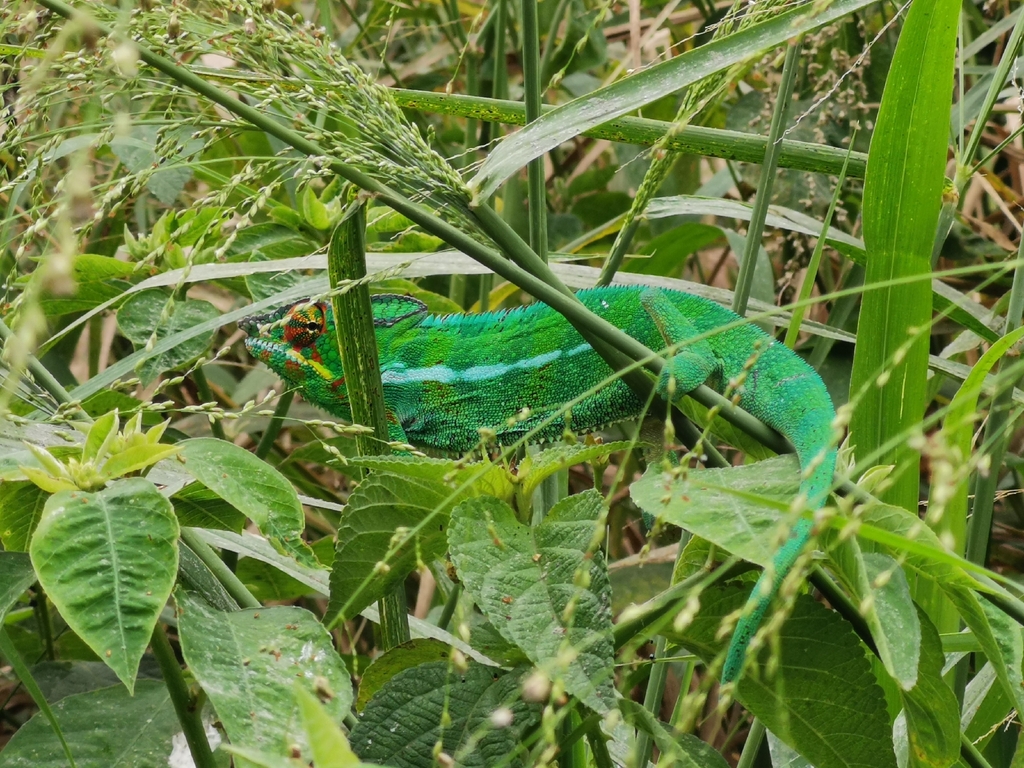
Grundlegend wurden erst einmal sowohl Calumma gastrotaenia als auch Calumma globifer, Calumma crypticum und Chamäleons der Calumma nasutum-Gruppe an allen drei Studiengebieten gefunden. Am häufigsten wurde mit weitem Abstand Calumma gastrotaenia entdeckt.  Generell konnten wie erwartet deutlich mehr Chamäleons während der Regenzeit als während der Trockenzeit entdeckt werden, darunter vor allem mehr Schlüpflinge. An allen drei Orten waren zu allen Jahreszeiten mehr Weibchen als Männchen zu finden. In ungestörtem, intaktem Regenwald waren mehr Chamäleons unterwegs als in zerstörten Gebieten. Neben den gesuchten Calumma-Arten konnten auch Brookesia ramanantsoai, Brookesia thieli und Furcifer willsii entdeckt werden.

Zwischen Regen- und Trockenzeit konnten keine Unterschiede in der bevorzugten Höhe der zum Schlafen genutzten Plätze gefunden werden. Insgesamt nutzten die Chamäleons eine sehr hohe Bandbreite an Vegetation zum Schlafen. Schlüpflinge und Jungtiere nutzten allgemein schmalere und höher gelegene Schlafplätze als adulte Chamäleons.

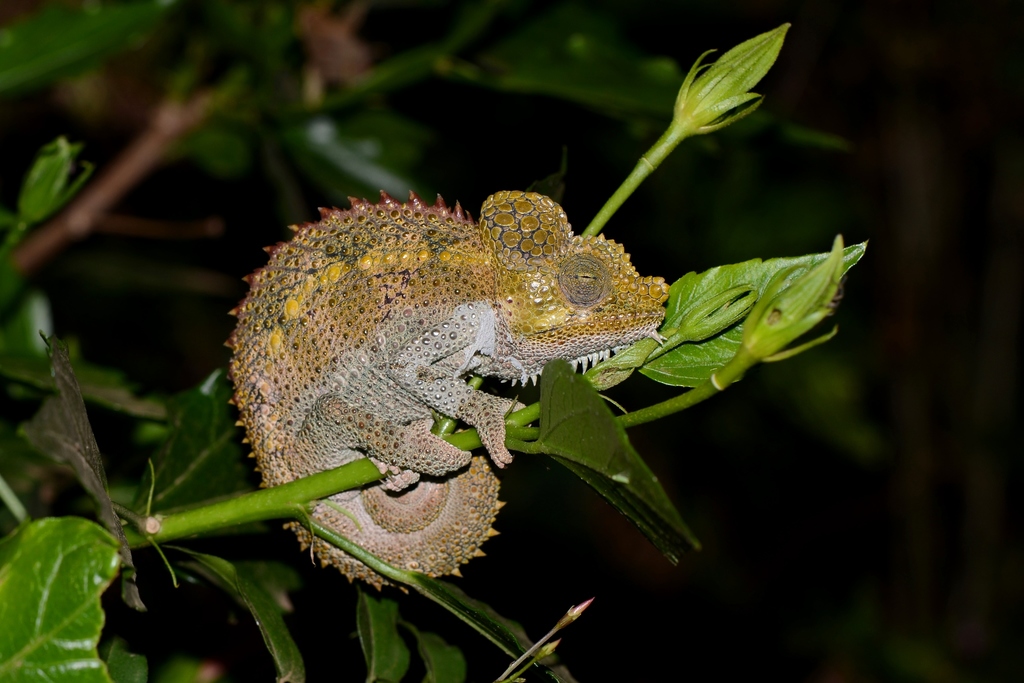
Die höchste Populationsdichte von Calumma globifer fand sich in Anorana mit 88 Individuen pro Hektar. Im Durchschnitt schliefen die Tiere dieser Art zwischen 0,5 und 5 m Höhe und fast 40% saß dabei auf Lianen. Jungtiere konnten ab und an auf Bambus, Drachenbäumen (Dracaena ssp.) und Steineiben (Podocarpus madagascariensis). Calumma gastrotaenia und Calumma globifer bevorzugten Lebensräume mit großen Bäumen und dichterem Bewuchs zwischen 2 und 4 m Höhe. Calumma globifer bewohnte vor allem Lebensräume mit geschlossenem Blätterdach.

Die höchste Populationsdichte von Calumma gastrotaenia fand sich in Ambohitantely mit 60 Individuen pro Hektar. Die Art war vor allem in Unterholz mit Bambus, Farnen, Pflanzen mit länglichen Blättern und Gräsern vertreten. Dabei fiel auf, dass über 30% der Schlafplätze Bambus waren. Insgesamt schien die Art besser als die anderen mit zerstörtem Lebensraum zurecht zu kommen.

Die höchste Populationsdichte der Calumma nasutum-Gruppe fand sich in Ambohitantely mit 61 Individuen pro Hektar. Sie kamen vergleichsweise häufig auch während der Trockenzeit in Ambohitantely und Antsahabe vor. Die Art bevorzugte vor allem die Enden kleiner, dünner Äste und Kletterpflanzen zum Schlafen. Sie saßen meist zwischen 0,3 und 6 m Höhe. Über die Hälfte der gefundenen Tiere der Calumma nasutum-Gruppe waren auf den Ästen von Sträuchern und Blättern, die andere Hälfte fand sich auf Lianen und kletterndem Bambus (Nastus ssp.).

Calumma crypticum zeigte eine im Gegensatz zu den anderen Arten sehr viel geringere Populationsdichte in den untersuchten Wäldern, mit maximal 9 Individuen pro Hektar in Antsahabe. Calumma crypticum war während der Regenzeit als einzige Art höher zu finden als während der Trockenzeit, auf durchschnittlich 4 bis 6 m. Die Art zeigte aber auch allgemein eine hohe Variation in der Höhe der Schlafplätze, ein Chamäleon wurde auf nur 0,5 m Höhe entdeckt. Die Art bevorzugte vor allem dickere Äste. Sowohl Calumma crypticum als auch Chamäleons der Calumma nasutum-Gruppe bevorzugten offene Lebensräume, die trotzdem reich an Ästen waren. Unklar bleibt, ob insgesamt nur sieben im gesamten Studiengebiet aufgefundene Calumma brevicorne tatsächlich dieser Art zuzurechnen sind oder es sich hierbei um nicht zur fast 150 Jahre alten Originalbeschreibung passenden Individuen handelt.

Schlussendlich bestätigte sich, dass die Vegetationstruktur eines Lebensraums die Populationsdichte der untersuchten Calumma-Arten stark beeinflusst. Der von den Wissenschaftlern am als besten für Calumma-Arten geeignet beschriebenes Habitat boten die Wälder von Antsahabe und Anorana, beide befinden sich im Anjozorobe-Angavo-Korridor. In letzterem fanden sich auch die maximale Gesamtzahl an Calumma gastrotaenia und Calumma globifer. Das Reservat Ambohitantely dagegen fiel vor allem wegen sehr viel zerstörtem Waldgebiet auf. Allein in zwei Jahren während der Studie hatten mehrere große Feuer nach Brandrodung zu massivem Baumverlust geführt. Ambohitantely ist der Ort, von dem die Erstbeschreibung von Calumma crypticum stammt – dabei war genau diese Art in den Studiengebieten am geringsten vertreten.

Habitat use, selection, and population density of chameleon communities (Calumma spp.) in the fragmented central highland forests of Madagascar
Fandresena Raktoroarimalala, Arianna L. Kuhn, Achille P. Raselimanana, A. Tahinarivovny Jacquis, Sara Ruane
MBC Ecology and Evolution 25: 137.
DOI: 10.1186/s12862-025-02479-4
Kostenloser Download des Artikels

Foto: Calumma globifer in Maintsoanala, fotografiert von Alex Negro[:en]

Biologists from the University of Antananarivo recently investigated how different habitats affect the presence of four Calumma species in Madagascar. They chose the Ambohitantely Special Reserve, managed by Madagascar National Parks, and two forests in the Anjozorobe-Angavo corridor as their study areas: Anorana, not officially declared a protected area and managed by local communities, and Antsahabe, managed by the NGO Fanamby. The three study areas covered a wide variety of forest types, from intact rainforest to forest fragments with mainly young trees, including areas that had been cleared by burning. All three areas are located in the northern highlands of Madagascar.

During the dry and rainy seasons of two years, biologists searched for chameleons along 50-metre-long transects (14 transects per location, each with three parallel lines). The searches were carried out in pairs at night using torches. Each chameleon found was identified, measured and various data on the location of the find was recorded. In addition, 16 botanical transects, each 100 m long, were used to collect data on the surrounding habitat.

The results of individual transects had to be removed from the evaluation because slash-and-burn farming had taken place in their vicinity shortly before the search nights and an impact on the animals could not be ruled out. A total of 32 transects could still be evaluated.

Basically, Calumma gastrotaenia, Calumma globifer, Calumma crypticum and chameleons of the Calumma nasutum group were found in all three study areas. Calumma gastrotaenia was by far the most frequently discovered species. As expected, significantly more chameleons were discovered during the rainy season than during the dry season, including more hatchlings in particular. At all three locations, more females than males were found in all seasons. More chameleons were found in undisturbed, intact rainforest than in destroyed areas. In addition to the Calumma species sought, Brookesia ramanantsoai, Brookesia thieli and Furcifer willsii were also discovered.

No differences in the preferred height of sleeping places were found between the rainy and dry seasons. Overall, the chameleons used a very wide range of vegetation for sleeping. Hatchlings and juveniles generally used narrower and higher sleeping places than adult chameleons.

The highest population density of Calumma globifer was found in Anorana, with 88 individuals per hectare. On average, the animals of this species slept at heights between 0.5 and 5 m, with almost 40% sitting on lianas. Juveniles were occasionally found on bamboo, dragon trees (Dracaena ssp.) and stone pines (Podocarpus madagascariensis). Calumma gastrotaenia and Calumma globifer preferred habitats with large trees and denser vegetation between 2 and 4 m in height. Calumma globifer mainly inhabited habitats with a closed canopy.

The highest population density of Calumma gastrotaenia was found in Ambohitantely with 60 individuals per hectare. The species was mainly found in undergrowth with bamboo, ferns, plants with elongated leaves and grasses. It was noticeable that over 30% of the roosting sites were bamboo. Overall, the species seemed to cope better than the others with destroyed habitat.

The highest population density of the Calumma nasutum group was found in Ambohitantely, with 61 individuals per hectare. They were also relatively common during the dry season in Ambohitantely and Antsahabe. The species preferred the ends of small, thin branches and climbing plants for sleeping. They usually sat at a height of between 0.3 and 6 m. More than half of the animals found in the Calumma nasutum group were on the branches of shrubs and leaves, while the other half were found on lianas and climbing bamboo (Nastus ssp.).

In contrast to the other species, Calumma crypticum showed a much lower population density in the forests studied, with a maximum of 9 individuals per hectare in Antsahabe. Calumma crypticum was the only species found higher during the rainy season than during the dry season, at an average of 4 to 6 m. However, the species also showed a high variation in the height of its roosting places, with one chameleon discovered at a height of only 0.5 m. The species preferred thicker branches in particular. Both Calumma crypticum and chameleons of the Calumma nasutum group preferred open habitats that were nevertheless rich in branches. It remains unclear whether the seven Calumma brevicorne found in the entire study area can actually be attributed to this species or whether these are individuals that do not match the original description, which is almost 150 years old.

Ultimately, it was confirmed that the vegetation structure of a habitat has a significant influence on the population density of the Calumma species studied. The habitat described by the scientists as most suitable for Calumma species was found in the forests of Antsahabe and Anorana, both located in the Anjozorobe-Angavo corridor. The latter also had the highest total number of Calumma gastrotaenia and Calumma globifer. The Ambohitantely reserve, on the other hand, was notable mainly for its heavily destroyed forest area. In just two years during the study, several large fires following slash-and-burn practices had led to massive tree loss. Ambohitantely is the place where Calumma crypticum was first described – yet this species was the least represented in the study areas.

Habitat use, selection, and population density of chameleon communities (Calumma spp.) in the fragmented central highland forests of Madagascar
Fandresena Raktoroarimalala, Arianna L. Kuhn, Achille P. Raselimanana, A. Tahinarivovny Jacquis, Sara Ruane
MBC Ecology and Evolution 25: 137.
DOI: 10.1186/s12862-025-02479-4
Kostenloser Download des Artikels

Picture: Calumma globifer in Maintsoanala, photographed by Alex Negro[:]

[:de]Der Sehnerv von Chamäleons ist hoch spezialisiert[:en]The optic nerve of chameleons is highly specialised[:]

[:de]Der Sehnerv von Chamäleons ist hoch spezialisiert[:en]The optic nerve of chameleons is highly specialised[:]

Tiermedizin Wissenschaft

[:de]

Dass Chamäleons sehr spezielle Augen haben, ist schon lange bekannt. Besonders faszinierend ist, dass sie ihre Augen unabhängig voneinander in nahezu alle Richtungen bewegen können. Ein Team von US-amerikanischen Wissenschaftlern hat nun herausgefunden, dass auch der Sehnerv bei Chamäleons extrem spezialisiert ist.

Sie untersuchten adulte Schuppenkriechtiere 34 verschiedener Arten an Hand von CT-Modellen. Brookesia superciliaris, Rieppeleon brevicaudatus und Chamaeleo calyptratus repräsentierten dabei die Familie der Chamäleons. Dabei stellten sie fest, dass bei allen drei Chamäleon-Arten der Sehnerv quasi aufgerollt war. Diese anatomische Besonderheit führt dazu, dass der Nervus opticus bei Chamäleons insgesamt wesentlich länger ist, als es bei einem ruhig geradeaus schauendem Auge nötig wäre. Er ermöglicht den Tieren wahrscheinlich ihre extrem beweglichen Augen, ohne dabei Einschränkungen der Sehfähigkeit hinnehmen zu müssen. Vereinfacht erklärt funktioniert der Sehnerv also ein bisschen wie eine Flexileine: Bewegt sich das Auge stark, wird ein Teil des Sehnervs „ausgerollt“. Bewegt das Auge sich zurück, schnellt der Sehnerv zurück an seine ursprüngliche Position, ohne dass die Nervenfasern dabei überdehnt wurden.

A new twist in the evolution of chameleons uncovers an extremely specialized optic nerve morphology
Emily Collins, Aaron M. Bauer, Raul E. Diaz Junior, Alexandra Herrera-Martínez, Esteban Lavilla, Edward L. Stanley, Monte L. Thies, Juan D. Daza
Scientific Reports 15, 2025: 38270.
DOI: 10.1038/s41598-025-20357-3
Kostenloser Download des Artikels

Foto: Portrait von Brookesia superciliaris, fotografiert von Alex Negro[:en]

It has long been known that chameleons have very special eyes. What is particularly fascinating is that they can move their eyes independently of each other in almost any direction. A team of US scientists has now discovered that the optic nerve in chameleons is also extremely specialised.

They examined adult reptiles of 34 different species using CT models. Brookesia superciliaris, Rieppeleon brevicaudatus and Chamaeleo calyptratus represented the chameleon family. They found that in all three chameleon species, the optic nerve was extremely curled. This anatomical feature means that the optic nerve in chameleons is much longer than would be necessary for an eye looking straight ahead. It probably enables the animals to have extremely mobile eyes without compromising their vision. Put simply, the optic nerve functions a bit like a flexi leash: when the eye moves sharply, part of the optic nerve is ‘unrolled’. When the eye moves back, the optic nerve curls back to its original position without overstretching the nerve fibres.

A new twist in the evolution of chameleons uncovers an extremely specialized optic nerve morphology
Emily Collins, Aaron M. Bauer, Raul E. Diaz Junior, Alexandra Herrera-Martínez, Esteban Lavilla, Edward L. Stanley, Monte L. Thies, Juan D. Daza
Scientific Reports 15, 2025: 38270.
DOI: 10.1038/s41598-025-20357-3
Download the article for free

Photo: Portrait of Brookesia superciliaris, photographed by Alex Negro[:]

[:de]Erster digitaler Atlas zur Kopf-Anatomie des Jemenchamäleons[:en]First digital atlas of the head anatomy of the veiled chameleon[:]

[:de]Erster digitaler Atlas zur Kopf-Anatomie des Jemenchamäleons[:en]First digital atlas of the head anatomy of the veiled chameleon[:]

Tiermedizin Wissenschaft

[:de]

Die Anatomie von Chamäleons wurde schon in vielen – vornehmlich älteren – Veröffentlichungen besprochen. Wissenschaftler des University College in London (Großbritannien) in Zusammenarbeit mit belgischen, französischen und Schweizer Kollegen haben nun den ersten digitalen Atlas zur Kopf-Anatomie des Jemenchamäleons (Chamaeleo calyptratus) erstellt.

Dazu fertigten sie MikroCT-Scans von zwei toten, in Ethanol fixierten, adulten Chamaeleo calyptratus an. Ein Männchen und ein Weibchen wurden untersucht. Einige Wochen später wiederholten sie die CT-Scans noch einmal mit Spezialfärbungen. Anschließend wurden die Schädel beider Chamäleons digital mittels verschiedener Programme, darunter Dragonfly 3D World und UNet3D, herausgearbeitet. Knochenteile, Muskeln und sonstiges Weichteilgewebe wurde unterschieden und benannt. Zusätzlich wurden Schätzungen von Muskelkraft, Beißkraft, Muskelvolumen und Muskellängen vorgenommen.

Die Autoren stellten wie erwartet fest, dass das männliche Jemenchamäleon sich vom Weibchen vor allen durch den Gesichtsschädel und den höheren Helm unterschied. Der Muskel, der für die Bewegung des Unterkiefers zuständig ist, ist beim Männchen deutlich größer als beim Weibchen. Die MikroCT-Scans können allesamt hier kostenlos eingesehen werden.

3D anatomical atlas of the heads of male and female adult Chamaeleo calyptratus
Alice Leavey, Eloy Gálvez-López, Anthony Herrel, Laura B. Porro
The Anatomical Record, 2025: 1-33.
DOI: 10.1002/ar.70077
Kostenloser Download des Artikels

Grafik: Farbige Darstellung der verschiedenen Knochenteile des Schädels und Unterkiefers beim Jemenchamäleon[:en]

The anatomy of chameleons has been discussed in many publications, primarily older ones. Scientists at University College London (UK), in collaboration with Belgian, French and Swiss colleagues, have now created the first digital atlas of the head anatomy of the Veiled chameleon (Chamaeleo calyptratus).

To do this, they performed micro-CT scans of two dead adult Chamaeleo calyptratus specimens preserved in ethanol. One male and one female were examined. A few weeks later, they repeated the CT scans using special stains. The skulls of both chameleons were then digitally reconstructed using various programmes, including Dragonfly 3D World and UNet3D. Bone parts, muscles and other soft tissue were distinguished and named. In addition, estimates of muscle strength, bite force, muscle volume and muscle length were made.

As expected, the authors found that the male veiled chameleon differed from the female primarily in terms of its facial skull and higher casque. The muscle responsible for moving the lower jaw is significantly larger in males than in females. All of the micro-CT scans can be viewed here free of charge.

3D anatomical atlas of the heads of male and female adult Chamaeleo calyptratus
Alice Leavey, Eloy Gálvez-López, Anthony Herrel, Laura B. Porro
The Anatomical Record, 2025: 1-33.
DOI: 10.1002/ar.70077
Download the article for free

Graphic: Colour representation of the various bone parts of the skull and lower jaw of the veiled chameleon[:]

[:de]Nutzen Zwergchamäleons unterschiedlichen Körperbaus unterschiedliche Äste?[:en]Do different ecomorphs use different perches?[:]

[:de]Nutzen Zwergchamäleons unterschiedlichen Körperbaus unterschiedliche Äste?[:en]Do different ecomorphs use different perches?[:]

Wissenschaft

[:de]

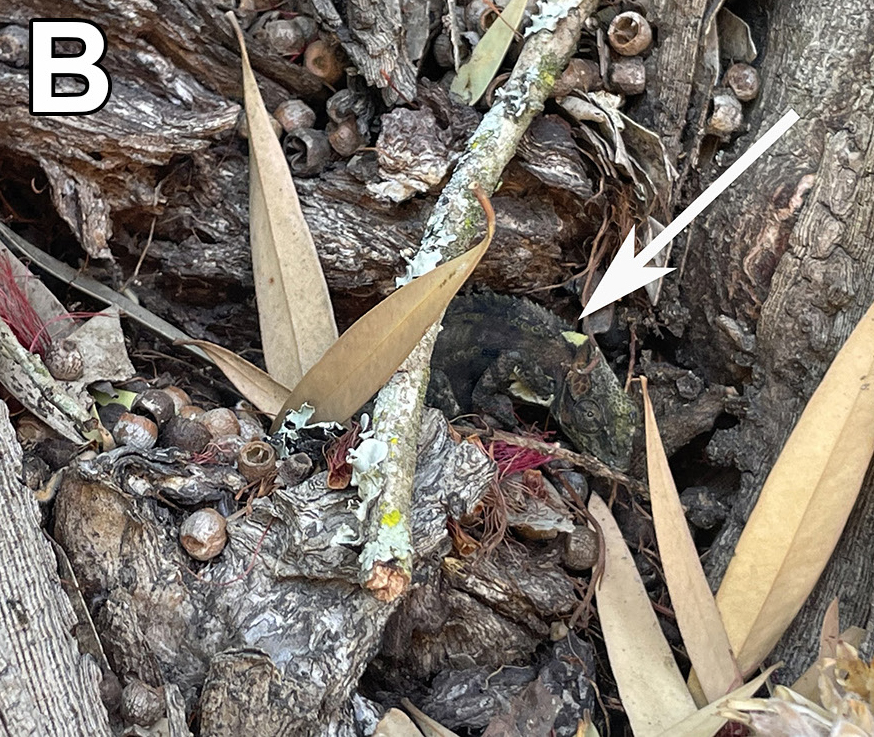
Südafrikanische Wissenschaftler haben sich damit beschäftigt, ob sich der Körperbau eines Zwergchamäleons auf die von ihm bevorzugt genutzten Äste auswirkt. In Südafrika sind drei verschiedene sogenannte Ektomorphe, also Körperbautypen, bei Zwergchamäleons der Gattung Bradypodion bekannt: Einmal den Waldtyp. Dieser Typ kommt in geschlossenen Wäldern vor, ist groß mit langem Schwanz, aber dabei relativ zierlich. Typisch für den Waldtyp sind leuchtende Farben und auffällige Kehlsack- und Helmbeschuppung. Der zweite Typ ist der des „kleinen braunen Chamäleons“, das in offenen Lebensräumen wie Heide, Grassavanne oder Fynbos vorkommt. Wie der Name es schon vermuten lässt, ist dieser Chamäleontyp klein, unauffällig braun oder grünlich gefärbt und zeigt eine stark reduzierte Kehl- und Helmbeschuppung. Der dritte Ektomorph ist der Buschlandtyp: Chamäleons in Buschland oder Dickicht, die groß, aber insgesamt eher plump und kurzschwänzig sind, eher unauffällig gefärbt, dabei aber eine auffällige Kehlsack- und Helmbeschuppung aufweisen.

Die Wissenschaftler maßen die Durchmesserung und Winkelung der von verschiedenen Bradypodion-Arten genutzten Ästen. Folgende Arten waren unter den Probanden: B. barabtulum, B. baviaanense, B. caffrum, B. damaranum, B. ketanicum, B. melanocephalum, B. occidentale, B. pumilum, B. setaroi, B. taeniabronchum, B. thamnobates, B. transvaalense und B. ventrale, zusätzlich die drei candidate species „emerald“, „groendal“ und „karkloof“. Chamäleons aus 38 verschiedenen Populationen in ganz Südafrika wurden jeweils nachts vermessen und in eine der drei genannten Körperbau-Typen sortiert. Zusätzlich wurde entlang je 100 m langer, zufällig ausgewählter Transekte alle 10 m Ast-Durchmesser und -winkel im Umkreis von je einem Meter vermessen.

Anschließend wurden die Daten statistisch ausgewertet. Im Zeitraum von 2007 bis 2024 konnten insgesamt 1755 adulte Bradypodion und deren Äste vermessen werden. Im Wald stand den Chamäleons eine wesentlich höhere Vielfalt and Durchmesser und Winkelung geeigneter Äste zur Verfügung als in den beiden anderen Habitaten. Die Chamäleons zeigten im Wald keine Bevorzugung bestimmter Äste, sondern „nutzten was da war“. Der Lebensraum der „kleinen braunen Chamäleons“ dagegen wies deutlich mehr vertikale, dünnere Äste als der Wald auf, die aber eine ähnliche Winkelung hatten. Die Dichte an Zweigen war in diesem Habitat am höchsten. Die „kleinen braunen Chamäleons“ wählten jedoch signifikant weniger häufig vertikale und meist auch dickere Äste als in ihrem Lebensraum vorhanden gewesen wäre. Im Buschland fanden die Wissenschaftler mehr vertikale und dünnere Äste als im Wald, und in der Zahl unterschieden sich die Äste nicht vom offenen Lebensraum wie Fynbos, aber durch einen anderen Astdurchmesser. Der Buschland-Körpertyp war größer als in den beiden anderen Lebensräumen. Auffällig war bei den Buschland-Chamäleons, dass Weibchen lieber dickere Äste nutzten und auch lieber weniger vertikale Äste als vorhanden waren.

Die Studie zeigt, dass tatsächlich unterschiedliche Ektomorphe von Zwergchamäleons in Südafrika auch unterschiedliche Lebensraumstrukturen besetzen.

Comparing perch availability and perch use between African dwarf chameleon (Bradypodion) ectomorphs
Jody M. Barends, Melissa A. Petford, Krystal A. Tolley
Current Zoology 71(5), 2025: 633-644
DOI: 10.1093/cz/zoae076
Kostenloser Download des Artikels

Grafik: Die drei unterschiedlichen Körperbau-Typen, aus der oben genannten Publikation[:en]

South African scientists have investigated whether the physique of a dwarf chameleon affects the branches it prefers to use. In South Africa, three different ectomorphs, or body types, are known among dwarf chameleons of the genus Bradypodion: First, there is the forest ecomorph. This ecomorph is found in closed canopy forests, is large with a long tail, but relatively gracile. Typical for the forest ecomorph are bright colours and conspicuous gular and and casque ornamentations. The second ecomorph is the ‘small brown chameleon’, which occurs in open habitats such as heathland, grass savannah or fynbos. As the name suggests, this type of chameleon is small, inconspicuous brown or greenish in colour and has reduced gular and casque ornamentation. The third ecomorph is the bushland ecomorph: chameleons in bushland or thickets that are large but generally rather heavy-bodied and short-tailed, rather inconspicuous in colour, but with conspicuous gular and casque ornamentation.

The scientists measured the diameter and angle of the branches used by different Bradypodion species. The following species were among the test subjects: B. barabtulum, B. baviaanense, B. caffrum, B. damaranum, B. ketanicum, B. melanocephalum, B. occidentale, B. pumilum, B. setaroi, B. taeniabronchum, B. thamnobates, B. transvaalense and B. ventrale, as well as the three candidate species ‘emerald’, “groendal” and ‘karkloof’. Chameleons from 38 different populations across South Africa were measured at night and sorted into one of the three body types mentioned above. In addition, branch diameters and angles were measured every 10 metres along randomly selected 100-metre-long transects within a radius of one metre.

The data was then statistically evaluated. Between 2007 and 2024, a total of 1,755 adult Bradypodion and their branches were measured. The forest ecomorph chameleons had access to a much greater variety of suitable branches in terms of diameter and angle than in the other two habitats. The chameleons did not show a preference for certain branches in the forest, but rather ‘used what was available’. The habitat of the ‘small brown chameleons’, on the other hand, had significantly more vertical, thinner branches than the forest, but these had a similar angle. The density of branches was highest in this habitat. However, the ‘small brown chameleons’ chose vertical and usually thicker branches significantly less often than would have been available in their habitat. In the shrubland, the scientists found more vertical and thinner branches than in the forest, and in terms of number, the branches did not differ from the open habitat such as fynbos, but differed in branch diameter. The shrubland ecomorph was larger than those ecomorphs of the other two habitats. It was noticeable that the female shrubland chameleons preferred to use thicker branches and also preferred fewer vertical branches than were available.

The study shows that different ectomorphs of dwarf chameleons in South Africa do indeed occupy different habitat structures.

Comparing perch availability and perch use between African dwarf chameleon (Bradypodion) ecomorphs
Jody M. Barends, Melissa A. Petford, Krystal A. Tolley
Current Zoology 71(5), 2025: 633-644
DOI: 10.1093/cz/zoae076
Free download of the article

Graphic: The three different ecomorphs, from the above-mentioned publication[:]

[:de]Neue Verbreitungsdaten zu Rieppeleon brachyurus in Mosambik[:en]New distribution data of Rieppeleon brachyurus in Mozambique[:]

[:de]Neue Verbreitungsdaten zu Rieppeleon brachyurus in Mosambik[:en]New distribution data of Rieppeleon brachyurus in Mozambique[:]

Beobachtungen Verbreitung Wissenschaft

[:de]

Rieppeleon brachyurus ist eine kleine Stummelschwanzchamäleon-Art, deren Erstbeschreibung vom Ende des 19. Jahhunderts von den Shire Highlands südlich des See Malawi berichtet. Die Art wurde seitdem in Malawi, Tansania und Mosambik gefunden. In Mosambik war sie bisher von Regen- und Galeriewäldern, sogenannten Miombo-Wäldern, bekannt. Bei Miombo-Wäldern handelt es sich um sehr offenenTrockenwälder, deren Boden nur spärlich von Gras bedeckt ist und daher einen eher savannenartigen Eindruck macht (daher auch der Begriff „Waldsavanne“). Der quer durch Mosambik verlaufende Fluss Sambesi galt bisher als natürliche Grenze für das Vorkommen von Rieppeleon brachyurus.

Herpetologen haben nun festgestellt, dass die Art auch südlich des Flusses vorkommt. Sie fanden zwei juvenile Individuen und zwei adulte Weibchen der Art in Coutada 11, einer 5000 km² großen Jagdkonzession im Herzen Mosambiks. Die Tiere wurden dort in einem Sandwald, einem seltenen tropischen Waldtyp auf Sanddünen, direkt neben einem flachen Feuchtgebiet. Diese Beobachtungen erweitern das bisher bekannte Verbreitungsgebiet der Art um rund 250 km weiter nach Süden.

Die Autoren berichten außerdem von zwei weiteren, neuen Fundorten von Rieppeleon brachyurus in Taratibu und Montepuez Rubi Mining Concession, wobei diese beiden Orte nördlich des Sambesi liegen. Bei beiden Beobachtungen wurden die Erdchamäleons in Miombo-Wald auf Höhen zwischen 250 und 400 m gefunden.

Rieppeleon brachyurus (Günther, 1893) Beardless Pygmy Chameleon First records south of the Zambezi River
W. Conradie, D. Botma, C. Nanvonnamuquitxo
African Herp News 88, 2025: 28-33
DOI: nicht verfügbar
Kostenloser Download des Artikels

Foto: Juveniles Rieppeleon brachyurus in Mosambik, fotografiert von Delport Botma, aus der oben genannten Publikation[:en]

Rieppeleon brachyurus is a small stump-tailed chameleon species, first described at the end of the 19th century from the Shire Highlands south of Lake Malawi. The species has since been found in Malawi, Tanzania and Mozambique. In Mozambique, it was previously known from rainforests and gallery forests, known as miombo forests. Miombo forests are very open dry forests with sparse grass cover, giving them a savannah-like appearance (hence the term ‘forest savannah’). The Zambezi River, which runs across Mozambique, was previously considered the natural boundary for the occurrence of Rieppeleon brachyurus.

Herpetologists have now discovered that the species also occurs south of the river. They found two juvenile individuals and two adult females of the species in Coutada 11, a 5000 km² hunting concession in the heart of Mozambique. The animals were found there in a sand forest, a rare type of tropical forest on sand dunes, right next to a shallow wetland. These observations extend the previously known range of the species by about 250 km further south.

The authors also report two further new locations where Rieppeleon brachyurus has been found, in Taratibu and Montepuez Rubi Mining Concession, both of which are located north of the Zambezi River. In both observations, the ground chameleons were found in miombo forest at altitudes between 250 and 400 m.

Rieppeleon brachyurus (Günther, 1893) Beardless Pygmy Chameleon First records south of the Zambezi River
W. Conradie, D. Botma, C. Nanvonnamuquitxo
African Herp News 88, 2025: 28-33
DOI: not available
Free download of the article

Photo: Juvenile Rieppeleon brachyurus in Mozambique, photographed by Delport Botma, from the above-mentioned publication[:]

[:de]Zwei „neue alte“ Chamäleonarten aus Madagaskar[:en]Two „new old“ chameleon species from Madagascar[:]

[:de]Zwei „neue alte“ Chamäleonarten aus Madagaskar[:en]Two „new old“ chameleon species from Madagascar[:]

Neubeschreibungen Wissenschaft

[:de]

Schon länger weiß man, dass es sich bei Calumma gallus aus dem Osten Madagaskars eher nicht nur um eine Art handelt, sondern um einen ganzen Art-Komplex. Wissenschaftler haben sich nun näher mit dem Komplex beschäftigt und neue genetische Untersuchungen veranlasst – und dabei einige Arten völlig über den Haufen geworfen.

Die Kurzfassung:

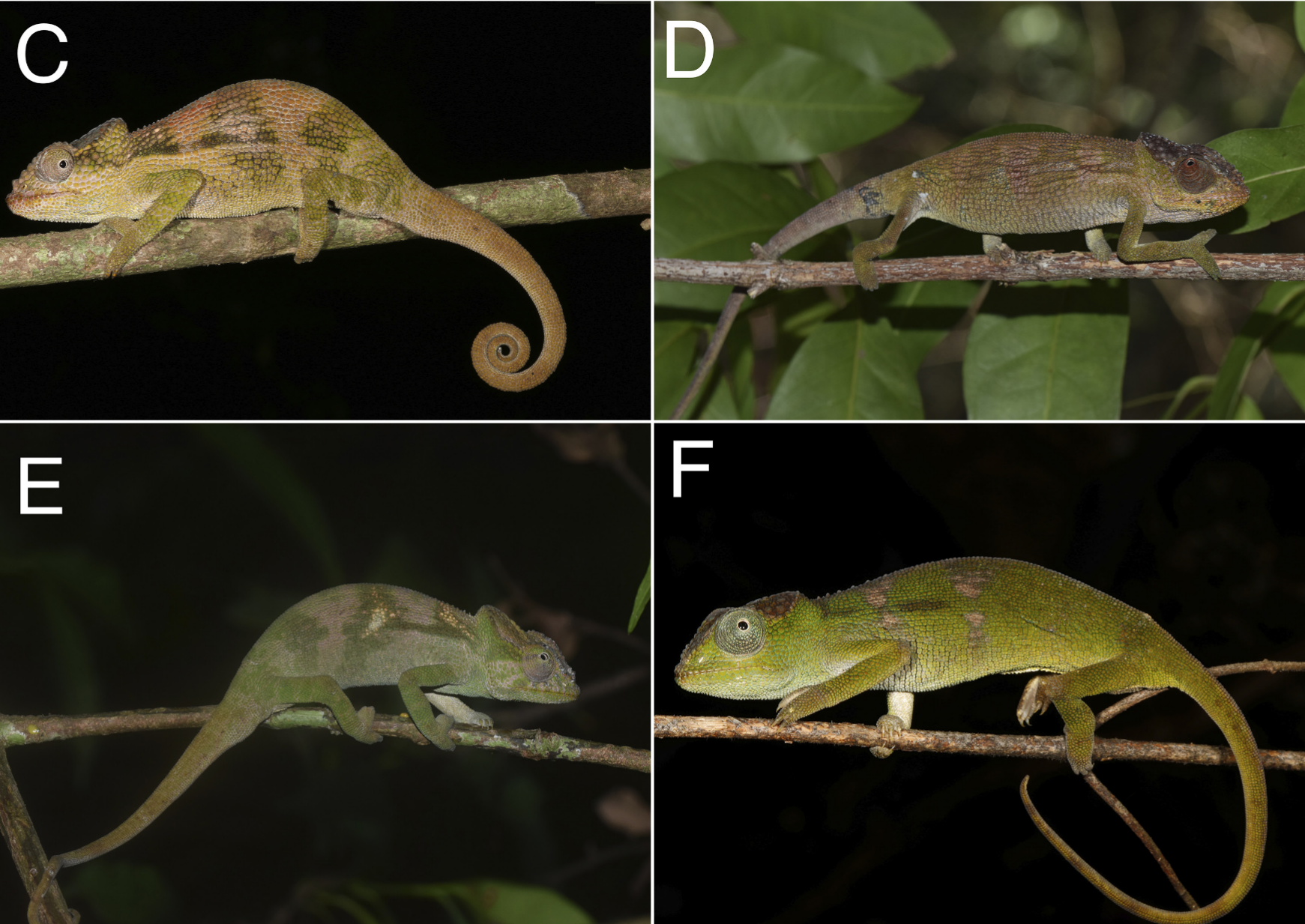
Das, was man bisher für Calumma nasutum aus Andasibe, Anosibe An’Ala und Tarzanville hielt, heißt jetzt Calumma hofreiteri. Die Weibchen sind nach wie vor nicht sicher von Calumma emelinae zu unterscheiden. Das „echte“ Calumma nasutum kommt in Regenwäldern nahe Ranomafana und Mananjary vor. Die Männchen von Calumma nasutum tragen einen deutlich größeren Nasenfortsatz, der häufig gelb gefärbt ist während die Weibchen nur eine rote Stupsnase haben. Calumma nasutum gehört übrigens zum gallus-Komplex.

Das, was man bisher für Calumma gallus hielt und im Schutzgebiet Vohimana und Umgebung vorkommt, heißt nun Calumma pinocchio. Das „echte“ Calumma gallus kommt in einem Waldfragment nahe Tarzanville, in Tsinjoarivo und mehreren kleinen Gebieten nahe Toamasina an der Ostküste Madagaskars vor. Sein Nasenfortsatz ist oben gezahnt, während der Nasenfortsatz von Calumma pinocchio glatt ist.

Towards a revision of the Malagasy chameleons of the Calumma gallus complex: Redefinition of Calumma nasutum based on a museomics approach and descriptions of two new species
Frank Glaw, Stefanie Agne, David Prötzel, Philip-Sebastian Gehring, Jörn Köhler, Michaela Preick, Fanomezana M. Ratsoavina, Nicolas Straube, Katharina Wollenberg Valero, Angelica Crottini, Miguel Vences
Salamandra 61(4): 442-466, 2025.
DOI: nicht verfügbar
Kostenloser Download des Artikels

Foto: aus der oben genannten Veröffentlichung, Calumma nasutum [:en]

It has long been known that Calumma gallus from eastern Madagascar is not just one species, but rather an entire species complex. Scientists have now taken a closer look at the complex and conducted new genetic studies – completely overturning some species classifications in the process.

The short version:

What was previously thought to be Calumma nasutum from Andasibe, Anosibe An’Ala and Tarzanville is now called Calumma hofreiteri. The females still cannot be reliably distinguished from Calumma emelinae. The ‘real’ Calumma nasutum occurs in rainforests near Ranomafana and Mananjary. The males of Calumma nasutum have a significantly larger rostral appendage, which is often yellow in colour, while the females only have a red snub nose. Calumma nasutum belongs to the gallus complex.

What was previously thought to be Calumma gallus and occurs in the Vohimana reserve and surrounding area is now called Calumma pinocchio. The ‘real’ Calumma gallus occurs in a forest fragment near Tarzanville, in Tsinjoarivo and several small areas near Toamasina on the east coast of Madagascar. Its rostral appendage is serrated at the top, while the rostral appendage of Calumma pinocchio is smooth.

Towards a revision of the Malagasy chameleons of the Calumma gallus complex: Redefinition of Calumma nasutum based on a museomics approach and descriptions of two new species
Frank Glaw, Stefanie Agne, David Prötzel, Philip-Sebastian Gehring, Jörn Köhler, Michaela Preick, Fanomezana M. Ratsoavina, Nicolas Straube, Katharina Wollenberg Valero, Angelica Crottini, Miguel Vences
Salamandra 61(4): 442-466, 2025.
DOI: not available
Free download of the article

Photo: from the above publication, Calumma nasutum [:]

[:de]Bradypodion pumilum: Doch ein Lauerjäger[:en]Cape dwarf chameleons are ambush predators[:]

[:de]Bradypodion pumilum: Doch ein Lauerjäger[:en]Cape dwarf chameleons are ambush predators[:]

Beobachtungen Wissenschaft

[:de]

Klassisch wurde lange nur zwischen zwei Varianten der Nahrungssuche unterschieden: Verfolgungsjäger (active forage) und Lauerjäger (sit and wait oder ambush foragers). Vor vielen Jahren stuften zwei Veröffentlichungen Chamäleons dann als „cruise forager“, also sich langsam durch das Gebüsch bewegende Jäger, ein. Eine Studie aus Südafrika beschäftigt sich nun damit, ob das stimmt und ob nicht weitere Faktoren zur Bewegung beitragen. Denn um den Modus der Nahrungssuche bewerten zu können, müsste man eigentlich auch Bewegung zur Regulation der Körpertemperatur, dem Ausweichen vor Fressfeinden oder Kontrahenten, der Suche nach Weibchen oder für Mate Guarding „herausrechnen“.

Dazu wurden 38 markierte (12 davon besenderte) Bradypodion pumilum über 10 Tage im April und 10 Tage im Februar begleitet. Die Chamäleons leben im Brümmer Park in Stellenbosch in der Provinz Westkap. Sie teilten sich auf in 17 männliche, 19 weibliche und 2 unbestimmte Bradypodion pumilum. Die Tiere wurden jeden Abend und jeden Morgen an den genannten Tagen mittels Telemetrie und bloßem Auge lokalisiert. Jedes Chamäleon wurde für 60 bis 180 Minuten am Stück beobachtet, wobei je zwei bis vier Beobachter sich dabei mit einem Fernglas zwischen 5 und 10 m vom zu beobachtenden Chamäleon weg befanden. Die Forscher zeichneten Bewegungen und stillsitzendes Verhalten auf und ordneten den Bewegungen jeweils die dazugehörige Motivation zu, nahmen Futteraufnahme und Schusszahlen auf.

Insgesamt kamen 171 Stunden Beobachtungszeit zusammen. Die überwiegende Zeit des Tages (über 75%) verbrachten die Bradypodion pumilum im Brümmer Park unbeweglich auf ihrem Ast. Am Morgen saßen sie sogar zu über 80% herum, wobei fast die Hälfte dieser Zeit gesonnt wurde, vermutlich um sich aufzuwärmen, und die andere Hälfte in schattiger Vegetation verbracht wurde. 26 Bradypodion pumilum fraßen im Beobachtungszeitraum insgesamt 110 Mal. Dabei fraßen sie signifikant häufiger (über 80%), wenn sie sich gerade nicht bewegten. Ein starker Faktor für Bewegung war die Interaktion mit Artgenossen – während den Beobachtungen wurde ein Männchen sogar von einem Weibchen so vertrieben, das es vom Baum fiel.

Die Autoren schließen aus ihrer Studie, dass es sich bei Bradypodion pumilum wohl doch eher um einen Lauerjäger handelt.

 A multi-index approach to assessing foraging mode: a case study using chameleons
Wade K. Stanton-Jones, Krystal A. Tolley, Jody M. Barends, Graham J. Alexander
Current Zoology, 2025, zoaf065
DOI: 10.1093/cz/zoaf065
Kostenloser Download des Artikels

Foto: Besendertes Bradypodion pumilum aus der genannten Studie[:en]

For a long time, only two types of foraging behaviour were distinguished: active foragers and sit-and-wait or ambush foragers. Many years ago, two publications classified chameleons as ‘cruise foragers’, i.e. hunters that move slowly through the bushes, stop to feed and then move on. A study from South Africa is now investigating whether this is true and whether other factors contribute to movement. In order to evaluate the mode of foraging, one would actually have to ‘factor out’ movement for regulating body temperature, evading predators or opponents, searching for females or mate guarding.

To this end, 38 tagged (12 of them radio-tagged) Bradypodion pumilum were tracked over 10 days in April and 10 days in February. The chameleons live in Brümmer Park in Stellenbosch in the Western Cape province. They were divided into 17 male, 19 female and 2 indeterminate Bradypodion pumilum. The animals were located every evening and every morning on the specified days using telemetry and the naked eye. Each chameleon was observed for 60 to 180 minutes at a time, with two to four observers using binoculars from a distance of 5 to 10 metres from the chameleon being observed. The researchers recorded movements and stationary behaviour and assigned the corresponding motivation to each movement, noting food intake and number of shots.

A total of 171 hours of observation time was accumulated. Bradypodion pumilum spent most of the day (over 75%) stationary on their branches in Brümmer Park. In the morning, over 80% of them were sitting around, with almost half of this time spent sunbathing, presumably to warm up, and the other half spent stationary in shady vegetation. During the observation period, 26 Bradypodion pumilum fed a total of 110 times. They ate significantly more often (over 80%) when they were not moving. A strong factor for movement was interaction with conspecifics – during the observations, one male was even chased away by a female, causing it to fall from the tree.

The authors conclude from their study that Bradypodion pumilum is more likely to be a ambush hunter.

A multi-index approach to assessing foraging mode: a case study using chameleons
Wade K. Stanton-Jones, Krystal A. Tolley, Jody M. Barends, Graham J. Alexander
Current Zoology, 2025, zoaf065
DOI: 10.1093/cz/zoaf065
Free article download

Photo: Bradypodion pumilum tagged with a transmitter from the study mentioned above[:]

[:de]Vortrag in Frankfurt über Äthiopien[:en]Presentation in Frankfurt about Ethiopia[:]

[:de]Vortrag in Frankfurt über Äthiopien[:en]Presentation in Frankfurt about Ethiopia[:]

Reiseberichte Vorträge Wissenschaft

[:de]

Der Herpetologe Dr. Arthur Tiutenko von der Friedrich-Alexander-Universität Erlangen-Nürnberg hält am Freitag, den 26. September 2025 einen bilderreichen Vortrag über einen sehr speziellen Wald in  Äthiopien.

Der Harenna-Wald, der sich entlang des Südhangs des Bale-Gebirges im Süden Äthiopiens erstreckt, ist eines der letzten Waldgebiete am Horn von Afrika und der größte noch verbliebene Regenwald des afrikanischen Festlandes. Er ist nicht nur die Heimat des Arabica-Kaffees, sondern beherbergt auch zahlreiche andere endemische Pflanzen- und Tierarten, von denen viele noch nicht wissenschaftlich entdeckt und beschrieben sind. Die Herpetofauna des Harenna-Waldes umfasst mehr als 40 Arten, darunter die beiden großen äthiopischen Vipern – Bitis harenna und Bitis parviocula. Die Lebensräume dieser Tiere und das gesamte Ökosystem werden durch Überbevölkerung und zunehmende wirtschaftliche Nutzung zerstört. Sogar die Zukunft der offiziell geschützten Teile des Waldes sieht schwarz aus. Umso wichtiger ist es, Wissen über die Arten zu erlangen, die im Wald noch leben, bevor es zu spät ist. Arthur Tiutenko hat den Harenna Wald in zehn Expeditionen erkundet, über deren Ergebnisse er in diesem Vortrag berichtet.

Dr. Arthur Tiutenko Harenna Forest, Äthiopien – 12 Jahre Expeditionen in den letzten Regenwald am Horn von Afrika
DGHT Stadtgruppe Frankfurt
Zooschule des Zoo Frankfurt
Bernhard-Grzimek-Allee 1
60316 Frankfurt am Main
Vortragsbeginn 19.00 Uhr, Einlass ab 18:30 Uhr über das Ausgangstor am Haupteingang Alfred-Brehm-Platz (Tor zwischen Zoo-Shop und Zoogesellschaftshaus)

Foto: Trioceros balebicornutus, fotografiert von Arthur Tiutenko auf einer seiner Reisen[:en]

On Friday, 26 September 2025, herpetologist Dr Arthur Tiutenko from Friedrich-Alexander University Erlangen-Nuremberg will give a lecture accompanied by numerous images about a very special forest in Ethiopia.

The Harenna Forest, which stretches along the southern slopes of the Bale Mountains in southern Ethiopia, is one of the last remaining forest areas in the Horn of Africa and the largest remaining rainforest on the African mainland. It is not only home to Arabica coffee, but also to numerous other endemic plant and animal species, many of which have not yet been scientifically discovered and described. The herpetofauna of the Harenna Forest includes more than 40 species, including the two large Ethiopian vipers – Bitis harenna and Bitis parviocula. The habitats of these animals and the entire ecosystem are being destroyed by overpopulation and increasing economic exploitation. Even the future of the officially protected parts of the forest looks bleak. This makes it all the more important to gain knowledge about the species that still live in the forest before it is too late. Arthur Tiutenko has explored the Harenna Forest in ten expeditions, the results of which he reports on in this lecture.

Dr. Arthur Tiutenko Harenna Forest, Ethiopia – 12 years of expeditions into the last rainforest in the Horn of Africa [German]
DGHT Stadtgruppe Frankfurt
Zoo school of Zoo Frankfurt
Bernhard-Grzimek-Allee 1
60316 Frankfurt am Main
Lecture begins at 7 p.m., doors open at 6:30 p.m. via the exit gate at the main entrance on Alfred-Brehm-Platz (gate between the zoo shop and the zoo society building).

Photo: Trioceros balebicornutus, photographed by Arthur Tiutenko on one of his travels[:]