[:de]Chamäleon-Literatur abzugeben[:en]Chameleon literature available[:]

[:de]Chamäleon-Literatur abzugeben[:en]Chameleon literature available[:]

Abzugeben AG Interna

[:de]

Ein langjähriges AG-Mitglied hat uns dankenswerterweise eine ganze Reihe Chamäleon- und Reptilienbücher und -paper zur Verfügung gestellt, die zu Gunsten der AG Chamäleons nun abgegeben werden. Darunter sind einige sehr alte Schätze und viele vergriffene Ausgaben von Büchern sowie alte Publikationen, teils im Original. Alle Bücher und Paper können ggf. per Post verschickt werden, Versand kommt auf den Preis obendrauf. Bitte bei Interesse eine E-Mail an info@agchamaeleons.de schreiben. Im Folgenden eine Liste der vorhandenen Literatur mit Informationen zum Erhaltungszustand. Fotos zu allen Stücken anbei gibt es gerne auf Anfrage oder hier.

1 Philippe Philippe de Vosjoli: Essential Care of Chameleons
Paperback, 72 Seiten, 3. Auflage von 2004, vergriffen
Preis: 10 €
Zustand: Sehr gut, innen einwandfrei, außen dezent bestoßene Ecken und Kanten

2 Wolfgang Schmidt, Klaus Tamm, Erich Wallikewitz: Chamäleons Drachen unserer Zeit
Paperback, 160 Seiten, 2. Auflage von 1996
Preis: 10 €
Zustand: Sehr gut, innen einwandfrei, außen dezent bestoßene Ecken und Kanten

3 Rolf Müller, Nicolá Lutzmann, Ulrike Walbröl: Furcifer pardalis, Das Pantherchamäleon
Paperback, 127 Seiten, 1. Auflage von 2004, vergriffen
Preis: 10 €
Zustand: fast wie neu, außen minimal bestoßene Ecken

4 Dr. Wolfgang Uthmöller: Schlangen wie ich sie sah
Hardcover, 127 Seiten, vermutlich von 1948
Preis: 20 €
Zustand: für sein Alter sehr gut, Seiten natürlich vergilbt, Schnitt und Einband stellenweise fleckig, innen im Einband Reste alter Aufkleber, Seiten selbst innen einwandfrei.

5 Joseph Nicolai Laurenti: Austriaci Viennensis Specimen medicum exhibens Synopsin Reptilium emendatam cum experimentis circa venena et antidota reptilium austriacorum
Paperback, 248 Seiten, Reprint mit englischer Übersetzung von 2005
Preis: 25 €
Zustand: wie neu

6 James B. Murphy: Chameleons: Johann von Fischer and other perspectives
Paperback, 123 Seiten, 1. Auflage von 2005
Preis: 15 €
Zustand: sehr, außen minimal bestoßene Ecken und sehr dezente Knicke, innen einwandfrei

7 Vincent A. Wagner: The life of the chameleon
Paperback, 32 Seiten, 2. Auflage von 1987
Zustand: gut bis sehr gut, Einband auf den Flächen und an den Ecken etwas bestoßen (siehe Foto), innen einwandfrei

8 Philippe de Vosjoli: True chameleons Part II, Notes on popular species, diseases and disorders
Paperback, 28 Seiten, 1. Auflage 1990, vergriffen
Preis: 15 €
Zustand: gut, Einband mit Lagerungsflecken und minimalen Knicke, innen einwandfrei

9 Philippe de Vosjoli: True Chameleons Part I Husbandry
Paperback, 36 Seiten, 1. Auflage von 1990, vergriffen
Preis: 15 €
Zustand: gut, Einband mit kleineren Flecken, Buchrücken etwas angestoßen, innen einwandfrei

10 Frank Glaw, Miguel Vences: A fieldguide to the amphibians and reptiles of Madagascar
Paperback, 480 Seiten, 2. Auflage von 1994
Preis: 5 €
Zustand: sehr gut, Kanten und Ecken bestoßen, innen einwandfrei

11 Krystal Tolley, Marius Burger: Chameleons of Southern Africa
Paperback, 100 Seiten, 1. Auflage von 2007
Preis: 15 €
Zustand: fast wie neu, Ecken und Kanten minimal bestoßen

12 Michaela Jötzlaff: Das Helmchamäleon Chamaeleo (Trioceros) hoehnelli
Paperback, 63 Seiten, 1. Auflage von 2008
Preis: 10 €
Zustand: wie neu, innen mit Widmung mit Namen versehen

13 Rudolf Malkmus: Die Amphibien und Reptilien Portugals, Madeiras und der Azoren
Paperback, 98 Seiten, 1. Auflage von 1995
Preis: 15 €
Zustand: sehr gut, kleinere Flecke auf dem Einband und Schnitt, innen einwandfrei

14 Francois LeBerre, R.D. Bartlett, Patricia Bartlett: The Chameleon Handbook
Paperback, 128 Seiten, 2. Auflage von 2000
Preis: 15 €
Zustand: wie neu, Preisaufkleber auf der Rückseite des Einbands

15 R.D. Bartlett, Patricia Bartlett: Chameleons, a complete pet owner’s manual
Paperback, 103 Seiten, 1. Auflage von 1995
Preis: 10 €
Zustand: sehr gut, Ecken und Kanten etwas bestoßen, Buchrücken ausgeblichen

16 Günther Masurat: Vermehrung von Chamäleons
Hardcover, 143 Seiten, 1. Auflage von 2005
Preis: 15 €
Zustand; sehr gut, Ecken minimal bestoßen, innen wie neu

17 Gaston-Francois de Witte: Les Caméléons de l’Afrique Centrale
Paperback, > 200 Seiten, vermutlich 1. Auflage von 1965, vergriffen
Preis: 50 €
Zustand: sehr gut, Buchrücken ausgeblichen, Kanten minimal bestoßen, auf erster Seite innen mit Bleistift Notizen, innen einwandfrei

18 E.-R. Brygoo: Faune de Madagascar, XXXIII Reptiles Sauriens Chamaeleonidae Genre Chamaeleo
Paperback, 318 Seiten, 1. Auflage von 1971
Preis: 40 €
Zustand: Gut, Einband vergilbt, Kanten des Buchrückens deutlich bestoßen, der Rückseite des Einbands fehlen beide Ecken; innen völllig einwandfrei

19 Philippe de Vosjoli, Gary Ferguson: Care and Breeding of Chameleons
Paperback, 128 Seiten, 1. Auflage von 1995, vergriffen
Preis: 15 €
Zustand: gut bis sehr gut, Einband v.a. an Ecken und Kanten bestoßen und mit kleinen Rissen und Knicken, Buchrücken verblichen, innen einwandfrei

20 Rolf Müller, Wolfgang Schmidt: Stummelschwanzchamäleons der Gattung Rieppeleon
Paperback, 95 Seiten, 1. Auflage von 2008
Preis: 10 €
Zustand: sehr gut, Kanten stellenweise bestoßen, auf der ersten Seite eine Widmung der Autoren, sonst innen einwandfrei

21 Fitzinger’s Systema Reptilium
Paperback, 115 Seiten, Reprint von 1973, vergriffen
Preis: 30 €
Zustand: auf erster Seite innen kleine Notiz mit Bleistift, sonst einwandfrei; Buchrücken etwas ausgeblichen, Ecken und Kanten leicht bestoßen

22 Henkel, Schmidt: Amphibien und Reptilien Madagaskars, der Maskarenen, Seychellen und Komoren
Hardcover, 312 Seiten, 1. Auflage von 1995
Preis: 10 €
Zustand: gut bis sehr gut, Ecken etwas bestoßen, Einband ausgeblichen, innen einwandfrei

23 J.E. Gray’s The Zoological Miscellany
Paperback, 90 Seiten 1. Auflage von 1971
Preis: 10 €
Zustand: gut bis sehr gut, Buchrücken und Teile des Einbands verfärbt/verblichen, sonst einwandfrei

24 William R. Branch, Aaron M. Bauer: The herpetological contributions of Sir Andrew Smith
Paperback, 85 Seiten, 1. Auflage von 2005
Preis: 15 €
Zustand: wie neu

25 Charles Klaver, Wolfgang Böhme: Phylogeny and classification of the Chamaeleonidae (Sauria) with special reference to hemipenis morphology
Paperback, 64 Seiten, 1. Auflage von 1986
Zustand: kleine Beschädigung am Buchrücken, Buchrücken verblichen, sonst sehr gut

26 Robert Mertens, Willi Henning, Heinz Wermuth: Das Tierreich, eine Zusammenstellung und Kennzeichnung der rezenten Tierformen
Paperback, 38 Seiten, 1. Auflage von 1966
Zustand: sehr gut, Ecken und Kanten bestoßen, Bleistiftnotiz auf der ersten Seite, sonst innen einwandfrei

27 A. E. Gunther: The miscellaneous autobiographical manuscripts of John Edward Gray (1800-1875)
Paperback, 245 Seiten, 1. Auflage von 1980
Preis: 10 €
Zustand: gut bis sehr gut, Bleistiftnotiz auf Einband, Einband mit kleineren Knicken und Flecken, innen einwandfrei

28 A.S. Rand: Notes on the Chamaeleo bitaeniatus complex
Paperback, 30 Seiten, 1. Auflage von 1963
Preis: 10 €
Zustand: sehr gut, kleinere Flecken unten auf Einband, Rücken verblichen, Ränder dito, innen einwandfrei

29 Robert Mertens: Das Chamäleon der Insel Pemba
2 Seiten von 1964
Preis: 10 €
Zustand: sehr gut, minimale Knicke am oberen Rand

30 Separate of a paper published by The international Trust for Zoological nomenclature on behalf of the international commission on zoological nomenclature
3 Seiten geklammert, von 1971
Preis: 10 €
Zustand: sehr gut, Einband mit Knick in oberer Ecke und sehr kleinen Flecken

31 Prof. Dr. Robert Mertens: Lebendgebärende Dreihorn-Chamäleons
Heft 7/8 Natur und Volk von 1949, 5 Seiten
Preis:
Zustand: sehr gut, dezente Knicke, innen einwandfrei

32 Thomas Barbour: Two new species of chameleons
Proceedings of the biological society of Washington, Vol. XVI, 1903, 1 Seite
Preis: 15 €
Zustand: sehr gut

33 Zoologischer Anzeiger vom 10. April 1893
Preis: 25 €
Zustand: sehr gut, Titelseite mit Stempel und handschriftlicher Notiz, sonst einwandfrei für das Alter

34 A. Stanley Rand: A new subspecies of Chamaeleo jacksonii Boulenger and a key to the species of three-horned chameleons
Breviora, Museum of Comparative Zoology Nr. 99, 4 Seiten von 1958
Preis: 15 €
Zustand: sehr gut, Notiz auf Titelseite rechts oben, dezente Knicke

35 Claudia Schnieper, Max Meier: Das Chamäleon, Meisterschütze und Verwandlungskünstler
Hardcover, 40 Seiten, 2. Auflage 1988
Preis: 5 €
Zustand: sehr gut, minimale Flecke am Einband, dezente Verfärbungen der Seitenränder innen

36 Friedrich Wilhelm Henkel, Wolfgang Schmidt: Agamen im Terrarium
Hardcover, 151 Seiten, 1. Auflage von 1997
Preis: 10 €
Zustand: sehr gut, zwei Ecken des Einbands deutlich angestoßen, winziger Riss im Buchrücken, sonst einwandfrei

37 Martin Eisentraut: Im Schatten des Mongo-ma-loba
Hardcover, 240 Seiten, 1. Auflage 1982
Preis: 5 €
Zustand: gut bis sehr gut, Einband ausgeblichen mit kleineren Knicken, Ecken etwas bestoßen, kleine Bleistiftnotiz auf erster Seite, innen einwandfrei

38 Gunther Köhler: Inkubation von Reptilieneiern
Hardcover, 205 Seiten, 1. Auflage von 1997
Preis: 10 €
Zustand: gut bis sehr gut, Einband deutlich verblichen, sonst einwandfrei

39 Kameleon Vereniging Nederland: Kameleons, een fascinerende hobby
Paperback, 96 Seiten, Lacerta 64-5/6 von 2006
Preis:
Zustand: sehr gut, Ecken und Kanten minimal bestoßen

40 Martin Eisentraut: Die Wirbeltierfauna von Fernando Poo und Westkamerun
Bonner Zoologische Monographien Nr. 3, 1973
Preis: 20 €
Zustand: gut bis sehr gut, Einband stellenweise verblichen, Kanten und Ecken bestoßen

41 Annals of the South African Museum Cape Town, Vol. 61, 1973
Paperback, 160 Seiten
Preis: 40 €
Zustand: gut, Einband mit diversen Knicken und Flecken, innen einwandfrei

42 Herpetozoa 18(3/4) von 2005
Paperback, Seite 97-208
Preis: 20 €
Zustand: wie neu

44 E.-R. Brygoo: Faune de Madagacar 47, Reptiles Sauriens Chamaeleonidae: Genre Brookesia et complement pour le genre Chamaeleo
Paperback, 174 Seiten, von 1978
Preis: 35 €
Zustand: sehr gut, Knick und kleiner Riss im Buchrücken, innen einwandfrei

45 Linda J. Davison: Chameleons, their care and breeding
Paperback, 112 Seiten, Auflage von 1997
Preis: 25 €
Zustand: sehr gut, Widmung der Autorin auf der ersten Seite (ohne Namensnennung), dezenter Knick rechts oben, Einband mit diversen sehr kleinen Flecken

46 Draco Terraristik-Themenheft Madagaskar
Nr. 19, Jahrgang 5, 3-2004; Paperback, 96 Seiten
Preis: 20 €
Zustand: wie neu

47 Draco Terraristik-Themenheft Chamäleons
Nr. 1/2000, Jahrgang 1(1), 96 Seiten
Preis: 20 €
Zustand: wie neu

49 Verenigingsblad van de Kameleonvereniging Nederland Nr. 1, 2004
28 Seiten
Preis: 5 €
Zustand; gut bis sehr gut, gelocht und Umschlag etwas vergilbt, innen einwandfrei

50 Abhandlungen der Senckenbergischen Naturforschenden Gesellschaft, Nr. 442
Robert Mertens: Herpetologische Ergebnisse einer Reise nach Kamerun
Paperback, 60 Seiten, 1938
Preis: 35 €
Zustand: sehr gut für das Alter, Einband mit sehr kleinem Riss oben, Rücken bestoßen, unten fehlt ein kleines Stück, darüber ist der Rücken eingerissen, Einband und Seiten mit Vergilbungen an den Rändern, erste Seite innen mit kleinen Flecken, alles übrige innen einwandfrei[:en]

A long-standing member of our working group has kindly provided us with a whole series of books and papers on chameleons and other reptiles, which are now being made available for the benefit of the Chameleon Working Group (AG Chamäleons). Among them are some very old original treasures and many out-of-print editions of books. All books and papers can be sent by post (from Germany), with shipping costs added to the price. If you are interested, please send an email to info@agchamaeleons.de . Below is a list of the available literature with information on its condition. Photos of all items are available on request or here.

1 Philippe Philippe de Vosjoli: Essential Care of Chameleons
Paperback, 72 pages, 3rd edition from 2004, out of print
Price: €10
Condition: Very good, inside flawless, outside with slight wear to corners and edges

2 Wolfgang Schmidt, Klaus Tamm, Erich Wallikewitz: Chamäleons, Drachen unsrer Zeit
Paperback, 160 pages, 2nd edition from 1996
Price: €10
Condition: Very good, inside flawless, outside with slight wear to corners and edges

3 Rolf Müller, Nicolá Lutzmann, Ulrike Walbröl: Furcifer pardalis, das Pantherchamäleon
Paperback, 127 pages, 1st edition from 2004, out of print
Price: €10
Condition: almost like new, minimal wear to corners on the outside

4 Dr. Wolfgang Uthmöller: Schlangen wie ich sie sah
Hardcover, 127 pages, probably from 1948
Price: €20
Condition: very good for its age, pages naturally yellowed, edges and cover stained in places, remnants of old stickers inside the cover, pages themselves in perfect condition.

5 Joseph Nicolai Laurenti: Austriaci Viennensis Specimen medicum exhibens Synopsin Reptilium emendatam cum experimentis circa venena et antidota reptilium austriacorum
Paperback, 248 pages, reprint with English translation from 2005
Price: €25
Condition: like new

6 James B. Murphy: Chameleons: Johann von Fischer and other perspectives
Paperback, 123 pages, 1st edition from 2005
Price: €15
Condition: very good, minimal wear to corners and very slight creases on the outside, inside in perfect condition

7 Vincent A. Wagner: The life of the chameleon
Paperback, 32 pages, 2nd edition from 1987
Condition: good to very good, cover slightly worn on the edges and corners (see photo), inside in perfect condition

8 Philippe de Vosjoli: True chameleons Part II, Notes on popular species, diseases and disorders
Paperback, 28 pages, 1st edition 1990, out of print
Price: €15
Condition: good, cover with storage stains and minimal creases, interior flawless

9 Philippe de Vosjoli: True Chameleons Part I Husbandry
Paperback, 36 pages, 1st edition 1990, out of print
Price: €15
Condition: good, cover with minor stains, spine slightly bumped, interior flawless

10 Frank Glaw, Miguel Vences: A field guide to the amphibians and reptiles of Madagascar
Paperback, 480 pages, 2nd edition from 1994
Price: €5
Condition: very good, edges and corners bumped, inside flawless

11 Krystal Tolley, Marius Burger: Chameleons of Southern Africa
Paperback, 100 pages, 1st edition from 2007
Price: €15
Condition: almost like new, corners and edges minimally bumped

12 Michaela Jötzlaff: Das Helmchamäleon (Trioceros) hoehnelli
Paperback, 63 pages, 1st edition from 2008
Price: €10
Condition: like new, inside with dedication and name

13 Rudolf Malkmus: Die Amphibien und Reptilien Portugals, Madeiras und der Azoren
Paperback, 98 pages, 1st edition from 1995
Price: €15
Condition: very good, minor stains on the cover and edges, inside flawless

14 Francois LeBerre, R.D. Bartlett, Patricia Bartlett: The Chameleon Handbook
Paperback, 128 pages, 2nd edition from 2000
Price: €15
Condition: like new, price sticker on the back of the cover

15 R.D. Bartlett, Patricia Bartlett: Chameleons, a complete pet owner’s manual
Paperback, 103 pages, 1st edition from 1995
Price: 10 €
Condition: very good, corners and edges slightly bumped, spine faded

16 Günther Masurat: Vermehrung von Chamäleons
Hardcover, 143 pages, 1st edition from 2005
Price: 15 €
Condition: very good, corners slightly bumped, inside like new

17 Gaston-Francois de Witte: Les Caméléons de l’Afrique Centrale
Paperback, > 200 pages, presumably 1st edition from 1965, out of print
Price:  40 €
Condition: very good, spine faded, edges minimally bumped, pencil notes on first page inside, interior flawless

18 E.-R. Brygoo: Faune de Madagascar, XXXIII Reptiles Sauriens Chamaeleonidae Genre Chamaeleo
Paperback, 318 pages, 1st edition from 1971
Price: €40
Condition: good, cover yellowed, edges of spine clearly bumped, both corners of back cover missing; inside completely flawless

19 Philippe de Vosjoli, Gary Ferguson: Care and Breeding of Chameleons
Paperback, 128 pages, 1st edition from 1995, out of print
Price: €15
Condition: good to very good, cover scuffed, especially at the corners and edges, with small tears and creases, spine faded, inside in perfect condition

20 Rolf Müller, Wolfgang Schmidt: Stummelschwanzchamäleons der Gattung Rieppeleon Paperback, 95 pages, 1st edition from 2008
Price: 10 €
Condition: very good, edges bumped in places, dedication by the authors on the first page, otherwise inside in perfect condition

21 Fitzinger’s Systema Reptilium
Paperback, 115 pages, reprint from 1973, out of print
Price: €30
Condition: small note in pencil on the first page, otherwise flawless; spine slightly faded, corners and edges slightly bumped

22 Henkel, Schmidt: Amphibians and Reptiles of Madagascar, the Mascarene Islands, Seychelles and Comoros
Hardcover, 312 pages, 1st edition from 1995
Price: €10
Condition: good to very good, corners slightly bumped, cover faded, interior flawless

23 J.E. Gray’s The Zoological Miscellany
Paperback, 90 pages, 1st edition from 1971
Price: €10
Condition: good to very good, spine and parts of the cover discoloured/faded, otherwise flawless

24 William R. Branch, Aaron M. Bauer: The herpetological contributions of Sir Andrew Smith
Paperback, 85 pages, 1st edition from 2005
Price: €15
Condition: like new

25 Charles Klaver, Wolfgang Böhme: Phylogeny and classification of the Chamaeleonidae (Sauria) with special reference to hemipenis morphology
Paperback, 64 pages, 1st edition from 1986
Condition: minor damage to spine, spine faded, otherwise very good

26 Robert Mertens, Willi Henning, Heinz Wermuth: Das Tierreich, eine Zusammenstellung und Kennzeichnung der rezenten Tierformen
Paperback, 38 pages, 1st edition from 1966
Condition: very good, corners and edges bumped, pencil note on the first page, otherwise flawless inside

27 A. E. Gunther: The miscellaneous autobiographical manuscripts of John Edward Gray (1800-1875)
Paperback, 245 pages, 1st edition from 1980
Price: €10
Condition: good to very good, pencil note on cover, cover with minor creases and stains, interior flawless

28 A.S. Rand: Notes on the Chamaeleo bitaeniatus complex
Paperback, 30 pages, 1st edition from 1963
Price: €10
Condition: very good, minor stains on the bottom of the cover, spine faded, edges ditto, interior flawless

29 Robert Mertens: The Chameleon of Pemba Island
2 pages from 1964
Price: €10
Condition: very good, minimal creases on the top edge

30 Separate of a paper published by The International Trust for Zoological Nomenclature on behalf of the International Commission on Zoological Nomenclature
3 pages stapled, from 1971
Price: €10
Condition: very good, cover with crease in upper corner and very small spots

31 Prof. Dr. Robert Mertens: Live-bearing three-horned chameleons
Issue 7/8 Natur und Volk from 1949, 5 pages
Price:
Condition: very good, slight creases, interior flawless

32 Thomas Barbour: Two new species of chameleons
Proceedings of the Biological Society of Washington, Vol. XVI, 1903, 1 page
Price: €15
Condition: very good

33 Zoologischer Anzeiger from 10 April 1893
Price: €25
Condition: very good, title page with stamp and handwritten note, otherwise flawless for its age

34 A. Stanley Rand: A new subspecies of Chamaeleo jacksonii Boulenger and a key to the species of three-horned chameleons
Breviora, Museum of Comparative Zoology No. 99, 4 pages from 1958

Price: €15
Condition: very good, note on the top right of the title page, slight creases

35 Claudia Schnieper, Max Meier: Das Chamäleon, Meisterschütze und Verwandlungskünstler
Hardcover, 40 pages, 2nd edition 1988
Price: €5
Condition: very good, minimal marks on the cover, slight discolouration of the inner page edges

36 Friedrich Wilhelm Henkel, Wolfgang Schmidt: Agamen im Terrarium
Hardcover, 151 pages, 1st edition 1997
Price: €10
Condition: very good, two corners of the cover clearly bumped, tiny tear in the spine, otherwise flawless

37 Martin Eisentraut: Im Schatten des Mongo-ma-loba
Hardcover, 240 pages, 1st edition 1982
Price: €5
Condition: good to very good, cover faded with minor creases, corners slightly bumped, small pencil note on first page, interior flawless

38 Gunther Köhler: Inkubation von Reptilieneiern
Hardcover, 205 pages, 1st edition from 1997
Price: €10
Condition: good to very good, cover significantly faded, otherwise flawless

39 Kameleon Vereniging Nederland: Chameleons, a fascinating hobby
Paperback, 96 pages, Lacerta 64-5/6 from 2006
Price:
Condition: very good, corners and edges minimally bumped

40 Martin Eisentraut: The vertebrate fauna of Fernando Poo and West Cameroon
Bonner Zoologische Monographien No. 3, 1973
Price: €20
Condition: good to very good, cover faded in places, edges and corners bumped

41 Annals of the South African Museum Cape Town, Vol. 61, 1973
Paperback, 160 pages
Price: €40
Condition: good, cover with various creases and stains, interior flawless

42 Herpetozoa 18(3/4) from 2005
Paperback, pages 97-208
Price: €20
Condition: like new

44 E.-R. Brygoo: Faune de Madagacar 47, Reptiles Sauriens Chamaeleonidae: Genre Brookesia et complement pour le genre Chamaeleo
Paperback, 174 pages, from 1978
Price: €35
Condition: very good, crease and small tear in the spine, inside in perfect condition

45 Linda J. Davison: Chameleons, their care and breeding
Paperback, 112 pages, edition from 1997
Price: €25
Condition: very good, dedication by the author on the first page (without name), slight crease at top right, cover with several very small spots

46 Draco Terraristik special issue Madagascar
No. 19, Volume 5, 3-2004; paperback, 96 pages
Price: €20
Condition: like new

47 Draco Terraristik Special Issue Chameleons
No. 1/2000, Volume 1(1), 96 pages
Price: €20
Condition: like new

49 Verenigingsblad van de Kameleonvereniging Nederland No. 1, 2004
28 pages
Price: €5
Condition: good to very good, punched and cover slightly yellowed, inside flawless

50 Treatises of the Senckenberg Natural History Society, No. 442
Robert Mertens: Herpetological Findings from a Trip to Cameroon
Paperback, 60 pages, 1938
Price: €35
Condition: very good for its age, cover with a very small tear at the top, spine bumped, a small piece missing at the bottom, above which the spine is torn, cover and pages yellowed at the edges, first page inside with small stains, everything else inside in perfect condition[:]

[:de]Einfluss von Straßen auf das Europäische Chamäleon[:en]Impact of roads on the European chameleon[:]

[:de]Einfluss von Straßen auf das Europäische Chamäleon[:en]Impact of roads on the European chameleon[:]

Wissenschaft

[:de]

Auf der iberischen Halbinsel ist das Europäische Chamäleon (Chamaeleo chamaeleon) zwar lokal verbreitet, sein Lebensraum wird jedoch im Bereich der dicht besiedelten Küste vielfach von Straßen durchschnitten. Biologen der Universität von Málaga (Spanien) haben kürzlich untersucht, ob und wie sich stark frequentierte Straßen auf das Verhalten und die Populationsdichte des Europäischen Chamäleons auswirkt.

Sie untersuchten ein Studiengebiet in Privatbesitz in der Provinz Málaga im Süden Spanien, das sich am Rand der Autobahn A7 befindet. Die A7 hat ein hohes Verkehrsaufkommen mit täglich rund 43.121 Autos. Das Studiengebiet bestand aus aufgegebenen Oliven- und Mandelhainen, aber vor allem großen Gebieten mit Buschland aus gelbem Ginster und ginsterähnlichen Gewächsen wie Lavendel, Fenchel und grünen Zwergpalmen.

Die Biologen teilten das Studiengebiet in fünf je 225 m breite Felder ein, die unterschiedlich weit von der A7 entfernt waren. Nachts wurde dann mit Taschenlampen nach Chamäleons gesucht. Geschlecht, Saison, Gewichte und Position gefundener Chamaeleo chamaeleon wurden aufgenommen und ihr Vorkommen statistisch ausgewertet. Zusätzlich wurde notiert, in welcher Vegetation die Tiere sich befanden und ob Nahrung verfügbar war. Um die Verfügbarkeit von Arthropoden besser einschätzen zu können, wurden diese mit Fallen gefangen und gezählt.

Insgesamt konnten 148 adulte und 92 juvenile Chamaeleo chamaeleo gefunden werden, wobei 592 Kontrollpunkte ohne Chamäleonbeobachtungen blieben. Es fiel auf, dass die Populationsdichte von Chamaeleo chamaeleon in den Feldern, die am weitesten von der A7 entfernt lagen, am höchsten war. Nur 24,3% der adulten Chamäleons wurde in direkter Nähe zur Autobahn entdeckt, 62,2% dagegen befanden sich in den am weitesten von der Autobahn entfernten Bereichen. In den beiden Feldern direkt an der Autobahn fanden sich dazu passend auch die wenigstens Jungtiere. Die Chamäleons scheinen also von der Autobahn gestört zu sein und ziehen sich aus deren Nähe zurück. Das Angebot an Arthropoden, also potenziellem Futter), war in allen fünf Bereichen jedoch vergleichbar groß. Interessanterweise stellte sich außerdem heraus, dass mehr Chamäleons in Bereichen mit weniger Sträuchern vorkamen. Das spricht dafür, dass Chamaeleo chamaeleo Lebensräume mit sehr dichtem Gestrüpp eher meidet.

Die Ergebnisse der Studie passen zu denen bei anderen Reptilien, die unter anderem die sogenannte Road-effect zone beschreiben. Dabei handelt es sich um das Phänomen, das gerade und über weite Strecken verlaufende Straßen auch dann zu sehr viel ungeeignetem Lebensraum führen, wenn sie „nur“ schmale Säume haben, die von den Tieren vermieden werden. Die Länge der Straße und die Vielzahl der Straßen kann dann trotzdem den Lebensraum einer Art extrem stark beschneiden oder verkleinern. Diese Erkenntnis ist für das Europäische Chamäleon neu und für den Artenschutz wichtig.

Die Autoren kommen zu dem Schluss, dass Gebiete mit hoch frequentierten Straßen in weniger als 500 bis 675 m Entfernung für Chamaeleo chamaeleon ungeeignete Lebensräume darstellen.

Effects of habitat characteristics in an anthropized landscape on the spatial behavior and abundance of a common chameleon (Chamaeleo chameleon) population
M.A. Farfán, J. Duarte, D. Romero, L. Colorado-Pedrero, P. García-Quevedo, R. Arroyo-Morales, F. Dìaz-Ruiz
Conservation Science and Practice 2025: e70070.
DOI: 10.1111/csp2.70070
Kostenloser Download des Artikels[:en]

Although the European chameleon (Chamaeleo chamaeleon) is locally widespread on the Iberian Peninsula, its habitat is often cut through by roads in densely populated coastal areas. Biologists at the University of Málaga (Spain) recently investigated whether and how busy roads affect the behaviour and population density of the European chameleon.

They studied a privately owned study area in the province of Málaga in southern Spain, located on the edge of the A7 motorway. The A7 has a high volume of traffic, with 43,121 cars passing through every day. The study area consisted of abandoned olive and almond groves, but mainly large areas of scrubland with yellow broom and broom-like plants such as lavender, fennel and green dwarf palms.

The biologists divided the study area into five 225-metre-wide fields, each at different distances from the A7 motorway. At night, they searched for chameleons using torches. The sex, season, weight and position of any Chamaeleo chamaeleon found were recorded and their occurrence statistically evaluated. In addition, they noted the type of vegetation in which the animals were found and whether food was available. In order to better assess the availability of arthropods, these were caught in traps, identified and counted.

A total of 148 adult and 92 juvenile Chamaeleo chamaeleo were found, with 592 control points remaining without chameleon observations. It was noticeable that the population density of Chamaeleo chamaeleon was highest in the fields furthest away from the A7 motorway. Only 24.3% of adult chameleons were discovered in the immediate vicinity of the motorway, while 62.2% were found in the areas furthest from the motorway. Accordingly, the two fields directly adjacent to the motorway also had the fewest juveniles. The chameleons therefore appear to be disturbed by the motorway and retreat from its vicinity. However, the availability of arthropods (i.e. potential food) was comparable in all five areas. Interestingly, it was also found that more chameleons were present in areas with fewer shrubs. This suggests that Chamaeleo chamaeleo tends to avoid habitats with very dense undergrowth.

The results of the study are consistent with those for other reptiles, which describe, among other things, the so-called road effect zone. This is the phenomenon whereby straight roads running over long distances lead to a large amount of unsuitable habitat, even if they ‘only’ have narrow verges that are avoided by the animals. The length of the road and the number of roads can still severely restrict or reduce the habitat of a species. This finding is new for the European chameleon and important for species conservation. The authors conclude that areas with highly frequented roads less than 500 to 675 metres away are unsuitable habitats for Chamaeleo chamaeleon.

Effects of habitat characteristics in an anthropized landscape on the spatial behavior and abundance of a common chameleon (Chamaeleo chameleon) population
M.A. Farfán, J. Duarte, D. Romero, L. Colorado-Pedrero, P. García-Quevedo, R. Arroyo-Morales, F. Dìaz-Ruiz
Conservation Science and Practice 2025: e70070.
DOI: 10.1111/csp2.70070
Free download of the article[:]

[:de]Vortrag in Dingolfing über Chamäleons[:en]Presentation in Bavaria about chameleons[:]

[:de]Vortrag in Dingolfing über Chamäleons[:en]Presentation in Bavaria about chameleons[:]

Haltungsberichte Reiseberichte Vorträge

[:de]

Das langjährige AG-Mitglied Nicolá Lutzmann aus Heidelberg hält am Samstag, den 20. September 2025 einen interessanten Vortrag über Chamäleons.

Er berichtet bei diesem Vortrag über abenteuerliche Chamäleon-Beobachtungen im Freiland, sowie über die artgerechte Haltung der hochspezialisierten Echsen im Terrarium. Die faszinierenden Reptilien sind bekannt für ihre einzigartige Fähigkeit des Farbwechsels, ihre unabhängig voneinander beweglichen Augen und ihre blitzschnelle Schleuderzunge, mit der sie Insekten fangen.

Dr. Nicolá Lutzmann Chamäleons: Freilandbeobachtungen und die Haltung im Terrarium
DGHT Regionalgruppe Niederbayern
Restaurant Aurora
Klausenweg 15
84152 Mengkofen
Vortragsbeginn 20.00 Uhr, gemeinsames Essen ab 18.30 Uhr[:en]

Long-standing AG member Nicolá Lutzmann from Heidelberg will give an interesting lecture on chameleons on Saturday, 20 September 2025. In this lecture, he will report on adventurous chameleon observations in the wild, as well as on the species-appropriate keeping of these highly specialised lizards in terrariums. These fascinating reptiles are known for their unique ability to change colour, their independently movable eyes and their lightning-fast forked tongue, which they use to catch insects.

Dr. Nicolá Lutzmann Chameleons: Outdoor observations and keeping them in a terrarium [German]
DGHT regional group lower Bavaria
Restaurant Aurora
Klausenweg 15
84152 Mengkofen
Lecture begins at 8 p.m., dinner together from 6.30 p.m.[:]

[:de]Neue Daten zu Furcifer campani in Ankaratra (Madagaskar)[:en]New data about Furcifer campani in Ankaratra (Madagascar)[:]

[:de]Neue Daten zu Furcifer campani in Ankaratra (Madagaskar)[:en]New data about Furcifer campani in Ankaratra (Madagascar)[:]

Wissenschaft

[:de]

Zwei madagassische Biologen haben sich kürzlich mit der aktuellen Lage des Chamäleons Furcifer campani im Schutzgebiet Ankaratra beschäftigt. Ankaratra liegt rund 80 km südlich der Hauptstadt Antananarivo im zentralen Hochland, unweit der Kleinstadt Ambatolampy. Das Schutzgebiet erstreckt sich über Höhen von 1601 bis 2656 m und deckt dichten Regenwald, Pinienforst und Savannen mit Gebieten ähnlich einer Heidelandschaft ab. Die Durchschnittstemperaturen liegen in der Trockenzeit (Juli) bei 11,9°C, in der Regenzeit (Januar) bei 17,9°C.

Die Studie wurde mittels sogenanntem Distance sampling durchgeführt. Dabei werden an unterschiedlichen Orten innerhalb des Studiengebiets je drei Linien von 50 m Länge gezogen, die jeweils 25 m entfernt voneinander liegen. Nach einer Wartezeit von 24 h gingen die beiden Biologen die Transekte in der Nacht mit Taschenlampen ab und suchten nach Chamäleons. Die Fundhöhe sowie das Geschlecht der aufgefundenen Chamäleons wurde notiert. Außerdem wurde beurteilt, ob sich das Tier in einem stark zerstörten Habitat befand oder nicht (Brandrodung in den letzten 4-5 Jahren).

Die Ergebnisse der Studie ergeben eine Populationsdichte von Furcifer campani in Ankaratravon 19,06 Individuen pro ha in wenig zerstörten Lebensräumen sowie 12,62 Individuen pro ha in stark zerstörten Habitaten. Ungefähr die Hälfte der Transekte befanden sich dabei in stark durch Brandrodung zerstörten Lebensräumen. Furcifer campani war nachts auf Höhen zwischen 4 cm und 3 m über dem Boden zu finden. Im Durchschnitt befanden sich die Chamäleons mit 47 cm gegenüber 40 cm in unzerstörten Lebensräumen etwas weiter oben in der Vegetation schlafend.

Die beiden Autoren machten in Ankaratra zwei große Gefahren für Furcifer campani aus: Zum einen Brandrodung, die allerdings in zweifacher Hinsicht ein Problem darstellt. Nicht nur zerstört Brandrodung durch den Menschen geeigneten Lebensraum unwiderbringlich, die Autoren fanden auch an Brandverletzungen verstorbene Furcifer campani während ihrer Studie. Als zweite große Bedrohung machten die Autoren die Pinienforste innerhalb des Schutzgebietes aus. Pinien wurden dort an vielen Stellen zur späteren Abholzung angepflanzt. Sie breiten sich aber auch außerhalb des ursprünglich dafür angedachten Gebietes aus und greifen auf andere Lebensräume über. Furcifer campani bevorzugt jedoch den Aufenthalt in Savannen, die in Ankaratra vor allem aus Philippia und Helichrysum-Gräsern besteht, und kann mit den Pinienforsten nichts anfangen. Eine nennenswerte Entnahme von Tieren für den internationalen Handel findet in den letzten Jahren nicht mehr statt und wird daher nicht als akute Bedrohung gesehen.

Habitat quality and roost preference of jewelled chameleon (Furcifer campani) in Ankaratra highlands, central Madagascar
Rodlis Raphali Andriantsimanarilafy, Joseph Christian Randrianantoandro
Scientific Reports in Life Sciences 6(3), 2025: 33-40.
DOI:  10.5281/zenodo.16895177
Kostenloser Download des Artikels

Foto: Furcifer campani auf Madagaskar, fotografiert von Thorsten Negro[:en]

Two Madagascan biologists recently studied the current situation of the jewelled chameleon (Furcifer campani) in the Ankaratra reserve. Ankaratra is located around 80 km south of the capital Antananarivo in the central highlands, not far from the small town of Ambatolampy. The reserve extends over altitudes of 1601 to 2656 m and covers dense rainforest, pine forest and savannahs with areas similar to heathland. Average temperatures are 11.9°C in the dry season (July) and 17.9°C in the rainy season (January).

The study was conducted using a method known as distance sampling. This involves drawing three lines, each 50 metres long and 25 metres apart, at different locations within the study area. After a waiting period of 24 hours, the two biologists walked the transects at night with torches and searched for chameleons. The perch height and sex of the chameleons found were noted. In addition, an assessment was made as to whether or not the animal was in a severely destroyed habitat (= slash-and-burn in the last 4-5 years).

The results of the study show a population density of Furcifer campani in Ankaratra of 19.06 individuals per hectare in habitats with little destruction and 12.62 individuals per hectare in habitats with severe destruction. Approximately half of the transects were located in habitats severely destroyed by slash-and-burn practices. Furcifer campani was found at night at heights between 4 cm and 3 m above the ground. On average, the chameleons slept slightly higher up in the vegetation at 47 cm compared to 40 cm in undisturbed habitats.

The two authors identified two major threats to Furcifer campani in Ankaratra: firstly, slash-and-burn farming, which poses a double problem. Not only does slash-and-burn irretrievably destroy suitable habitat, but the authors also found Furcifer campani that had died from burn injuries during their study. The authors identified the pine forests within the protected area as the second major threat. Pine trees were planted there in many places for later logging. However, they are also spreading outside the area originally intended for them and encroaching on other habitats. Furcifer campani prefers to live in savannahs, which in Ankaratra consist mainly of Philippia and Helichrysum grasses, and cannot thrive in pine forests. There has been no significant removal of animals for international trade in recent years and this is therefore not considered an acute threat.

Habitat quality and roost preference of jewelled chameleon (Furcifer campani) in Ankaratra highlands, central Madagascar
Rodlis Raphali Andriantsimanarilafy, Joseph Christian Randrianantoandro
Scientific Reports in Life Sciences 6(3), 2025: 33-40.
DOI:  10.5281/zenodo.16895177
Free article download

Picture: Furcifer campani in Madagascar, photographed by Thorsten Negro[:]

[:de]Vortrag in Leipzig über Madagaskar[:en]Presentation in Leipzig about Madagascar[:]

[:de]Vortrag in Leipzig über Madagaskar[:en]Presentation in Leipzig about Madagascar[:]

Reiseberichte Vorträge

[:de]

Thomas Hofmann zeigt am Mittwoch, 03. September 2025 in Leipzig (Sachsen) einen bilderreichen Vortrag über Madagaskar. Die Insel im Indischen Ozean ist das Mekka für herpetologisch interessierte Reisende. Über 90% der hier vorkommenden Reptilien und Amphibien ist endemisch – es gibt sie nirgendwo sonst auf der Welt. Unter den Endemiten sind nicht nur sehr viele Chamäleons, sondern auch viele andere herpetologische Highlights.

Thomas Hofmann Streifzüge durch den Nordwesten, Westen und „Mittleren Osten“ Madagaskars
DGHT Stadtgruppe Leipzig
Gaststätte Neumann
Strelitzer Straße 1
04157 Leipzig
Veranstaltungsbeginn 19.00 Uhr[:en]

On Wednesday, 3 September 2025, Thomas Hofmann will give a lecture rich in images about Madagascar in Leipzig (Saxony). The island in the Indian Ocean is a mecca for travellers interested in herpetology. Over 90% of the reptiles and amphibians found here are endemic – they exist nowhere else in the world. Among the endemic species are not only a large number of chameleons, but also many other herpetological highlights.

Thomas Hofmann Excursions through the north-west, west and ‘Middle East’ of Madagascar [German]
DGHT Stadtgruppe Leipzig
Restaurant Neumann
Strelitzer Straße 1
04157 Leipzig
Start of the event 7 p.m.[:]

[:de]Vortrag in Bargteheide über Madagaskar[:en]Presentation in Hamburg about Madagascar’s chameleons[:]

[:de]Vortrag in Bargteheide über Madagaskar[:en]Presentation in Hamburg about Madagascar’s chameleons[:]

Reiseberichte Vorträge

[:de]

Lars Dwinger Mitglied der AG Chamäleons, zeigt am Samstag, den 06. September 2025 einen ausführlichen Vortrag über seine diesjährige Reise nach Madagaskar.

Gemeinsam mit dem Team von Tanalahorizon und dem Herpetologen Dr. Frank Glaw machte er sich auf in den Nordosten Madagaskars. Eine ganze Woche verbrachte das Team im Gebirgsregenwald von Marojejy, um dort unbeschriebene Chamäleonarten zu finden, zu dokumentieren und – dank permits- auch zu sammeln. Eine fantastische Erfahrung mit zahlreichen unerwarteten Highlights! Im Anschluss an diese Schweiß treibende, aber was Chamäleons angeht sehr erfolgreiche Expedition ging es in den Tieflandregenwald von Bobangira direkt am Indischen Ozean. Dieser Teil der Insel ist dank seiner schlechten Erreichbarkeit – was der Vortrag bestens darstellt – praktisch unerforscht und beherbergt neben einer Vielzahl an Schlangen weitere unbeschriebene Chamäleons. Aber nicht nur Chamäleonfreunde werden bei diesem Vortrag auf ihre Kosten kommen, auch andere Reptilien und Amphibien werden zahlreich in tollen Fotos gezeigt.


Lars Dwinger Der Gipfel von Marojejy und der Galeriewald von Bobangira – zwei nahezu unerforschte Herping-Paradiese
50. Jubiläum und VDA Bezirkstag
Ganztagszentrum
Am Markt 2
22941 Bargteheide
Vortragsbeginn 14.00 Uhr

Foto: Palleon lolontany, fotografiert von Markus Bartels auf ebendieser Reise[:en]

Lars Dwinger, member of the Chameleon Working Group, will give a detailed presentation on his trip to Madagascar this year on Saturday, 6 September 2025.

Together with the Tanalahorizon team and herpetologist Dr. Frank Glaw, he set off for north-eastern Madagascar. The team spent a whole week in the mountain rainforest of Marojejy to find, document and – thanks to permits – also collect undescribed chameleon species. A fantastic experience with numerous unexpected highlights! Following this sweat-inducing but, as far as chameleons are concerned, very successful expedition, the team headed to the lowland rainforest of Bobangira, right on the Indian Ocean. This part of the island is practically unexplored due to its poor accessibility – as the lecture clearly illustrates – and is home to a large number of snakes and other undescribed chameleons. But it’s not just chameleon lovers who will get their money’s worth at this lecture; other reptiles and amphibians are also shown in numerous fantastic photos.

Lars Dwinger The summit of Marojejy and the gallery forest of Bobangira – two virtually unexplored herping paradises [German]
50th Jubilee and VDA regional day
Ganztagszentrum
Am Markt 2
22941 Bargteheide
Presentation begins at 2 p.m.

Picture: Palleon lolontany, photographed by Markus Bartels on this very trip[:]

[:de]Neuer Fundort von Calumma vencesi (Madagaskar)[:en]New locality record of Calumma vencesi (Madagascar)[:]

[:de]Neuer Fundort von Calumma vencesi (Madagaskar)[:en]New locality record of Calumma vencesi (Madagascar)[:]

Verbreitung Wissenschaft

[:de]

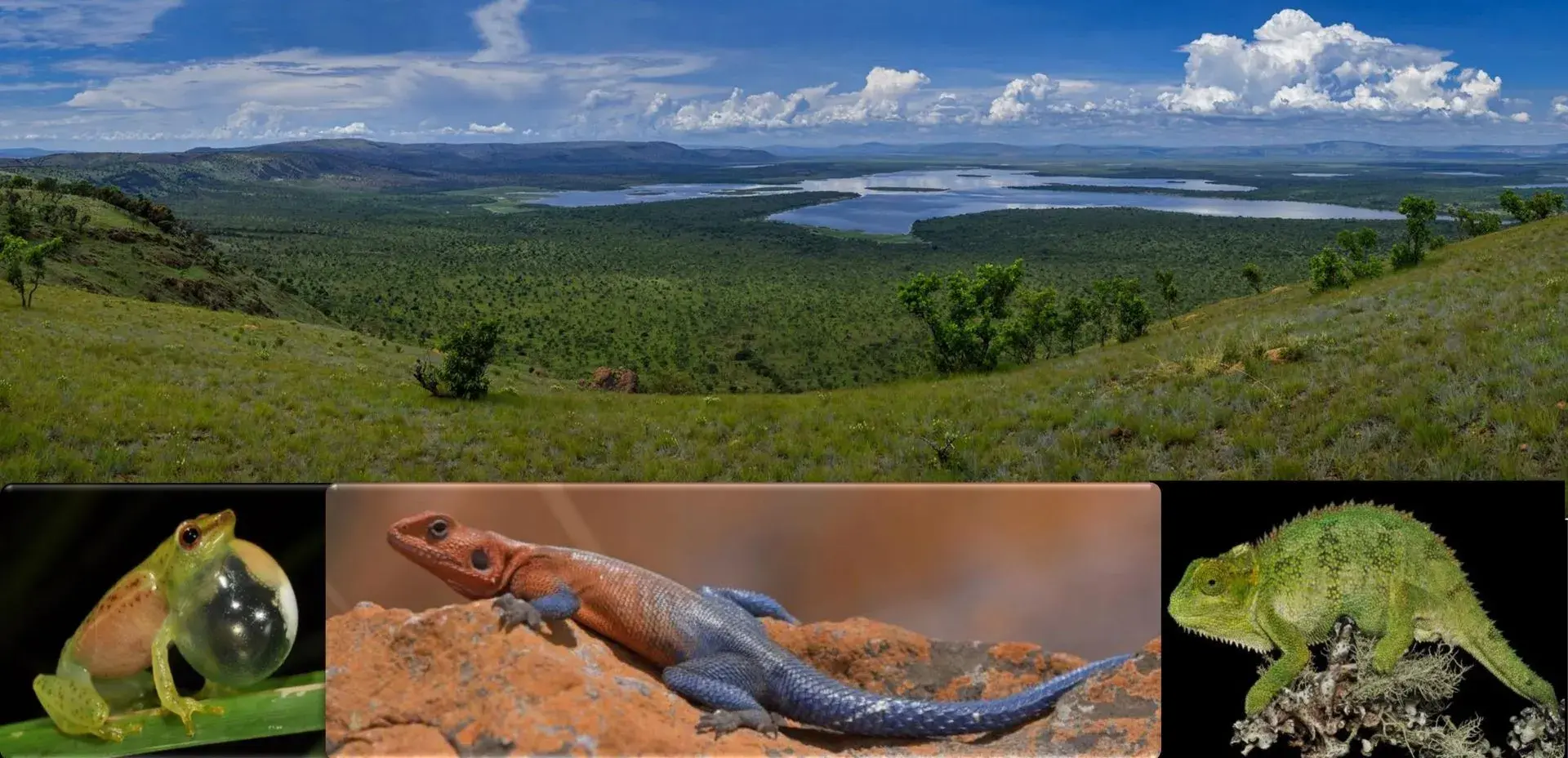
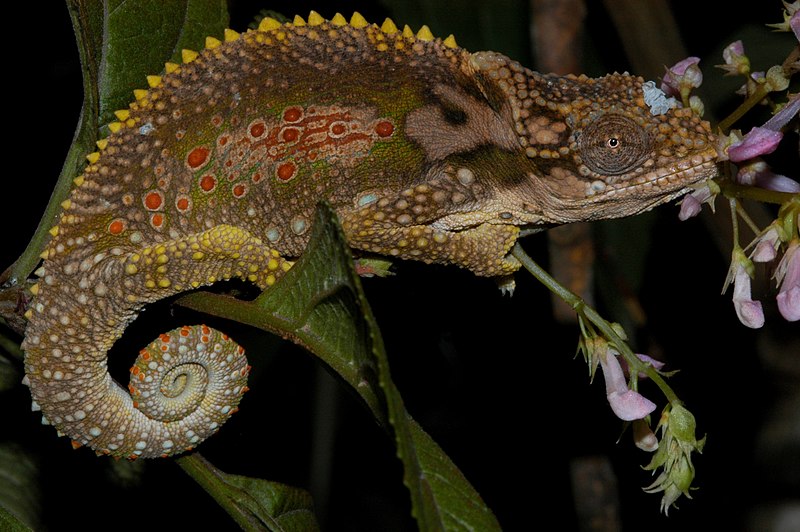
Calumma vencesi kommt im Norden Madagaskars vor und ist dort bisher von den Fundorten Betaolana, Besariaka und Tsararano bekannt. Ein madagassisches Forscherteam hat die Art nun noch in einem weiteren Regenwald entdecken können: In Sorata. Sorata gehört zum sogenannten COMATSA-Korridor, der vor allem aus den Regenwäldern Marojejy, Anjanaharibe Sud und Tsaratanana besteht. Sorata dagegen liegt noch etwas nördlicher in Richtung Vohémar. Der Regenwald wird derzeit vom WWF zusammen mit dem örtlichen Verein Ambodimandresy Miaro ny Ala (AMA) verwaltet.

Die Wissenschaftler verteilten zufällig 14 Transekte im Regenwald, die aus je drei parallel verlaufenden Linien von 50 m bestanden. Dann suchten sie nachts mit Taschenlampen entlang der Transekte nach schlafenden Chamäleons. Die Häufigkeit der Art pro 100 m wurde berechnet, die genutzten Pflanzen dokumentiert und die Schlafhöhe gemessen.

Insgesamt konnten acht Calumma vencesi gefunden werden. Sie schliefen auf einer durchschnittlichen Asthöhe vvon 1,43 m meist auf Blättern, wenige Individuen auf Ästen. Fünf Chamäleons wurden vertikal schlafend angetroffen, drei eher horizontal. Sieben von acht Calumma vencesi schliefen mit dem Kopf nach oben, nur eines kopfüber.

Das Vorkommen von nur 0,38 Individuen pro 100 m ist erstaunlich gering und unterschreitet sogar das von als vom Aussterben bedroht eingestuften Chamäleonarten wie Calumma tarzan. Bisher war Calumma vencesi außerdem ausschließlich unter 1000 m gefunden worden, das Studiengebiet in Sorata lag jedoch durchschnittlich auf 1326 m. Calumma vencesi kommt damit in Sorata im gleichen Verbreitungsgebiet wie Brookesia nana vor, was die Schutzbedürftigkeit dieses Regenwaldes noch dringender macht. Der Wald Brandrodung und illegalem Holzschlag sowie weidendem Vieh und Vanilleplantagen bedroht.

 A new locality for the endangered Vence’s Chamaeleon, Calumma vencesi Andreone et al., 2001, from Sorata Forest, northeastern Madagascar
Jeanneney Rabearivony, Andriatsitohaina Ranaivojaona, Moussaïna Jao, Achille P. Raselimanana
Herpetology Notes 18, 2025: 817-820.
DOI: nicht vorhanden
Kostenloser Download des Artikels

Foto: Calumma vencesi, fotografiert von Asméralie William, aus der genannten Publikation[:en]

Calumma vencesi occurs in northern Madagascar and has so far been found in Betaolana, Besariaka and Tsararano. A Madagascan research team has now discovered the species in another rainforest: Sorata. Sorata is part of the COMATSA corridor, which mainly consists of the Marojejy, Anjanaharibe Sud and Tsaratanana rainforests. Sorata, on the other hand, is located slightly further north towards Vohémar. The rainforest is currently managed by the WWF in collaboration with the local association Ambodimandresy Miaro ny Ala (AMA).

The scientists randomly distributed 14 transects in the rainforest, each consisting of three parallel lines of 50 m. Then, at night, they searched for sleeping chameleons along the transects with flashlights. The frequency of the species per 100 m was calculated, the plants used were documented and the sleeping height was measured.

A total of eight Calumma vencesi were found. They slept at an average branch height of 1.43 m, mostly on leaves, with a few individuals on branches. Five chameleons were found sleeping vertically, three more horizontally. Seven of the eight Calumma vencesi slept with their heads up, only one upside down.

The occurrence of only 0.38 individuals per 100 m is surprisingly low and even falls below that of chameleon species classified as critically endangered, such as Calumma tarzan. Until now, Calumma vencesi had only been found below 1000 m, but the study area in Sorata was at an average altitude of 1326 m. Calumma vencesi occurs in Sorata in the same distribution area as Brookesia nana, which makes the need to protect this rainforest even more urgent. The forest is threatened by slash-and-burn farming, illegal logging, grazing livestock and vanilla plantations.

 A new locality for the endangered Vence’s Chamaeleon, Calumma vencesi Andreone et al., 2001, from Sorata Forest, northeastern Madagascar
Jeanneney Rabearivony, Andriatsitohaina Ranaivojaona, Moussaïna Jao, Achille P. Raselimanana
Herpetology Notes 18, 2025: 817-820.
DOI: not available
Free article download

Photo: Calumma vencesi, photographed by Asméralie William, from the aforementioned publication[:]

[:de]Ultraschall des Urogenitaltrakts bei Chamäleons[:en]Ultrasound of the urogenital tract in chameleons[:]

[:de]Ultraschall des Urogenitaltrakts bei Chamäleons[:en]Ultrasound of the urogenital tract in chameleons[:]

Tiermedizin Wissenschaft

[:de]

In den letzten Jahren gab es erste Studien zur Bildgebung in der Diagnose von Erkrankungen speziell bei Chamäleons. Eine weitere Untersuchung von Tierärzten der Universität Leipzig legt nun weitere Vergleichsdaten zum Urogenitaltrakt von Chamäleons vor.

Sie untersuchten Nieren, Blase und Geschlechtsorgane von 42 Echsen, die von privaten Haltern an der Uniklinik vorgestellt wurden, mittels Ultraschall. Unter den Patienten waren sieben Chamaeleo calyptratus, fünf Furcifer pardalis. Von diesen 12 Chamäleons waren sechs männlich und sechs weiblich. Alle Organe wurden vermessen, beschrieben und Beispielbilder gespeichert.

Leider konnten bei keinem der weiblichen Chamäleons die Geschlechtsorgane für die Studie beurteilt werden, da sie entweder krankhaft verändert oder mittels vorangehender Operation bereits entfernt worden waren. Als Ankopplungsort für den Ultraschall der Nieren stellte sich bei den Chamäleons eine seitliche Ankopplung etwa einen Zentimeter vor der Hüfte als günstig heraus. Der postpelvine Anteil der Nieren war stets kleiner als der präpelvine. Die Nieren wiesen bei allen männlichen Chamäleons heterogene Flecken auf, während die Nieren der Weibchen stets homogen waren. Diese Streifung ist vermutlich auf Sexualsegmente in den Nieren bei Männchen zurückzuführen. Das Nierengewebe war isoechogen zu Muskelgewebe und hypoechogener als Fettgewebe. Die Hoden der männlichen Chamäleons lagen jeweils im hinteren Drittel der Coelomhöhle direkt unter der Wirbelsäule und vor den Nieren. Der rechte Hoden lag jeweils etwas weiter vorne als der linke. Die Kapsel war bei allen Männchen hyperechogen, während die Hodenstruktur stets homogen war. Durchschnittliche Maße der Nieren und Hoden der Jemen- und Pantherchamäleons werden in der Studie ebenfalls angegeben.

Die Daten entsprechen größtenteils den bereits von Aßmann 2015 zusammengetragenen Daten zum Ultraschall des Urogenitaltrakts von Chamäleons. Lediglich die Nierenlänge unterschied sich deutlich (länger) von vorhergehenden Untersuchungen.

Comparative sonographic studies of the urogenital tract of lizards
Nils B. Klützow, Volker Schmidt
Veterinary Radiology & Ultrasound 2025, 66:e70075
DOI: 10.1111/vru.70075
Kostenloser Download des Artikels[:en]

In recent years, initial studies have been conducted on imaging in the diagnosis of diseases specifically in chameleons. A further study by veterinarians at the University of Leipzig (Germany) now presents additional comparative data on the urogenital tract of chameleons.

They examined the kidneys, bladder and reproductive organs of 42 lizards brought to the university hospital by private owners using ultrasound. Among the patients were seven Chamaeleo calyptratus and five Furcifer pardalis. Of these 12 chameleons, six were male and six were female. All organs were measured, described and sample images were saved.

Unfortunately, the sex organs of none of the female chameleons could be assessed for the study, as they were either pathologically altered or had already been removed during previous surgery. The most suitable location for coupling the ultrasound probe to the kidneys of the chameleons was found to be approximately one centimetre in front of the hip. The postpelvic portion of the kidneys was always smaller than the prepelvic portion. The kidneys of all male chameleons showed heterogeneous stripes, while the kidneys of the females were always homogeneous. This striping is probably due to sexual segments in the kidneys of males. The kidney tissue was isoechogenic to muscle tissue and more hypoechoic than adipose tissue. The testes of the male chameleons were located in the posterior third of the coelomic cavity, directly below the spine and in front of the kidneys. The right testicle was slightly further forward than the left. The capsule was hyperechoic in all males, while the testicular structure was always homogeneous. The study also provides average measurements of the kidneys and testicles of Yemen and panther chameleons.

The data largely correspond to the data already compiled by Aßmann in 2015 on ultrasound of the urogenital tract of chameleons. Only the kidney length differed significantly (longer) from previous studies.

Comparative sonographic studies of the urogenital tract of lizards
Nils B. Klützow, Volker Schmidt
Veterinary Radiology & Ultrasound 2025, 66:e70075
DOI: 10.1111/vru.70075
Free download of the article[:]

[:de]Gencodierung bei Chamäleonzähnen[:en]Gene evolution in chameleon teeth[:]

[:de]Gencodierung bei Chamäleonzähnen[:en]Gene evolution in chameleon teeth[:]

Wissenschaft

[:de]

Chamäleons verfügen über akrodonte, das heißt dem Knochen direkt aufsitzende, Zähne. Säuger dagegen haben sogenannte Alveolen, in denen die Zähne sitzen. Wissenschaftler aus Michigan (USA) haben nun die genetische evolutionäre Entwicklung der Zahnstrukturen im Vergleich von Säugetieren zu akrodonten Reptilien untersucht.

Dazu verglichen sie die Genome von 24 akrodonten Reptilien und 12 Säugetierarten. Unter den akrodonten Reptilien befanden sich unter anderem die Chamäleonarten Furcifer pardalis, Trioceros harennae und Chamaeleo calyptratus sowie nicht auf Artebene bestimmte Chamäleons der Gattungen Chamaeleo, Bradypodion und Trioceros.  Die Gene für Aminosäuren, aus denen bestimmte Eiweiße des Zahnschmelzes gebaut werden, wurden mittels verschiedener Berechnungen und Analysen verglichen.

Dabei kam heraus, dass der Verlust des Zahnwechsels bei akrodonten Reptilien tatsächlich zu Veränderungen in den Genen für die Zahnschmelzbildung führte.

Reduction of tooth replacement disproportionately affects the evolution of enamel matrix proteins

John Abramyan, Gengxin Li, Hannah Khansa
Journal of Molecular Evolution 93, 2025: 494-510.
DOI: 10.1007/s00239-025-10258-4
Kostenloser Download des Artikels

Foto: Präparat eines Pantherchamäleon-Schädels mit akrodonten Zähnen, fotografiert von Alex Negro[:en]

Chameleons have acrodont teeth, which means that their teeth are directly attached to the bone. Mammals, on the other hand, have so-called alveoli in which the teeth are seated. Scientists from Michigan (USA) have now investigated the genetic evolutionary development of tooth structures by comparing mammals with acrodont reptiles.

To do this, they compared the genomes of 24 acrodont reptiles and 12 mammal species. The acrodont reptiles included the chameleon species Furcifer pardalis, Trioceros harennae and Chamaeleo calyptratus, as well as chameleons of the genera Chamaeleo, Bradypodion and Trioceros that were not identified at the species level. The genes for amino acids, from which certain proteins in tooth enamel are built, were compared using various calculations and analyses.

The results showed that the loss of tooth replacement in acrodont reptiles did indeed lead to changes in the genes responsible for tooth enamel formation.

Reduction of tooth replacement disproportionately affects the evolution of enamel matrix proteins
John Abramyan, Gengxin Li, Hannah Khansa
Journal of Molecular Evolution 93, 2025: 494-510.
DOI: 10.1007/s00239-025-10258-4
Kostenloser Download des Artikels

Photo: Specimen of a panther chameleon skull with acrodont teeth, photographed by Alex Negro[:]

[:de]Tagungsort 2026 steht fest[:en]Location for the 2024 conference[:]

[:de]Tagungsort 2026 steht fest[:en]Location for the 2024 conference[:]

AG Interna Allgemeines

[:de]

Jetzt steht es fest: Wir treffen uns zur Tagung 2026 in der Hautpstadt des Landes Niedersachsen, Hannover. Wie von den Mitgliedern abgestimmt wird die Tagung vom 29. bis 31. Mai 2026 stattfinden. Hannover bietet neben einer sehr vielfältigen Stadt eine hervorragende ICE-Anbindung und einen Flughafen für Reisende von weiter weg. Wir tagen im Stadtteilzentrum Lister Turm, einem historischen Gebäude, das wunderschön am Rande des Stadtwald Eilenriede liegt. In unmittelbarer Nähe gibt es einen Biergarten für die Erwachsenen und einen Spielplatz für Kinder. Der Erlebniszoo Hannover liegt direkt auf der anderen Seite der Eilenriede in fußläufiger Nähe.Ebenfalls in fußläufiger Entfernung finden sich etliche Hotels, es wird also für jeden Geldbeutel und für jede Aufenthaltsdauer etwas dabei sein. Wir freuen uns schon auf Euch!

Foto: Lister Turm CC BY-SA 3.0 losch

[:en]

It’s now official: we will be meeting for the 2026 conference in Hanover, the capital of Lower Saxony. As voted by the members, the conference will take place from 29 to 31 May 2026. Hanover is a very diverse city and offers excellent ICE connections and an airport for travellers from further afield. We will meet in the Lister Turm district centre, a historic building beautifully located on the edge of the Eilenriede city forest. There is a beer garden for adults and a playground for children in the immediate vicinity. The Hannover Adventure Zoo is located directly on the other side of the Eilenriede forest, within walking distance. There are also several hotels within walking distance, so there will be something for every budget and length of stay. We look forward to seeing you there!

Picture: Lister Turm CC BY-SA 3.0 losch[:]