[:de]
In den Archiven von Museen und anderen zoologischen Sammlungen sind nach wie vor viele Einzel-Gen-Fragmentdaten enthalten. Obwohl es heute relativ einfach möglich ist, ganze Genome zu entschlüsseln und Material zur Aufbewahrung entsprechend zu präparieren, war es das früher lange Zeit nicht. Wissenschaftler an der Universität von Johannesburg (Südafrika) haben nun untersucht, ob und wenn ja welche Bestandteile dieser Einzelgene bei Zwergchamäleons Rückschluss auf das gesamte Genom bezüglich der Erstellung von phylogenetischen Stammbäumen geben können.
Von 44 Zwergchamäleons wurden während diverser Expeditionen zwischen 2010 und 2022 Proben in Form von abgeschnittenen Schwanzspitzen entnommen. Die beprobten Tiere wurden in den Provinzen Eastern Cape, KwaZulu-Natal, Limpopo, Mpumalanga, Northern Cape und Western Cape gefangen und wieder freigelassen. Sie gehörten zu den Arten Bradypodion barbatulum, caeruleogula, caffrum, damaranum, gutturale, melanocephalum, ngomeense, occidentale, pumilum, setaroi, taeniabronchum, thamnobates, transvaalense, ventrale, venustum sowie candidate species aus Greytown, Kamberg. Karkloof Forest und Gilboa Forest in KwaZulu-Natal. Als Referenzgenom wurde ein bereits vorhandenenes Mitogenom eines Chamaeleo chamaeleon verwendet. Außerdem wurden die Mitogenome von sieben anderen Genera zum Vergleich aus der GenBank geladen.
Aus allen Proben wurde DNA extrahiert und phylogenetisch mit unter anderem Geneious Prime und IQ-Tree analysiert. Insgesamt 22 verschiedene Alignments konnten erstellt werde: Ein vollständiges Mitogenom-Alignment (ohne tRNA), 15 Alignments einzelner Loci, das kurze Fragment von 16S, ein häufig verwendetes COI-Fragment, eine Verkettung von 16S-Fragment mit ND2, eine Verkettung von ND2 und ND5, eine Verkettung der beiden ribosomalen Untereinheiten und eine Verkettung aller proteinkodierenden Gene (PCG). Eine statistische Auswertung der Daten folgte.
Die Ergebnisse zeigten, dass die vollständige Mitogenom-Topologie weitestgehend mit den bisher veröffentlichten Phylogenesen afrikanischer Zwergchamäleons aus ND2-16S-Verkettungen übereinstimmen. Die Phylogenese basierend auf den ND2-Fragmenten erwies sich als stabiler und war sogar noch näher am Mitogenom dran. Diese Genfragmente sind also gut dazu geeignet, ein Genom und damit eine Chamäleon-Art phylogenetisch einzuordnen. Ein paar Unterschiede zu den bisher veröffentlichten Phylogenesen gab es jedoch auch. Die Mitogenom-Topologie sieht Bradypodion setaroi und Bradypodion caffrum als Schwestertaxa an. Außerdem gehört Bradypodion ngomeense möglicherweise genetisch in die Bradypodion transvaalense clade hinein, anstatt nur ein Schwestertaxon derselben zu sein.
The efficacy of single mitochondrial genes at reconciling the complete mitogenome phylogeny – a case study on dwarf chameleons
Devon C. Main, Jody M. Taft, Anthony J. Geneva, Bettine Jansen van Vuuren, Krystal A. Tolley
PeerJ 12:e17076, 2024
DOI: 10.7717/peerj.17076
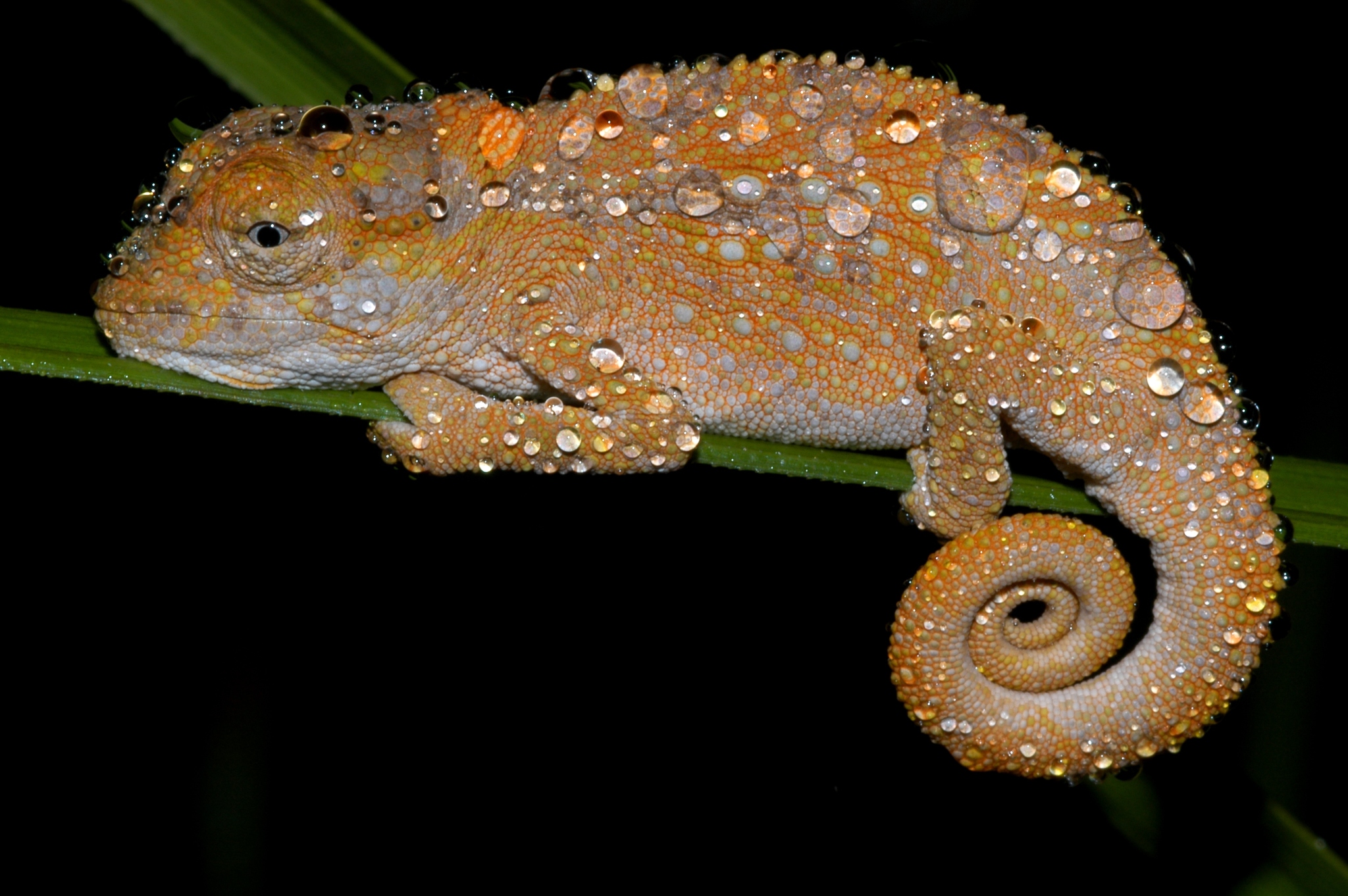
Foto: Bradypodion transvaalense, fotografiert von Ryan van Huyssteen, Creative Commons Attribution-Share Alike 4.0 International[:en]
The archives of museums and other zoological collections still contain a lot of single-gene fragment data. Although it is now relatively easy to decode entire genomes and prepare material for storage, this was not the case for a long time. Scientists at the University of Johannesburg (South Africa) have now investigated whether and, if so, which components of these single genes in dwarf chameleons can provide information on the entire genome with regard to the creation of phylogenetic family trees.
Samples were taken from 44 dwarf chameleons in the form of cut-off tail tips during various expeditions between 2010 and 2022. The sampled animals were captured and released in the Eastern Cape, KwaZulu-Natal, Limpopo, Mpumalanga, Northern Cape and Western Cape provinces. They belonged to the species Bradypodion barbatulum, caeruleogula, caffrum, damaranum, gutturale, melanocephalum, ngomeense, occidentale, pumilum, setaroi, taeniabronchum, thamnobates, transvaalense, ventrale, venustum as well as candidate species from Greytown, Kamberg. Karkloof Forest and Gilboa Forest in KwaZulu-Natal. An existing mitogenome of a Chamaeleo chamaeleon was used as a reference genome. In addition, the mitogenomes of seven other genera were loaded from GenBank for comparison.
DNA was extracted from all samples and phylogenetically analysed using Geneious Prime and IQ-Tree, among others. A total of 22 different alignments were created: a complete mitogenome alignment (without tRNA), 15 alignments of individual loci, the short fragment of 16S, a frequently used COI fragment, a concatenation of 16S fragment with ND2, a concatenation of ND2 and ND5, a concatenation of the two ribosomal subunits and a concatenation of all protein-coding genes (PCG). A statistical analysis of the data followed.
The results showed that the complete mitogenome topology is largely consistent with the previously published phylogenies of African dwarf chameleons from ND2-16S concatenations. The phylogeny based on the ND2 fragments proved to be more stable and even closer to the mitogenome. These gene fragments are therefore well suited to phylogenetically classify a genome and thus a chameleon species. However, there were also a few differences to the previously published phylogenies. The mitogenome topology considers Bradypodion setaroi and Bradypodion caffrum to be sister taxa. Furthermore, Bradypodion ngomeense possibly belongs genetically to the Bradypodion transvaalense clade instead of being a sister taxon of it.
The efficacy of single mitochondrial genes at reconciling the complete mitogenome phylogeny – a case study on dwarf chameleons
Devon C. Main, Jody M. Taft, Anthony J. Geneva, Bettine Jansen van Vuuren, Krystal A. Tolley
PeerJ 12:e17076, 2024
DOI: 10.7717/peerj.17076
Picture: Bradypodion transvaalense, photographed by Ryan van Huyssteen, Creative Commons Attribution-Share Alike 4.0 International[:]

![[:de]Gencodierung bei Chamäleonzähnen[:en]Gene evolution in chameleon teeth[:]](https://www.agchamaeleons.de/wp-content/uploads/2025/08/2025-Furcifer-pardalis-teeth-Alex-Laube.jpg "[:de]Gencodierung bei Chamäleonzähnen[:en]Gene evolution in chameleon teeth[:]")
![[:de]Neue Genome von sechs Chamäleonarten aus Äthiopien[:en]New genomes of six chameleon species from Ethiopia[:]](https://www.agchamaeleons.de/wp-content/uploads/2025/03/Chamaeleo-laevigatus-John-Lyakurwa-CC-BY-4.0.jpg "[:de]Neue Genome von sechs Chamäleonarten aus Äthiopien[:en]New genomes of six chameleon species from Ethiopia[:]")
![[:de]Phylogenetik bei afrikanischen Zwergchamäleons[:en]Phylogenetics of African dwarf chameleons[:]](https://www.agchamaeleons.de/wp-content/uploads/2024/06/Bradypodion_transvaalense_Wikimedia-Commons-CCY-BY-40.jpg "[:de]Phylogenetik bei afrikanischen Zwergchamäleons[:en]Phylogenetics of African dwarf chameleons[:]")