Aus der Hauptstadt Madagaskars, Antananarivo, berichten drei Autoren von einer interessanten Beobachtung. In der Nähe von Akamasoa beobachteten sie ein männliches Furcifer oustaleti, das gerade dabei war, ein anderes Chamäleon zu verschlingen. Das Tier war nicht beim Jagen beobachtet worden. Das Opfer, vermutlich ein Tepichchamäleon (Furcifer lateralis), wurde innerhalb weniger Minuten vollständig verschlungen.
Die Beobachtung reiht sich ein in wenige spannende Sichtungen von relativ großen Chamäleons, die auf den ersten Blick „zu große“ Beute fressen. Es scheint aber nicht allzu oft vorzukommen, denn die existenten wenigen Beobachtungen verteilen sich über mehrere Jahrzehnte. Interessant ist, dass die neue Beobachtung in der Trockenzeit gemacht wurde, wenn die Insektendichte im Vergleich zur Regenzeit deutlich niedriger ist.
Predation on Furcifer sp. by Oustalet’s Chameleon, Furcifer oustaleti (Mocquard, 1894), in the Central Highlands of Madagascar Angelinah René de Roland, Duvivier Razarazafy, Séraphin Fabrice Herpetology Notes 18: 305-306.
DOI: nicht vorhanden
Foto: aus der genannten Veröffentlichung[:en]
Three authors report an interesting observation from the capital of Madagascar, Antananarivo. Near Akamasoa, they observed a male Furcifer oustaleti in the process of devouring another chameleon. The animal had not been observed hunting. The victim, presumably a carpet chameleon (Furcifer lateralis), was completely devoured within a few minutes.
The observation is one of a few exciting sightings of relatively large chameleons that at first glance appear to eat ‘too large’ prey. However, this does not seem to happen very often, as the few existing observations are spread over several decades. It is interesting that the new observation was made in the dry season, when the insect density is significantly lower compared to the rainy season.
Predation on Furcifer sp. by Oustalet’s Chameleon, Furcifer oustaleti (Mocquard, 1894), in the Central Highlands of Madagascar Angelinah René de Roland, Duvivier Razarazafy, Séraphin Fabrice Herpetology Notes 18: 305-306.
DOI: not available
Der Bobaomby-Komplex liegt am nördlichsten Zipfel Madagaskars, nördlich und westlich der größten Küstenstadt des Nordens, Antsiranana (französisch Diego Suarez). Er besteht aus Trockenwald auf Meeresniveau bis maximal 200 m üNN sowie ausgedehnten Savannen auf Karstgestein und verschiedenen Felsformationen. Bisher unterliegt die Gegend keinerlei Schutz.
Wissenschaftler aus Madagaskar führten 2018 Zählungen von Reptilien im Bobaomby Komplex durch. Gezählt wurde im Februar und März, also während der Regenzeit. Fünf verschiedene Orte wurden untersucht: Beantely, Antsisikala und Ambanililabe als Beispiele unterschiedlich stark zerstörten Trockenwalds, Anjiabe wegen seines intakten Trockenwalds und Ampombofofo mit relativ intaktem Wald. Um Tiere zu finden, wurde an 25 Tagen zum einen mit dem bloßen Auge tagsüber und nachts in ausgewählten Transekten gesucht, teils gezielt in geeignet erscheinenden Habitaten wie Blattachseln oder unter toten Baumstämmen, zum anderen wurden Fallgruben entlang aufgestellter Zäune genutzt.
Insgesamt wurden 42 Reptilienarten nachgewiesen. Alle davon, ausgenommen eine Gecko-Art, kommen ursprünglich nur auf Madagaskar vor, zwei weitere Gecko-Arten findet man inzwischen auch auf benachbarten Inseln. Bei den Chamäleons gibt es eine kleine Neuerung: Erstmals konnte das Erdchamäleon Brookesia ebenaui in Bobaomby, genauer in Beantely, nachgewiesen werden. Brookesia stumpffi und Furcifer petteri wurde in Beantely, Anjiabe und Ampombofofo gefunden. Furcifer pardalis und Furcifer oustaleti kamen wie erwartet im gesamten Bobaomby-Komplex vor.
Die Autoren schlagen vor, den Bobaomby-Komplex – insbesondere aber die drei Wälder, in denen die meisten Reptilien gefunden wurden, unter Schutz zu stellen, um die dortige Herpetofauna zu erhalten.
Overview of reptile diversity from Bobaomby complex, northern tip of Madagascar Randriamialisoa, Raphali R. Andriantsimanarilafy, Alain J. Rakotondrina, Josué A. Rakotoarisoa, Nasaina T. Ranaivoson, Jeanneney Rabearivony, Achille P. Raselimanana Animals 13: 3396, 2023
DOI: 10.3390/ani13213396
Foto: Furcifer petteri, männlich, im Norden Madagaskars, fotografiert von Alex Laube[:en]
The Bobaomby complex is located at the northernmost tip of Madagascar, north and west of the largest coastal town in the north, Antsiranana (Diego Suarez in French). It consists of dry forest at sea level up to a maximum of 200 metres above sea level as well as extensive savannahs on karst rock and various rock formations. The area has not been protected to date.
Scientists from Madagascar conducted reptile counts in the Bobaomby complex in 2018. The counts were carried out in February and March, i.e. during the rainy season. Five different locations were analysed: Beantely, Antsisikala and Ambanililabe as examples of varying degrees of degraded dry forest, Anjiabe for its intact dry forest and Ampombofofo with relatively intact forest. To find animals, the visual survey was used on 25 days during the day and at night in selected transects, sometimes specifically in suitable habitats such as leaf axils or under dead tree trunks, and pitfall traps along erected fences were also used.
A total of 42 reptile species have been recorded. All of them, except one gecko species, originally only occur on Madagascar, while two other gecko species are now also found on neighbouring islands. There is a small novelty among the chameleons: the leaf chameleon Brookesia ebenaui was recorded for the first time in Bobaomby, more precisely in Beantely. Brookesia stumpffi and Furcifer petteri were found in Beantely, Anjiabe and Ampombofofo. Furcifer pardalis and Furcifer oustaleti occurred as expected throughout the whole Bobaomby complex.
The authors suggest that the Bobaomby complex – especially the three forests where most of the reptiles were found – should be protected to preserve the local herpetofauna.
Overview of reptile diversity from Bobaomby complex, northern tip of Madagascar Randriamialisoa, Raphali R. Andriantsimanarilafy, Alain J. Rakotondrina, Josué A. Rakotoarisoa, Nasaina T. Ranaivoson, Jeanneney Rabearivony, Achille P. Raselimanana Animals 13: 3396, 2023
DOI: 10.3390/ani13213396
Photo: Furcifer petteri, male, in the north of Madagascar, photographed by Alex Laube[:]
Der „Sunshine State“ Florida im Südosten der USA ist schon lange bekannt für eine Vielzahl eingeschleppter Reptilien. Studenten der Universität von Florida haben kürzlich eine kleine Broschüre über den aktuellen Stand dort eingeschleppter Chamäleon-Arten veröffentlicht.
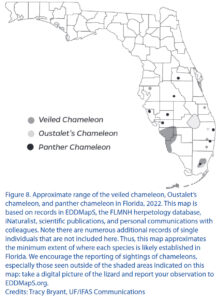
Bereits in den späten 1800er Jahren fand nachweislich ein nicht-einheimisches Reptil mit einem Schiff den Weg nach Florida: Ein Anolis. Seitdem wurden rund 150 eingeschleppte Arten in dem US-Bundesstaat dokumentiert, darunter acht Arten Chamäleons. Drei davon sind inzwischen über die gesamte südliche Hälfte der Halbinsel verbreitet und vermehren sich sogar: Das Jemenchamäleon Chamaeleo calyptratus, das Madagaskar-Riesenchamäleon Furcifer oustaleti und das Pantherchamäleon Furcifer pardalis.
Aktuell bekannte Verbreitung von Panther-, Jemen- und Madagaskar-Riesenchamäleon in Florida
Man geht davon aus, dass alle drei Arten mit zunehmendem Zoohandel und der Privathaltung von Chamäleons ins Land kamen. Furcifer oustaleti ist seit mindestens dem Jahr 2000 in Florida. Bekannt wurden damals erste Funde in einer Avocadoplantage, die sich in direkter Nähe der Gebäude eines ehemaligen Importeurs in Miami – Dade County, befand. Chamaeleo calyptratus wurde nur wenig später, 2002, erstmals in Fort Myers auf einem leerstehenden Grundstück nachgewiesen. Furcifer pardalis folgte 2008.
Die Frage, ob eine der drei genannten Arten als invasiv zu betrachten ist, ist mangels Daten bisher schwierig zu beantworten. Als invasiv wird eine Art gesehen, die nicht-einheimisch ist, durch den Menschen eingeschleppt wurde und nachweislich Schaden an der einheimischen Flora und Fauna verursacht. Der letzte Punkt ist jedoch strittig. Während von Jacksons Chamäleons auf Hawaii nachgewiesen wurde, dass sie unter anderem einheimische bedrohte Schnecken-Arten verzehren, ist dergleichen aus Florida bisher unbekannt. Dort gelten die Tere aktuell eher als Lästlinge, allerdings mit Potenzial zur Bedrohung der einheimischen Wirbellosenfauna.
Problematisch ist, dass wohl nach wie vor Chamäleons ausgesetzt werden – teils entlaufen sie unabsichtlich, teils werden jedoch auch gezielt Tiere ausgesetzt, um später den Nachwuchs einzusammeln und zu verkaufen. Für letzteres benötigt man eine Genehmigung in Florida. Interessant dazu: Jeder darf eingeschleppte Chamäleons auf dem eigenen Grundstück „auf humane Weise“ töten. An einigen Orten werden bereits gezielt Chamäleons abgesammelt, um sie an Privathalter zu vermitteln.
Die Studenten rufen dazu auf, Beobachtungen von Chamäleons in Florida im Internet über IveGot1.org oder über die gleichnamige App zu melden. Bisher sind nicht alle Populationen bekannt, da viele Informationen nur unter der Hand weitergegeben werden. Des Weiteren bitten sie darum, „lästig gewordene“ Chamäleons nicht auszusetzen, sondern beim Exotic Pet Amnesty Program der Florida Fish and Wildlife Conservation Commission abzugeben. Die Abgabe dort ist kostenlos, das EPAP sucht letztlich neue Halter für die Tiere.
Florida’s introduced reptiles: Veiled Chameleon (Chamaeleo calyptratus), Oustalet’s chameleon (Furcifer oustaleti), and panther chameleon (Furcifer pardalis)
Max Maddox, Karissa Beloyan, Natalie M. Claunch, Steve A. Johnson
Veröffentlichung des Wildlife Ecology and Conservation Department, Universität of Florida
DOI: 10.32473/edis-UW501-2022
[:en]
The „Sunshine State“ Florida in the southeast of the USA has long been known for a variety of introduced reptiles. Students at the University of Florida recently published a small brochure on the current status of chameleon species introduced there.
As early as the late 1800s, a non-native reptile was documented to have found its way to Florida by ship: an anole. Since then, some 150 introduced species have been documented in the US state, including eight species of chameleons. Three of them are now spread over the entire southern half of the peninsula and even reproduce: the Yemen chameleon Chamaeleo calyptratus, the Malagasy Giant chameleon Furcifer oustaleti, and the panther chameleon Furcifer pardalis.
Current known distribution of Panther, Veiled, and Malagasy Giant Chameleons in Florida.
All three species are thought to have come into the country with increasing pet trade and private keeping of chameleons. Furcifer oustaleti has been in Florida since at least the year 2000. At that time, the first findings became known in an avocado plantation located in the immediate vicinity of the buildings of a former importer in Miami – Dade County. Chamaeleo calyptratus was first recorded in Fort Myers on a vacant lot only a little later, in 2002. Furcifer pardalis followed in 2008.
The question of whether any of the three species mentioned should be considered invasive is difficult to answer so far due to a lack of data. A species is considered invasive if it is non-native, has been introduced by humans, and has been proven to cause damage to native flora and fauna. The last point, however, is debatable. While Jackson’s chameleons in Hawaii have been shown to consume endangered native snail species, among others, the same is not yet known from Florida. There, the animals are currently considered more of a nuisance, but with the potential to threaten the native invertebrate fauna.
The problem is that chameleons are still being released – sometimes they escape unintentionally, but sometimes they are deliberately released in order to collect and sell the offspring later. For the latter, you need a permit in Florida. Interesting to note: Anyone is allowed to kill introduced chameleons on their own property „in a humane way“. In some places, chameleons are already being collected to be sold to private owners.
The students call for observations of chameleons in Florida to be reported on the internet via IveGot1.org or via the app of the same name. So far, not all populations are known, as much information is only passed on by hand. Furthermore, they ask that chameleons that have become a nuisance should not be abandoned, but handed into the Exotic Pet Amnesty Program of the Florida Fish and Wildlife Conservation Commission. The surrender there is free of charge, and the EPAP is ultimately looking for new keepers for the animals.
Florida’s introduced reptiles: Veiled Chameleon (Chamaeleo calyptratus), Oustalet’s chameleon (Furcifer oustaleti), and panther chameleon (Furcifer pardalis)
Max Maddox, Karissa Beloyan, Natalie M. Claunch, Steve A. Johnson
Veröffentlichung des Wildlife Ecology and Conservation Department, Universität of Florida
DOI: 10.32473/edis-UW501-2022
[:]
[:de]Wir benötigen deine Zustimmung! [:en]We need your consent![:]
[:de]Um dir eine optimale Website präsentieren zu können, verwenden wir Cookies und vergleichbare Technologien. Cookies sorgen für eine bessere Performance der Website und sind für die Nutzung sozialer Medien notwendig. Um den vollen Funktionsumfang der Website zu erhalten, empfehlen wir, alle Cookies zu akzeptieren. Alternativ kannst du deine Cookie-Einstellungen selbst konfigurieren und auswählen, welche Cookies du akzeptieren möchtest und welche nicht. [:en]
In order to present you with an optimal website, we use cookies and similar technologies. Cookies ensure better performance of the website and are necessary for the use of social media. To get the full functionality of the website, we recommend that you accept all cookies. Alternatively, you can configure your cookie settings yourself by clicking on "cookie settings". [:]
[:de]Informationen zu Cookies[:en]Privay overview[:]
[:de]Diese Website verwendet Cookies, um die Website möglichst benutzerfreundlich zu machen. "Funktionale Cookies" werden in Deinem Browser gespeichert, da ohne sie die Website nicht nutzbar ist. Wir verwenden auch Cookies von Dritten, die uns helfen zu analysieren und zu verstehen, wie Du diese Website nutzt. Diese Cookies werden nur mit Deiner Zustimmung in Deinem Browser gespeichert.[:en]This website uses cookies to improve your experience while you navigate through the website. Out of these, the cookies that are categorized as necessary are stored on your browser as they are essential for the working of basic functionalities of the website. We also use third-party cookies that help us analyze and understand how you use this website. These cookies will be stored in your browser only with your consent. You also have the option to opt-out of these cookies. But opting out of some of these cookies may affect your browsing experience.[:]
Functional cookies help to perform certain functionalities like sharing the content of the website on social media platforms, collect feedbacks, and other third-party features.
Cookie
Dauer
Beschreibung
Cookie Consent
[:de]ein Jahr[:en]one year[:]
[:de]Dieser Cookie merkt sich, was du in deinen Cookie-Einstellungen auswählst.[:en]Records the default button state of the corresponding category & the status of CCPA. It works only in coordination with the primary cookie.[:]
qTranslate-X
[:de]ein Jahr[:en]one year[:]
[:de]Dieses Plugin ist notwendig, damit die Seite in mehreren Sprachen gelesen werden kann. Schaltest du dieses Plugin aus, bekommst du alle Sprachen nebeneinander angezeigt. Damit wird die Website unlesbar.[:en]This plugin is necessary so that the page can be read in several languages. If you switch off this plugin, all languages will be displayed next to each other. This makes the website unreadable.[:]
Analytical cookies are used to understand how visitors interact with the website. These cookies help provide information on metrics the number of visitors, bounce rate, traffic source, etc.
[:de]Diese Cookies wurden noch keiner Kategorie zugewiesen.
[:en]Other uncategorized cookies are those that are being analyzed and have not been classified into a category as yet.
[:]

![[:de]Madagaskar-Riesenchamäleon frisst Teppichchamäleon[:en]Madagascar giant chameleon eats carpet chameleon[:]](https://www.agchamaeleons.de/wp-content/uploads/2025/05/Furcifer-oustaleti-frisst-Furcifer-lateralis.jpg "[:de]Madagaskar-Riesenchamäleon frisst Teppichchamäleon[:en]Madagascar giant chameleon eats carpet chameleon[:]")
![[:de]Chamäleons in Bobaomby (Madagaskar)[:en]Chameleons in Bobaomby (Madagascar)[:]](https://www.agchamaeleons.de/wp-content/uploads/2024/01/Furcifer-petteri-maennlich-Foto-Alex-Laube.jpg "[:de]Chamäleons in Bobaomby (Madagaskar)[:en]Chameleons in Bobaomby (Madagascar)[:]")
![[:de]Eingeschleppte Chamäleons in Florida[:en]Introduced chameleons in Florida[:]](https://www.agchamaeleons.de/wp-content/uploads/2023/01/Furcifer-pardalis-Ambilobe-male-2019-3.jpg "[:de]Eingeschleppte Chamäleons in Florida[:en]Introduced chameleons in Florida[:]")