
![[:de]Eingeschleppte Chamäleons in Florida[:en]Introduced chameleons in Florida[:]](https://www.agchamaeleons.de/wp-content/uploads/2023/01/Furcifer-pardalis-Ambilobe-male-2019-3.jpg "[:de]Eingeschleppte Chamäleons in Florida[:en]Introduced chameleons in Florida[:]")
[:de]
Der „Sunshine State“ Florida im Südosten der USA ist schon lange bekannt für eine Vielzahl eingeschleppter Reptilien. Studenten der Universität von Florida haben kürzlich eine kleine Broschüre über den aktuellen Stand dort eingeschleppter Chamäleon-Arten veröffentlicht.
Bereits in den späten 1800er Jahren fand nachweislich ein nicht-einheimisches Reptil mit einem Schiff den Weg nach Florida: Ein Anolis. Seitdem wurden rund 150 eingeschleppte Arten in dem US-Bundesstaat dokumentiert, darunter acht Arten Chamäleons. Drei davon sind inzwischen über die gesamte südliche Hälfte der Halbinsel verbreitet und vermehren sich sogar: Das Jemenchamäleon Chamaeleo calyptratus, das Madagaskar-Riesenchamäleon Furcifer oustaleti und das Pantherchamäleon Furcifer pardalis.
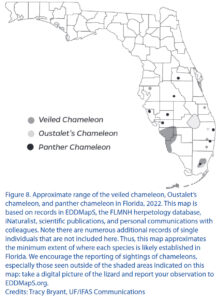
Man geht davon aus, dass alle drei Arten mit zunehmendem Zoohandel und der Privathaltung von Chamäleons ins Land kamen. Furcifer oustaleti ist seit mindestens dem Jahr 2000 in Florida. Bekannt wurden damals erste Funde in einer Avocadoplantage, die sich in direkter Nähe der Gebäude eines ehemaligen Importeurs in Miami – Dade County, befand. Chamaeleo calyptratus wurde nur wenig später, 2002, erstmals in Fort Myers auf einem leerstehenden Grundstück nachgewiesen. Furcifer pardalis folgte 2008.
Die Frage, ob eine der drei genannten Arten als invasiv zu betrachten ist, ist mangels Daten bisher schwierig zu beantworten. Als invasiv wird eine Art gesehen, die nicht-einheimisch ist, durch den Menschen eingeschleppt wurde und nachweislich Schaden an der einheimischen Flora und Fauna verursacht. Der letzte Punkt ist jedoch strittig. Während von Jacksons Chamäleons auf Hawaii nachgewiesen wurde, dass sie unter anderem einheimische bedrohte Schnecken-Arten verzehren, ist dergleichen aus Florida bisher unbekannt. Dort gelten die Tere aktuell eher als Lästlinge, allerdings mit Potenzial zur Bedrohung der einheimischen Wirbellosenfauna.
Problematisch ist, dass wohl nach wie vor Chamäleons ausgesetzt werden – teils entlaufen sie unabsichtlich, teils werden jedoch auch gezielt Tiere ausgesetzt, um später den Nachwuchs einzusammeln und zu verkaufen. Für letzteres benötigt man eine Genehmigung in Florida. Interessant dazu: Jeder darf eingeschleppte Chamäleons auf dem eigenen Grundstück „auf humane Weise“ töten. An einigen Orten werden bereits gezielt Chamäleons abgesammelt, um sie an Privathalter zu vermitteln.
Die Studenten rufen dazu auf, Beobachtungen von Chamäleons in Florida im Internet über IveGot1.org oder über die gleichnamige App zu melden. Bisher sind nicht alle Populationen bekannt, da viele Informationen nur unter der Hand weitergegeben werden. Des Weiteren bitten sie darum, „lästig gewordene“ Chamäleons nicht auszusetzen, sondern beim Exotic Pet Amnesty Program der Florida Fish and Wildlife Conservation Commission abzugeben. Die Abgabe dort ist kostenlos, das EPAP sucht letztlich neue Halter für die Tiere.
Florida’s introduced reptiles: Veiled Chameleon (Chamaeleo calyptratus), Oustalet’s chameleon (Furcifer oustaleti), and panther chameleon (Furcifer pardalis)
Max Maddox, Karissa Beloyan, Natalie M. Claunch, Steve A. Johnson
Veröffentlichung des Wildlife Ecology and Conservation Department, Universität of Florida
DOI: 10.32473/edis-UW501-2022
[:en]
The „Sunshine State“ Florida in the southeast of the USA has long been known for a variety of introduced reptiles. Students at the University of Florida recently published a small brochure on the current status of chameleon species introduced there.
As early as the late 1800s, a non-native reptile was documented to have found its way to Florida by ship: an anole. Since then, some 150 introduced species have been documented in the US state, including eight species of chameleons. Three of them are now spread over the entire southern half of the peninsula and even reproduce: the Yemen chameleon Chamaeleo calyptratus, the Malagasy Giant chameleon Furcifer oustaleti, and the panther chameleon Furcifer pardalis.
All three species are thought to have come into the country with increasing pet trade and private keeping of chameleons. Furcifer oustaleti has been in Florida since at least the year 2000. At that time, the first findings became known in an avocado plantation located in the immediate vicinity of the buildings of a former importer in Miami – Dade County. Chamaeleo calyptratus was first recorded in Fort Myers on a vacant lot only a little later, in 2002. Furcifer pardalis followed in 2008.
The question of whether any of the three species mentioned should be considered invasive is difficult to answer so far due to a lack of data. A species is considered invasive if it is non-native, has been introduced by humans, and has been proven to cause damage to native flora and fauna. The last point, however, is debatable. While Jackson’s chameleons in Hawaii have been shown to consume endangered native snail species, among others, the same is not yet known from Florida. There, the animals are currently considered more of a nuisance, but with the potential to threaten the native invertebrate fauna.
The problem is that chameleons are still being released – sometimes they escape unintentionally, but sometimes they are deliberately released in order to collect and sell the offspring later. For the latter, you need a permit in Florida. Interesting to note: Anyone is allowed to kill introduced chameleons on their own property „in a humane way“. In some places, chameleons are already being collected to be sold to private owners.
The students call for observations of chameleons in Florida to be reported on the internet via IveGot1.org or via the app of the same name. So far, not all populations are known, as much information is only passed on by hand. Furthermore, they ask that chameleons that have become a nuisance should not be abandoned, but handed into the Exotic Pet Amnesty Program of the Florida Fish and Wildlife Conservation Commission. The surrender there is free of charge, and the EPAP is ultimately looking for new keepers for the animals.
Florida’s introduced reptiles: Veiled Chameleon (Chamaeleo calyptratus), Oustalet’s chameleon (Furcifer oustaleti), and panther chameleon (Furcifer pardalis)
Max Maddox, Karissa Beloyan, Natalie M. Claunch, Steve A. Johnson
Veröffentlichung des Wildlife Ecology and Conservation Department, Universität of Florida
DOI: 10.32473/edis-UW501-2022
[:]