
Four new species of Nadzikambia in Mozambique

Four new species of Nadzikambia in Mozambique

Neubeschreibungen Science

The South East Africa Montane Archipelago (SEAMA) stretches across northern Mozambique and into southern Malawi. It consists of a chain of around 30 so-called inselbergs, which are completely isolated from one another by valleys. They have long been recognised as biodiversity hotspots. For decades, ongoing unrest made it difficult to conduct herpetological surveys of the insular mountains. And when the opportunity finally arose again, new species of chameleon were promptly discovered – one on each of the insular mountains surveyed to date. The new species have since been studied genetically and morphologically. Four new species of Nadzikambia were described in the process.

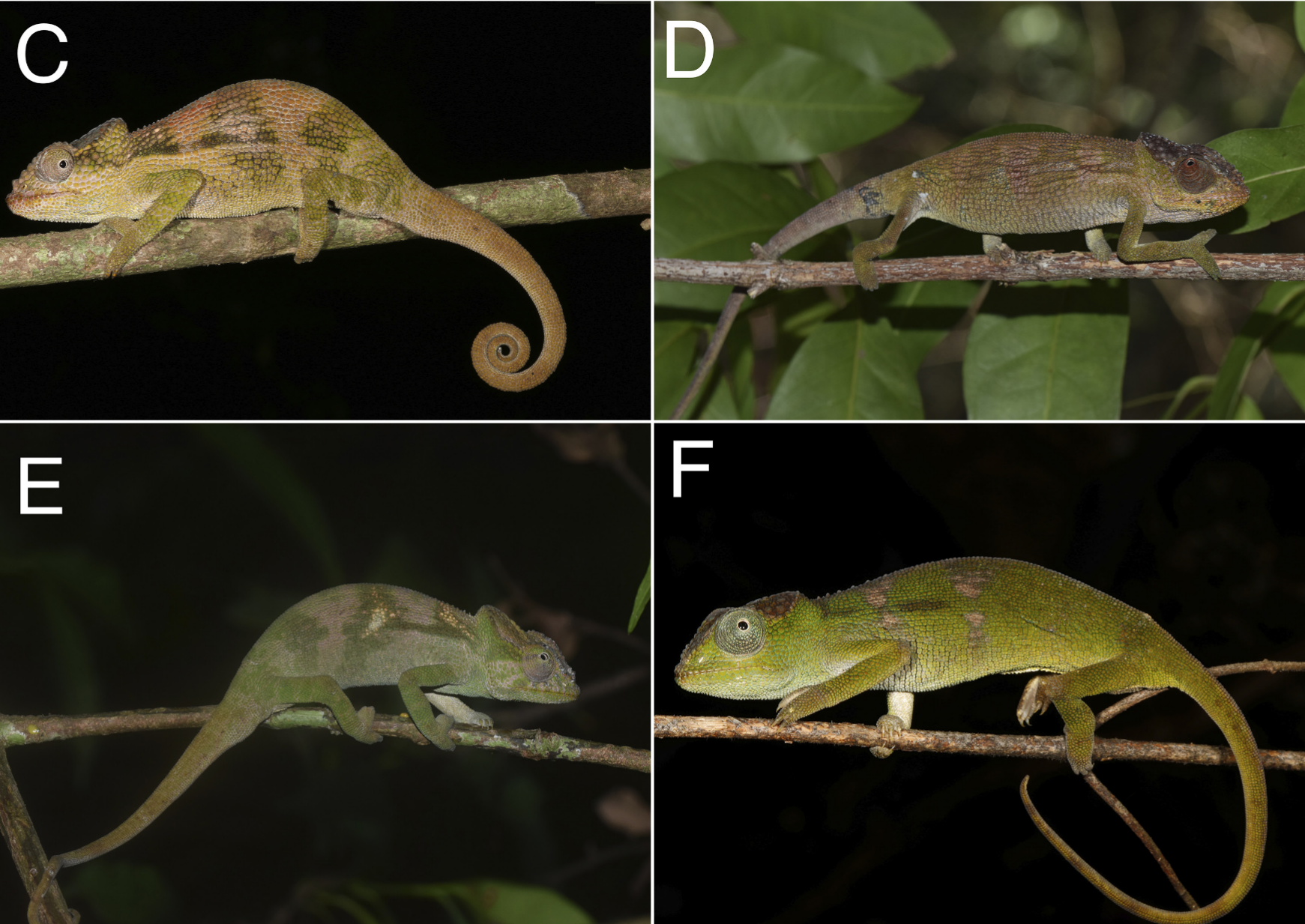
Nadzikambia franklinae was named in honour of the British biochemist Rosalind Franklin. The species is found in the Mahno and Ukalini wet forests on Mount Namuli in Mozambique. It has so far been found at altitudes between 1,618 and 1,632 metres. The males have a taller and rounder casque with smoother crests than other Nadzikambia species. The species’ three remaining habitats are each only around 0.67 km² in size and are under massive pressure from land clearance for small-scale farming, such as maize and potato cultivation.

Nadzikambia goodallae was named after the recently deceased chimpanzee researcher Jane Goodall. The species inhabits the wet forest on the western slope of Mount Ribáuè in Mozambique.  It has so far been found at very specific altitudes between 1,052 and 1,142 metres. This species, too, is under severe threat from slash-and-burn farming and deforestation of its habitat. Only 4.8 km² of forest area currently remains. The males of Nadzikambia goodallae have a flat, broad casque with rough scales.

Nadzikambia evanescens was named after the Latin word for transience. This is intended to highlight the species’ critically endangered status. This chameleon species now survives in just a single fragment of wet forest on Mount Inago in Mozambique. Since 2009 alone, 85% of the forest area that existed at that time has been cleared. Currently, just 2.3 km² remains. The small habitat lies at an altitude of 1,235 to 1,281 m. The males of the species have a tall, round casque with smooth crest scales.

Nadzikambia nubila was named after the Latin word for clouds. Its habitat, Mount Chaperone, provides the rainfall essential for the region’s survival through its surrounding cloud formations. To date, only females of Nadzikambia nubila have been recorded; no males have yet been found. The chameleons inhabit wet forest at altitudes between 1,017 and 1,053 metres, although the existing forest area has more than halved since 2009, mainly due to slash-and-burn farming and illegal logging. Currently, only 7 km² remain. Furthermore, the highest elevations of Mount Chaperone, which are less threatened by human activity, appear to be changing from dense woodland to more exposed granite outcrops. The authors suspect that this may be due to climate change.

Unfortunately, the already known species Nadzikambia mlanjensis is just as threatened as the four new species. And this is despite the fact that it occurs at altitudes ranging from 600 to almost 2,000 metres, meaning it inhabits significantly more varied habitats. The forest area that once covered Mount Mlanje in Malawi decades ago now consists only of tiny, isolated forest fragments. In total, perhaps 12 km² remain; the rest has already been cleared. Nor is much left of Ruo Gorge Forest, the site where the species was first discovered. It is not yet clear whether Nadzikambia mlanjensis also occurs on nearby Mount Mchese.

The sixth and final species of the genus, Nadzikambia baylissi, appears to have fared slightly better. The species is found in wet forests at altitudes of between 1,000 and 1,400 metres on Mount Mabu in Mozambique. Here, the forest is still largely intact, even though the forest edges are struggling with slash-and-burn farming. However, it is not entirely clear whether the estimated 48 km² of habitat for this chameleon species is still accurate.

Sky islands of Mozambique harbour cryptic species of chameleons: Description of four new species of sylvan chameleons (Squamat: Chamaeleonidae: Nadzikambia Tilbury, Tolley & Branch, 2006)
Krystal A. Tolley, Werner Conradie
Vertebrate Zoology 76, 2026: 207-246
DOI: 10.3897/vz.76.e178403
Download the article for free

Photos: From top left to bottom right Nadzikambia franklinae, Nadzikambia goodallae, Nadzikambia avanescens and Nadzikambia nubila
Spines of tree- and ground-dwelling chameleons

Spines of tree- and ground-dwelling chameleons

Tiermedizin Science

Various anatomical adaptations of the spine between ground and tree dwellers are known from mammals, especially primates. In some cases, the different vertebrae are even associated with certain movement patterns and bodily functions. In a comparative study, two scientists from New York (USA) have now investigated how the spine of ground- and tree-dwelling chameleons differs.

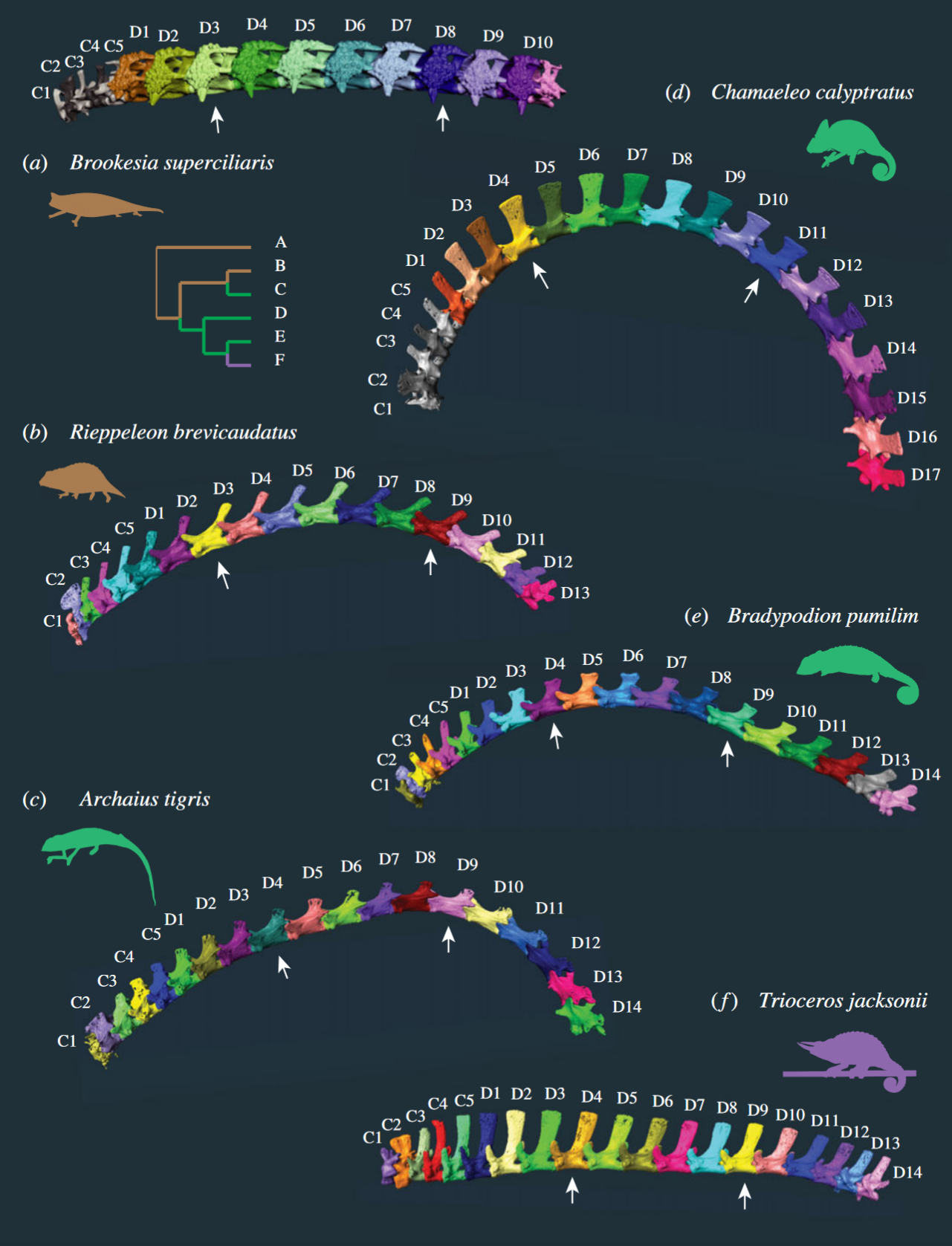
They measured the already existing CT scans on Morphosource.org of a total of 28 chameleons of different species. Brookesia perarmata, Brookesia superciliaris, Brookesia thieli, Palleon nasus, Rhampholeon platyceps, Rhampholeon spectrum, Rieppeleon brevicaudatus and Rieppeleon kerstenii were classified as ground dwellers. Archaius tigris, Bradypodion melanocephalum, Bradypodion pumilum, Bradypodion thamnobates, Calumma amber, Calumma brevicorne, Calumma parsonii, Chamaeleo calyptratus, Chamaeleo gracilis, hamaeleo zeylanicus, Furcifer lateralis, Furcifer pardalis, Furcifer verrucosus, Kinyongia carpenteri, Kinyongia tavetana, Kinyongia xenorhina, Nadzikambia mlanjensis, Trioceros feae, Trioceros jacksonii and Trioceros quadricornis were considered arboreal. The vertebrae were counted and the width of the lamina, length, width, height of the vertebral body, and the height of the spinous process and transverse processes on each vertebra were measured. In addition, the so-called prezygapophysial angle was determined. This is the angle of the intervertebral joint, i.e. the contact surfaces between the individual vertebrae. The measurements of ground and tree dwellers were compared and statistically evaluated. Only the vertebral column of the trunk was considered, the caudal vertebral column was left out.

First of all, the results showed that ground-dwelling chameleons generally have fewer trunk vertebrae (15 to 19) than tree-dwelling chameleons (18 to 23). The trunk spine of almost all species could be divided into the already known three areas: Cervical spine and anterior and posterior dorsal spine. A thoracic and lumbar spine as in mammals is generally not distinguished in chameleons because of the continuous ribs. Five chameleon species had four regions instead of three: they had an anterior and a posterior cervical spine, the anterior one consisting of only two vertebrae with rib processes. Six chameleon species had two additional lumbar vertebrae and one species had three transitional vertebrae in the region between the cervical and dorsal spine. In Kinyongia carpenteri, a total of five regions could be distinguished in the trunk spine: The chameleon had anterior and posterior cervical vertebrae as well as anterior and posterior dorsal vertebrae and two additional lumbar vertebrae. Brookesia perarmata was also a special case: the trunk spine of this chameleon consisted of only two regions and at the same time the smallest number of vertebrae of all species studied.

The greatest differences between ground and tree-dwelling chameleons were found in the prezygapophyseal angle (PZA) and the height of the spinous process. The intervertebral joint surfaces in the anterior dorsal vertebrae of tree-dwelling chameleons were clearly more dorsoventrally oriented and smaller than in ground-dwelling species. Several tree-dwellers showed a PZA of less than 90°. In tree-dwelling chameleons, the largest spinous processes were located at the transition from the cervical to the dorsal spine. Among the ground-dwelling species, the spinous processes were similar only in Palleon nasus. In ground-dwelling chameleons, the appearance of the spinous process varied greatly. Rieppeleon, for example, showed narrow, backward-sloping spinous processes, while the spinous processes in Brookesia were more like a kind of bone bridge than a process. Archaius tigris was an exception: The spinous processes in this chameleon hardly differed along the entire spine.

The authors conclude from the results that the anatomy of the different vertebrae is strongly related to the chameleons’ way of life and different locomotion. The intervertebral joint surfaces in tree-dwelling chameleons are probably important for climbing by supporting the function of the shoulder girdle. Reduced mobility in the mediolateral plane provides greater trunk stiffness, which facilitates climbing in arboreal dwellers. Stiffening of the axial skeleton (skull, trunk spine and thorax) is also known from tree-dwelling mammals. The larger spinous processes in larger chameleons could facilitate shoulder girdle rotation and muscle movement, resulting in increased stride length, better head support, and thus possibly easier feeding.

Morphological and functional regionalization of trunk vertebrae as an adaption for arboreal locomotion in chameleons
Julia Molnar, Akinobu Watanabe
Royal Society Open Science 10, 2023: 221509
DOI: 10.1098/rsos.221509

Illustration: Spines of different chameleon species

Species diversification in chameleons

Species diversification in chameleons

Science

From earlier studies, we know that the first chameleons evolved in the late Cretaceous, about 90 million years ago, on mainland of Africa. Around the border between the Cretaceous and Tertiary periods, about 65 million years ago, different species began to evolve. It is still unclear today which factors contributed to the diversity of species. Two researchers from Swansea University in Wales have now used various computational models of phylogenetics to investigate what might have influenced diversification (the splitting of chameleons into many different species).

First, they studied the diversification of chameleon species in Madagascar. In terms of evolutionary history, there are two points in time when chameleons apparently spread across the sea from mainland Africa to Madagascar. One is about 65 million years in the past, the other 45 million years. You could now think that the climatically extremely different habitats in Madagascar could have driven the evolution of the species very quickly after the spread across the sea. To the surprise of the researchers, however, no evidence of this was found. The species richness of chameleons on Madagascar must therefore come from the fact that chameleons spread there very early and thus simply had much more time to develop into different species than elsewhere.

Furthermore, the researchers investigated whether switching between two ecomorphs – from ground-dwelling stub-tailed chameleons to tree-dwelling chameleons with longer tails – had an impact on species diversity. Rather surprisingly, this did not seem to be the case. The evolution to tree-dwellers with longer tails occurred relatively early on one or two occasions. No evidence could be found that different ecomorphs accelerated diversification. Instead, speciation rates were found to slow down progressively over the last 60 million years. Only a very early dispersal event of the genus Bradypodion in South Africa around 10 million years ago was accompanied by a two- to fourfold diversification rate.

As a third focus of the study, the researchers examined the genus Bradypodion. During the climate change in the Miocene around 10 million years ago, South Africa changed a lot. Forests disappeared, leaving behind isolated forest habitats and, in between, savannahs, some of which are now so-called hot spots of biodiversity. Two of them, the Cape Floristic Region at the southwestern tip of South Africa and Maputuland-Pondoland-Albany on the east coast of South Africa, are home to a particularly large number of Bradypodion species. Each species is limited to a geographically very clearly defined area. The researchers, therefore, suspect that Bradypodion species have actually evolved faster under the influence of habitat change. It should be noted that the diversification rate of the genus Bradypodion is probably rather underestimated, as there are still many hidden species to be assumed.

Diversification dynamics of chameleons (Chamaeleonidae)
Stephen Giles, Kevin Arbuckle
Journal of Zoology, 2022
DOI: 10.1111/jzo.13019