
The South East Africa Montane Archipelago (SEAMA) stretches across northern Mozambique and into southern Malawi. It consists of a chain of around 30 so-called inselbergs, which are completely isolated from one another by valleys. They have long been recognised as biodiversity hotspots. For decades, ongoing unrest made it difficult to conduct herpetological surveys of the insular mountains. And when the opportunity finally arose again, new species of chameleon were promptly discovered – one on each of the insular mountains surveyed to date. The new species have since been studied genetically and morphologically. Four new species of Nadzikambia were described in the process.
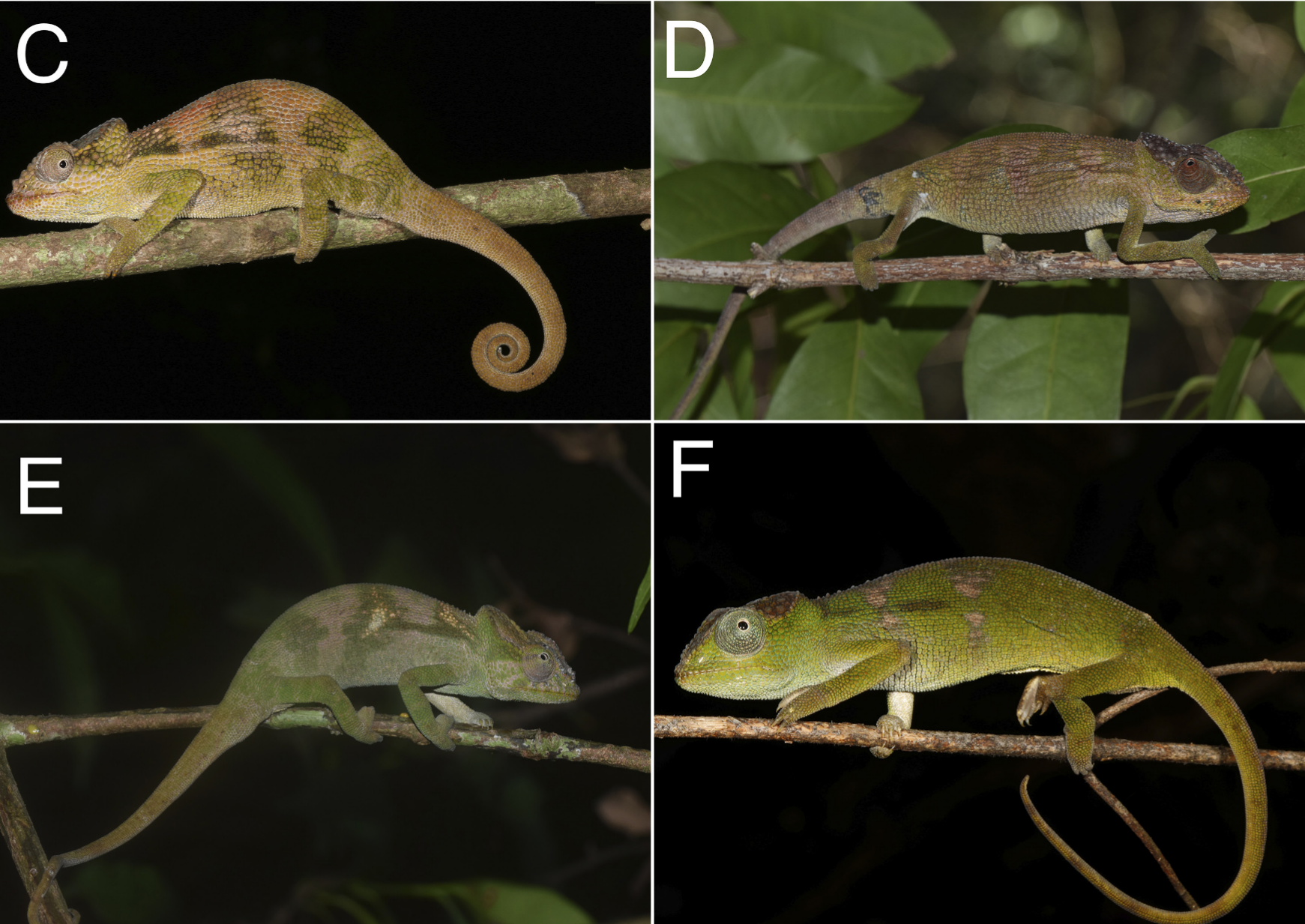
Nadzikambia franklinae was named in honour of the British biochemist Rosalind Franklin. The species is found in the Mahno and Ukalini wet forests on Mount Namuli in Mozambique. It has so far been found at altitudes between 1,618 and 1,632 metres. The males have a taller and rounder casque with smoother crests than other Nadzikambia species. The species’ three remaining habitats are each only around 0.67 km² in size and are under massive pressure from land clearance for small-scale farming, such as maize and potato cultivation.
Nadzikambia goodallae was named after the recently deceased chimpanzee researcher Jane Goodall. The species inhabits the wet forest on the western slope of Mount Ribáuè in Mozambique. It has so far been found at very specific altitudes between 1,052 and 1,142 metres. This species, too, is under severe threat from slash-and-burn farming and deforestation of its habitat. Only 4.8 km² of forest area currently remains. The males of Nadzikambia goodallae have a flat, broad casque with rough scales.
Nadzikambia evanescens was named after the Latin word for transience. This is intended to highlight the species’ critically endangered status. This chameleon species now survives in just a single fragment of wet forest on Mount Inago in Mozambique. Since 2009 alone, 85% of the forest area that existed at that time has been cleared. Currently, just 2.3 km² remains. The small habitat lies at an altitude of 1,235 to 1,281 m. The males of the species have a tall, round casque with smooth crest scales.
Nadzikambia nubila was named after the Latin word for clouds. Its habitat, Mount Chaperone, provides the rainfall essential for the region’s survival through its surrounding cloud formations. To date, only females of Nadzikambia nubila have been recorded; no males have yet been found. The chameleons inhabit wet forest at altitudes between 1,017 and 1,053 metres, although the existing forest area has more than halved since 2009, mainly due to slash-and-burn farming and illegal logging. Currently, only 7 km² remain. Furthermore, the highest elevations of Mount Chaperone, which are less threatened by human activity, appear to be changing from dense woodland to more exposed granite outcrops. The authors suspect that this may be due to climate change.
Unfortunately, the already known species Nadzikambia mlanjensis is just as threatened as the four new species. And this is despite the fact that it occurs at altitudes ranging from 600 to almost 2,000 metres, meaning it inhabits significantly more varied habitats. The forest area that once covered Mount Mlanje in Malawi decades ago now consists only of tiny, isolated forest fragments. In total, perhaps 12 km² remain; the rest has already been cleared. Nor is much left of Ruo Gorge Forest, the site where the species was first discovered. It is not yet clear whether Nadzikambia mlanjensis also occurs on nearby Mount Mchese.
The sixth and final species of the genus, Nadzikambia baylissi, appears to have fared slightly better. The species is found in wet forests at altitudes of between 1,000 and 1,400 metres on Mount Mabu in Mozambique. Here, the forest is still largely intact, even though the forest edges are struggling with slash-and-burn farming. However, it is not entirely clear whether the estimated 48 km² of habitat for this chameleon species is still accurate.
Sky islands of Mozambique harbour cryptic species of chameleons: Description of four new species of sylvan chameleons (Squamat: Chamaeleonidae: Nadzikambia Tilbury, Tolley & Branch, 2006)
Krystal A. Tolley, Werner Conradie
Vertebrate Zoology 76, 2026: 207-246
DOI: 10.3897/vz.76.e178403
Download the article for free
Photos: From top left to bottom right Nadzikambia franklinae, Nadzikambia goodallae, Nadzikambia avanescens and Nadzikambia nubila