
The optic nerve of chameleons is highly specialised

The optic nerve of chameleons is highly specialised

Tiermedizin Science

It has long been known that chameleons have very special eyes. What is particularly fascinating is that they can move their eyes independently of each other in almost any direction. A team of US scientists has now discovered that the optic nerve in chameleons is also extremely specialised.

They examined adult reptiles of 34 different species using CT models. Brookesia superciliaris, Rieppeleon brevicaudatus and Chamaeleo calyptratus represented the chameleon family. They found that in all three chameleon species, the optic nerve was extremely curled. This anatomical feature means that the optic nerve in chameleons is much longer than would be necessary for an eye looking straight ahead. It probably enables the animals to have extremely mobile eyes without compromising their vision. Put simply, the optic nerve functions a bit like a flexi leash: when the eye moves sharply, part of the optic nerve is ‘unrolled’. When the eye moves back, the optic nerve curls back to its original position without overstretching the nerve fibres.

A new twist in the evolution of chameleons uncovers an extremely specialized optic nerve morphology
Emily Collins, Aaron M. Bauer, Raul E. Diaz Junior, Alexandra Herrera-Martínez, Esteban Lavilla, Edward L. Stanley, Monte L. Thies, Juan D. Daza
Scientific Reports 15, 2025: 38270.
DOI: 10.1038/s41598-025-20357-3
Download the article for free

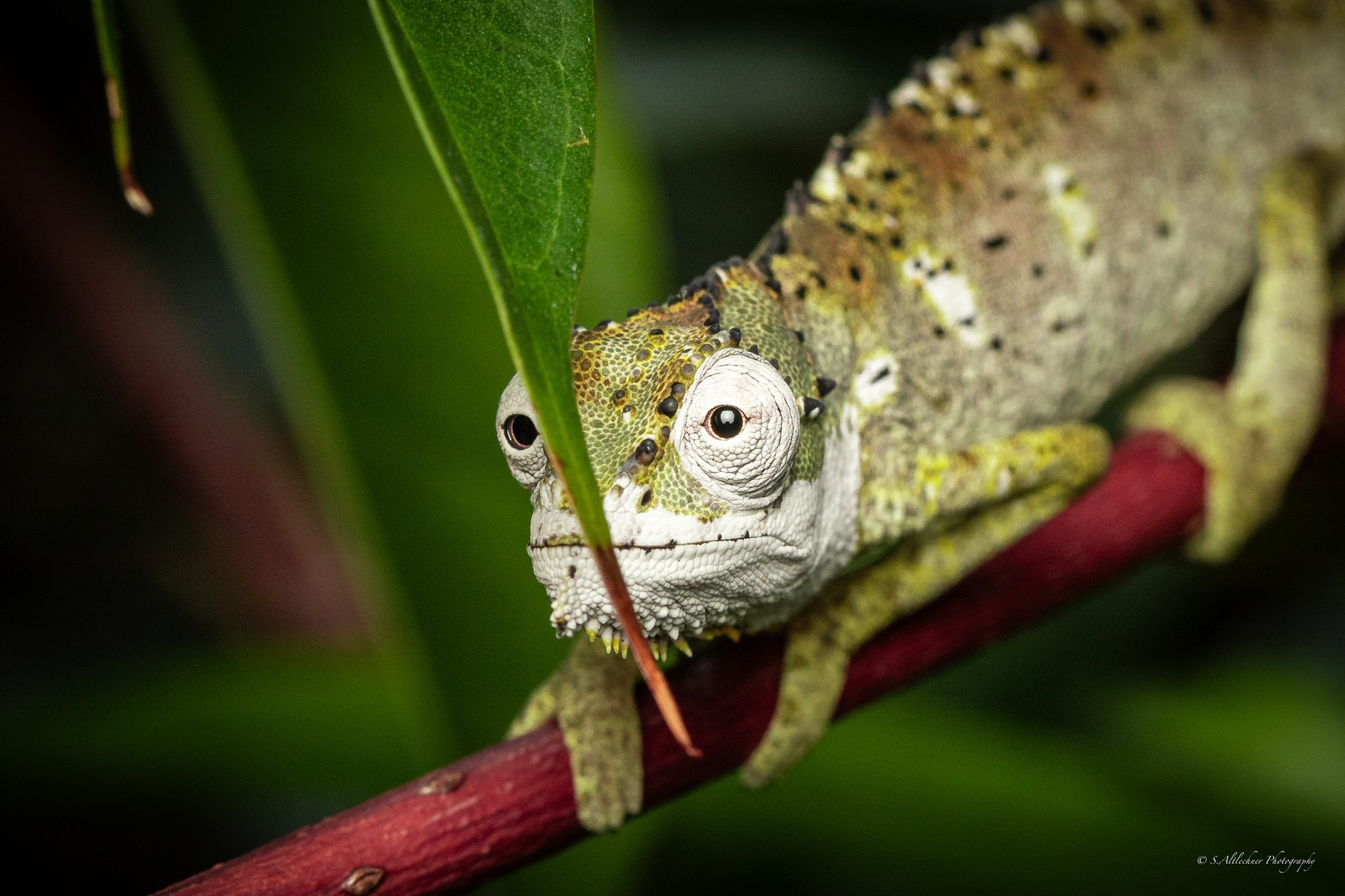
Photo: Portrait of Brookesia superciliaris, photographed by Alex Negro

Presentation in Cologne about chameleon keeping

Presentation in Cologne about chameleon keeping

Haltungsberichte Live lectures

Jean-Dominique Dufraine, member of the AG Chameleons, will give a detailed lecture on 16 December 2023 in Cologne on the keeping of two chameleon species.

It will be about the tiger chameleon, Archaius tigris, and a species of stump-tailed chameleon, Rieppeleon brevicaudatus. The tiger chameleon comes from the Seychelles and has been successfully bred in terrariums for many years. In recent years it has found an increasingly small group of enthusiasts. The fact that the tiger chameleon can be kept well in a group is particularly important. Rieppeleon brevicaudatus, a species originally from Tansania, has been somewhat forgotten in recent years, having been bred in quite good numbers in the 2000s and up to the beginning of the 2010s. Wrongly so! Because these are very interesting chameleons that are quite easy to keep. Jean-Dominique has been keeping and breeding both species for several years and passes on tips and tricks on keeping and breeding. He hopes that both species will have a good chance of being reintroduced into German terrariums in the future and would like to actively contribute to spreading the joy of keeping these animals.

Jean-Dominique Dufraine Keeping and breeding Archaius tigris and Rieppeleon brevicaudatus
Verein für Aquarien- und Terrarienkunde Köln-Mühlheim e.V. 1910
DGHT City Group Cologne
Restaurant “Steakhaus bei Marco”
Clevischer Ring 120-122
51063 Cologne
Start of lecture 20.00 hrs

Photo: Archaius tigris by Jean-Dominique-Dufraine
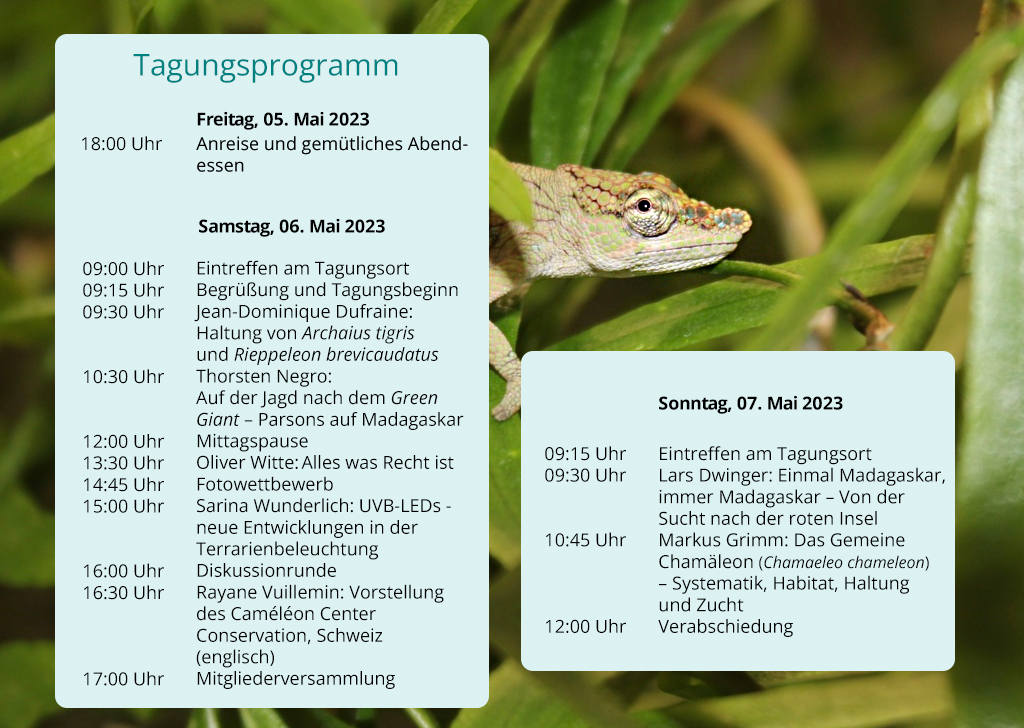
Our conference programme for May 2023

Our conference programme for May 2023

AG Interna

After we were able to publish a preview of the conference programme in December last year, we now have the final conference programme. This year’s conference will take place from 05 to 07 May 2023 in the tranquil town of Boppard am Rhein. As experience shows that the weekends in Boppard are booked up quickly, we recommend that you look for a hotel or guesthouse soon. Our programme has become a nice mixture of keeping reports, general terraristics and travel reports. Friday is the traditional day for arrival and a pleasant dinner in the local restaurants.

Saturday starts with a classic husbandry and breeding report. Jean-Dominique Dufraine has been keeping Rieppeleon brevicaudatus and Archaius tigris for several years. He talks about his experiences in breeding, but also in the everyday keeping of the two species. Afterwards, Thorsten Negro will take us on a search for Parson’s Chameleons in their natural habitat in Madagascar.

In the afternoon, Oliver Witte will give us an exciting insight into law, legislation and terrarium keeping – don’t worry, it won’t be as dry as it sounds, but very interesting for chameleon keepers. As a highlight, the physicist Sarina Wunderlich from www.lichtimterrarium.de has also agreed to join us. LEDs are becoming increasingly popular in terrarium keeping, not least because they can save a lot of electricity. Sarina will show us the advantages and risks of LEDs and discuss the latest development, UV LEDs. After these two presentations, we have planned plenty of time for discussion and questions, because there will certainly be plenty to talk about. At the end of Saturday, Rayana Vuillemain will introduce us to the Association Caméléon Centre Conservation (Switzerland) – this is the only presentation in English.

Sunday will be another colourful day: Lars Dwinger will report on a Madagascar trip to the southern highlands and the central east of the island. He travelled between carpet chameleons and rice fields as well as in the rainforest of Ranomafana, where he met a variety of small and large chameleons. Markus Grimm will conclude with an overview of Chamaeleo chamaeleon in its natural habitat in Europe as well as keeping and breeding them in terrariums.

We are very much looking forward to a nice meeting and many chameleon friends!