
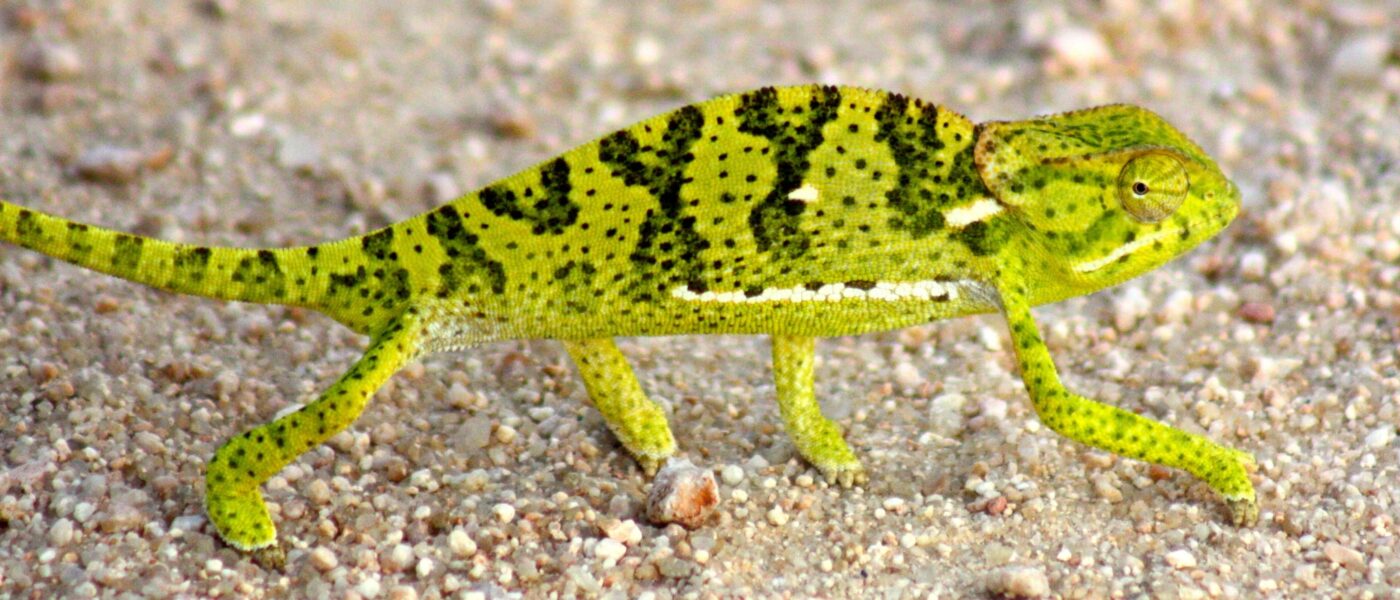
Description of Chamaeleo incognitus has been declared invalid
The Chamaeleo dilepis complex continues to raise a great many questions. A comprehensive study of its genetics and morphology across large parts of Africa has yet to be carried out. In 2025, Nečas described the species Chamaeleo incognitus in the journal Archaius, which he himself edited, managed and published. He also elevated the subspecies Chamaeleo dilepis roperi and Chamaeleo dilepis martensi to species status. South African researchers have now examined the issue in greater detail and concluded that both the new description and the changes to the species’ status are invalid.
The authors of the current paper highlight several issues underlying this species description. Firstly, Nečas assumes that a preserved chameleon from Mombasa (Kenya) is the ‘true’ Chamaeleo dilepis. However, the type locality of Chamaeleo dilepis is Gabon, some 3,300 km away from the East African Chamaeleo dilepis. Furthermore, there exists no detailed description of the hemipenes from the holotype – that is, the specimen first described under the name Chamaeleo dilepis. Only a publication from 2007 mentions the hemipenes of Chamaeleo dilepis briefly, in nine words. Nevertheless, Nečas uses these few words as an established description and states that the hemipenes of Chamaeleo incognitus differed from them. What he then describes very briefly, corresponds to the hemipenes of Chamaeleo dilepis roperi. In the photographs of the hemipenes of Chamaeleo incognitus, however – just to add to the confusion – the South African scientists recognise the same characteristics as those found on the hemipenes of Chamaeleo dilepis from Mombasa.
Furthermore, a 2022 study using phylogenetic analysis stated that the Chamaeleo dilepis of East Africa differ significantly from those of West Africa. Both the lowland and highland species of East Africa form a single clade. Purely in terms of appearance, it is not possible to reliably distinguish between the Chamaeleo dilepis roperi from the coastal region and those from the highlands. If one were to describe one of the two populations as a separate species – in this case, the one in the highlands as Chamaeleo incognitus – genetic evidence would be required. This is lacking in Nečas’s publication. The only remaining difference between the species is the different habitat or altitude – which is not sufficient for the South African scientists to describe a separate species. Chamaeleo incognitus should therefore be regarded as a synonym of Chamaeleo dilepis roperi.
Furthermore, the description did not comply with the rules of the ICZN (International Code of Zoological Nomenclature). Common ‘best practice’ guidelines, such as disclosing a conflict of interest, were not followed. This includes, for example, publishing an article in one’s own journal without expert review (known as peer review).
Chamaeleo incognitus or Chamaeleo ignotus? Questioning the taxonomic validity of a new chameleon species
Devon C. Main, Colin R. Tilbury
African Journal of Herpetology, April 2026
DOI: 0.1080/21564574.2025.2595158
Free article download
Picture: Chamaeleo dilepis from Botswana
Neubeschreibungen Science