What influences colour patterns in chameleons

What influences colour patterns in chameleons

Science

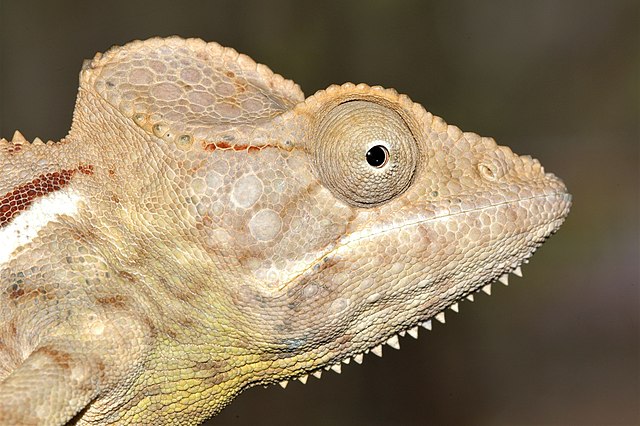
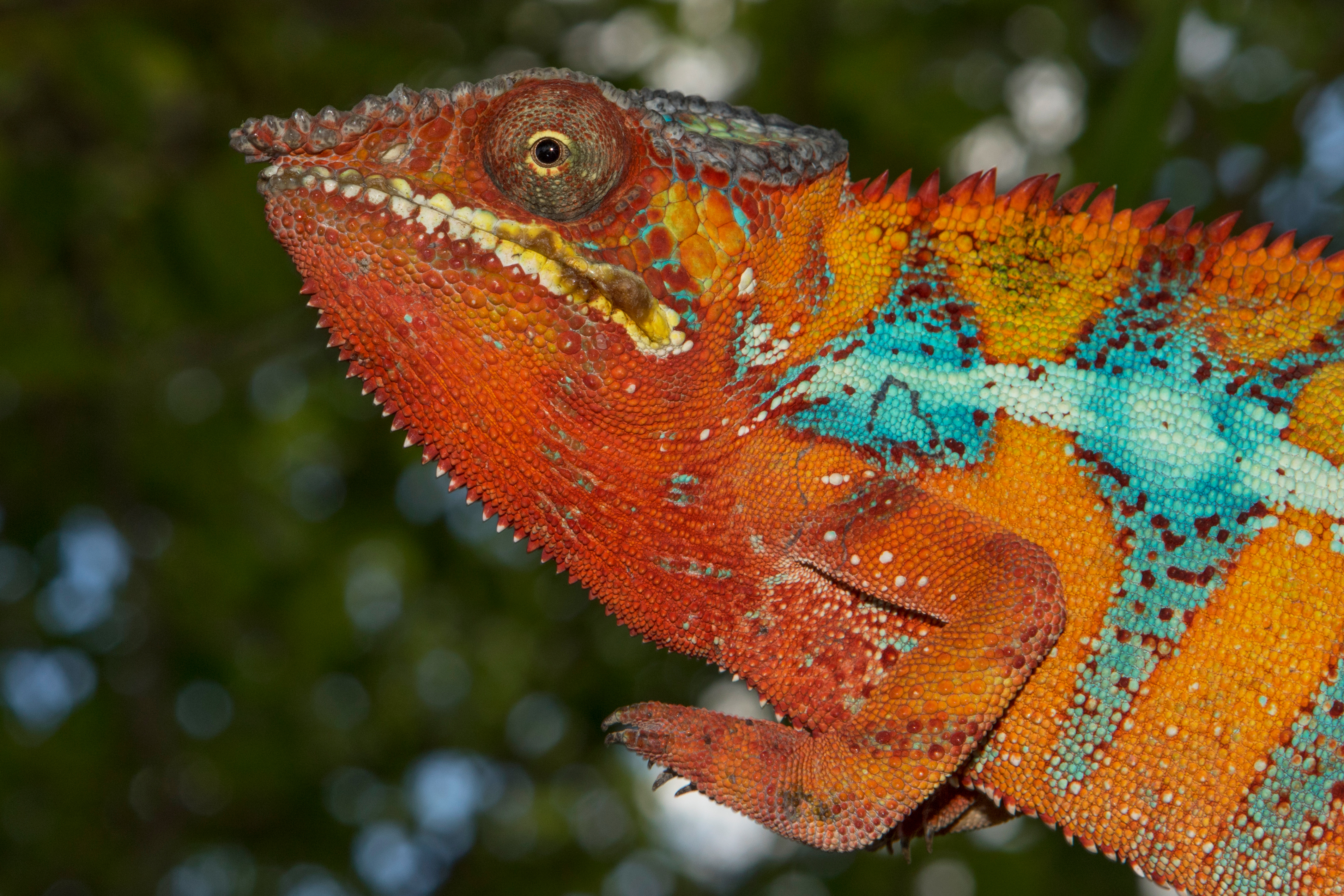
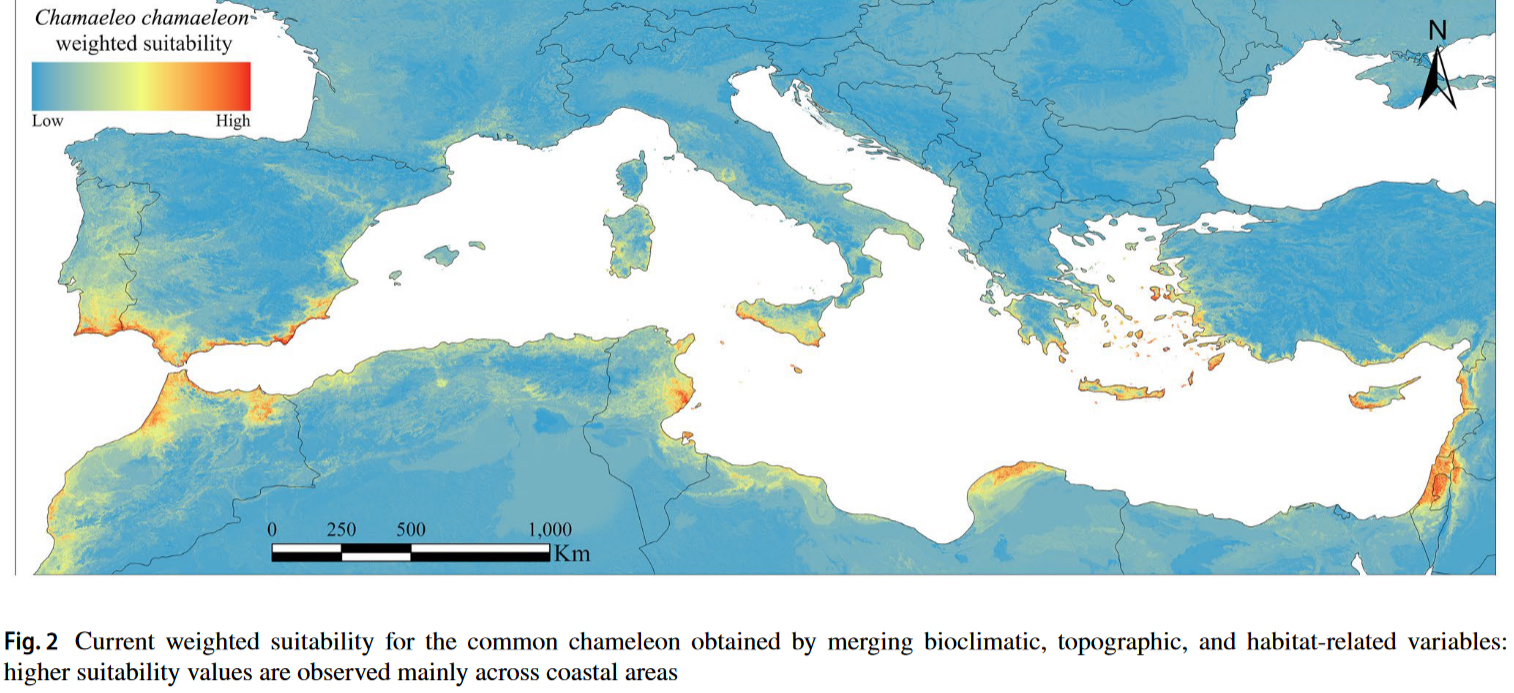
Chameleons are known for their ability to change colour. International scientists have now investigated what exactly influences different colour patterns in different populations. They want to know to what extent the habitat itself, the distance to other populations or social interactions influence the colour change.

The test subjects were European chameleons (Chamaeleo chamaeleon) caught in La Herradura and Sanlúcar in Spain. The two regions are around 230 kilometres apart. Other Chamaeleo chameleon were collected in the north-western Negev and on the Carmel coast in Israel (around 180 km apart). On the other hand, flap-necked chameleons (Chamaeleo dilepis) were captured in Simbithi, Zulu Falls and Maduma Boma in South Africa. The three locations are between 100 and 550 kilometres apart.

Each chameleon was subjected to two experiments. In the first, the scientists let the chameleon walk two metres on a horizontal stick, which was placed in the sun about one metre above the ground. In the second experiment, a second chameleon of the same species was placed on the same stick 50 cm away from the first. The colour patterns shown by the animal during the experiments and its behaviour were recorded for 20 minutes. The data was then analysed using computer programs. Blood was taken from a cut claw of all chameleons and genetically analysed. The habitats and soil conditions were also analysed in various ways and statistically evaluated. The captured animals were kept in ventilated plastic cages for a maximum of 12 hours and released after the analyses. Unfortunately, the study does not mention how many chameleons were caught and released in total.

As expected, it turned out that the individual populations of both the European and the flap-necked chameleon differed genetically from each other. The populations of Chamaeleo dilepis had significantly different haplotypes.

In the flap-necked chameleon, the females were significantly larger than the males in two locations, but not in Simbithi. The scientists also found that the colour patterns of the three populations studied could be clearly distinguished from each other. They concluded from the results that the colour patterns in Chamaeleo dilepis are primarily dependent on genetic isolation. The habitat itself and the size of the chameleons did not influence the colour patterns.

In the European chameleon, however, the situation was different: Body size and genetic distance to other populations predicted colour patterns in males very well. However, the colour patterns were independent of the location where the animals were found. Soil or vegetation colours only had a minor influence on the colour of females.

Genetic and behavioural factors affecting interpopulation colour pattern variation in two congeneric chameleon species
Tammy Keren-Rotem, Devon C. Main, Adi Barocas, David Donaire-Barroso, Michal Haddas-Sasson, Carles Vila, Tal Shaharabany, Lior Wolf, Krystal A. Tolley, Eli Geffen
Royal Society Open Science 11: 231554
DOI:  0.1098/rsos.231554

Presentation in Zurich about Spain and Morocco

Presentation in Zurich about Spain and Morocco

Live lectures

Dr Herbert Billinger will give a wonderful lecture on Morocco and southern Spain on Monday, 29 January 2024 in Zurich.

When the days get shorter and shorter in late autumn in Switzerland, the sun hides behind a thick layer of fog and the reptiles and amphibians sleep in their winter quarters, his wife Yvonne and he are always drawn to more southerly climes. The lecture is a summary of several winter trips to southern Spain and Morocco. And there is a lot to see there in terms of herpetology!

Dr. Herbert Billing Herpetological winter excursions in Morocco and southern Spain
DGHT City Group Zurich (Switzerland)
Canteen in the operations building of Zurich Zoo (1st floor)
Zürichbergstraße 221
8044 Zürich
Start of lecture 20.00 hrs

Online lecture about parasites in reptiles

Online lecture about parasites in reptiles

Tiermedizin Webinars

The DGHT has created a novelty this year with the digital regulars’ table. Every last Thursday of the month, reptile keepers from all over Germany meet to discuss a given topic and a corresponding lecture. No-one has to travel far to attend, as the speakers and participants come to their living room via an online connection.

Paula Sapion Miranda will kick things off on 25 January 2024. The vet researches parasites in reptiles and amphibians at Justus Liebig University in Giessen and also works at Exomed, the well-known veterinary laboratory for exotic animals. She will talk about common and less common unwanted lodgers. Please register by e-mail to bonsels@dght.de by the day before, and the participation link will be sent out on the day of the regulars’ table.

Paula Sapion Miranda Parasites in reptiles and amphibians
1st online regulars’ table of the DGHT
Start 20.00 hrs

Preliminary conference programme online

Preliminary conference programme online

AG Interna

Our preliminary conference programme is online! As an absolute novelty, we will not be meeting in Boppard on the Rhine this year from 24 to 26 May, but in Fulda. Fulda not only offers a beautiful historic city centre and excellent ICE connections, but also a great conference venue in the form of the Stadtgasthof Drei Linden. The Stadtgasthof not only has newly renovated rooms, but also its own butcher’s shop (don’t worry, there are also vegetarian and vegan dishes), a playground for children and a beer garden for adults.

The first travellers will meet up on Friday evening for an after-work beer in the old town of Fulda, which is just a ten-minute walk from the conference venue. On Saturday, the conference programme will get underway, which will once again offer a colourful mix of travel lectures, terraristics, veterinary aspects and research projects. A first preview can be found here.

What influences the rediscovery of lost species?

What influences the rediscovery of lost species?

Science

Throughout history, there have always been species that have been described once and then never seen again. There are also such cases among chameleons. Only a few years ago, the chameleon Furcifer voeltzkowi, which was thought to have been lost for almost 100 years, was rediscovered in western Madagascar. A recent publication by a large number of international authors now deals with the question of which factors influence rediscovery.

In 2023, the IUCN published a list of over 2,000 vertebrate species that had not been seen for more than ten years. Re:wild also published a list of 1008 lost species. Based on these lists and other literature, the scientists searched for species that had not been seen in the wild for more than ten years. In addition, there could not be any ex-situ populations (care in human hands outside the original occurrence). The result was a list of 1280 vertebrate species, which was then finalised with specialists in the respective fields. For example, species that are now considered extinct were excluded. This left 856 lost species, 42% of which were reptiles. The collected data was statistically analysed based on various factors.

Fewer reptiles were represented in the rediscoveries than mammals. Fewer reptile species were rediscovered than would have been statistically probable by chance. Reptiles also die out significantly faster than species are rediscovered. Overall, however, the rediscovery rate for reptiles is on the rise. Most rediscoveries have taken place in the tropics. Brazil and Ecuador are by far the countries with the most discoveries, closely followed by Australia, India and Madagascar. Surprisingly, a higher threat of habitat loss resulted in a higher rediscovery rate for reptiles.

Overall, there are several possible reasons why lost species have not yet been rediscovered. Firstly, there is a lack of data for several species – Brookesia lambertoni, which has not been seen in Madagascar since 1921, is mentioned here as an example. In the original description, its area of discovery is given as “Fito”. Fito is Malagasy for the number seven. Unfortunately, it is still not known what is meant by this name. There are many villages with the name, but it could also have meant a region, a river or a forest. It is also possible that the original description of the origin is due to a linguistic misunderstanding and that “Fito” does not exist as a place at all.

Furthermore, a lack of research capacity, especially in developing countries, also means a lower search intensity for lost species. In addition, many reptile species are rather inconspicuous and small. As a result, they are more difficult to advertise and attract little or no attention from potential sponsors. In addition, the habitat can also play a part in a species not being rediscovered. This is the case, for example, with very remote habitats or landscapes that are difficult to access, such as swamps.

What factors influence the rediscovery of lost tetrapod species?
Tim Lindken, Christopher V. Anderson, Daniel Ariano-Sánchez, Goni Barki, Christina Biggs, Philip Bowles, Ramamoorthi Chaitanya, Drew T. Cronin, Sonja C. Jähnig, Jonathan M. Jeschke, Rosalind J. Kennerley, Thomas E. Lacher Jr., Jennifer A. Luedtke, Chunlong Liu, Barney Long, David Mallon, Gabriel M. Martin, Shai Meiri, Stesha A.. Pasachnik, Victor Hugo Reynoso, Craig B. Stanford, P. J. Stephenson, Krystal A. Tolley, Omar Torres-Carvajal, David L. Waldien, John C.Z. Woinarksi, Thomas Evans
Global Change Biology 30, 2024, pp. 1-18.
DOI:  10.1111/gcb.17107

Photo: Furcifer voeltzkowi in Mahajanga, photographed by Alex Laube

Chameleons in Bobaomby (Madagascar)

Chameleons in Bobaomby (Madagascar)

Verbreitung Science

The Bobaomby complex is located at the northernmost tip of Madagascar, north and west of the largest coastal town in the north, Antsiranana (Diego Suarez in French). It consists of dry forest at sea level up to a maximum of 200 metres above sea level as well as extensive savannahs on karst rock and various rock formations. The area has not been protected to date.

Scientists from Madagascar conducted reptile counts in the Bobaomby complex in 2018. The counts were carried out in February and March, i.e. during the rainy season. Five different locations were analysed: Beantely, Antsisikala and Ambanililabe as examples of varying degrees of degraded dry forest, Anjiabe for its intact dry forest and Ampombofofo with relatively intact forest. To find animals, the visual survey was used on 25 days during the day and at night in selected transects, sometimes specifically in suitable habitats such as leaf axils or under dead tree trunks, and pitfall traps along erected fences were also used.

A total of 42 reptile species have been recorded. All of them, except one gecko species, originally only occur on Madagascar, while two other gecko species are now also found on neighbouring islands. There is a small novelty among the chameleons: the leaf chameleon Brookesia ebenaui was recorded for the first time in Bobaomby, more precisely in Beantely. Brookesia stumpffi and Furcifer petteri were found in Beantely, Anjiabe and Ampombofofo. Furcifer pardalis and Furcifer oustaleti occurred as expected throughout the whole Bobaomby complex.

The authors suggest that the Bobaomby complex – especially the three forests where most of the reptiles were found – should be protected to preserve the local herpetofauna.

Overview of reptile diversity from Bobaomby complex, northern tip of Madagascar
Randriamialisoa, Raphali R. Andriantsimanarilafy, Alain J. Rakotondrina, Josué A. Rakotoarisoa, Nasaina T. Ranaivoson, Jeanneney Rabearivony, Achille P. Raselimanana
Animals 13: 3396, 2023
DOI:  10.3390/ani13213396

Photo: Furcifer petteri, male, in the north of Madagascar, photographed by Alex Laube

Merry Christmas and a happy New Year!

Merry Christmas and a happy New Year!

AG Interna General topics

We can look back on an eventful 2023. We had a great conference, lots of news about the world of chameleons and, most recently, we were able to successfully place a number of animals. Let’s hope that 2024 will be even more active. The entire board of the AG Chameleons wishes you all a Merry Christmas and happy holidays! We are particularly looking forward to next year’s conference, which will be held in Fulda for the first time in over 20 years. The programme is currently being prepared and will be published shortly – then you will also receive more information on registration and room bookings. It will be a very interesting and varied programme – stay tuned!

Bild: pikisuperstar und catalyststuff / Freepik

Presentation in Cologne about chameleon keeping

Presentation in Cologne about chameleon keeping

Haltungsberichte Live lectures

Jean-Dominique Dufraine, member of the AG Chameleons, will give a detailed lecture on 16 December 2023 in Cologne on the keeping of two chameleon species.

It will be about the tiger chameleon, Archaius tigris, and a species of stump-tailed chameleon, Rieppeleon brevicaudatus. The tiger chameleon comes from the Seychelles and has been successfully bred in terrariums for many years. In recent years it has found an increasingly small group of enthusiasts. The fact that the tiger chameleon can be kept well in a group is particularly important. Rieppeleon brevicaudatus, a species originally from Tansania, has been somewhat forgotten in recent years, having been bred in quite good numbers in the 2000s and up to the beginning of the 2010s. Wrongly so! Because these are very interesting chameleons that are quite easy to keep. Jean-Dominique has been keeping and breeding both species for several years and passes on tips and tricks on keeping and breeding. He hopes that both species will have a good chance of being reintroduced into German terrariums in the future and would like to actively contribute to spreading the joy of keeping these animals.

Jean-Dominique Dufraine Keeping and breeding Archaius tigris and Rieppeleon brevicaudatus
Verein für Aquarien- und Terrarienkunde Köln-Mühlheim e.V. 1910
DGHT City Group Cologne
Restaurant “Steakhaus bei Marco”
Clevischer Ring 120-122
51063 Cologne
Start of lecture 20.00 hrs

Photo: Archaius tigris by Jean-Dominique-Dufraine

Presentation on Oman in Francfort

Presentation on Oman in Francfort

Reiseberichte Live lectures

On 15 December 2023, Benjamin Scheler from Burgrieden will give an illustrated talk in Frankfurt am Main about a trip to Oman. The Sultanate of Oman is located in the south-east of the Arabian Peninsula and borders the United Arab Emirates, Saudi Arabia and Yemen.

As a desert connoisseur, Benjamin Scheler travelled through Oman for two weeks last year. He travelled around 4500 km. From his starting point in Muscat, he travelled south-east down the coast. A short detour to the country’s largest island – Masirah – then took him to Dhofar. This southernmost province of Oman is the only area of the Arabian Peninsula to feel the influence of the summer monsoon. The flora and fauna are correspondingly different compared to the rest of the country. From there, we travelled a little further north, away from the coast, into the desert areas. We then took the only road through the arid hinterland back to the capital Muscat. Benjamin was able to track down 45 species of reptiles and amphibians, some in unexpectedly high numbers – including chameleons.

All in all, you can expect a great, colourful presentation that will certainly not only delight desert fans!

Benjamin Scheler A (first) trip to Oman to find reptiles and amphibians
DGHT City Group Frankfurt
Zoo school of Zoo Frankfurt
Alfred-Brehm-Platz 16
60316 Frankfurt am Main
Einlass ab 18.30 Uhr, Vortragsbeginn 19.00 Uhr

Photo: Chamaeleo arabicus in Oman, photographed by Benjamin Scheler

The Indian Chameleon in Solapur (India)

The Indian Chameleon in Solapur (India)

Verbreitung Science

It has long been known that the Indian chameleon occurs in Maharashtra. A recently published survey study has even found evidence of it in an area near Solapur that is covered only with grass and bushes.

The area studied is a 15 km² area of semi-arid grassland around a site earmarked for an airport at an altitude of 450 to 500 metres. The nearest village is Boramani, a small town just outside the city of Solapur in the state of Maharashtra in western India. For one year, about half of the grassland was surveyed four times a month for the presence of reptiles. Squares of 50 metres x 50 metres were laid out, each at least 300 metres apart. Each observation period consisted of five hours and only observations with the naked eye.

During the study period, 888 individuals of 14 different reptile species were recorded. Of these, more than 300 were Sitana laticeps, a fan-throated lizard. Among the species found were two Chamaeleo zeylanicus. The activity of the lizards increased from March, stabilised during the monsoon season in June-July and then declined again from August.

The authors argue in favour of protecting the grassland area due to the existing biodiversity. This should prevent the construction of the airport and thus the disappearance of the habitat.

Ecology of lizards in an ecologically significant semi-arid grassland patch near Solapur, Maharashtra, India
Mahindrakar Yogesh Y., Waghmare Akshay M., Hippargi Rajshekhar V.
International Journal of Zoological Investigations 9 (2) 2023, pp. 210-223
DOI: 10.33745/ijzi.2023.v09i02.022