
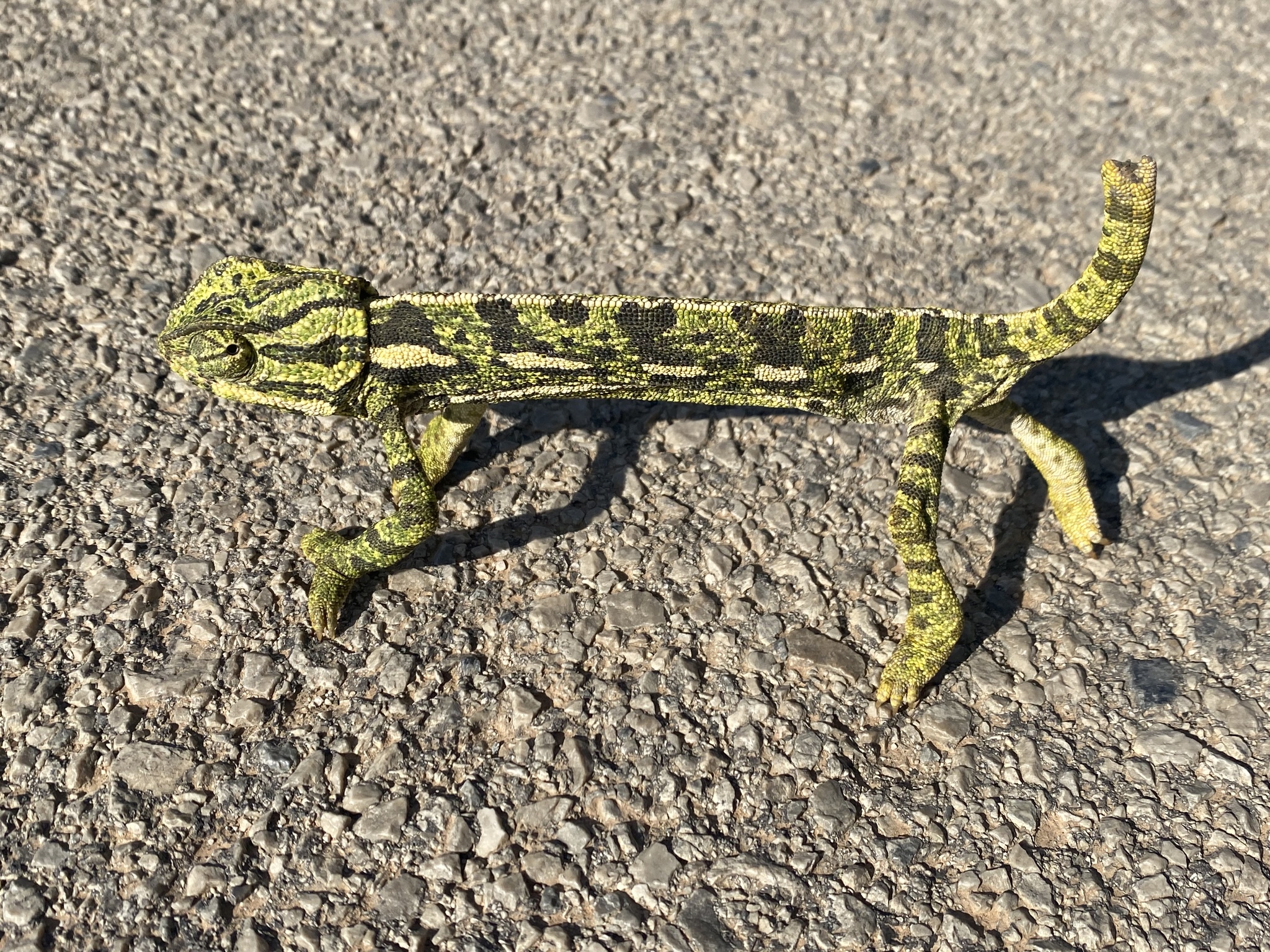
Although the European chameleon (Chamaeleo chamaeleon) is locally widespread on the Iberian Peninsula, its habitat is often cut through by roads in densely populated coastal areas. Biologists at the University of Málaga (Spain) recently investigated whether and how busy roads affect the behaviour and population density of the European chameleon.
They studied a privately owned study area in the province of Málaga in southern Spain, located on the edge of the A7 motorway. The A7 has a high volume of traffic, with 43,121 cars passing through every day. The study area consisted of abandoned olive and almond groves, but mainly large areas of scrubland with yellow broom and broom-like plants such as lavender, fennel and green dwarf palms.
The biologists divided the study area into five 225-metre-wide fields, each at different distances from the A7 motorway. At night, they searched for chameleons using torches. The sex, season, weight and position of any Chamaeleo chamaeleon found were recorded and their occurrence statistically evaluated. In addition, they noted the type of vegetation in which the animals were found and whether food was available. In order to better assess the availability of arthropods, these were caught in traps, identified and counted.
A total of 148 adult and 92 juvenile Chamaeleo chamaeleo were found, with 592 control points remaining without chameleon observations. It was noticeable that the population density of Chamaeleo chamaeleon was highest in the fields furthest away from the A7 motorway. Only 24.3% of adult chameleons were discovered in the immediate vicinity of the motorway, while 62.2% were found in the areas furthest from the motorway. Accordingly, the two fields directly adjacent to the motorway also had the fewest juveniles. The chameleons therefore appear to be disturbed by the motorway and retreat from its vicinity. However, the availability of arthropods (i.e. potential food) was comparable in all five areas. Interestingly, it was also found that more chameleons were present in areas with fewer shrubs. This suggests that Chamaeleo chamaeleo tends to avoid habitats with very dense undergrowth.
The results of the study are consistent with those for other reptiles, which describe, among other things, the so-called road effect zone. This is the phenomenon whereby straight roads running over long distances lead to a large amount of unsuitable habitat, even if they ‘only’ have narrow verges that are avoided by the animals. The length of the road and the number of roads can still severely restrict or reduce the habitat of a species. This finding is new for the European chameleon and important for species conservation. The authors conclude that areas with highly frequented roads less than 500 to 675 metres away are unsuitable habitats for Chamaeleo chamaeleon.
Effects of habitat characteristics in an anthropized landscape on the spatial behavior and abundance of a common chameleon (Chamaeleo chameleon) population
M.A. Farfán, J. Duarte, D. Romero, L. Colorado-Pedrero, P. García-Quevedo, R. Arroyo-Morales, F. Dìaz-Ruiz
Conservation Science and Practice 2025: e70070.
DOI: 10.1111/csp2.70070
Free download of the article
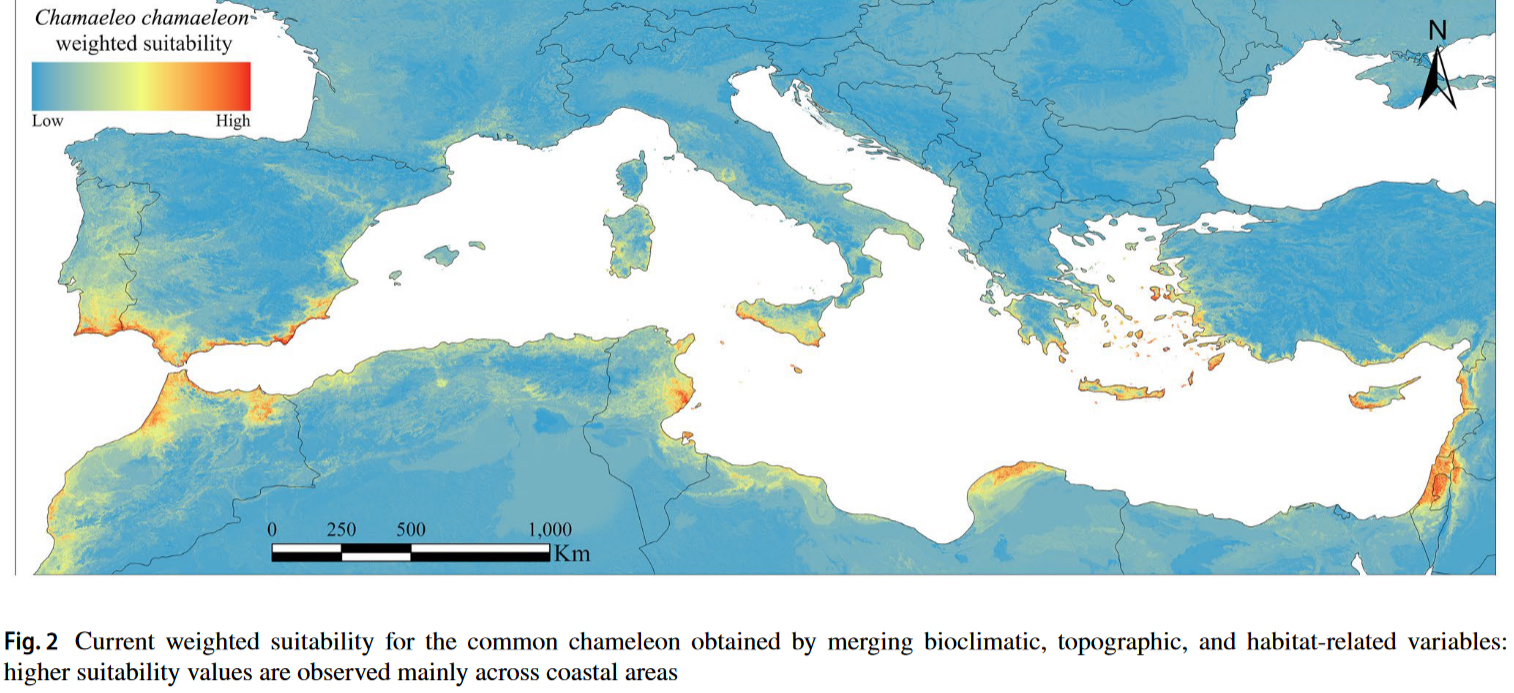
 For the study, the existing literature, sampling by the author himself, OpenStreetMaps and information from the Global Biodiversity Information Facility (GBIF) were used, statistically processed and analysed. Climate, topography, habitat of the sites and connections of existing populations were used to predict potentially suitable new habitats.