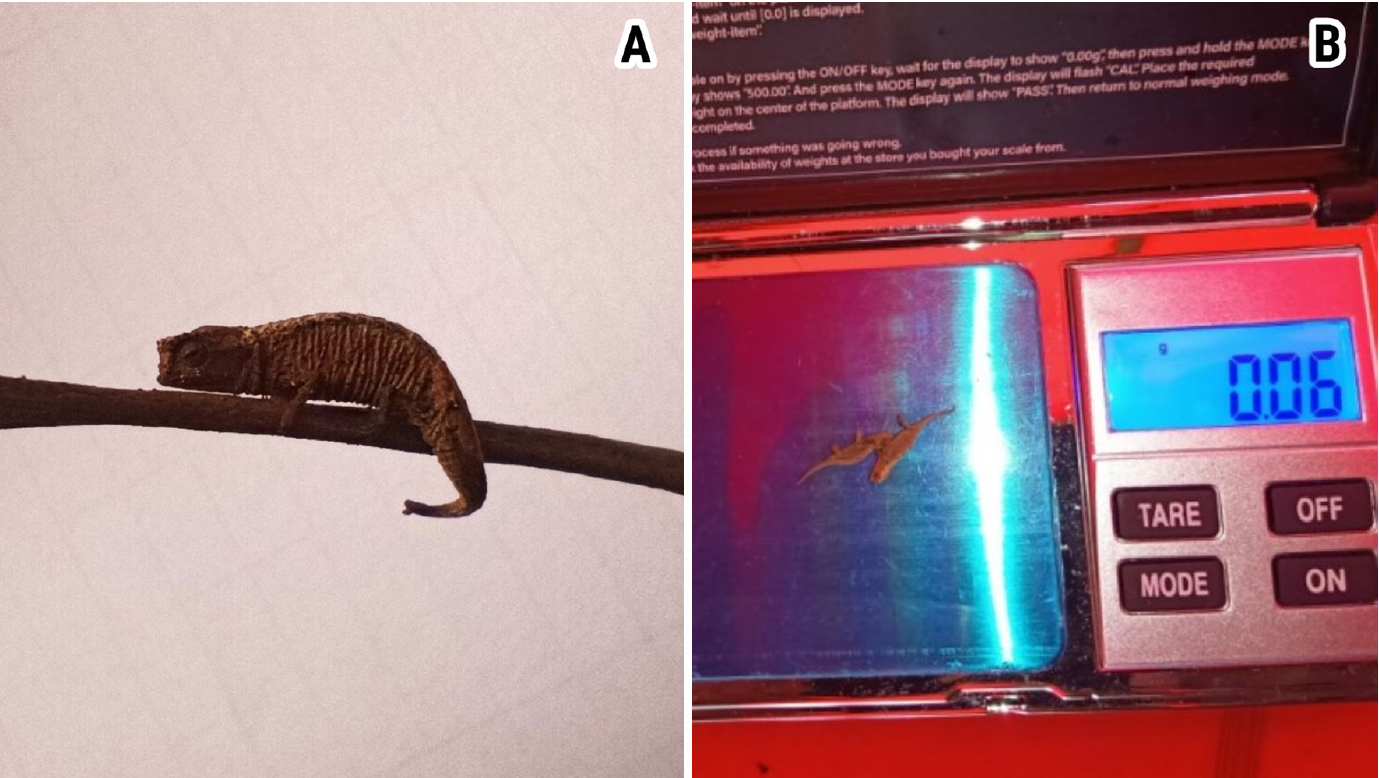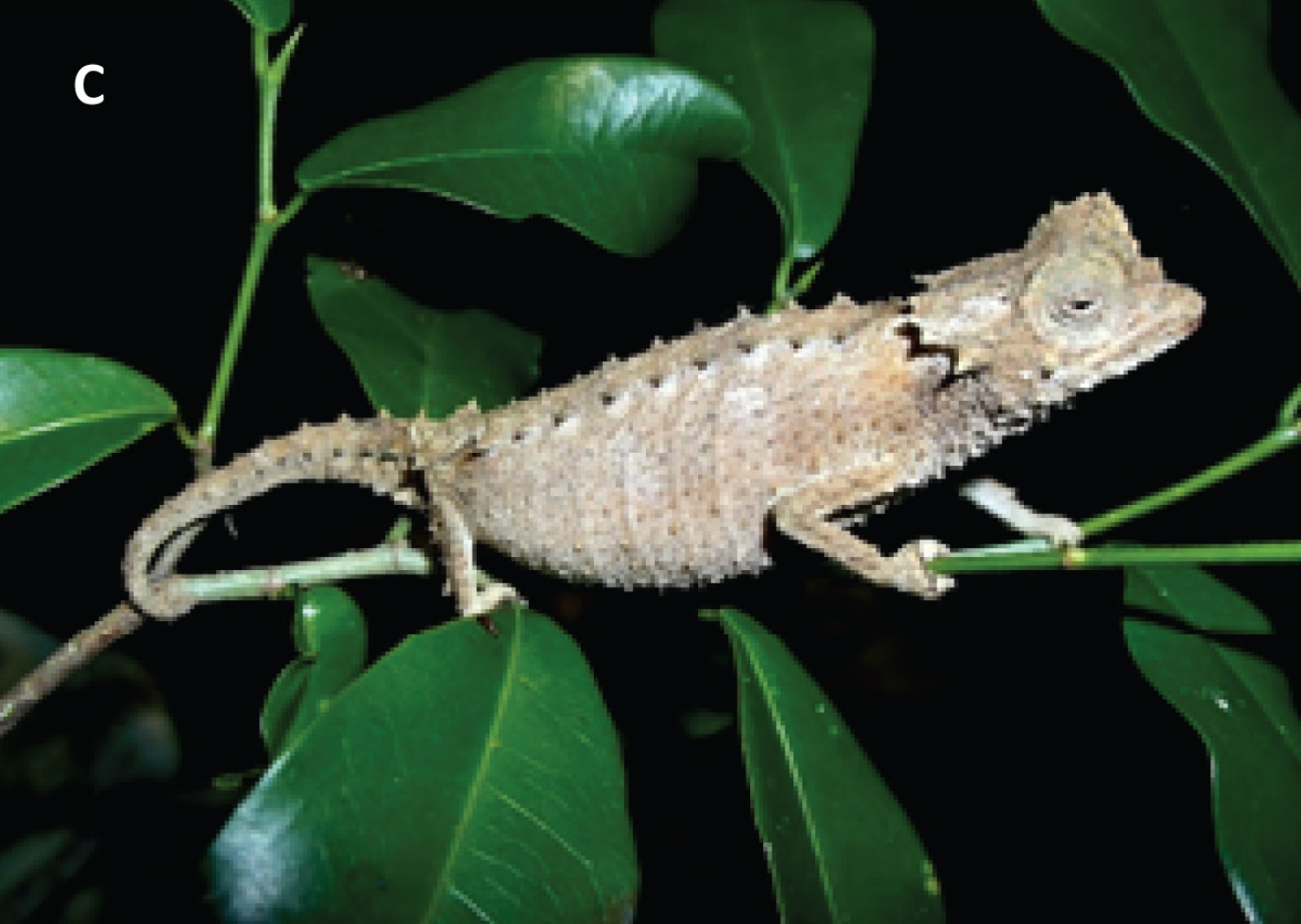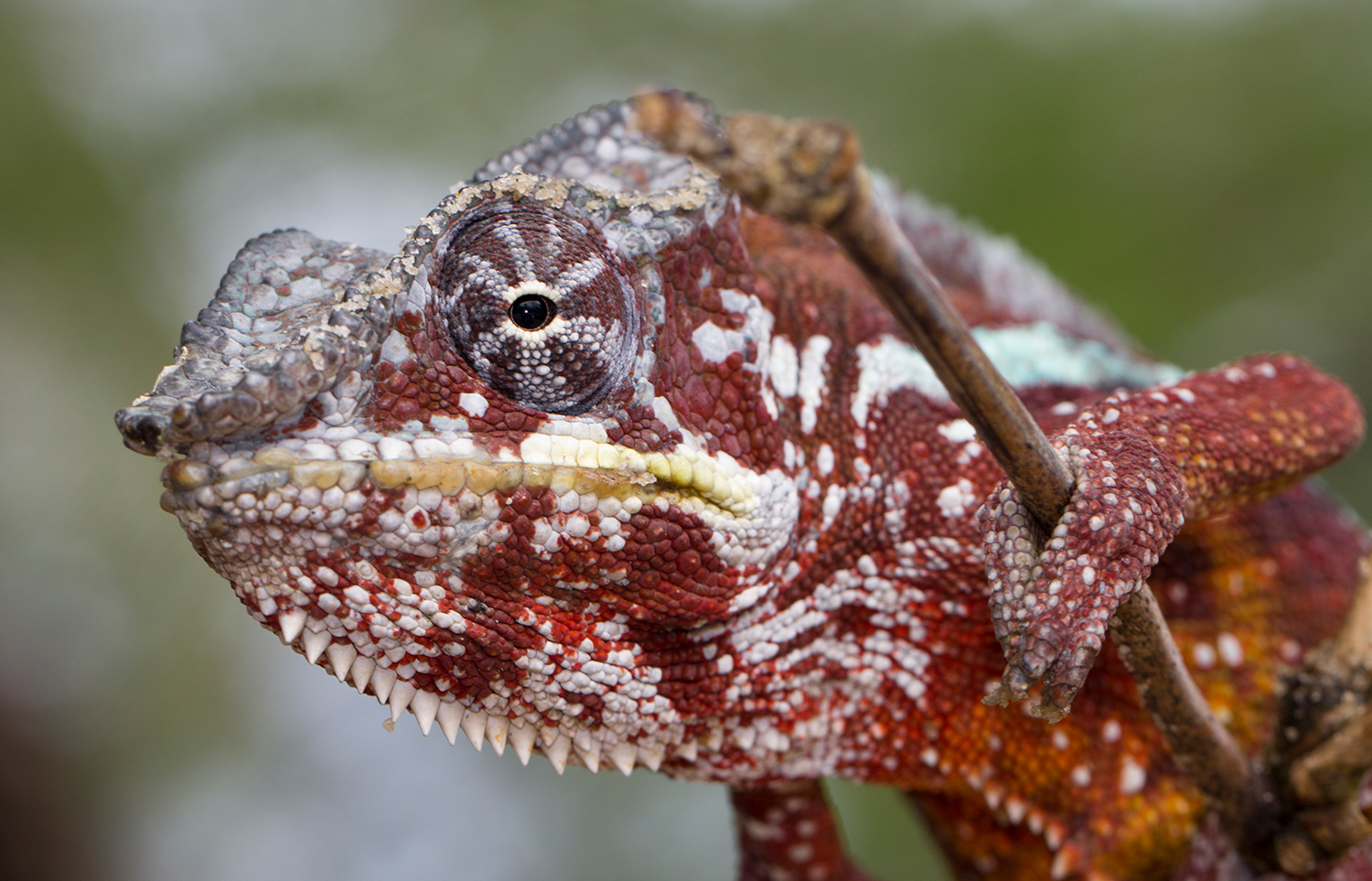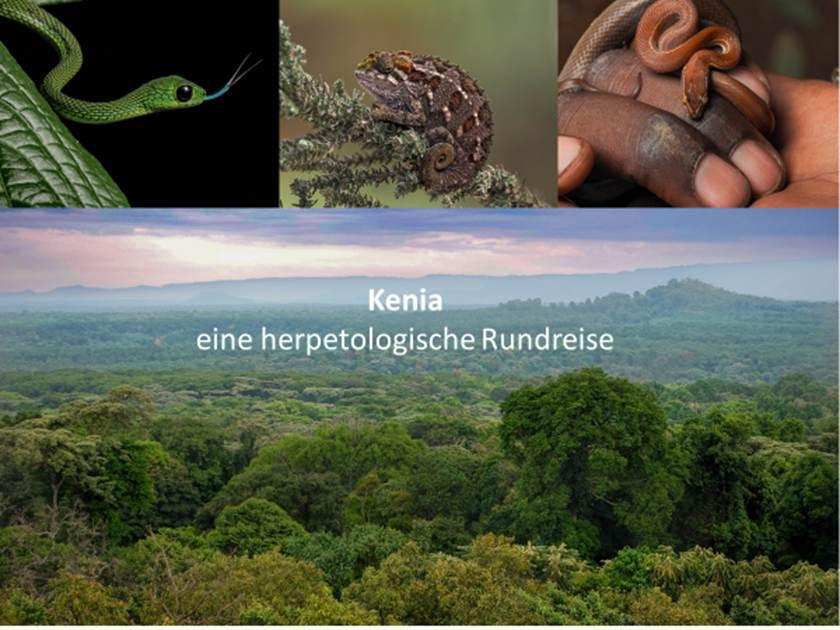
The optic nerve of chameleons is highly specialised

The optic nerve of chameleons is highly specialised

Tiermedizin Science

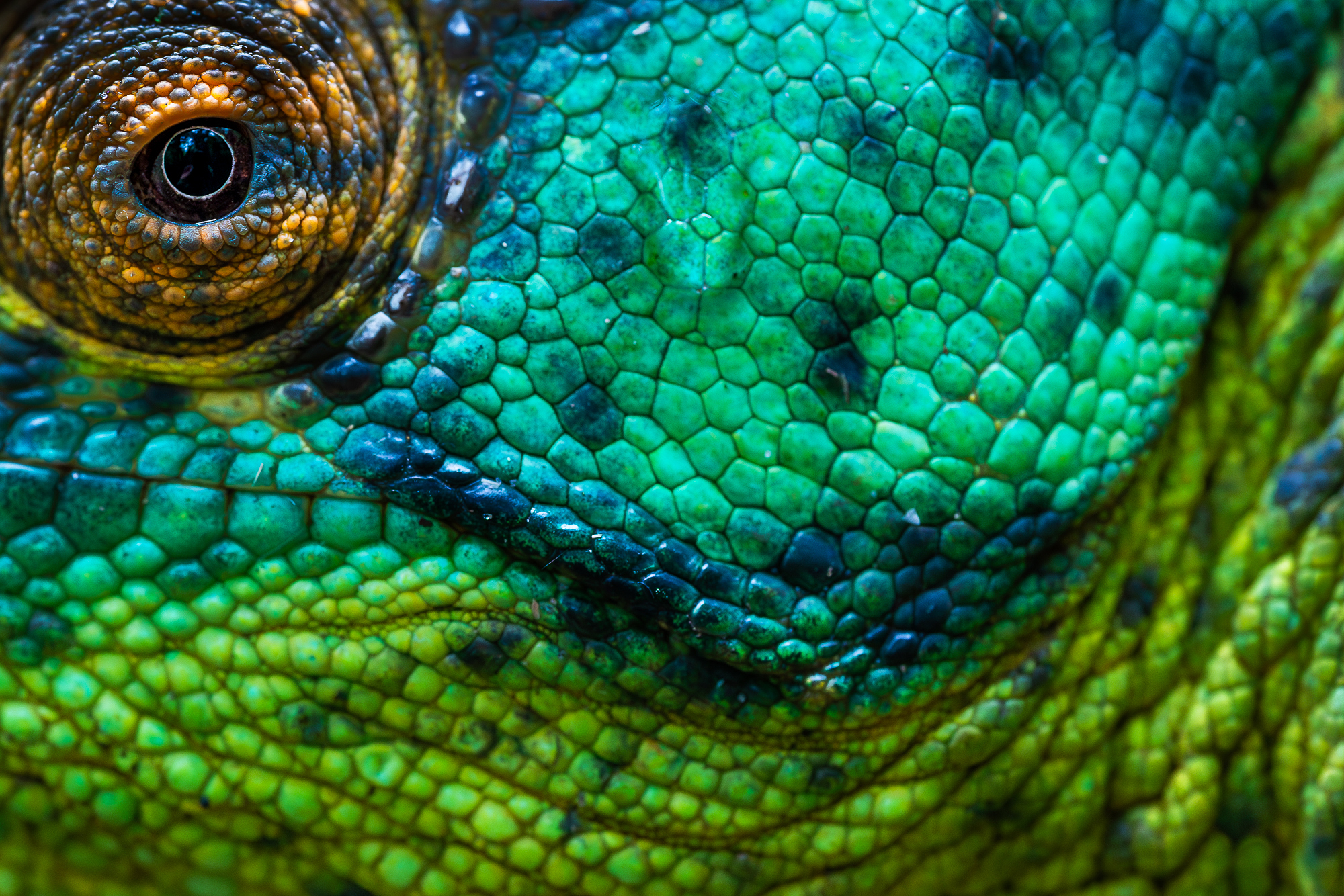
It has long been known that chameleons have very special eyes. What is particularly fascinating is that they can move their eyes independently of each other in almost any direction. A team of US scientists has now discovered that the optic nerve in chameleons is also extremely specialised.

They examined adult reptiles of 34 different species using CT models. Brookesia superciliaris, Rieppeleon brevicaudatus and Chamaeleo calyptratus represented the chameleon family. They found that in all three chameleon species, the optic nerve was extremely curled. This anatomical feature means that the optic nerve in chameleons is much longer than would be necessary for an eye looking straight ahead. It probably enables the animals to have extremely mobile eyes without compromising their vision. Put simply, the optic nerve functions a bit like a flexi leash: when the eye moves sharply, part of the optic nerve is ‘unrolled’. When the eye moves back, the optic nerve curls back to its original position without overstretching the nerve fibres.

A new twist in the evolution of chameleons uncovers an extremely specialized optic nerve morphology
Emily Collins, Aaron M. Bauer, Raul E. Diaz Junior, Alexandra Herrera-Martínez, Esteban Lavilla, Edward L. Stanley, Monte L. Thies, Juan D. Daza
Scientific Reports 15, 2025: 38270.
DOI: 10.1038/s41598-025-20357-3
Download the article for free

Photo: Portrait of Brookesia superciliaris, photographed by Alex Negro

First digital atlas of the head anatomy of the veiled chameleon

First digital atlas of the head anatomy of the veiled chameleon

Tiermedizin Science

The anatomy of chameleons has been discussed in many publications, primarily older ones. Scientists at University College London (UK), in collaboration with Belgian, French and Swiss colleagues, have now created the first digital atlas of the head anatomy of the Veiled chameleon (Chamaeleo calyptratus).

To do this, they performed micro-CT scans of two dead adult Chamaeleo calyptratus specimens preserved in ethanol. One male and one female were examined. A few weeks later, they repeated the CT scans using special stains. The skulls of both chameleons were then digitally reconstructed using various programmes, including Dragonfly 3D World and UNet3D. Bone parts, muscles and other soft tissue were distinguished and named. In addition, estimates of muscle strength, bite force, muscle volume and muscle length were made.

As expected, the authors found that the male veiled chameleon differed from the female primarily in terms of its facial skull and higher casque. The muscle responsible for moving the lower jaw is significantly larger in males than in females. All of the micro-CT scans can be viewed here free of charge.

3D anatomical atlas of the heads of male and female adult Chamaeleo calyptratus
Alice Leavey, Eloy Gálvez-López, Anthony Herrel, Laura B. Porro
The Anatomical Record, 2025: 1-33.
DOI: 10.1002/ar.70077
Download the article for free

Graphic: Colour representation of the various bone parts of the skull and lower jaw of the veiled chameleon

Do different ecomorphs use different perches?

Do different ecomorphs use different perches?

Science

South African scientists have investigated whether the physique of a dwarf chameleon affects the branches it prefers to use. In South Africa, three different ectomorphs, or body types, are known among dwarf chameleons of the genus Bradypodion: First, there is the forest ecomorph. This ecomorph is found in closed canopy forests, is large with a long tail, but relatively gracile. Typical for the forest ecomorph are bright colours and conspicuous gular and and casque ornamentations. The second ecomorph is the ‘small brown chameleon’, which occurs in open habitats such as heathland, grass savannah or fynbos. As the name suggests, this type of chameleon is small, inconspicuous brown or greenish in colour and has reduced gular and casque ornamentation. The third ecomorph is the bushland ecomorph: chameleons in bushland or thickets that are large but generally rather heavy-bodied and short-tailed, rather inconspicuous in colour, but with conspicuous gular and casque ornamentation.

The scientists measured the diameter and angle of the branches used by different Bradypodion species. The following species were among the test subjects: B. barabtulum, B. baviaanense, B. caffrum, B. damaranum, B. ketanicum, B. melanocephalum, B. occidentale, B. pumilum, B. setaroi, B. taeniabronchum, B. thamnobates, B. transvaalense and B. ventrale, as well as the three candidate species ‘emerald’, “groendal” and ‘karkloof’. Chameleons from 38 different populations across South Africa were measured at night and sorted into one of the three body types mentioned above. In addition, branch diameters and angles were measured every 10 metres along randomly selected 100-metre-long transects within a radius of one metre.

The data was then statistically evaluated. Between 2007 and 2024, a total of 1,755 adult Bradypodion and their branches were measured. The forest ecomorph chameleons had access to a much greater variety of suitable branches in terms of diameter and angle than in the other two habitats. The chameleons did not show a preference for certain branches in the forest, but rather ‘used what was available’. The habitat of the ‘small brown chameleons’, on the other hand, had significantly more vertical, thinner branches than the forest, but these had a similar angle. The density of branches was highest in this habitat. However, the ‘small brown chameleons’ chose vertical and usually thicker branches significantly less often than would have been available in their habitat. In the shrubland, the scientists found more vertical and thinner branches than in the forest, and in terms of number, the branches did not differ from the open habitat such as fynbos, but differed in branch diameter. The shrubland ecomorph was larger than those ecomorphs of the other two habitats. It was noticeable that the female shrubland chameleons preferred to use thicker branches and also preferred fewer vertical branches than were available.

The study shows that different ectomorphs of dwarf chameleons in South Africa do indeed occupy different habitat structures.

Comparing perch availability and perch use between African dwarf chameleon (Bradypodion) ecomorphs
Jody M. Barends, Melissa A. Petford, Krystal A. Tolley
Current Zoology 71(5), 2025: 633-644
DOI: 10.1093/cz/zoae076
Free download of the article

Graphic: The three different ecomorphs, from the above-mentioned publication

New distribution data of Rieppeleon brachyurus in Mozambique

New distribution data of Rieppeleon brachyurus in Mozambique

Beobachtungen Verbreitung Science

Rieppeleon brachyurus is a small stump-tailed chameleon species, first described at the end of the 19th century from the Shire Highlands south of Lake Malawi. The species has since been found in Malawi, Tanzania and Mozambique. In Mozambique, it was previously known from rainforests and gallery forests, known as miombo forests. Miombo forests are very open dry forests with sparse grass cover, giving them a savannah-like appearance (hence the term ‘forest savannah’). The Zambezi River, which runs across Mozambique, was previously considered the natural boundary for the occurrence of Rieppeleon brachyurus.

Herpetologists have now discovered that the species also occurs south of the river. They found two juvenile individuals and two adult females of the species in Coutada 11, a 5000 km² hunting concession in the heart of Mozambique. The animals were found there in a sand forest, a rare type of tropical forest on sand dunes, right next to a shallow wetland. These observations extend the previously known range of the species by about 250 km further south.

The authors also report two further new locations where Rieppeleon brachyurus has been found, in Taratibu and Montepuez Rubi Mining Concession, both of which are located north of the Zambezi River. In both observations, the ground chameleons were found in miombo forest at altitudes between 250 and 400 m.

Rieppeleon brachyurus (Günther, 1893) Beardless Pygmy Chameleon First records south of the Zambezi River
W. Conradie, D. Botma, C. Nanvonnamuquitxo
African Herp News 88, 2025: 28-33
DOI: not available
Free download of the article

Photo: Juvenile Rieppeleon brachyurus in Mozambique, photographed by Delport Botma, from the above-mentioned publication

Two “new old” chameleon species from Madagascar

Two “new old” chameleon species from Madagascar

Neubeschreibungen Science

It has long been known that Calumma gallus from eastern Madagascar is not just one species, but rather an entire species complex. Scientists have now taken a closer look at the complex and conducted new genetic studies – completely overturning some species classifications in the process.

The short version:

What was previously thought to be Calumma nasutum from Andasibe, Anosibe An’Ala and Tarzanville is now called Calumma hofreiteri. The females still cannot be reliably distinguished from Calumma emelinae. The ‘real’ Calumma nasutum occurs in rainforests near Ranomafana and Mananjary. The males of Calumma nasutum have a significantly larger rostral appendage, which is often yellow in colour, while the females only have a red snub nose. Calumma nasutum belongs to the gallus complex.

What was previously thought to be Calumma gallus and occurs in the Vohimana reserve and surrounding area is now called Calumma pinocchio. The ‘real’ Calumma gallus occurs in a forest fragment near Tarzanville, in Tsinjoarivo and several small areas near Toamasina on the east coast of Madagascar. Its rostral appendage is serrated at the top, while the rostral appendage of Calumma pinocchio is smooth.

Towards a revision of the Malagasy chameleons of the Calumma gallus complex: Redefinition of Calumma nasutum based on a museomics approach and descriptions of two new species
Frank Glaw, Stefanie Agne, David Prötzel, Philip-Sebastian Gehring, Jörn Köhler, Michaela Preick, Fanomezana M. Ratsoavina, Nicolas Straube, Katharina Wollenberg Valero, Angelica Crottini, Miguel Vences
Salamandra 61(4): 442-466, 2025.
DOI: not available
Free download of the article

Photo: from the above publication, Calumma nasutum 

Cape dwarf chameleons are ambush predators

Cape dwarf chameleons are ambush predators

Beobachtungen Science

For a long time, only two types of foraging behaviour were distinguished: active foragers and sit-and-wait or ambush foragers. Many years ago, two publications classified chameleons as ‘cruise foragers’, i.e. hunters that move slowly through the bushes, stop to feed and then move on. A study from South Africa is now investigating whether this is true and whether other factors contribute to movement. In order to evaluate the mode of foraging, one would actually have to ‘factor out’ movement for regulating body temperature, evading predators or opponents, searching for females or mate guarding.

To this end, 38 tagged (12 of them radio-tagged) Bradypodion pumilum were tracked over 10 days in April and 10 days in February. The chameleons live in Brümmer Park in Stellenbosch in the Western Cape province. They were divided into 17 male, 19 female and 2 indeterminate Bradypodion pumilum. The animals were located every evening and every morning on the specified days using telemetry and the naked eye. Each chameleon was observed for 60 to 180 minutes at a time, with two to four observers using binoculars from a distance of 5 to 10 metres from the chameleon being observed. The researchers recorded movements and stationary behaviour and assigned the corresponding motivation to each movement, noting food intake and number of shots.

A total of 171 hours of observation time was accumulated. Bradypodion pumilum spent most of the day (over 75%) stationary on their branches in Brümmer Park. In the morning, over 80% of them were sitting around, with almost half of this time spent sunbathing, presumably to warm up, and the other half spent stationary in shady vegetation. During the observation period, 26 Bradypodion pumilum fed a total of 110 times. They ate significantly more often (over 80%) when they were not moving. A strong factor for movement was interaction with conspecifics – during the observations, one male was even chased away by a female, causing it to fall from the tree.

The authors conclude from their study that Bradypodion pumilum is more likely to be a ambush hunter.

A multi-index approach to assessing foraging mode: a case study using chameleons
Wade K. Stanton-Jones, Krystal A. Tolley, Jody M. Barends, Graham J. Alexander
Current Zoology, 2025, zoaf065
DOI: 10.1093/cz/zoaf065
Free article download

Photo: Bradypodion pumilum tagged with a transmitter from the study mentioned above

Presentation in Frankfurt about Ethiopia

Presentation in Frankfurt about Ethiopia

Reiseberichte Live lectures Science

On Friday, 26 September 2025, herpetologist Dr Arthur Tiutenko from Friedrich-Alexander University Erlangen-Nuremberg will give a lecture accompanied by numerous images about a very special forest in Ethiopia.

The Harenna Forest, which stretches along the southern slopes of the Bale Mountains in southern Ethiopia, is one of the last remaining forest areas in the Horn of Africa and the largest remaining rainforest on the African mainland. It is not only home to Arabica coffee, but also to numerous other endemic plant and animal species, many of which have not yet been scientifically discovered and described. The herpetofauna of the Harenna Forest includes more than 40 species, including the two large Ethiopian vipers – Bitis harenna and Bitis parviocula. The habitats of these animals and the entire ecosystem are being destroyed by overpopulation and increasing economic exploitation. Even the future of the officially protected parts of the forest looks bleak. This makes it all the more important to gain knowledge about the species that still live in the forest before it is too late. Arthur Tiutenko has explored the Harenna Forest in ten expeditions, the results of which he reports on in this lecture.

Dr. Arthur Tiutenko Harenna Forest, Ethiopia – 12 years of expeditions into the last rainforest in the Horn of Africa [German]
DGHT Stadtgruppe Frankfurt
Zoo school of Zoo Frankfurt
Bernhard-Grzimek-Allee 1
60316 Frankfurt am Main
Lecture begins at 7 p.m., doors open at 6:30 p.m. via the exit gate at the main entrance on Alfred-Brehm-Platz (gate between the zoo shop and the zoo society building).

Photo: Trioceros balebicornutus, photographed by Arthur Tiutenko on one of his travels

Chameleon literature available

Chameleon literature available

Abzugeben AG Interna

A long-standing member of our working group has kindly provided us with a whole series of books and papers on chameleons and other reptiles, which are now being made available for the benefit of the Chameleon Working Group (AG Chamäleons). Among them are some very old original treasures and many out-of-print editions of books. All books and papers can be sent by post (from Germany), with shipping costs added to the price. If you are interested, please send an email to info@agchamaeleons.de . Below is a list of the available literature with information on its condition. Photos of all items are available on request or here.

1 Philippe Philippe de Vosjoli: Essential Care of Chameleons
Paperback, 72 pages, 3rd edition from 2004, out of print
Price: €10
Condition: Very good, inside flawless, outside with slight wear to corners and edges

2 Wolfgang Schmidt, Klaus Tamm, Erich Wallikewitz: Chamäleons, Drachen unsrer Zeit
Paperback, 160 pages, 2nd edition from 1996
Price: €10
Condition: Very good, inside flawless, outside with slight wear to corners and edges

3 Rolf Müller, Nicolá Lutzmann, Ulrike Walbröl: Furcifer pardalis, das Pantherchamäleon
Paperback, 127 pages, 1st edition from 2004, out of print
Price: €10
Condition: almost like new, minimal wear to corners on the outside

4 Dr. Wolfgang Uthmöller: Schlangen wie ich sie sah
Hardcover, 127 pages, probably from 1948
Price: €20
Condition: very good for its age, pages naturally yellowed, edges and cover stained in places, remnants of old stickers inside the cover, pages themselves in perfect condition.

5 Joseph Nicolai Laurenti: Austriaci Viennensis Specimen medicum exhibens Synopsin Reptilium emendatam cum experimentis circa venena et antidota reptilium austriacorum
Paperback, 248 pages, reprint with English translation from 2005
Price: €25
Condition: like new

6 James B. Murphy: Chameleons: Johann von Fischer and other perspectives
Paperback, 123 pages, 1st edition from 2005
Price: €15
Condition: very good, minimal wear to corners and very slight creases on the outside, inside in perfect condition

7 Vincent A. Wagner: The life of the chameleon
Paperback, 32 pages, 2nd edition from 1987
Condition: good to very good, cover slightly worn on the edges and corners (see photo), inside in perfect condition

8 Philippe de Vosjoli: True chameleons Part II, Notes on popular species, diseases and disorders
Paperback, 28 pages, 1st edition 1990, out of print
Price: €15
Condition: good, cover with storage stains and minimal creases, interior flawless

9 Philippe de Vosjoli: True Chameleons Part I Husbandry
Paperback, 36 pages, 1st edition 1990, out of print
Price: €15
Condition: good, cover with minor stains, spine slightly bumped, interior flawless

10 Frank Glaw, Miguel Vences: A field guide to the amphibians and reptiles of Madagascar
Paperback, 480 pages, 2nd edition from 1994
Price: €5
Condition: very good, edges and corners bumped, inside flawless

11 Krystal Tolley, Marius Burger: Chameleons of Southern Africa
Paperback, 100 pages, 1st edition from 2007
Price: €15
Condition: almost like new, corners and edges minimally bumped

12 Michaela Jötzlaff: Das Helmchamäleon (Trioceros) hoehnelli
Paperback, 63 pages, 1st edition from 2008
Price: €10
Condition: like new, inside with dedication and name

13 Rudolf Malkmus: Die Amphibien und Reptilien Portugals, Madeiras und der Azoren
Paperback, 98 pages, 1st edition from 1995
Price: €15
Condition: very good, minor stains on the cover and edges, inside flawless

14 Francois LeBerre, R.D. Bartlett, Patricia Bartlett: The Chameleon Handbook
Paperback, 128 pages, 2nd edition from 2000
Price: €15
Condition: like new, price sticker on the back of the cover

15 R.D. Bartlett, Patricia Bartlett: Chameleons, a complete pet owner’s manual
Paperback, 103 pages, 1st edition from 1995
Price: 10 €
Condition: very good, corners and edges slightly bumped, spine faded

16 Günther Masurat: Vermehrung von Chamäleons
Hardcover, 143 pages, 1st edition from 2005
Price: 15 €
Condition: very good, corners slightly bumped, inside like new

17 Gaston-Francois de Witte: Les Caméléons de l’Afrique Centrale
Paperback, > 200 pages, presumably 1st edition from 1965, out of print
Price:  40 €
Condition: very good, spine faded, edges minimally bumped, pencil notes on first page inside, interior flawless

18 E.-R. Brygoo: Faune de Madagascar, XXXIII Reptiles Sauriens Chamaeleonidae Genre Chamaeleo
Paperback, 318 pages, 1st edition from 1971
Price: €40
Condition: good, cover yellowed, edges of spine clearly bumped, both corners of back cover missing; inside completely flawless

19 Philippe de Vosjoli, Gary Ferguson: Care and Breeding of Chameleons
Paperback, 128 pages, 1st edition from 1995, out of print
Price: €15
Condition: good to very good, cover scuffed, especially at the corners and edges, with small tears and creases, spine faded, inside in perfect condition

20 Rolf Müller, Wolfgang Schmidt: Stummelschwanzchamäleons der Gattung Rieppeleon Paperback, 95 pages, 1st edition from 2008
Price: 10 €
Condition: very good, edges bumped in places, dedication by the authors on the first page, otherwise inside in perfect condition

21 Fitzinger’s Systema Reptilium
Paperback, 115 pages, reprint from 1973, out of print
Price: €30
Condition: small note in pencil on the first page, otherwise flawless; spine slightly faded, corners and edges slightly bumped

22 Henkel, Schmidt: Amphibians and Reptiles of Madagascar, the Mascarene Islands, Seychelles and Comoros
Hardcover, 312 pages, 1st edition from 1995
Price: €10
Condition: good to very good, corners slightly bumped, cover faded, interior flawless

23 J.E. Gray’s The Zoological Miscellany
Paperback, 90 pages, 1st edition from 1971
Price: €10
Condition: good to very good, spine and parts of the cover discoloured/faded, otherwise flawless

24 William R. Branch, Aaron M. Bauer: The herpetological contributions of Sir Andrew Smith
Paperback, 85 pages, 1st edition from 2005
Price: €15
Condition: like new

25 Charles Klaver, Wolfgang Böhme: Phylogeny and classification of the Chamaeleonidae (Sauria) with special reference to hemipenis morphology
Paperback, 64 pages, 1st edition from 1986
Condition: minor damage to spine, spine faded, otherwise very good

26 Robert Mertens, Willi Henning, Heinz Wermuth: Das Tierreich, eine Zusammenstellung und Kennzeichnung der rezenten Tierformen
Paperback, 38 pages, 1st edition from 1966
Condition: very good, corners and edges bumped, pencil note on the first page, otherwise flawless inside

27 A. E. Gunther: The miscellaneous autobiographical manuscripts of John Edward Gray (1800-1875)
Paperback, 245 pages, 1st edition from 1980
Price: €10
Condition: good to very good, pencil note on cover, cover with minor creases and stains, interior flawless

28 A.S. Rand: Notes on the Chamaeleo bitaeniatus complex
Paperback, 30 pages, 1st edition from 1963
Price: €10
Condition: very good, minor stains on the bottom of the cover, spine faded, edges ditto, interior flawless

29 Robert Mertens: The Chameleon of Pemba Island
2 pages from 1964
Price: €10
Condition: very good, minimal creases on the top edge

30 Separate of a paper published by The International Trust for Zoological Nomenclature on behalf of the International Commission on Zoological Nomenclature
3 pages stapled, from 1971
Price: €10
Condition: very good, cover with crease in upper corner and very small spots

31 Prof. Dr. Robert Mertens: Live-bearing three-horned chameleons
Issue 7/8 Natur und Volk from 1949, 5 pages
Price:
Condition: very good, slight creases, interior flawless

32 Thomas Barbour: Two new species of chameleons
Proceedings of the Biological Society of Washington, Vol. XVI, 1903, 1 page
Price: €15
Condition: very good

33 Zoologischer Anzeiger from 10 April 1893
Price: €25
Condition: very good, title page with stamp and handwritten note, otherwise flawless for its age

34 A. Stanley Rand: A new subspecies of Chamaeleo jacksonii Boulenger and a key to the species of three-horned chameleons
Breviora, Museum of Comparative Zoology No. 99, 4 pages from 1958

Price: €15
Condition: very good, note on the top right of the title page, slight creases

35 Claudia Schnieper, Max Meier: Das Chamäleon, Meisterschütze und Verwandlungskünstler
Hardcover, 40 pages, 2nd edition 1988
Price: €5
Condition: very good, minimal marks on the cover, slight discolouration of the inner page edges

36 Friedrich Wilhelm Henkel, Wolfgang Schmidt: Agamen im Terrarium
Hardcover, 151 pages, 1st edition 1997
Price: €10
Condition: very good, two corners of the cover clearly bumped, tiny tear in the spine, otherwise flawless

37 Martin Eisentraut: Im Schatten des Mongo-ma-loba
Hardcover, 240 pages, 1st edition 1982
Price: €5
Condition: good to very good, cover faded with minor creases, corners slightly bumped, small pencil note on first page, interior flawless

38 Gunther Köhler: Inkubation von Reptilieneiern
Hardcover, 205 pages, 1st edition from 1997
Price: €10
Condition: good to very good, cover significantly faded, otherwise flawless

39 Kameleon Vereniging Nederland: Chameleons, a fascinating hobby
Paperback, 96 pages, Lacerta 64-5/6 from 2006
Price:
Condition: very good, corners and edges minimally bumped

40 Martin Eisentraut: The vertebrate fauna of Fernando Poo and West Cameroon
Bonner Zoologische Monographien No. 3, 1973
Price: €20
Condition: good to very good, cover faded in places, edges and corners bumped

41 Annals of the South African Museum Cape Town, Vol. 61, 1973
Paperback, 160 pages
Price: €40
Condition: good, cover with various creases and stains, interior flawless

42 Herpetozoa 18(3/4) from 2005
Paperback, pages 97-208
Price: €20
Condition: like new

44 E.-R. Brygoo: Faune de Madagacar 47, Reptiles Sauriens Chamaeleonidae: Genre Brookesia et complement pour le genre Chamaeleo
Paperback, 174 pages, from 1978
Price: €35
Condition: very good, crease and small tear in the spine, inside in perfect condition

45 Linda J. Davison: Chameleons, their care and breeding
Paperback, 112 pages, edition from 1997
Price: €25
Condition: very good, dedication by the author on the first page (without name), slight crease at top right, cover with several very small spots

46 Draco Terraristik special issue Madagascar
No. 19, Volume 5, 3-2004; paperback, 96 pages
Price: €20
Condition: like new

47 Draco Terraristik Special Issue Chameleons
No. 1/2000, Volume 1(1), 96 pages
Price: €20
Condition: like new

49 Verenigingsblad van de Kameleonvereniging Nederland No. 1, 2004
28 pages
Price: €5
Condition: good to very good, punched and cover slightly yellowed, inside flawless

50 Treatises of the Senckenberg Natural History Society, No. 442
Robert Mertens: Herpetological Findings from a Trip to Cameroon
Paperback, 60 pages, 1938
Price: €35
Condition: very good for its age, cover with a very small tear at the top, spine bumped, a small piece missing at the bottom, above which the spine is torn, cover and pages yellowed at the edges, first page inside with small stains, everything else inside in perfect condition

Impact of roads on the European chameleon

Impact of roads on the European chameleon

Science

Although the European chameleon (Chamaeleo chamaeleon) is locally widespread on the Iberian Peninsula, its habitat is often cut through by roads in densely populated coastal areas. Biologists at the University of Málaga (Spain) recently investigated whether and how busy roads affect the behaviour and population density of the European chameleon.

They studied a privately owned study area in the province of Málaga in southern Spain, located on the edge of the A7 motorway. The A7 has a high volume of traffic, with 43,121 cars passing through every day. The study area consisted of abandoned olive and almond groves, but mainly large areas of scrubland with yellow broom and broom-like plants such as lavender, fennel and green dwarf palms.

The biologists divided the study area into five 225-metre-wide fields, each at different distances from the A7 motorway. At night, they searched for chameleons using torches. The sex, season, weight and position of any Chamaeleo chamaeleon found were recorded and their occurrence statistically evaluated. In addition, they noted the type of vegetation in which the animals were found and whether food was available. In order to better assess the availability of arthropods, these were caught in traps, identified and counted.

A total of 148 adult and 92 juvenile Chamaeleo chamaeleo were found, with 592 control points remaining without chameleon observations. It was noticeable that the population density of Chamaeleo chamaeleon was highest in the fields furthest away from the A7 motorway. Only 24.3% of adult chameleons were discovered in the immediate vicinity of the motorway, while 62.2% were found in the areas furthest from the motorway. Accordingly, the two fields directly adjacent to the motorway also had the fewest juveniles. The chameleons therefore appear to be disturbed by the motorway and retreat from its vicinity. However, the availability of arthropods (i.e. potential food) was comparable in all five areas. Interestingly, it was also found that more chameleons were present in areas with fewer shrubs. This suggests that Chamaeleo chamaeleo tends to avoid habitats with very dense undergrowth.

The results of the study are consistent with those for other reptiles, which describe, among other things, the so-called road effect zone. This is the phenomenon whereby straight roads running over long distances lead to a large amount of unsuitable habitat, even if they ‘only’ have narrow verges that are avoided by the animals. The length of the road and the number of roads can still severely restrict or reduce the habitat of a species. This finding is new for the European chameleon and important for species conservation. The authors conclude that areas with highly frequented roads less than 500 to 675 metres away are unsuitable habitats for Chamaeleo chamaeleon.

Effects of habitat characteristics in an anthropized landscape on the spatial behavior and abundance of a common chameleon (Chamaeleo chameleon) population
M.A. Farfán, J. Duarte, D. Romero, L. Colorado-Pedrero, P. García-Quevedo, R. Arroyo-Morales, F. Dìaz-Ruiz
Conservation Science and Practice 2025: e70070.
DOI: 10.1111/csp2.70070
Free download of the article

Presentation in Bavaria about chameleons

Presentation in Bavaria about chameleons

Haltungsberichte Reiseberichte Live lectures

Long-standing AG member Nicolá Lutzmann from Heidelberg will give an interesting lecture on chameleons on Saturday, 20 September 2025. In this lecture, he will report on adventurous chameleon observations in the wild, as well as on the species-appropriate keeping of these highly specialised lizards in terrariums. These fascinating reptiles are known for their unique ability to change colour, their independently movable eyes and their lightning-fast forked tongue, which they use to catch insects.

Dr. Nicolá Lutzmann Chameleons: Outdoor observations and keeping them in a terrarium [German]
DGHT regional group lower Bavaria
Restaurant Aurora
Klausenweg 15
84152 Mengkofen
Lecture begins at 8 p.m., dinner together from 6.30 p.m.