
Tick species detected on chameleon for the first time

Tick species detected on chameleon for the first time

Beobachtungen Tiermedizin

Ticks are a relatively rare parasite in chameleons. A recent case report of tick infestation in a chameleon comes from southern Turkey.

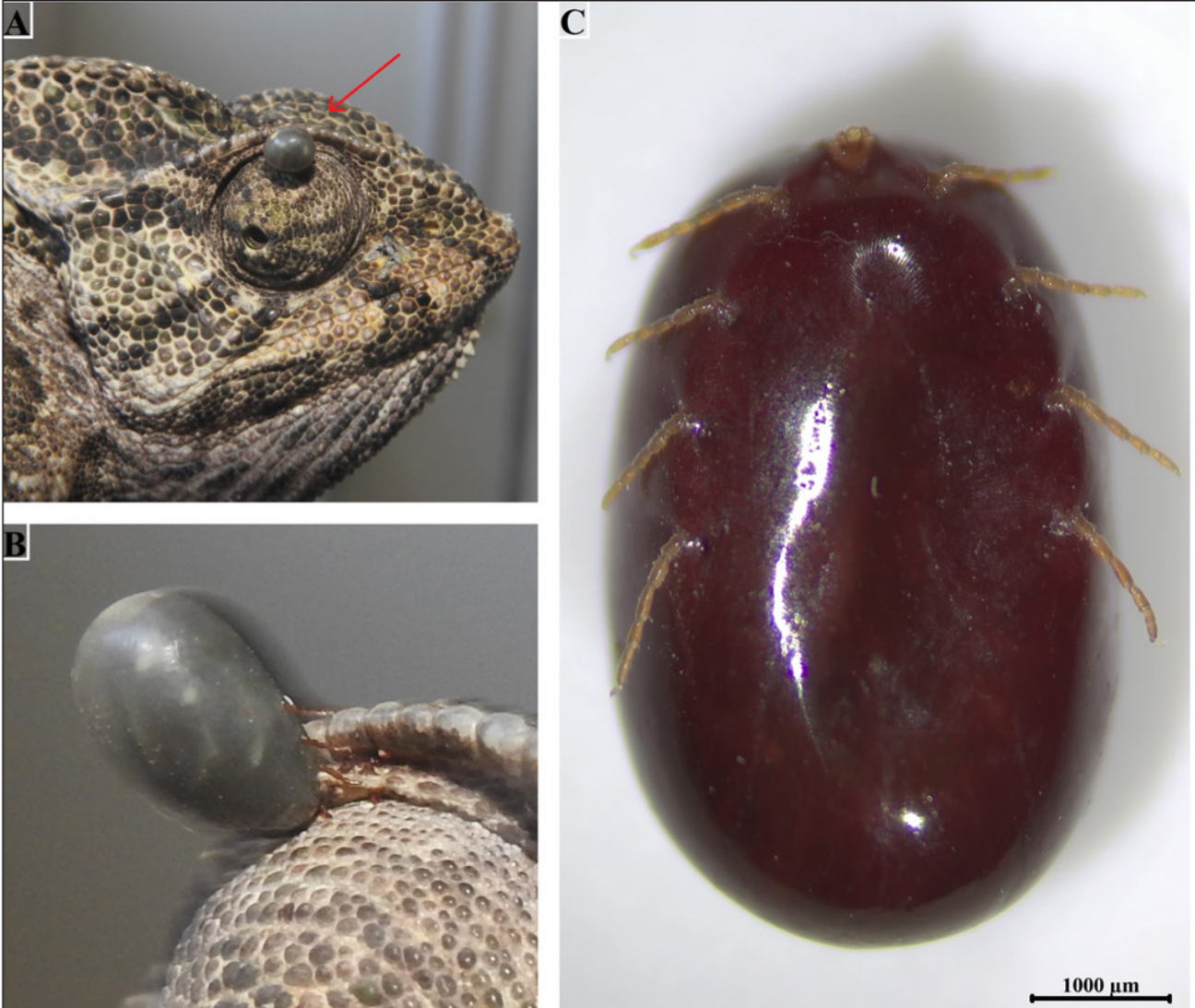
A Chamaeleo chamaeleon with an engorged tick above its right eye was noticed by a veterinarian right next to a path on the campus of a department of the Agricultural Research and Policy Authority in Demre. He removed the tick and had it examined further. Under the microscope, it turned out to be a nymph of the species Hyalomma aegypticum. Hyalomma aegypticum is known to date in reptiles, especially tortoises of the genus Testudo, but the spectrum of possible hosts also includes numerous mammals. Chameleons were not previously known as hosts, so this is the first case worldwide.

Incidentally, ticks of the genus Hyalomma have also been present in Germany for about ten years. Unlike many other tick species, they can ‘actively hunt’, i.e. pursue their host, and have become ‘notorious’ thanks to media exaggeration. In addition, some species transmit Crimean-Congo haemorrhagic fever (CCHF) to humans, while others transmit spotted fever. With reference to the current publication, it would be interesting to know whether other Hyalomma species native to this country are potentially hosts for chameleons in outdoor enclosures.

A novel host record: Hyalomma aegypticum (Linnaeus, 1758) infestation on the Mediterranean Chameleon, Chamaeleo chamaeleon (Linnaeus, 1758) in Türkiye
Gokhan Eren
Eurasian Journal of Veterinary Sciences 2025: 41:e0454
DOI: 10.63673/eurasianjvetsci.454

Photo: The tick found, together with the host chameleon, from the publication mentioned above.
Potential new distribution areas of the European chameleon

Potential new distribution areas of the European chameleon

Verbreitung Science

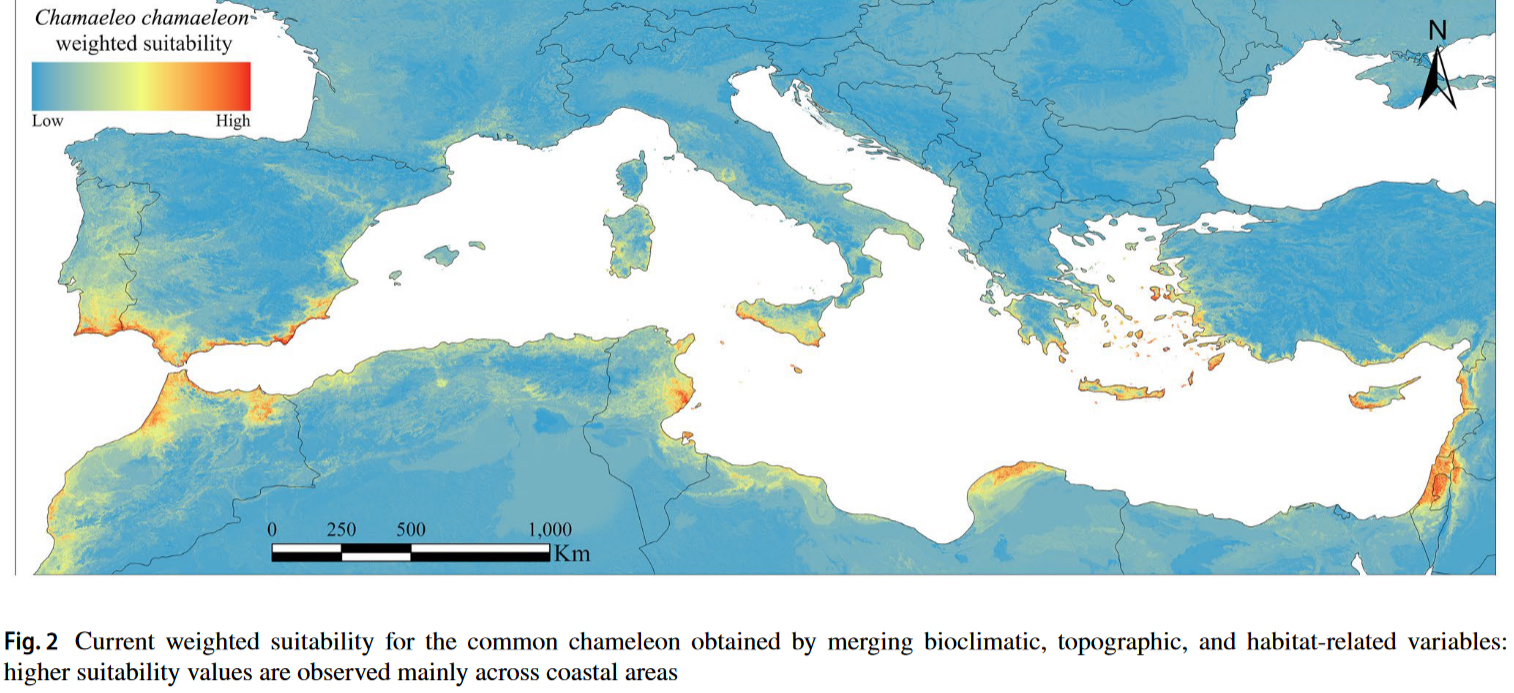
The European chameleon (Chamaeleo chameleon) was historically found in some small areas of the Mediterranean and Central Asia. Today, however, it is much more widespread. It is now assumed that the animals were brought to their new distribution areas by humans and were able to reproduce there due to the favourable climatic conditions. Scientists have now investigated where there are further suitable habitats for the European chameleon and how the existing populations could develop over the next 50 years.

The three subspecies studied were Chamaeleo chamaeleon chamaeleon, Chamaeleo chamaeleon musae and Chamaeleo chamaeleon reticrista. The former is known from the southern edge of Portgual and Spain as well as from southern Italy, Algeria, Egypt, Libya, Malta, Morocco, Tunisia, the western Sahara and Yemen. The second subspecies is currently found in Jordan, Israel and Egypt. The third subspecies occurs between Greece and Turkey, in Cyprus, Israel, Lebanon and Syria, but is actually native to northern Africa and the Middle East. It was probably introduced by people in southern Spain and Portgual, but is now considered a native species there.

For the study, the existing literature, sampling by the author himself, OpenStreetMaps and information from the Global Biodiversity Information Facility (GBIF) were used, statistically processed and analysed. Climate, topography, habitat of the sites and connections of existing populations were used to predict potentially suitable new habitats.

A total of 553 Chamaeleo chamaeleon findings were included in the study. 22% of the finds could be assigned to urban areas, 21% to scrubland and 18% to agricultural land. Most of the finds were made at altitudes of 0 to 100 metres above sea level. Not surprisingly, the areas currently colonised by Chamaeleo chamaeleon proved to be very suitable habitat. Potential well-suited new distribution areas in the future could be the Iberian Islands between Murcia and the Algarve in Portugal, Sicily, Calabria, Apulia and Sardinia in Italy, Morocco, Tunisia, Libya, the region between Israel and Lebanon in the Middle East, Cyprus and all coasts and islands of the Aegean Sea. Overall, a progressive increase in all existing habitats of the European chameleon is expected over the next 50 years. The only exceptions to this are probably some regions in Tunisia and Turkey. Further habitat losses are assumed on the Aegean coast in Turkey and Israel. In Spain and Portgual, the distribution area could shift westwards.

Habitat suitability and connectivity modelling predict a latitudinal-driven expansion in the Mediterranean basin for a historically introduced reptile
Davide Serva, Viviana Cittadino, Ilaria Bernabò, Maurizio Biondi, Mattia Iannella
European Journal of Wildlife Resarch 70 (27), 2024
DOI: 10.1007/s10344-024-01780-9

The two graphics are both from the publication mentioned.

Chamaeleo chamaeleon in Turkey

Chamaeleo chamaeleon in Turkey

Science

The European chameleon Chamaeleo chamaeleon inhabits a range that extends from North Africa through southern Portugal and Spain as well as Cyprus and Malta to Lebanon, Syria and Turkey. So far, however, very little is known about the populations in Turkey.

Turkish biologists have recently undertaken the first small study to change this state. They examined 29 European chameleons for their snout-vent-length and, using skeletochronology, for their age. 15 of them were males, 14 females. The animals studied were museum specimens from Dokuz Eylül University. They were collected in the surroundings of the Akyatan lagoon at earlier times. Akyatan is located in the south of Turkey directly on the Mediterranean Sea, about 200 km from the Syrian border. The nearest major Turkish cities are Mersin and Adana.

The average head-torso length of Chamaeleo chamaeleon from Akyatan was 85.34 mm, with females slightly larger than males. The smallest chamaeleon measured 59.71 mm, and the largest 106.84 mm. Thus, the studied population in Akyatan seems to be possibly somewhat smaller than the comparative populations in Spain and Egypt. However, the numbers of animals examined are too small to be able to make reliable statements about this. The age of the animals was between two and four years. The males reached sexual maturity after the first hibernation, while the females did not reach sexual maturity until the second year of life.

Age and body size of the Mediterranean Chameleon, Chamaeleo chamaeleon (Linnaeus 1758) (Lacertilia: Chamaeleonidae) specimens collected from Adana, Türkiye
Elif Yildirim, Nurettin Beşer, Can Yilmaz, Kamil Candan, Yusuf Kumlutaş, Çetin Ilgaz, Elnaz Najafi Majd
Commagene Journal of Biology
DOI: 10.31594/commagene.1104020