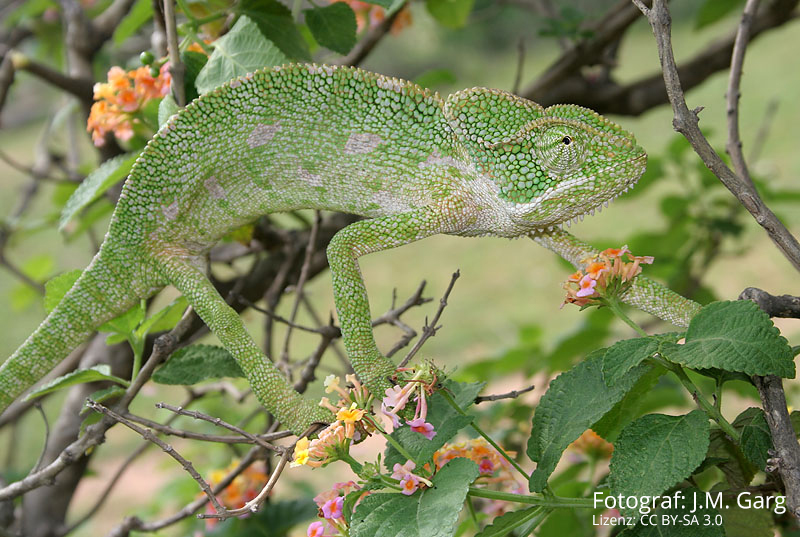
First vertebrate with annual allochrony: Chamaeleo chamaeleon musae

First vertebrate with annual allochrony: Chamaeleo chamaeleon musae

Science

Allochrony describes the phenomenon that two or more populations of a species have different reproductive cycles over time, even though they occur in the same habitat. In so-called annual allochrony, the populations reproduce at different times of the year. Allochrony is known from many different species, such as insects and corals, which reproduce at different times of the day. Annual allochrony, on the other hand, is extremely rare and has never been demonstrated in vertebrates. Two scientists from Israel have now discovered this phenomenon in chameleons for the first time.

Between 2009 and 2021, they studied the Chamaeleo chamaeleon musae populations in the Holot Mash’abim Nature Reserve in Israel on two nights per month. The reserve is located in the northwestern part of the Negev desert. During the study, the chameleons were searched for from a slow-moving car with flashlights along a 4 km long path. Animals found were measured, sexed, location recorded and claws clipped in a specific sequence for identification. All animals were released at their location within less than 20 minutes. In order to estimate the age of the animals, the time periods between the recovery of previously marked animals were used, as well as an algorithm developed using XGBoost. The chameleons could thus be assigned to the age classes < 1 year, 1-2 years and > 2 years. All data was statistically analyzed.

The astonishing results show that Chamaeleo chamaeleon musae probably occurs in two populations in the Negev desert, separated by annual allochrony. In odd-numbered years, one population of chameleons hatches in September. These animals survive until about November of the following year. In even-numbered years, the second population of chameleons hatches, whose animals also live until November of the following year. The lifespans of the two populations only overlap for a short period of time, when one population is hatching and the already adult animals of the other population are laying eggs. The reproductive Chamaeleo chamaeleon musae of both populations therefore do not overlap or only very rarely due to very few, longer-lived individuals.

The scientists were able to find a total of 1289 chameleons < 1 year old, 231 aged 1 to 2 years and 27 chameleons > 2 years old. Of these, 713 Chamaeleo chamaeleon musae had already been caught for the first time as juveniles, so that their age could be estimated very well. Only 9 of these were rediscovered between 1 and 2 years of age. The survival rate of the hatchlings until their first breeding season was extremely low. In odd-numbered years it was 1%, in even-numbered years 2.5%. Even fewer chameleons survived the first year, at 0.46% and 1.3%. Both populations of Chamaeleo chamaeleon musae were highest in the first and second month of hatching and then declined rapidly. Male chameleons were slightly less likely to survive the first breeding season than females, but overall survival rates were similar for both sexes. In each year of observation, the first hatchlings emerged between mid-September and mid-October, at the end of the hot season. During the cooler and wetter season from December to March, significantly fewer chameleons, most of them juveniles, were found.

This very exciting study naturally raises many more questions. There are several short-lived chameleons, but the entire life cycle of only a few, such as Furcifer labordi, is even known or has been studied. It is possible that there are even more vertebrates with annual allochrony among the chameleons – this still needs to be researched!

First evidence of yearly allochrony in a terrestrial vertebrate: A case study of an annual chameleon
Liran Sagi, Amos Bouskila
Ecology 106(6), 2025: e70144
DOI: 10.1002/ecy.70144

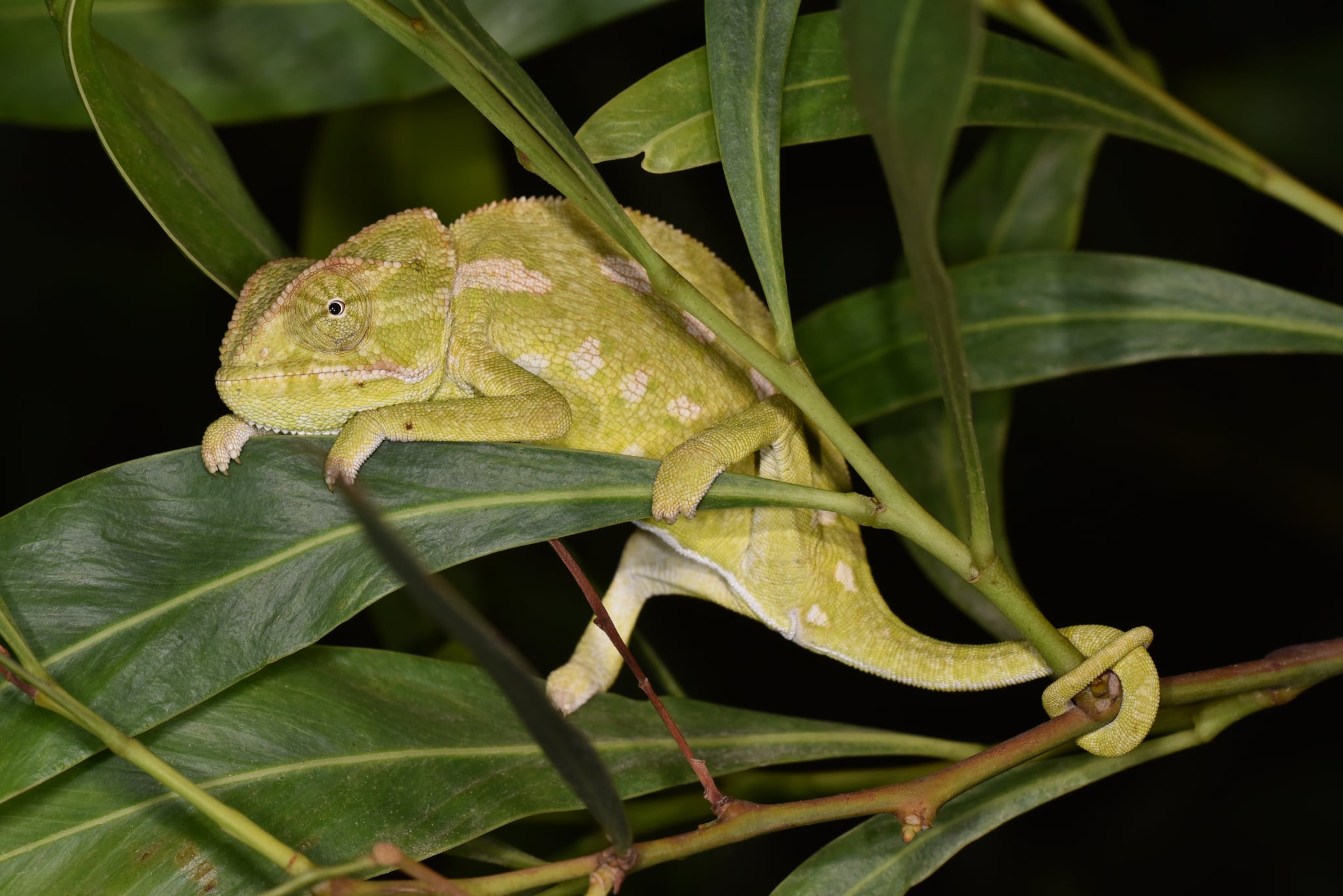
Picture: Chamaeleo chamaeleon, photographed by Markus Grimm
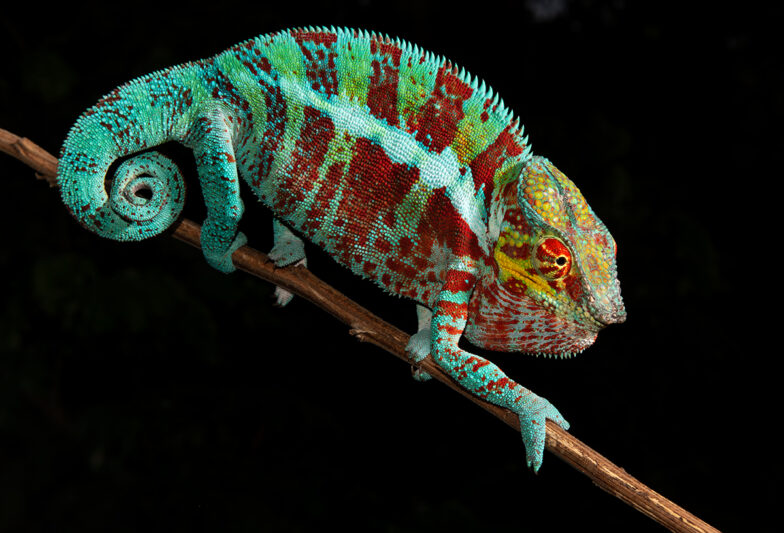
Panther chameleons in Madagascar

Panther chameleons in Madagascar

General topics Verbreitung Newspaper articles

In the bi-monthly magazine of the DGHT e.V., the Elaphe, a nice article on the panther chameleons of Madagascar has been published. It was written by two members of the AG Chamäleons who regularly travel to the island.

The article describes in words and pictures the distribution area of the panther chameleons on Madagascar, which extends over the northern half of the island, more precisely from a few kilometres south of the village of Ankaramibe in the northwest to the north of Madagascar and down the east coast to about 90 km south of the port city of Toamasina. The chameleons are found mainly in secondary vegetation in open landscapes, but also in cocoa plantations, overgrown gardens and rainforests.

The life cycle of the panther chameleons in Madagascar is mainly determined by the rainy season between November and March. The chameleons mate during this time. After 30 to 40 days, the females lay between 11 and 35 eggs in a nest they have dug themselves. The young hatch only in the next rainy season.

The article goes into particular detail about the different local forms, the different colour appearance of the male panther chameleons depending on the location. The authors currently count more than 30 different local forms on Madagascar, which are separated from each other by natural barriers such as rivers. There are probably many more, but not all of them have been discovered yet.

Pantherchamäleons (Furcifer pardalis) – Meister der Farben
Thorsten Negro and Alexandra Laube
Elaphe 3, 2023, pp. 12-25

Photo: Panther chameleon of the local form Ambanja on Madagascar, photographed by Thorsten Negro.

Factors in the geographical dispersal of chameleons

Factors in the geographical dispersal of chameleons

Science

For a long time, people have been trying to find out how and why chameleons have spread across the African continent, to islands and as far as Europe and Asia. French scientists, in collaboration with international colleagues, have now used phylogenetics and various computational models to investigate how the factors of body size, coastal habitat and extreme lifestyles may have affected the distribution of different chameleon species. The study examined 181 species divided into nine main biogeographical regions: North Africa and Arabia, Central Africa, Southeast Africa, Southwest Africa, India, Socotra, Madagascar, Comoros and Seychelles.

Chameleon species that occurred more than 10 km from the sea historically spread significantly less than the 74 coastal chameleon species. A similar phenomenon is known from skinks and crocodiles. Dispersal probably took place mainly along the coasts, mostly on the same continent and only rarely across the water to other continents or islands.

The size of the different chameleons also seems to have influenced their dispersal throughout history: Large chameleons spread further and more frequently than small chameleons. This could be related to the fact that larger chameleons have a lower metabolic rate – so they need less energy overall relative to smaller competitors. In addition, larger chameleons lay clutches with significantly more eggs, which simply gives them an advantage in numbers.

A somewhat unexpected result came from the study of different life cycles. One would initially assume that short life cycles are associated with faster dispersal. In fact, the calculations showed that especially chameleon species with extreme life cycles spread further. Thus, those that reproduced particularly slowly or particularly quickly were historically more successful among chameleons than the species “in the middle”. In this regard, the authors consider whether particularly slow life cycles with late sexual maturity and long gestation might be more successful on the same continent, while faster reproductive strategies with large clutches are more favourable for dispersal across the sea to islands and other continents. In line with this, Furcifer polleni and Furcifer cephalolepis in Comoros and Chamaeleo zeylanicus in India, all three examples of aquatic dispersal, have a very fast life cycle.

The 34 chameleon species with the combination of living close to the coast, large size and extreme life cycle had a 98% higher dispersal rate than species without these characteristics.  All in all, this is certainly a very theoretical study, but it nevertheless provides exciting insights into the historical distribution and dispersal of chameleons.

Chameleon biogeographic dispersal is associated with extreme life history strategies
Sarah-Sophie Weil, Laurie Gallien, Sébastien Lavergne, Luca Börger, Gabriel W. Hassler, Michaël P.J. Nicolaï & William L. Allen
Ecography
DOI: 10.1111/ecog.06323