
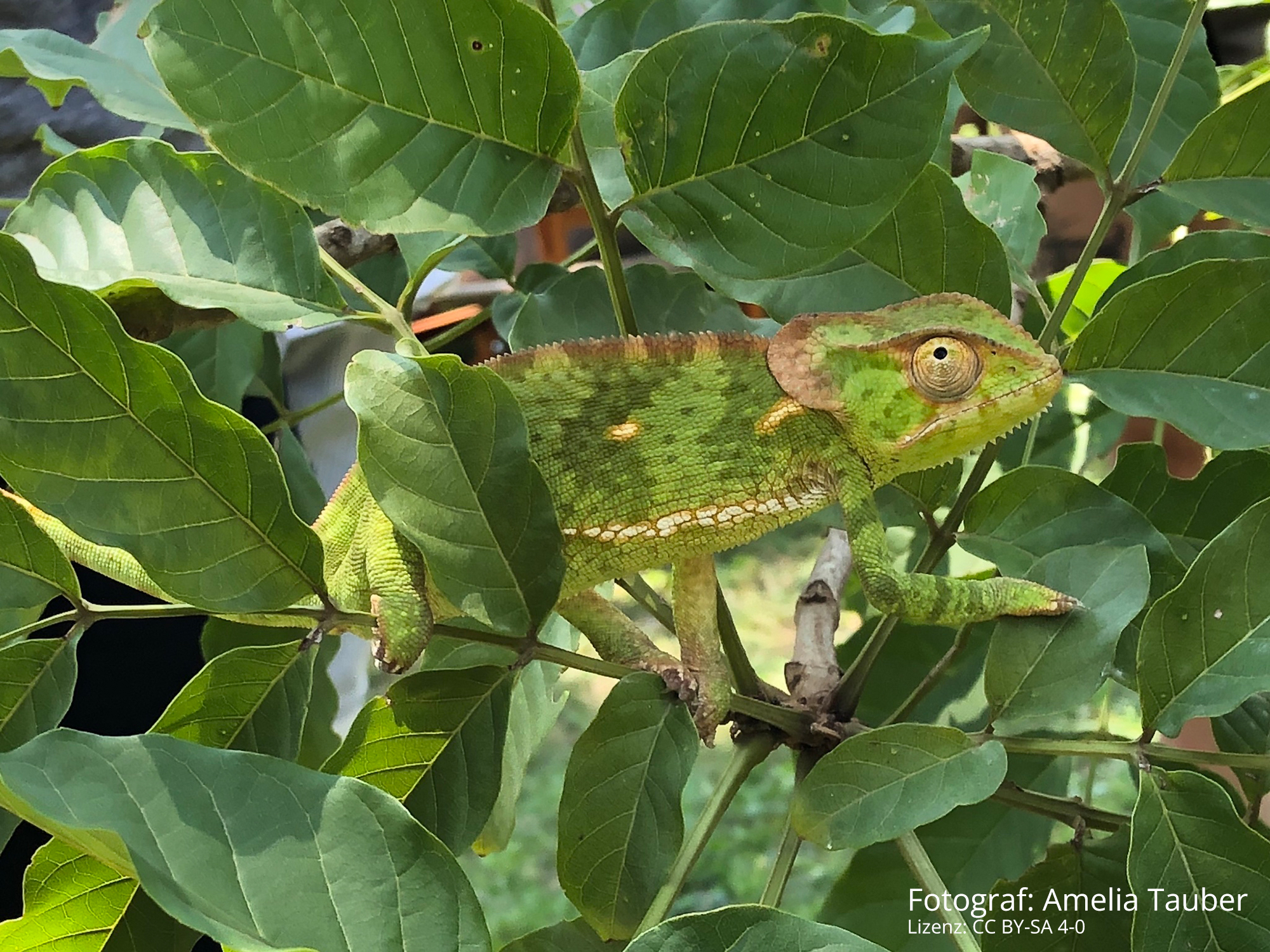
Chameleons are known for their ability to change colour. International scientists have now investigated what exactly influences different colour patterns in different populations. They want to know to what extent the habitat itself, the distance to other populations or social interactions influence the colour change.
The test subjects were European chameleons (Chamaeleo chamaeleon) caught in La Herradura and Sanlúcar in Spain. The two regions are around 230 kilometres apart. Other Chamaeleo chameleon were collected in the north-western Negev and on the Carmel coast in Israel (around 180 km apart). On the other hand, flap-necked chameleons (Chamaeleo dilepis) were captured in Simbithi, Zulu Falls and Maduma Boma in South Africa. The three locations are between 100 and 550 kilometres apart.
Each chameleon was subjected to two experiments. In the first, the scientists let the chameleon walk two metres on a horizontal stick, which was placed in the sun about one metre above the ground. In the second experiment, a second chameleon of the same species was placed on the same stick 50 cm away from the first. The colour patterns shown by the animal during the experiments and its behaviour were recorded for 20 minutes. The data was then analysed using computer programs. Blood was taken from a cut claw of all chameleons and genetically analysed. The habitats and soil conditions were also analysed in various ways and statistically evaluated. The captured animals were kept in ventilated plastic cages for a maximum of 12 hours and released after the analyses. Unfortunately, the study does not mention how many chameleons were caught and released in total.
As expected, it turned out that the individual populations of both the European and the flap-necked chameleon differed genetically from each other. The populations of Chamaeleo dilepis had significantly different haplotypes.
In the flap-necked chameleon, the females were significantly larger than the males in two locations, but not in Simbithi. The scientists also found that the colour patterns of the three populations studied could be clearly distinguished from each other. They concluded from the results that the colour patterns in Chamaeleo dilepis are primarily dependent on genetic isolation. The habitat itself and the size of the chameleons did not influence the colour patterns.
In the European chameleon, however, the situation was different: Body size and genetic distance to other populations predicted colour patterns in males very well. However, the colour patterns were independent of the location where the animals were found. Soil or vegetation colours only had a minor influence on the colour of females.
Genetic and behavioural factors affecting interpopulation colour pattern variation in two congeneric chameleon species
Tammy Keren-Rotem, Devon C. Main, Adi Barocas, David Donaire-Barroso, Michal Haddas-Sasson, Carles Vila, Tal Shaharabany, Lior Wolf, Krystal A. Tolley, Eli Geffen
Royal Society Open Science 11: 231554
DOI: 0.1098/rsos.231554