Comparisons between dwarf chameleons in South Africa

Comparisons between dwarf chameleons in South Africa

Science

South African scientists have recently been investigating whether three closely related Bradypodion lineages in the Eastern Cape Province of South Africa have evolved differently due to their different habitats or whether other causes are responsible.

The scientists are studying the two species Bradypodion ventrale from the Nama Karoo and Bradypodion taeniabronchium from the Elandsberg and Tsitsikamma Mountains and the fynbos of Thyspunt and Honeyville, as well as a population of dwarf chameleons from the fynbos of the Groot Winterhoek Mountains that has not yet been described as a separate species. The latter are often referred to as Bradypodion sp. ‘groendal’ because they occur in the Groendal Nature Reserve, among other places.

At night, chameleons were searched for using flashlights and the naked eye. Adult chameleons with a body length (SVL) of more than 36 mm were taken away overnight to be released back at the site where they were found the next day. All animals were measured accurately. Tissue samples were taken from the tip of the tail. In addition, the thickness and height of the branches on which the chameleons were found were measured. Further branch thicknesses were recorded along three 100 m long transects in each population. The data collected was statistically evaluated and the tissue samples were genetically examined.

A total of 232 chameleons were sampled for the study. Bradypodion taeniabronchium had significantly smaller head features than the other two species, but larger hands and feet. Bradypodion ventrale was larger overall than the others, but had longer limbs. Bradypodion taeniabronchium used the widest branches (average diameter 2.83 mm), but also the lowest (average height 82 cm above the ground). Bradypodion ventrale, on the other hand, used the thinnest branches (average diameter 1.52 mm), but the highest (average just under 93 cm above the ground).

The researchers found that all three populations of dwarf chameleons showed increased external similarity (convergence) when they occurred in the same habitats and less similarity (divergence) when they occurred in different habitats. The dwarf chameleons preferred certain branch thicknesses depending on their population, even though other branches were also available in their habitat. Finally, the authors point out that all the evidence available so far suggests that the as yet undescribed dwarf chameleons of the Groendal Nature Reserve represent a separate species.

Ecological factors promote convergent evolution and ecological speciation in dwarf chameleons (Bradypodion)
Krystal A. Tolley, Devon C. Main, Keith M. Dube, Bettine Jansen van Vuuren, Jessica M. da Silva
Zoosystematics and Evolution 101(3) 2025: 1227-1247
DOI: 10.3897/zse.101.151926

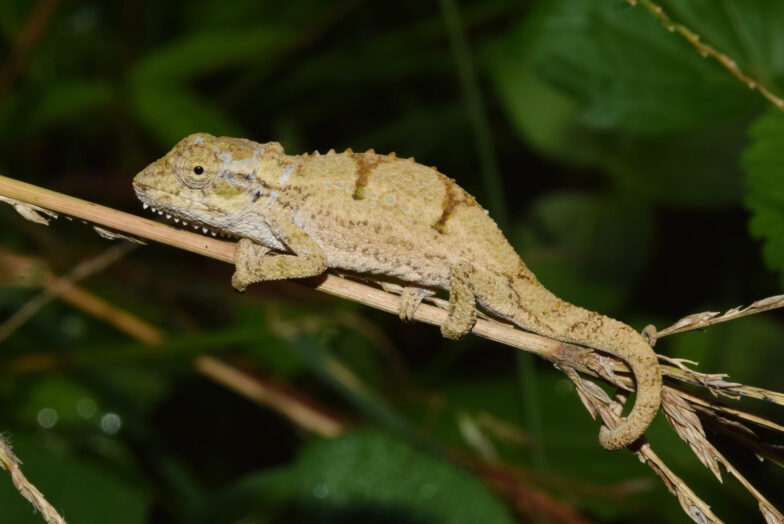
Photo: Bradypodion ventrale, from the publication cited

Dwarf chameleons in South Africa larger in urban environments than in the wild

Dwarf chameleons in South Africa larger in urban environments than in the wild

Science

Dwarf chameleons of the genus Bradypodion from South Africa have long been known to adapt very well to urban habitats. Two scientists from Cape Town and Johannesburg have now investigated how different populations differ in body size, body weight and body condition score within urban and natural environments.

A total of 1107 individuals of five different dwarf chameleon species were studied over a period of four years. Bradypodion damaranum in George (Western Cape), Bradypodion melanocephalum in Durban (KwaZulu-Natal), Bradypodion setaroi in St Lucia (KwaZulu-Natal), Bradypodion thamnobates in Howick (KwaZulu-Natal) and Bradypodion ventrale in Jeffrey’s Bay (Eastern Cape) were each searched at night at three to eight locations. Forest fragments, grass savannahs or coastal bushland less than 15 km from the centre of the nearest town were classified as ‘natural sites’. All sites located within a city and consisting of both introduced and native flora regularly cut back by humans (gardens, public parks and green spaces, roadsides) were categorised as ‘urban’. The dwarf chameleons found were measured, weighed, sexed and marked with a felt-tip pen to avoid duplicate measurements on the same animals. Obviously pregnant females were not measured.

Statistical analyses and comparisons revealed that the chameleons at natural sites were always smaller and lighter on average than the populations of the same species at urban sites. Significantly larger and heavier in the city were both sexes in Bradypodion damaranum, the males in Bradypodion melanocephalum, ventrale and setaroi and the females in Bradypodion thamnobates. The body condition score was higher in urban areas for both sexes of Bradypodion damaranum and setaroi and males of Bradypodion melanocephalum than for the chameleons in natural habitats. In Bradypodion ventrale and thamnobates, there were no differences in body condition score between the different populations.

Research into exactly how these exciting differences come about is still pending.

Big cities, big bodies: urbanisation correlates with large body sizes and enhanced body condition in African dwarf chameleons (Genus: Bradypodion)
Jody M. Barends, Krystal A. Tolley
African Zoology 2024, 59(3)
DOI: 10.1080/15627020.2024.2402256

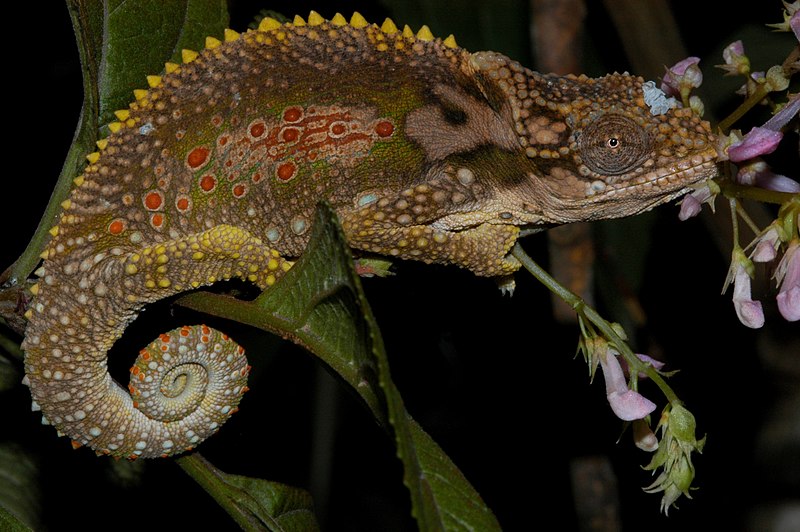
Photo: Bradypodion melanocephalum, photographed by suncana, licence Creative Commons Attribution 4.0 International

Genome of South African dwarf chameleons decoded

Genome of South African dwarf chameleons decoded

Science

After a reference genome for the panther chameleon (Furcifer pardalis) was recently published for the first time in China, scientists from South Africa have now followed with the genome of two dwarf chameleon species.

For the analyses, a male Bradypodion pumilum from Cape Town and a male Bradypodion ventrale from an introduced population in Johannesburg were taken. Muscle and liver tissue was used for long sequencing (HiC). The genome size of Bradypodion pumilum is 2.43 gigabase pairs (Gb), that of Bradypodion ventrale 2.40 Gb. The BUSCO analysis demonstrated a high completeness with about 97% of all existing coding genes in vertebrates. Furthermore, the current publication confirms the six macrochromosomes already found from the karyotype in Bradypodion thamnobates 2017. Various comparisons with Anolis sagrei were made. It remains open which chromosomes in Bradypodion are sex chromosomes.

The genomes can be viewed in the NCBI BioProject under the number PRJNA9861319 and under the BioSample numbers SAMN35825189 and SAMN35825190 respectively.

De novo whole genome assemblies for two Southern African Dwarf Chameleons (Bradypodion, Chamaeleonidae)
Jody M. Taft, Krystal A. Tolley, Graham J. Alexander, Anthony J. Geneva
Genome Biology and Evolution 15 (10), 2023, pp. 1-8
DOI: 10.1093/gbe/evad182