For a long time, only two types of foraging behaviour were distinguished: active foragers and sit-and-wait or ambush foragers. Many years ago, two publications classified chameleons as ‘cruise foragers’, i.e. hunters that move slowly through the bushes, stop to feed and then move on. A study from South Africa is now investigating whether this is true and whether other factors contribute to movement. In order to evaluate the mode of foraging, one would actually have to ‘factor out’ movement for regulating body temperature, evading predators or opponents, searching for females or mate guarding.
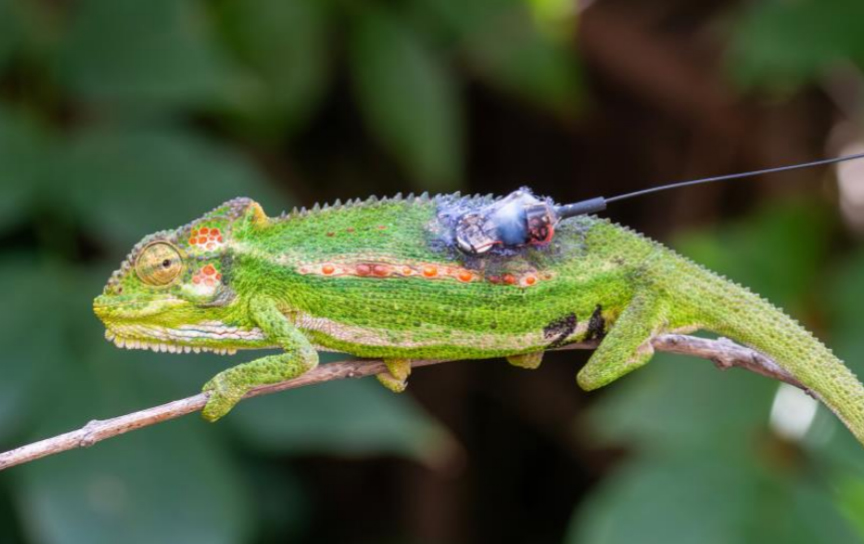
To this end, 38 tagged (12 of them radio-tagged) Bradypodion pumilum were tracked over 10 days in April and 10 days in February. The chameleons live in Brümmer Park in Stellenbosch in the Western Cape province. They were divided into 17 male, 19 female and 2 indeterminate Bradypodion pumilum. The animals were located every evening and every morning on the specified days using telemetry and the naked eye. Each chameleon was observed for 60 to 180 minutes at a time, with two to four observers using binoculars from a distance of 5 to 10 metres from the chameleon being observed. The researchers recorded movements and stationary behaviour and assigned the corresponding motivation to each movement, noting food intake and number of shots.
A total of 171 hours of observation time was accumulated. Bradypodion pumilum spent most of the day (over 75%) stationary on their branches in Brümmer Park. In the morning, over 80% of them were sitting around, with almost half of this time spent sunbathing, presumably to warm up, and the other half spent stationary in shady vegetation. During the observation period, 26 Bradypodion pumilum fed a total of 110 times. They ate significantly more often (over 80%) when they were not moving. A strong factor for movement was interaction with conspecifics – during the observations, one male was even chased away by a female, causing it to fall from the tree.
The authors conclude from their study that Bradypodion pumilum is more likely to be a ambush hunter.
A multi-index approach to assessing foraging mode: a case study using chameleons
Wade K. Stanton-Jones, Krystal A. Tolley, Jody M. Barends, Graham J. Alexander
Current Zoology, 2025, zoaf065
DOI: 10.1093/cz/zoaf065
Free article download
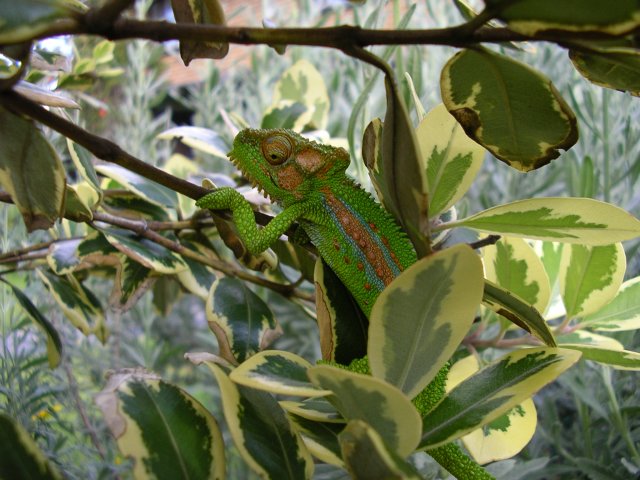
Photo: Bradypodion pumilum tagged with a transmitter from the study mentioned above