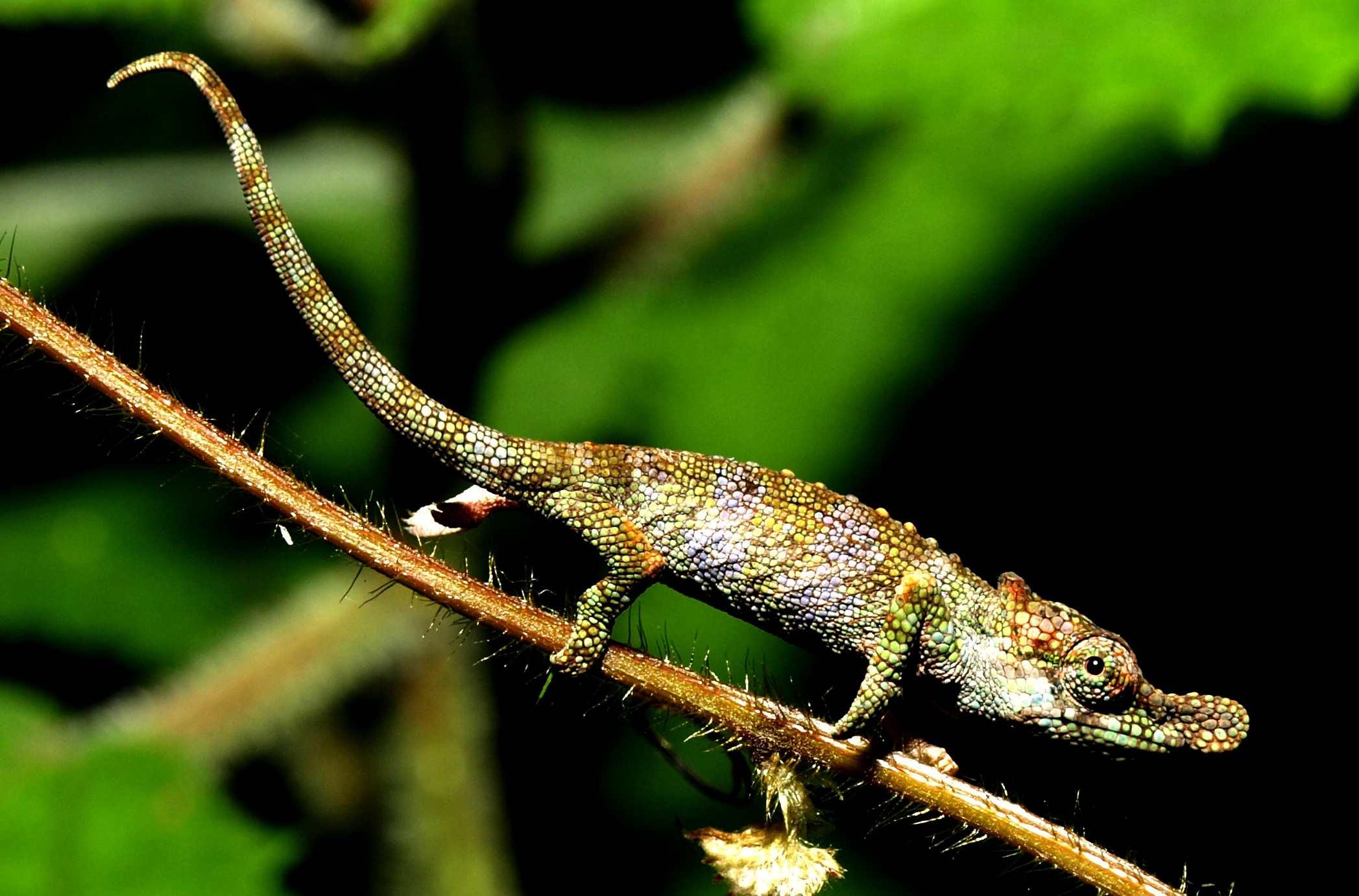
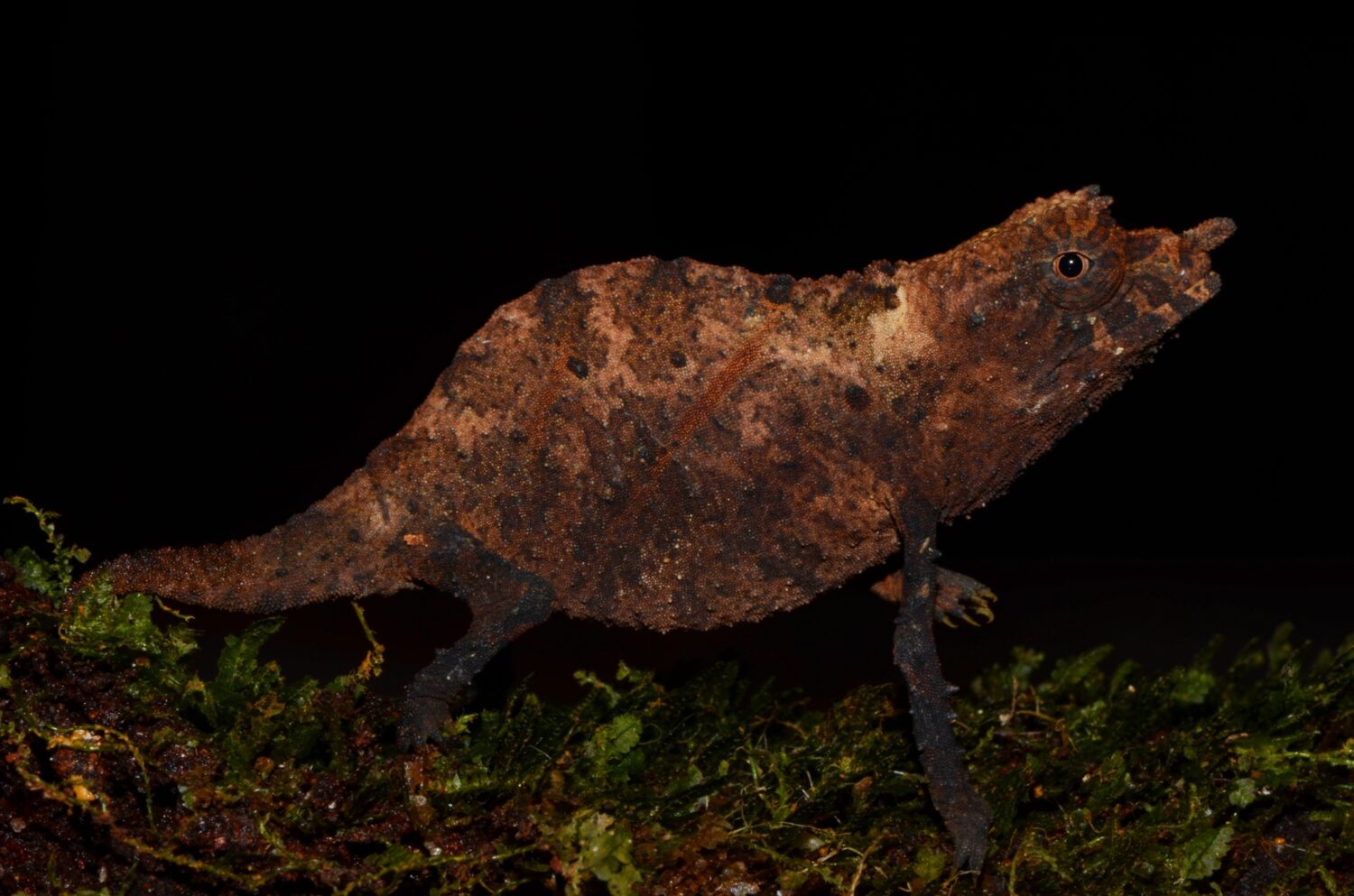
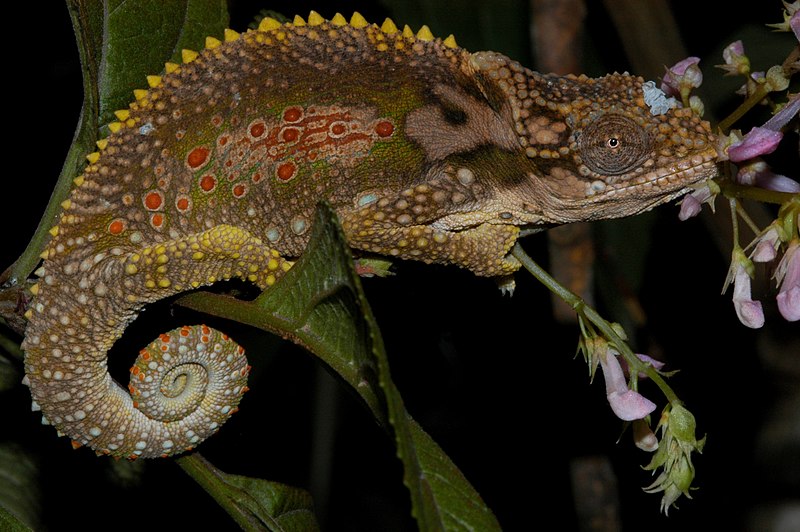
The pygmy chameleon genus Rhampholeon is mainly found in East Africa. Rhampholeon viridis, Rhampholeon spinosus, and Rhampholeon temporalis each live in clearly defined and isolated areas of Tanzania. Rhampholeon spectrum, however, seems to be the complete opposite so far: The species has an enormous range in western Africa. It extends from Côte d’Ivoire through Ghana, Togo, and Benin to Nigeria and the outskirts of Niger and Chad, then on through Cameroon, Equatorial Guinea, and Gabon into the Central African Republic as well as the Democratic Republic of Congo and the Republic of Congo. Researchers from the USA and Cameroon have now investigated genetically what is behind the wide distribution.
Samples from an island at the northernmost tip of Equatorial Guinea, several mountains in Cameroon, and samples from two areas in Gabon were examined. To the researchers’ astonishment, it turned out that Rhampoleon spectrum is by no means genetically identical everywhere. Two clades could be identified from the samples: One in the lowlands and one in the montane forest, where the chameleons are found exclusively above 700 m a.s.l. A total of five genetically distinct populations were identified, several of which may represent new, as yet undescribed chameleon species.
The lowland clade includes the population in Gabon, where chameleons were sampled from Ivindo National Park and animals in an area near the town of Mekambo. The second population of the lowland clade occurs at low altitudes on Mount Korup, a mountain of volcanic origin. Mount Korup is located in the protected national park of the same name in Cameroon on the border with Nigeria.
The montane clade of the Rhampholeon spectrum includes three populations. One population occurs on Mount Biao on the island of Bioko, which belongs to Equatorial Guinea. A second population is found on Mount Cameroon, an active volcano in western Cameroon not far from the Gulf of Guinea. The type specimen of Rhampholeon spectrum comes from Mount Cameroon. The locality mentioned in the first description, Mapanja, is only a few kilometres away from one of the places where individuals were collected in the present study. This population is therefore probably the “true” Rhampholeon spectrum, the so-called topotypic group. The third population of the montane clade is found on three neighbouring mountains in Cameroon: Mount Kupe, Mount Mangengouba, and Mount Nlonako. Together with Mount Cameroon and Mount Biao, all three belong to the so-called Cameroon Line, a mountain range of volcanic origin that stretches along the border between Cameroon and Nigeria from the sea to Lake Chad.
The researchers are also looking into the question of how the different populations might have evolved. The separation between Rhampoleon spectrum and the pygmy chameleons in Tanzania can be dated to the late Eocene around 40 million years ago. During this time, the previously continuous rainforests in West, Central, and East Africa broke up into smaller, sometimes isolated fragments. The Rhampoleon spectrum clade then split into lowland and montane populations in the Miocene around 11.1 million years ago. In the Miocene, tectonic movements led to the uplift of a low mountain range that extended from southern Cameroon to the south of the Republic of Congo. Rivers, deserts, and other geographical barriers changed. Somewhat later, about 9.3 million years ago, the population on Bioko Island split off. The island’s pygmy chameleons are thus older than the island itself – the researchers explain this phenomenon by the fact that the island must have been connected to mainland Africa via a land bridge in the past. The chameleons would therefore have colonised the island, found a home on the mountain, and only then became isolated from the mainland. However, the genetically identical population on the mainland could not be found – researchers consider it extinct. In the late Miocene, around 6.9 million years ago, the populations on Mount Korup and in Gabon emerged. Only at the transition from the Miocene to the Pleistocene, 5.2 million years ago, did the populations on Mount Cameroon and Mount Kupe emerge.
Further research on this topic will show whether new species are actually hiding under the name Rhampholeon spectrum – chances are good. It would also be interesting to investigate populations of the species that are not mentioned in this study. Because, of course, the Rhampholeon spectrum from southern and eastern Cameroon, continental Equatorial Guinea, southern Gabon, and the Congo could also be further, independent populations. Science remains exciting!
Diversification and historical demography of Rhampholeon spectrum in West-Central Africa
Walter Paulin, Tapondjou Nkonmeneck, Kaitlin E. Allen, Paul M. Hime, Kristen N. Knipp, Marina M. Kameni, Arnaud M. Tchassem, LeGrand N. Gonwouo, Rafe M. Brown
PLOS One, December 2022
DOI: 10.1371/journal.pone.0277107