New leaf chameleon in Madagascar

New leaf chameleon in Madagascar

Neubeschreibungen

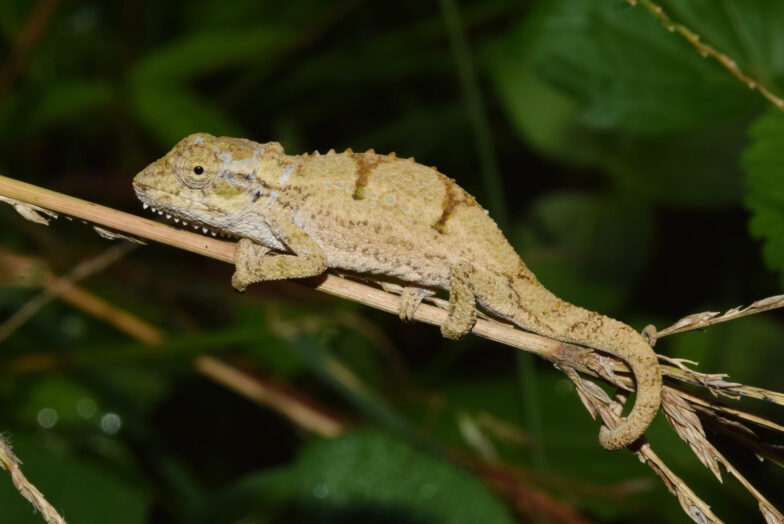
There are tiny chameleons in many places in Madagascar, including the smallest in the world. Now another tiny terrestrial chameleon has been described by Malagasy and German scientists: Brookesia nofy.

Brookesia nofy lives in a small remnant of lowland rainforest on the central east coast of Madagascar, in the Akanin’ny Nofy reserve. It probably also occurs in the neighbouring Vohibola reserve. The new species is related to Brookesia ramanantsoai, which occurs in the eastern highlands and not quite as close to the coast. Madagascar’s lowland rainforests are extremely threatened by deforestation. It is therefore all the better that this small chameleon already lives in two protected areas. Incidentally, the name nofy is the Malagasy word for dream and is therefore appropriate in two respects: firstly, because it was found in the ‘nest of dreams’ and secondly, because it lives in its own protected area, thus ensuring its survival for the time being.

A new miniaturized species of leaf chameleon, genus Brookesia, from a littoral forest fragment in eastern Madagascar
Andolalao Rakotoarison, Alida Frankline Hasiniaina, Frank Glaw, Miguel Vences
Zootaxa Vol. 5506(4):533-547
DOI: 10.11646/zootaxa.5506.4.3

Picture: Brookesia nofy in Akanin’ny Nofy, photographed by Alex Negro

Occurrence of the European chameleon in Tlemcen (Algeria)

Occurrence of the European chameleon in Tlemcen (Algeria)

Verbreitung Science

The 21.6 km² Tlemcen Hunting Reserve is located in the north of Algeria, in the province of the same name. The climate is Mediterranean, the province borders the Alborán Sea (the westernmost part of the Mediterranean Sea) and lies directly opposite south-east Spain. The reserve is located around 26 kilometres southwest of the city of Tlemcen, the second largest city in Algeria, and spans the highest areas of the Tlemcen Mountains.

A local veterinarian and biologist recently carried out a survey study of the animals currently found in the reserve. In order to investigate the herpetofauna, manual searches or traps were set along measured transects. Chamaeleo chamaeleon was found several times during the study.

Inventory of wildlife in the Tlemcen Hunting Reserve
Rafiq Rahmouni, Louiza Derouiche
Genetics and Biodiversity Journal 8(2), 2024
DOI: not available

Picture: Chamaeleo chameleon, photographed by Peter A. Mansfeld, licence Creative Commons Attribution 3.0 Unported

New modelling of species loss in Madagascar

New modelling of species loss in Madagascar

Verbreitung Science

For some time now, there have been various programmes and algorithms that can make various predictions about how many species in a country or region could be threatened with extinction in the future based on given data. Until now, this has always required a whole series of locations and data for the respective animal species as a basis. However, these are often not available for rare species.

Italian scientists have now developed an algorithm called ENphylo, which can make predictions from just two observations per species. It was tested in parallel to conventional algorithms on a model with 56 chameleon species from Madagascar. The occurrence and locations of the chameleons were taken from the Global Biodiversity Information Facility. Various scenarios of climate change and progressive changes in land use were modelled using CHELSA and other databases for the period between 2071 and 2100. For each of the chameleon species, 45 modelled predictions were calculated in the study.hnet.

As a result, the scientists predict a habitat loss of over 90% for the species Brookesia decaryi, Brookesia brunoi, Calumma globifer, Brookesia desperata, Brookesia karchei, Brookesia micra, Brookesia tristis, Calumma amber, Calumma guibei, Calumma ambreense, Calumma nasutum, Calumma fallax, Calumma peltierorum, Calumma boettgeri, Furcifer petteri and Furcifer willsii. As a result, these species would be directly threatened with extinction by 2100 due to climate change and changes in land use in Madagascar. The greatest area losses in potential habitats are expected in the dry forests of the west and north-west and the lowland rainforests of the east coast. The potential habitat loss is also expected to affect species that only occur in a very small distribution area but are very common there, such as Brookesia tuberculata.

An increasing development of the habitat is only assumed for Furcifer oustaleti, Furcifer rhinoceratus, Calumma parsonii (unfortunately without indication of the subspecies), Calumma oshaughnessyi, Calumma crypticum, Calumma brevicorne and Brookesia supericilaris. According to the various calculation models, Madagascar could lose between eight and eleven chameleon species by the year 2100.

Modelling reveals the effect of climate and land use change on Madagascar’s chameleons fauna
Alessandro Mondanaro, Mirko di Febbraro, Silvia Castiglione, Arianna Morena Belfiore, Girogia Girardi, Marina Melchionna, Carmela Serio, Antonella Esposito, Pasquale Raia
Communications Biology 7, 2024: 889
DOI: 10.1038/s42003-024-06597-5


Photo: Calumma crypticum in Ranomafana, Madagascar, photographed by Alex Laube

Chameleons in traditional medicine in Sierra Leone

Chameleons in traditional medicine in Sierra Leone

Science

In Sierra Leone in West Africa, animal parts are still used in traditional medicine today. Two scientists from the University of Nala have now investigated exactly which ones and what they are used for.

The study was conducted in the chiefdoms of Kowa and Dasse between March and July 2023. Around 24,000 inhabitants live here, almost all of them farmers. Both areas are located in the Moyamba region in eastern Sierra Leone and are sparsely populated with the exception of four urban regions. The scientists interviewed 40 people and visited the patients they were treating. The interviewees included herbalists, traditional healers, fetish priests and obstetricians selected by the local population. People familiar with the area were asked about the fauna present. The animal parts used were photographed and sampled as far as possible.

As many as 17 of the interviewees had attended secondary school, while 17 others had received no schooling at all. All of them stated that they had learnt the healing methods used from their ancestors. 30 of the 40 interviewees made their living from traditional medicine and had been practising for around 30 years. A few even stated that they earned between $ 2120 and $ 4230 per year (the average for an employee in Sierra Leone is $ 2900 per year). Forty-five animal species were used for medicinal purposes, and 40 diseases were named as indications. The most frequently used animals, around a third, were reptiles, followed directly by amphibians, snails and mammals. Primates alone accounted for 10% of the animals used.

Chamaeleo gracilis was mentioned eighteen times during the interviews as a potential remedy. It is locally called ‘duqui’. Its skin, muscle parts and intestines are said to improve memory. It is also used for various mystical purposes. Most parts are eaten cooked.

Traditional medicines containing animal parts: Use in Kowa and Dasse chiefdoms, Southern Sierra Leone
Jonathan Johnny, Alhassan Bangura
Journal of Pharmacognosy and Phytochemistry 2024, 13(3): pp. 308-317
DOI: 10.22271/phyto.2024.v13.i3d.14972

Photo: Chamaeleo gracilis photographed by kogia, licence Creative Commons Attribution 4.0 International

Furcifer viridis offspring in the AG

Furcifer viridis offspring in the AG

Nachzuchten

AG member David Prötzel has successfully incubated and hatched a clutch of Furcifer viridis. Congratulations!

Furcifer viridis is a small species of chameleon found in western Madagascar. It was long thought that the species belonged to the carpet chameleon Furcifer lateralis – but since 2012 it has been clear that it is a separate species. David incubated the eggs for around 50 days at 20-22°C (room temperature), then a further 50 days at 24-25°C in an incubator. From day 100 until hatching, the eggs were at 28 to 29°C. The total incubation period was 142 days. David used fine vermiculite as a substrate, which was moistened once.

Presentation in Dortmund about Namibia

Presentation in Dortmund about Namibia

Reiseberichte Live lectures

Regina Liebel will give a detailed presentation about a great trip to Namibia on July 5, 2024 in Bergkamen near Dortmund. After the European Championship match, of course ;) .

Regina Liebel A round trip over 3481 km through Namibia [German]
DGHT City Group Dortmund
Restaurant Olympia
Im Alten Dorf 2
59192 Bergkamen
Meeting from 5.30 pm
Lecture starts at 7.30 pm

Online lecture on environmental enrichment

Online lecture on environmental enrichment

Live lectures Webinars

The DGHT’s digital regulars’ table was launched this year. This platform is ideal for all those who prefer to watch lectures and exchange ideas with other reptile keepers from the comfort of their sofa, but don’t necessarily want to travel far to do so. On Thursday, 27 June 2024, the topic will be “Enrichment for reptiles”.

This term refers to various ways of making the lives of animals in human hands more interesting. There are different forms of enrichment. The best known are certainly the different ways of obtaining food through toys, which are often seen with great apes, bears or big cats in zoos, for example. However, enrichment is also possible and highly interesting for reptiles. Tobias Machts will introduce the topic and show how it works with reptiles. Please register by e-mail to digitaler-stammtisch@dght.de.

Tobias Machts Enrichement in reptiles [German!]
6. Digitaler Stammtisch der DGHT
Start 08.00 p.m.

Presentation in Basel about the European Chameleon

Presentation in Basel about the European Chameleon

Haltungsberichte Live lectures

Markus Grimm, long-time member of the AG Chameleons and for many years entrusted in Switzerland with the implementation of expert courses for chameleon keeping, will give a detailed lecture on the European chameleon on 28 June 2024 in Basel (Switzerland).

The European chameleon (Chamaeleo chamaeleon) describes the archetype of the chameleon as such and thus has status character for the human conception of chameleons. The rather seldom kept chameleon species makes some demands on keeping and breeding, which Markus was able to fathom during trips to the habitat as well as during keeping in the terrarium. After a short introduction, which includes systematics, Markus gives insights into the habitat of this chameleon in nature. In addition, the audience will learn the most important parameters for successful keeping and breeding in the terrarium. So it will definitely be very exciting – anyone interested in chameleons should definitely watch this lecture!

Markus Grimm The European Chameleon – Habitat, husbandry & breeding
Schildkrotte Grubbe Regio Basel
Gasthof Zur Saline
Rheinstraße 23
4133 Pratteln-Schweizerhalle (Switzerland)
Lecture starts at 7.30 pm

Picture: Markus Grimm

Rhampholeon acuminatus offspring at Citizen Conservation

Rhampholeon acuminatus offspring at Citizen Conservation

AG Interna Nachzuchten

AG member Falk Eckhardt recently had a great success: His Rhampholeon acuminatus have successfully produced their first clutch of eggs. Congratulations!

The Nguru Spiny Pigmy Chameleon occurs in the wild exclusively in the small Mingu Nature Reserve in the eponymous Nguru Mountains in Tanzania. The IUCN classifies the species as critically endangered on the Red List of Threatened Species. Rhampholeon acuminatus is the first chameleon species for which a professional breeding programme has been set up as part of Citizen Conservation. The original animals come from Schönbrunn Zoo in Vienna (Austria). So far, there have only been F1 offspring (= offspring of wild-caught animals). Falk’s offspring, if they hopefully hatch, would be the first F2 offspring of the Nguru Spiny Pigmy Chameleon in the Citizen Conservation project. We keep our fingers crossed!

Picture: The eggs

Presentation in Munich about Greece

Presentation in Munich about Greece

Live lectures

On Thursday, 20 June 2024, reptile specialist Jochen Zauner will give an richly illustrated lecture on Greece in Munich. He will report on his two trips to the western Peloponnese in 2006 and 2023. The Peoloponnese is a peninsula in the south of the Greek mainland. It is the southernmost part of the Balkan Peninsula and therefore the area of Greece that extends furthest into the Mediterranean. In addition to the famous cities of Mycenae, Corinth and Sparta, the peninsula is also home to a diverse herpetological fauna. Between the Strofilia forests in the north and the barren mountain slopes of the Mani in the south, you will encounter some endemics as well as old favourites of the Balkan Peninsula.

Addendum: The lecture was unfortunately cancelled due to the European Football Championship! Another date will hopefully be found.

Jochen Zauner Herpetological observations in the Peloponnese  [German!]
DGHT city group Munich
Tübinger Straße 10
80686 Munich
Start of lecture 7.00 pm