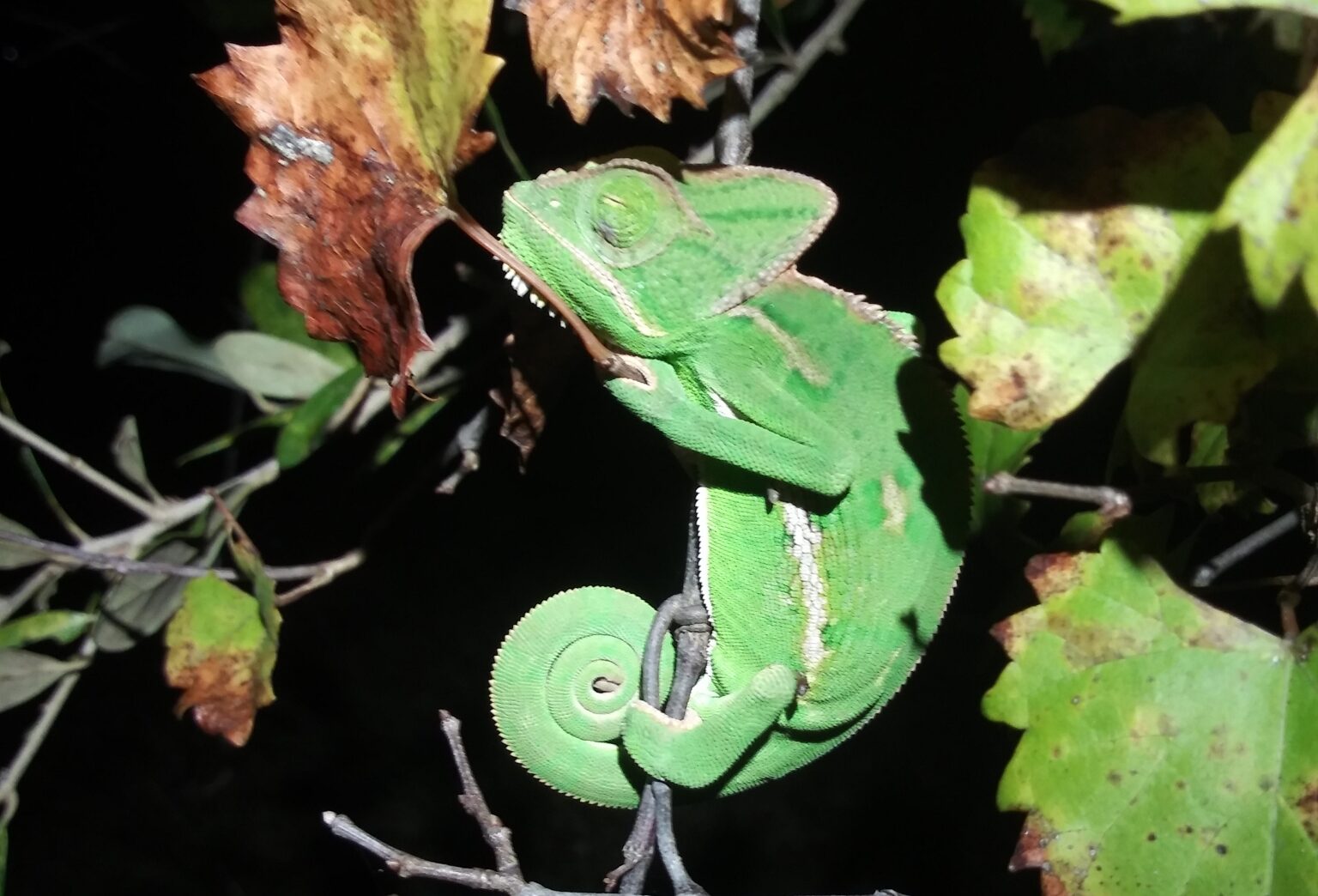
Furcifer verrucosus discovered in the stomach of a snake

Furcifer verrucosus discovered in the stomach of a snake

Beobachtungen Science

Biologists from the University of Michigan (USA) recently made a curious discovery: they analysed a snake of the species Langaha madagascariensis that had been prepared 31 years ago using dissection and microCT. The specimen had been largely untouched in the Zoological Museum of the University of Michigan since 1994. The snake was originally collected by R.A. Nussbaum in the extreme south of Madagascar, not far from Tolagnaro. Little is known about the diet of the leaf-nosed snake, only anecdotal case reports are known. Chameleons have now been added to the list of potential prey: An adult Furcifer verrucosus was found in the stomach of the female leaf-nosed snake examined.

Natural history notes: Langaha madagascariensis (Malagasy leaf-nosed snake)
Andressa L. Viol, Hayley L. Crowell, Justin L. Lee, Tristan D. Schramer
Herpetological Review 55 (2), 2025: 223-226.
DOI: not available

Photo: Furcifer verrucosus, photographed by Nick Newberry, CC BY 4.0

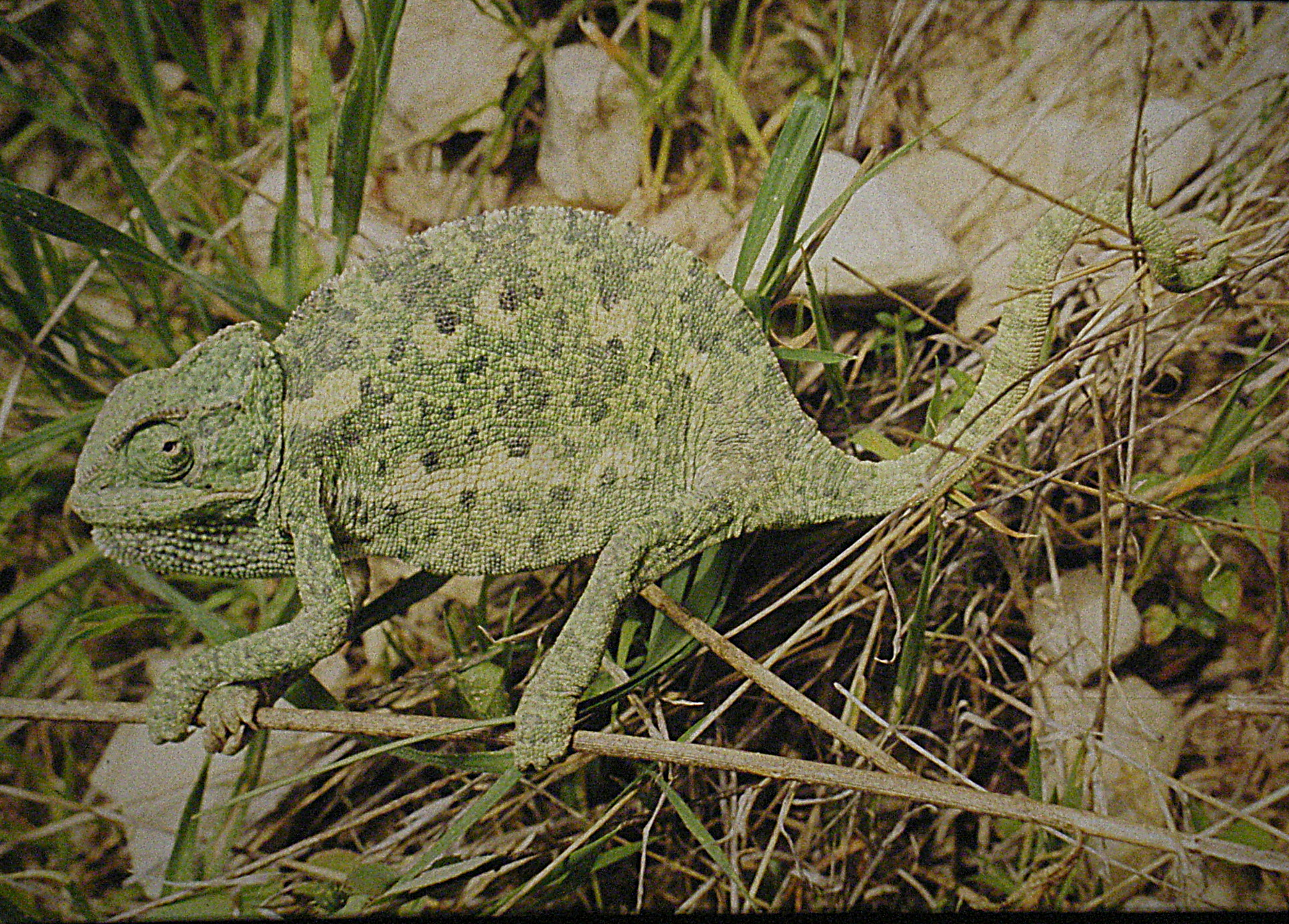
Veiled chameleon distributed over 12 new counties in Florida (USA)

Veiled chameleon distributed over 12 new counties in Florida (USA)

Verbreitung Science

Introduced Veiled chameleons (Chamaeleo calyptratus) have been living in Florida (USA) since at least 2002. The first wild Veiled chameleons were found in Collier County, two years later animals were observed in Fort Myers in Lee County. This was followed by findings in Hendry, Miamia-Dade, Broward, St. Lucie, Palm Beach, Monroe, Alachua and Hillsborough County. Now an author in the Herpetological Review reports on 12 further populations in Florida: in Brevard, Charlotte, De Soto, Glades, Indian River, Lake, Manatee, Osceola, Pinellas, Polk, Sarasota and Seminole County.

He used data from iNaturalist and EDDMapS. The author suspects that most of the new finds could be due to so-called chameleon ranching. Chameleons are deliberately released into other habitats in order to later collect and sell the resulting juveniles. But even without prior release, collecting (‘harvesting’) animals for sale has become a source of income in Florida, which has also led to the fact that distribution data on new populations is rarely published. It is now a common recreational activity in Florida to search for Veiled chameleons at night. There are even commercial operators offering guided tours.

One problem is increasingly the owners of private property who feel disturbed by ‘chameleon tourism’. The impact on native wildlife in the USA is still unclear. Theoretically, Veiled chameleons could eat smaller mammals or young birds, but there have been no reports of such incidents in Florida to date.

It seems increasingly unlikely that it will be possible to get rid of the introduced Veiled chameleons. A one-year trial in Lake Worth Beach (Palm Beach) resulted in 1043 chameleons being caught during 71 collection campaigns, but not in the elimination of the population living there.

New County Records for the Veiled Chameleon (Chamaeleo calyptratus) in Florida, USA
Kevin M. Enge
Herpetological Review 55 (2), 2025: 223-226.
DOI: not available

Photo: Chamaeleo calyptratus, found and photographed in Fort Myers (USA) by Andrew Durso, CC-BY
Online lecture on cognition in reptiles

Online lecture on cognition in reptiles

Live lectures Webinars

The DGHT’s digital regulars’ table was launched this year. This platform is ideal for all those who prefer to watch lectures and exchange ideas with other reptile keepers from the comfort of their sofa, but don’t necessarily want to travel far to do so. On Thursday, 27 March 2025, the topic will be ‘Cognition in reptiles’.

The term cognition refers, among other things, to perception and thought processes and the results derived from them. What do reptiles think? What can they perceive and can they draw conclusions from situations? Tobias Machts introduces the topic and shows how cognition works in reptiles. Please register by e-mail to digitaler-stammtisch@dght.de.

Tobias Machts Monkeys in scales? Cognition in reptiles [German]
15. Digitaler Stammtisch der DGHT
Start at 8 p.m.

New genomes of six chameleon species from Ethiopia

New genomes of six chameleon species from Ethiopia

Science

A very brief publication by three scientists deals with the genome sequences of reptiles. Wild reptiles from a total of 101 different species were sampled in Ethiopia, Guyana, Mexico and the USA. Unfortunately, the authors do not state exactly how the sampling was carried out and whether whole animals or only tissue samples were taken. DNA was extracted using the Qiagen DNAeasy Kit and Illumina TruSeq kits were used for sequencing.

All genomes were deposited at Genbank. Genomes of one Chamaeleo dilepis (JBHLFC00000000000), one Chamaeleo laevigatus (JBIELG00000000000), one Trioceros affinis (JBHUPM00000000000), one Trioceros balebicornutus (JBHZFU00000000000), one Trioceros harennae (JBHRFO00000000000) and one Chamaeleo gracilis (JBINKK00000000000) were deposited. Several entries of these species already existed in GenBank.

The complete genome sequences of 101 species of reptiles
Timothy J. Colston, Stacy Pirro, R. Alexander Pyron
Biodiversity Genomes, 2025
DOI: 10.56179/001c.129597

Picture: Chamaeleo laevigatus, photographed by John Lyakurwa, Creative Commons Attribution 4.0 International

Chameleons in Marsa El Brega (Lybia)

Chameleons in Marsa El Brega (Lybia)

Verbreitung Science

While other areas of Africa are regularly the subject of publications and expeditions, the herpetofauna of Libya has not been fully researched. Little is known about the reptiles of the coastal region of Marsa El Brega in particular. Marsa El Brega is located in the north of Libya directly on the Mediterranean Sea and therefore has a Mediterranean climate. The vegetation consists mainly of a desert-like landscape with low shrubs such as Nitraria retusa and small date palm oases in between.

A Hungarian herpetologist has investigated the reptile populations in Marsa El Brega during two expeditions. Unfortunately, the exact procedure for finding animals is not mentioned in the article. All animals found were photographed and species phenotyped according to existing field guides.

The author found a total of 25 reptile species in the Marsa El Brega region, including two Chamaeleo chameleons, one each two days apart. The coordinates given for the find site are in the outskirts of the town of Brega, right next to the garden of a bed’n’breakfast facing the beach. The author cites stray dogs and cats as the greatest potential threat to the local herpetofauna. In addition, the coastal area investigated was heavily littered.

Some reptiles from Marsa El Brega, Libya (Reptilia: Chamaeleonidae, Gekkonidae, Phyllodactylidae, Lacertidae and Scincidae)
Attila Haris
Natura Somogyiensis 45: 17-26, 2025
DOI: 10.24394/NatSom.2025.45.17

Survey on reptile husbandry

Survey on reptile husbandry

General topics

It is not only in Germany and the EU that the keeping of reptiles has been criticised and questioned for several years; in the UK, too, efforts to ban the keeping of reptiles by animal rights activists are nothing new. The Federation of British Herpetologists, together with Responsible Reptile Keeping, has now created a survey to collect data on the husbandry of reptiles worldwide. Voices from Germany, Austria and Switzerland are also needed, as well as anyone else! Please take part in the survey in large numbers – it is super quick, anonymous and can be completed in German, English and other languages. Everyone who completes the survey will receive a free subscription to ‘The Keeper’ magazine. In addition, three cash prizes will be raffled off among the participants.

Link to the survey – let’s go!

Presentation in Dingolfing about Greece

Presentation in Dingolfing about Greece

Live lectures

On Saturday, 15 March 2025, reptile specialist Jochen Zauner will give an richly illustrated lecture on Greece in Bavaria. He will report on his two trips to the western Peloponnese in 2006 and 2023. The Peoloponnese is a peninsula in the south of the Greek mainland. It is the southernmost part of the Balkan Peninsula and therefore the area of Greece that extends furthest into the Mediterranean. In addition to the famous cities of Mycenae, Corinth and Sparta, the peninsula is also home to a diverse herpetological fauna. Between the Strofilia forests in the north and the barren mountain slopes of the Mani in the south, you will encounter some endemics as well as old favourites of the Balkan Peninsula.

Jochen Zauner Herpetological observations in the Peloponnese  [German!]
DGHT regional group Niederbayern
Restaurant Aurora
Klausenweg 15
84152 Mengkofen
Begin of the presentation at 8.00 p.m.

The microbiome in the gut of South African dwarf chameleons

The microbiome in the gut of South African dwarf chameleons

Science

The term microbiome has been on everyone’s lips for some years now. In the intestine, this refers to the entirety of all microorganisms, especially bacteria, that colonise the mucous membrane. Now a group of researchers in South Africa has for the first time studied the gut microbiome in chameleons and how it changes in different habitats.

Three species of dwarf chameleons were searched for at night in the province of KwaZulu Natal with the help of torches: Bradypodion melanocephalum, Bradypodion thamnobates and Bradypodion setaroi. All animals were kept in containers for 24 hours and then released at the site. For each species, 10 buccal swabs and 10 faecal samples were collected in a natural and an urban habitat, resulting in a total of 120 samples. In the laboratory, DNA was extracted from the samples, amplified by PCR and then sequenced. Phylogenetic trees were created and statistical comparisons were made between the samples.

The samples were also analysed for zoonotic pathogens such as salmonella. However, only Campylobacter, Escherichia and Serratia were detected in human pathogens in the faeces. The authors conclude that the zoonotic potential of the microbiome of dwarf chameleons is very low.

In total, almost 350 different bacterial species were detected in the microbiome of the dwarf chameleons, which corresponds to other reptiles such as anoles and turtles. Proteobacteria, Firmicutes and Bacteroidota were most abundant in all samples. Overall, the microbiome was very similar in both buccal swab and faecal samples with only a few exceptions and slightly different depending on the species. The differences in the microbiome between natural and urban habitats were much smaller than expected. The microbiome of the buccal swab of Bradypodion melanocephalum living in urban environments showed more Caulobacteraceae and less Enterococcaceae than that in natural habitats, and Desulfovibrionaceae were more common in the faeces of urban animals. The microbiome of Bradypodion thamnobates showed more Ruminococcaceae and Akkermanisaceae in the faecal samples of urban chameleons. A striking feature of dwarf chameleons is the difference between the microbiota in the mouth and rectum, which has not yet been observed in other vertebrates. It remains to be seen whether chameleons in the animal kingdom have a specialized microbiome that could explain these differences.

Anthropogenic reverberations on the gut microbiome of dwarf chameleons (Bradypodion)
Matthew G. Adair, Krystal A. Tolley, Bettine Jansen van Vuuren, Jessica Marie da Silva
PeerJ 13, 2025
DOI: 10.7717/peerj.18811

Photo: Bradypodion melanocephalum, photographed by Marius Burger

Presentation in Basel about the Comoros

Presentation in Basel about the Comoros

Reiseberichte Live lectures

Dr Oliver Hawlitschek from the University of Zurich will be giving a great lecture on the Comoros on Wednesday, 5 March 2025 in Basel (Switzerland). The Comoros are a group of four volcanic islands in the Western Indian Ocean. Compared to similar oceanic archipelagos such as Hawai’i and the Galápagos, however, they are little known globally and little scientifically researched. The fauna is characterised by a large number of endemic species. Over the past 15 years, Oliver has studied the taxonomy, biogeography and ecology of the reptiles and amphibians living there and has been involved in numerous conservation projects. He will be presenting the results of this work on this evening – it’s sure to be very exciting!

Dr. Oliver Hawlitschek The Comoros, a hotspot of herpetological diversity in the Indian Ocean [German]
DGHT city group Basel
Restaurant Schiff
Baslerstraße 32
4102 Binningen
Vortragsbeginn 20.00 Uhr