
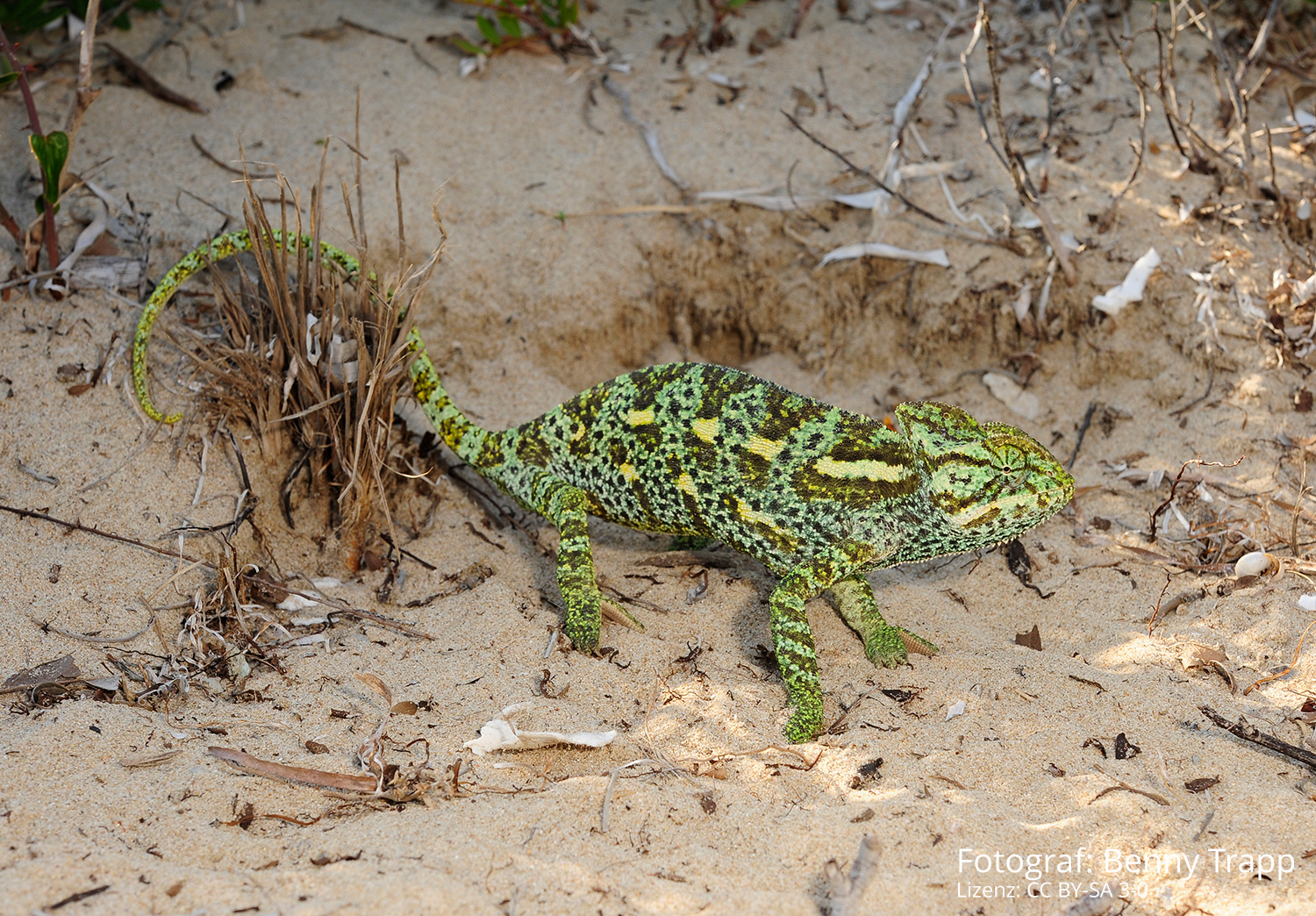
Chamaeleo africanus found in Greece outside Pylos

Chamaeleo africanus found in Greece outside Pylos

Verbreitung Science

It has long been known that Chamaeleo africanus occurs in the lagoon of Gialova, in the Pylos region (Greece). It differs not only visually but also genetically from Chamaeleo chameleon, which is relatively widespread in southern Europe. There have been sporadic reports of other occurrences of Chamaeleo africanus in Greece, but until now there has been no scientific evidence of the species in areas other than Pylos.

Scientists have now identified a second population of the species. They found at least seven individuals of the species about 130 km north of the Gialova lagoon on the Peloponnese. The chameleons live in a Natura 2000 area called Limnothalassa Kalogrias /Dasos Strogylias Kai Elos Lamias. A young animal was sampled via cheek swab to genetically confirm the species Chamaeleo africanus.

Genetic evidence for the presence of Chamaeleo africanus in Greece outside the Pylos region
Erika Lego, Maria Koutsokali, Michael Valachas
Conservation Genetics Resourecs 18(5), 2026
DOI: 0.1007/s12686-026-01409-w
Free preview of the article

Photo: Chamaeleo africanus, photographed by Benny Trapp, CC BY-SA 3.0

New distribution data of Rieppeleon brachyurus in Mozambique

New distribution data of Rieppeleon brachyurus in Mozambique

Beobachtungen Verbreitung Science

Rieppeleon brachyurus is a small stump-tailed chameleon species, first described at the end of the 19th century from the Shire Highlands south of Lake Malawi. The species has since been found in Malawi, Tanzania and Mozambique. In Mozambique, it was previously known from rainforests and gallery forests, known as miombo forests. Miombo forests are very open dry forests with sparse grass cover, giving them a savannah-like appearance (hence the term ‘forest savannah’). The Zambezi River, which runs across Mozambique, was previously considered the natural boundary for the occurrence of Rieppeleon brachyurus.

Herpetologists have now discovered that the species also occurs south of the river. They found two juvenile individuals and two adult females of the species in Coutada 11, a 5000 km² hunting concession in the heart of Mozambique. The animals were found there in a sand forest, a rare type of tropical forest on sand dunes, right next to a shallow wetland. These observations extend the previously known range of the species by about 250 km further south.

The authors also report two further new locations where Rieppeleon brachyurus has been found, in Taratibu and Montepuez Rubi Mining Concession, both of which are located north of the Zambezi River. In both observations, the ground chameleons were found in miombo forest at altitudes between 250 and 400 m.

Rieppeleon brachyurus (Günther, 1893) Beardless Pygmy Chameleon First records south of the Zambezi River
W. Conradie, D. Botma, C. Nanvonnamuquitxo
African Herp News 88, 2025: 28-33
DOI: not available
Free download of the article

Photo: Juvenile Rieppeleon brachyurus in Mozambique, photographed by Delport Botma, from the above-mentioned publication