
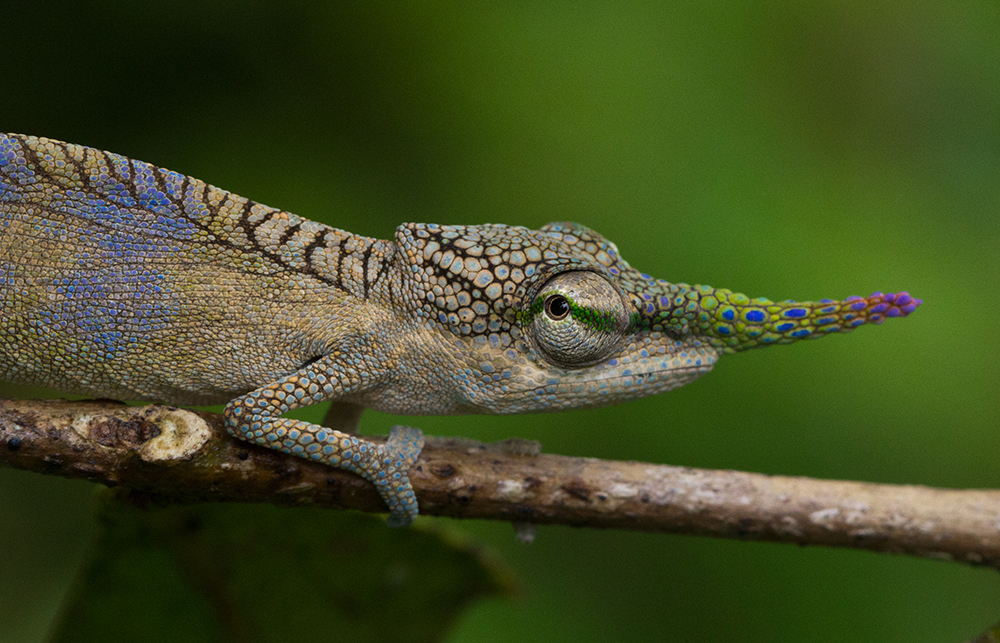
A study on the distribution and habitats of various chameleon species was recently carried out in Vohimana, Madagascar. The Vohimana Reserve is situated at an altitude of between 800 and 1,000 metres in the island’s eastern highlands. It covers an area of 15 km², comprising 6 km² of primary rainforest, 8.5 km² of secondary vegetation and just over 1 km² of eucalyptus forest. The rainy season runs from October to May and is characterised primarily by increased rainfall, although the dry season also sees a relatively high amount of rainfall.
Over a total of 195 days – 158 of which were during the rainy season and 37 during the dry season – chameleons were searched for with the naked eye within the reserve along the existing paths. In the process, various individuals covered a total distance of 350 km. 80% of the data collection took place at night, with only 20% during the day. Every chameleon found was photographed, and the temperature, relative humidity and UV index were measured at the site of discovery. The data was then statistically analysed.
A total of 577 chameleons were recorded during the entire study period. These included a single Calumma brevicorne, seven Furcifer willsii, two Brookesia ramanantsoai, seven Brookesia thieli, 143 Brookesia superciliaris and Brookesia therezieni (grouped together), 53 Calumma furcifer, 207 small Calumma of nasutum-complex (grouped together due to difficulties in identifying them solely on the basis of external characteristics), 24 Calumma parsonii, 118 Calumma pinocchio, 11 Furcifer bifidus and 4 Furcifer pardalis.
The most common species in Vohimana were Brookesia superciliaris and Brookesia therezieni, small chameleons of the Calumma nasutum complex, and Calumma pinocchio. Brookesia superciliaris, Brookesia therezieni and Calumma furcifer were rarely found outside the primary forest. Calumma pinocchio was most commonly found in a small remnant of primary forest in the north-east of the reserve. The scientists repeatedly found all other species in both primary forest and secondary vegetation. Calumma parsonii, Calumma pinocchio and species of the nasutum complex were frequently found along forest edges.
Temperatures at the study sites averaged 24.2°C during the wet season, compared with an average of 18.3°C during the dry season. During the wet season, more chameleons were observed during the day in locations with a higher UV index (averaging 0.5). Relative humidity in Vohimana was high throughout the year, averaging over 90% for both seasons. The differences between the various chameleon species were rather small in terms of microclimates. Individuals of Furcifer pardalis and Furcifer willsii were found at the highest recorded daytime and night-time temperatures (29°C and 27.5°C during the day, 25°C at night). These two species were also basking at the highest average UVI recorded (8.2 for Furcifer pardalis and 7.7 for Furcifer willsii). The UV indices for all other species were, on average, significantly lower.
Diversity, distribution, and microclimatic conditions experienced by the chameleons of the Vohimana Reserve, Madagascar
Olivier Marquis, Marc Gansuana, Sébastian Métrailler
Herpetological Conservation and Biology 21(1), 2026: 101-119
DOI: not available
Free article download
Photo: Calumma pinocchio in the Vohimana Reserve, photographed by Alex Negro