
The optic nerve of chameleons is highly specialised

The optic nerve of chameleons is highly specialised

Tiermedizin Science

It has long been known that chameleons have very special eyes. What is particularly fascinating is that they can move their eyes independently of each other in almost any direction. A team of US scientists has now discovered that the optic nerve in chameleons is also extremely specialised.

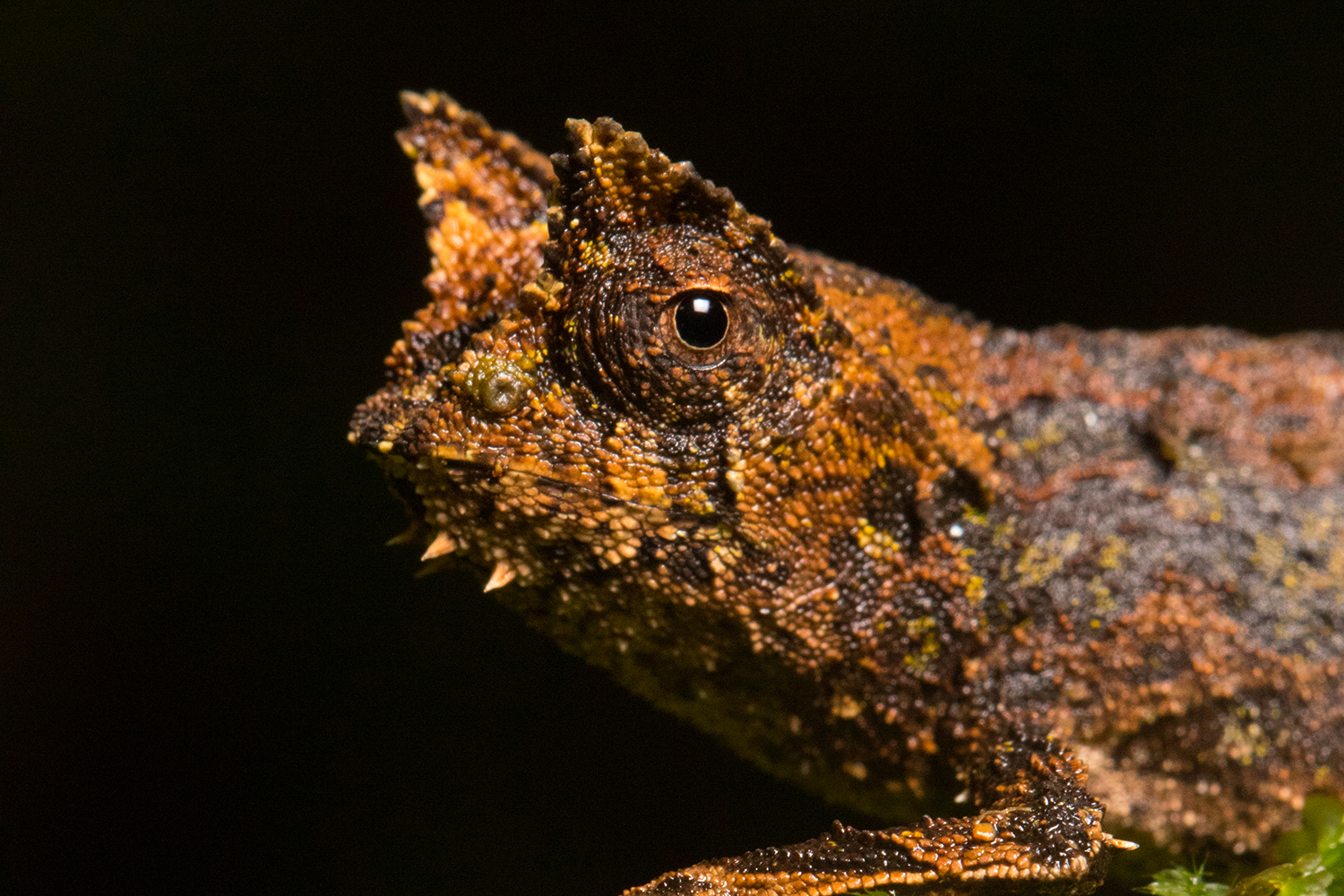
They examined adult reptiles of 34 different species using CT models. Brookesia superciliaris, Rieppeleon brevicaudatus and Chamaeleo calyptratus represented the chameleon family. They found that in all three chameleon species, the optic nerve was extremely curled. This anatomical feature means that the optic nerve in chameleons is much longer than would be necessary for an eye looking straight ahead. It probably enables the animals to have extremely mobile eyes without compromising their vision. Put simply, the optic nerve functions a bit like a flexi leash: when the eye moves sharply, part of the optic nerve is ‘unrolled’. When the eye moves back, the optic nerve curls back to its original position without overstretching the nerve fibres.

A new twist in the evolution of chameleons uncovers an extremely specialized optic nerve morphology
Emily Collins, Aaron M. Bauer, Raul E. Diaz Junior, Alexandra Herrera-Martínez, Esteban Lavilla, Edward L. Stanley, Monte L. Thies, Juan D. Daza
Scientific Reports 15, 2025: 38270.
DOI: 10.1038/s41598-025-20357-3
Download the article for free

Photo: Portrait of Brookesia superciliaris, photographed by Alex Negro

The panoramic view

The panoramic view

Internationaler Chamäleontag

Chameleons are known for being able to move their eyes independently of each other. They protrude far from the skull and are completely covered with scaly eyelid skin except for a narrow iris and the pupil. This anatomical peculiarity gives chameleons the effect of a pinhole camera in both eyes, allowing them to see much more clearly. Chameleons can see up to one kilometre (!) away. The focusing speed is around 60 dioptres per second – four times what a human is capable of. Chameleons mainly see colours and little contrast, which makes them practically blind at night. Small oil droplets that accumulate on the cones also provide chameleons with a kind of “built-in sunglasses”. But chameleon eyes can do much more! The chameleon has an incredibly large field of vision of 90° vertically and 180° horizontally. The total field of vision is a fantastic 342°! Only over the back directly behind the head is there a blind spot of 18°, in which a chameleon can see nothing. By comparison, humans only have a paltry 189° field of vision. Chameleons also have very special lenses. The chameleon’s range of accommodation is an incredible 45 dioptres. Humans can accommodate just 15 dioptres when they are young, and even less when they are older. However, it is not known whether the chameleon’s visual acuity decreases with age.

#show your colours #internationalchameleonday #chameleonday #chameleondayMay9 #agchamaeleons

Foto: Auge eines Pantherchamäleons, fotografiert von Brice Miller, Creative Commons Attribution-Share Alike 4.0 International