
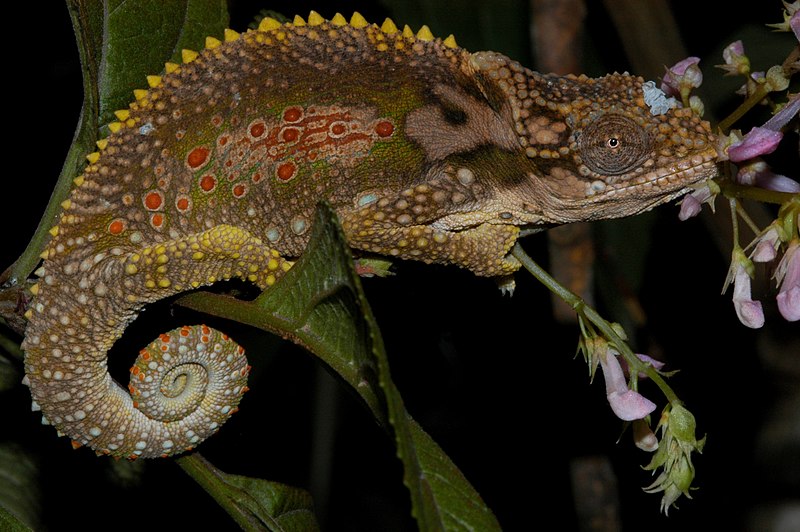
The diet of dwarf chameleons in different habitats
Zoologists at the University of Johannesburg have recently investigated which prey items are consumed by dwarf chameleons in different habitats. To this end, they collected chameleons of the two species Bradypodion damaranum and Bradypodion ventrale in the Western Cape and Eastern Cape provinces of South Africa. The animals were kept in captivity for a maximum of 24 hours until faeces were produced. A total of 22 faecal samples were obtained, eleven from each species. Of these, six faecal samples from each species came from natural habitats and five from peri-urban environments.
The various faecal samples were analysed using DNA techniques. Subsequently, statistical analyses were carried out to determine which different food components had been found in the various populations of dwarf chameleons.
41 different species of arthropods, as well as one species of worm, presumably from a dung beetle, were found in the faeces. The blowfly Stomorhina lunata was the most common prey species, closely followed by a tree bug (Glypsus conspicuus) and a predatory bug (Rhynocoris kumari). Both Bradypodion damaranum and Bradypodion ventrale fed mainly on beetles, dipterans, butterflies and leafhoppers.
To the scientists’ surprise, it turned out that the diet of the two chameleon species in different habitats hardly differed from one another. Overall, differences were observed primarily at the species level rather than the order level. Populations in natural habitats fed, among other things, on slightly more flies and arachnids, whilst those in urban environments relied more on butterflies. For the first time, lace-wings, thrips and caddiesflies were documented as prey for Bradypodion.
Peri-urban sustenance: unexpectedly broad overlap in dwarf chameleon (Bradypodion) diets between natural and transformed habitats
Matthew G. Adair, Peter R. Teske, Krystal A. Tolley
Urban Ecosystems 2026, 29:92.
DOI: not available
Download the article for free