
Comparisons between dwarf chameleons in South Africa
South African scientists have recently been investigating whether three closely related Bradypodion lineages in the Eastern Cape Province of South Africa have evolved differently due to their different habitats or whether other causes are responsible.
The scientists are studying the two species Bradypodion ventrale from the Nama Karoo and Bradypodion taeniabronchium from the Elandsberg and Tsitsikamma Mountains and the fynbos of Thyspunt and Honeyville, as well as a population of dwarf chameleons from the fynbos of the Groot Winterhoek Mountains that has not yet been described as a separate species. The latter are often referred to as Bradypodion sp. ‘groendal’ because they occur in the Groendal Nature Reserve, among other places.
At night, chameleons were searched for using flashlights and the naked eye. Adult chameleons with a body length (SVL) of more than 36 mm were taken away overnight to be released back at the site where they were found the next day. All animals were measured accurately. Tissue samples were taken from the tip of the tail. In addition, the thickness and height of the branches on which the chameleons were found were measured. Further branch thicknesses were recorded along three 100 m long transects in each population. The data collected was statistically evaluated and the tissue samples were genetically examined.
A total of 232 chameleons were sampled for the study. Bradypodion taeniabronchium had significantly smaller head features than the other two species, but larger hands and feet. Bradypodion ventrale was larger overall than the others, but had longer limbs. Bradypodion taeniabronchium used the widest branches (average diameter 2.83 mm), but also the lowest (average height 82 cm above the ground). Bradypodion ventrale, on the other hand, used the thinnest branches (average diameter 1.52 mm), but the highest (average just under 93 cm above the ground).
The researchers found that all three populations of dwarf chameleons showed increased external similarity (convergence) when they occurred in the same habitats and less similarity (divergence) when they occurred in different habitats. The dwarf chameleons preferred certain branch thicknesses depending on their population, even though other branches were also available in their habitat. Finally, the authors point out that all the evidence available so far suggests that the as yet undescribed dwarf chameleons of the Groendal Nature Reserve represent a separate species.
Ecological factors promote convergent evolution and ecological speciation in dwarf chameleons (Bradypodion)
Krystal A. Tolley, Devon C. Main, Keith M. Dube, Bettine Jansen van Vuuren, Jessica M. da Silva
Zoosystematics and Evolution 101(3) 2025: 1227-1247
DOI: 10.3897/zse.101.151926
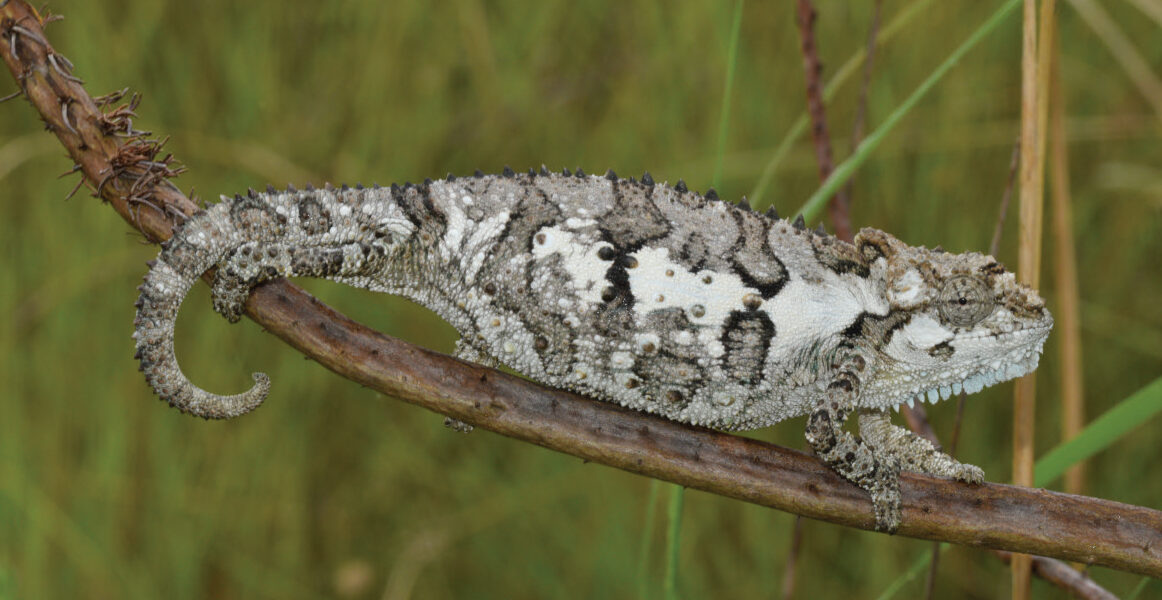
Photo: Bradypodion ventrale, from the publication cited
Science