
Presentation in Munster about Madagascar’s chameleons

Presentation in Munster about Madagascar’s chameleons

Reiseberichte Live lectures Science

The DGHT Münster is also starting the new year with lots of chameleons. On Friday, 16 January 2026, Philip-Sebastian Gehring will give a detailed lecture on Madagascar and its many chameleons.

Madagascar is home to almost half of all known chameleon species worldwide, all of which are found exclusively on this island. This extraordinary diversity makes Madagascar’s chameleons an important subject of scientific research, as they offer unique insights into the mechanisms of evolution and adaptation. Over the past 20 years, numerous studies and new discoveries have significantly expanded our understanding of species diversity and evolutionary processes within this group of reptiles. In particular, the identification and description of new species and the investigation of their genetic differences have provided key insights into the origin and differentiation of species. The lecture will provide a comprehensive overview of this research and clearly present the current state of research on Madagascan chameleons.

Dr. Philip-Sebastian Gehring Evolution and diversity of Madagascar’s chameleons – Latest research findings [German]
DGHT city group Munster
Zoo school of Allwetterzoo Munster
Sentruper Straße 315
48161 Münster
Lecture begins at 7 p.m., doors open at 6:30 p.m. via the main entrance of the zoo.

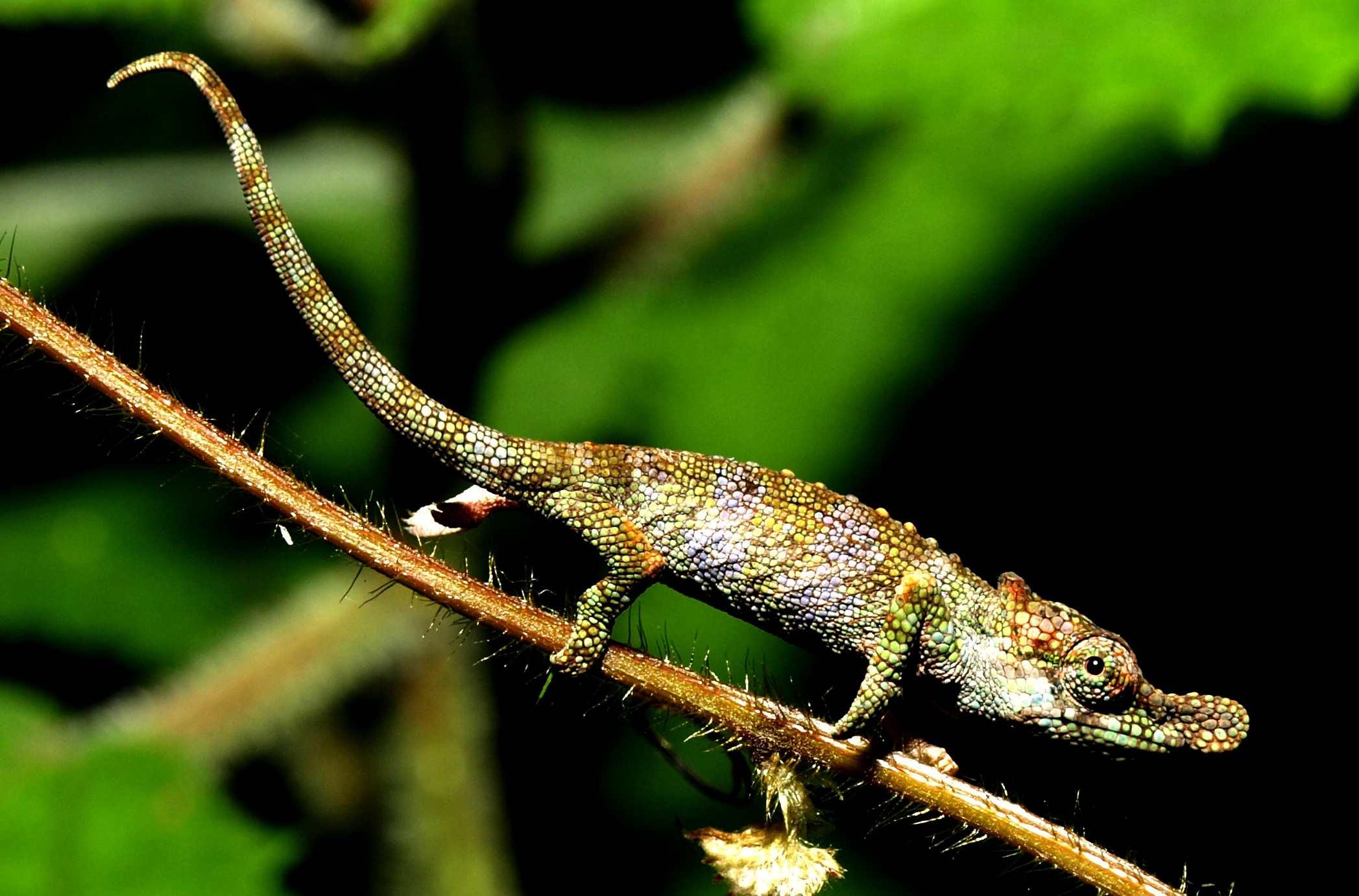
Photos: small Calumma species in Madagascar, photographed by Philip-Sebastian Gehring

Cryptic species

Cryptic species

Internationaler Chamäleontag

The chameleon world still has a lot to offer. Countless species have yet to be described – and sometimes species are hidden in places where none were expected. The increasing possibilities of genetics are providing taxonomists with ever more specialised species terms. And many new species!

Small chameleons can be found scattered all over the east coast of Madagascar, which could be attributed to Calumma radamanus or Calumma nasutum in purely visual terms, but whose populations are locally limited. Many of these populations have not yet been genetically analysed. This means that one or two new chameleon species are certainly still hiding here. On the African mainland, Chamaeleo dilepis could still be hiding some subspecies. It occurs in Tanzania and Rwanda, but also between Angola and Congo and from South Africa to Botswana, Zambia and Namibia. And in Tanzania, six new Rhampholeon species were just described a year and a half ago, which were identified within known species complexes using genetics. These are just three examples of species complexes that still contain hidden chameleon species – many more are still awaiting further research.

#showyourcolours #internationalchameleonday #chameleonday #chameleondayMay9 #agchamaeleons

Picture: Calumma cf. radamanus in Marojejy, north Madagascar, photographed by Alex Laube

Sechs neue Rhampholeon-Arten in Tansania


Versteckte Arten innerhalb der Gattung Chamaeleo