
Chameleons in St. Luce (Madagascar)

Chameleons in St. Luce (Madagascar)

Verbreitung Science

The St. Luce reserve is located in the south-east of Madagascar, just 34 km north of the city of Tolagnaro (Fort Dauphin). The protected area includes beaches and rocky cliffs on the coast of the Indian Ocean, lowland rainforest, marshland, savannah-like plains, rivers and lagoons. The remaining rainforest is broken up into many small fragments. There is also a very large rare earth mining project in the area. 12 of the 17 forest fragments of St. Luce are affected by the mining work. A group of scientists has now studied the herpetofauna of the area in more detail.

Over a period of two years, reptiles and amphibians were searched for and captured in St. Luce. The searches were carried out with the naked eye along existing transects. In addition, ground traps were used for two weeks along four 100 m long lines. Five artificial shelters and five corrugated sheets were laid out at a total of 12 locations to check for animals after a certain period of time. Samples of tail tips and toes were taken and measurements taken, after which the animals were released back to their original locations. The species were identified by genetic analysis.

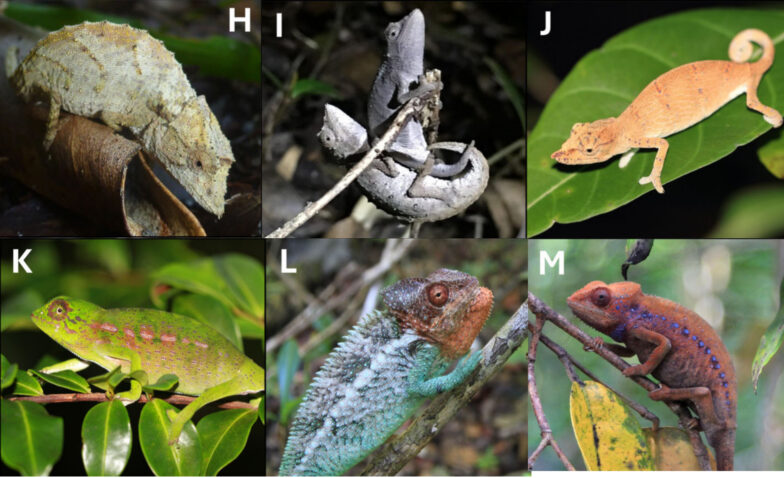
Of 17 rainforest fragments in St. Luce, the scientists found only one intact and another intact but heavily fragmented. All other forest fragments were found with clear signs of habitat destruction. A total of 22 amphibian and 54 reptile species were found. Four species of chameleons were among the reptiles: Palleon sp. aff. Nasus, Calumma tjiasmantoi, Furcifer major and Furcifer verrucosus. All four chameleon species occurred exclusively in the remaining intact or intact areas of the Angalavinaky, Ambandrika and Andranangy/Amboronteny/Agnalaro forests. In the forests already destroyed by the mine, no chameleons were found at all. Of the 76 amphibian and reptile species found, 13 were candidate species, which are presumably undescribed new species.

The authors point out that, according to the present study, the diversity of the herpetofauna in St. Luce is significantly greater than previously assumed. They suggest that several forest fragments should be included in the “Mining Avoidance Zones”, i.e. areas where rare earths should not be searched for, and that the protection status should be increased.

A littoral treasure trove: a comprehensive assessment of the herpetofauna of Sainte Luce, southeastern Madagascar
Sam Hyde Roberts, Marco Sannolo, Hoby Tsimijaly Longosoa, Ryan Clark, Leo Jhaveri, Gonçalo M. Rosa, Walter Cocca, Franco Andreone, Angelica Crottini
Systematics and Biodiversity 23(1): 2513472
DOI: 10.1080/14772000.2025.2513472

Photos: Chameleons found in St. Luce from the aforementioned publication
Karyograms of five Malagasy chameleons described

Karyograms of five Malagasy chameleons described

Science

It has been known for many years that the sex of chameleons is genetically determined. However, the karyograms of many species, i.e. the chromosome characteristics, are not yet known for all species. Italian scientists have now analysed the karyograms of five Madagascan chameleon species.

Existing, preserved chameleons were used for the study. One female each of the species Furcifer balteatus, Furcifer petteri, Furcifer major and Furcifer minor were sampled. One male and one female Brookesia superciliaris were also used for the study. All samples were subjected to DNA barcoding analysis using the mitochondrial gene fragment COI as a marker. The extracted DNA was amplified by PCR and then sequenced to create a karyogram for each animal.

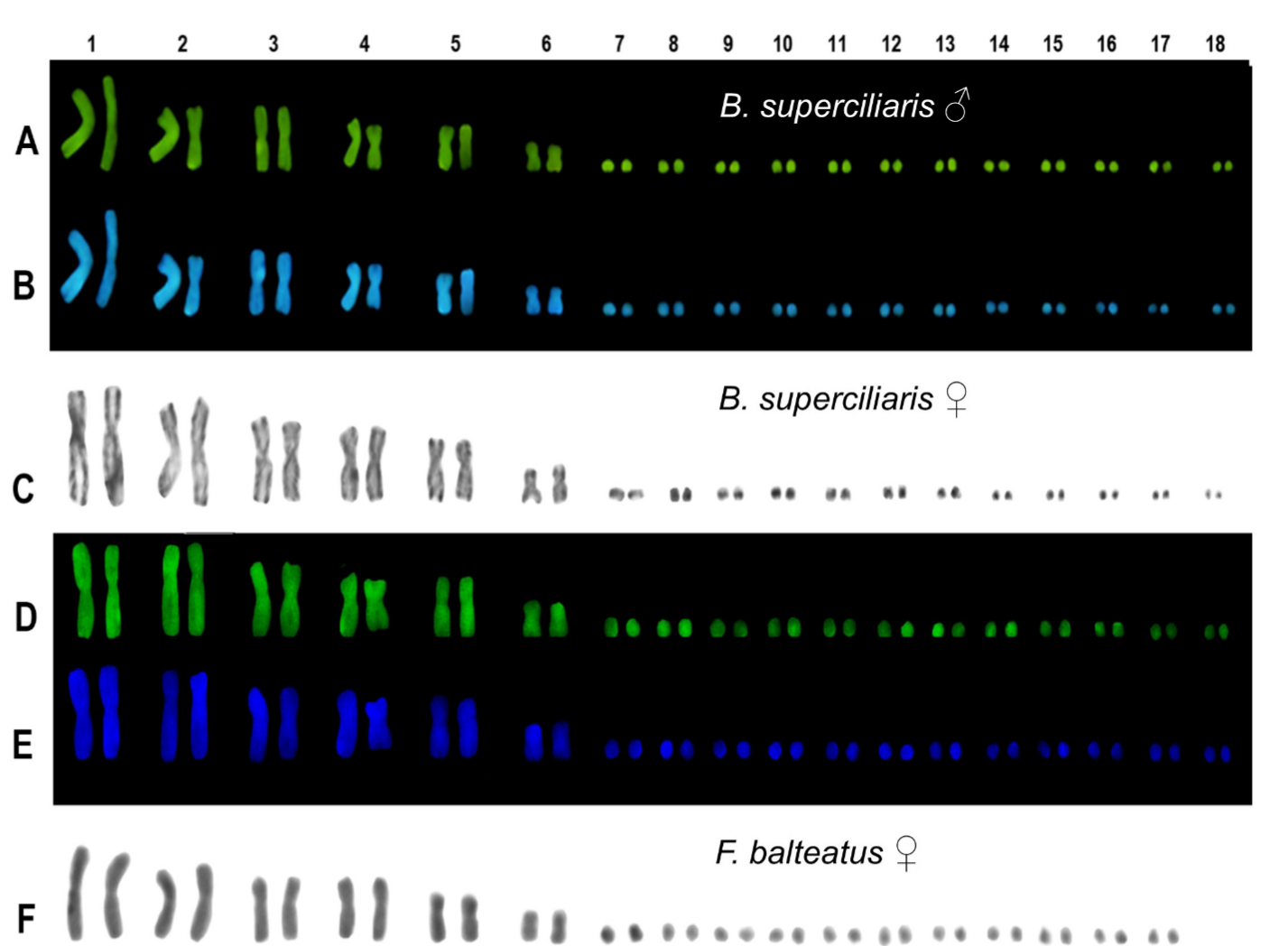
The karyogram of Brookesia superciliaris is 2 n = 34 for both sexes. Of the 34 chromosomes, six are macrochromosome pairs and eleven are microchromosome pairs. All macrochromosomes are metacentric. Morphologically, the chromosomes do not differ from each other, so that it remains unclear which could be the sex chromosomes.

Furcifer balteatus has a very special karyogram, which actually fits better with those of the genera Brookesia and Palleon than with the genus Furcifer. The karyogram is 2n = 34, which is the highest number of chromosomes among the chameleons. Of the 34 chromosomes, six are macrochromosome pairs and eleven are microchromosome pairs. The former are all metacentric. There are no morphological differences between the chromosome pairs, so that the sex chromosome has not yet been determined.

The karyogram of Furcifer major is 2n = 24. Nine of the chromosome pairs are macrochromosome pairs and three are microchromosome pairs. Seven of the macrochromosome pairs are metacentric, only pairs two and three are submetacentric. The eleventh chromosome pair, a microchromosome pair, codes for the sex chromosome W.

Furcifer minor has a karyogram of 2n = 22 chromosomes. Of these, eight pairs are macrochromosome pairs and three are microchromosome pairs. Among the macrochromosomes, the first five pairs are metacentric, while the remaining three pairs are acrocentric. A portion of the sixth pair of chromosomes was almost completely heterochromatic and probably represents the sex chromosome W.

The karyogram of Furcifer petteri is also 2n = 22, of which eight pairs of chromosomes are macrochromosomes and three microchromosomes. Seven pairs of macrochromosomes are metacentric, only the fifth pair is submetacentric. The sex chromosome W is part of the seventh pair of macrochromosomes.

All newly described karyograms are deposited in GenBank under the number PQ272538-4. In this study, the genus Furcifer was also found to have the highest diversity in the karyograms. It also appears to be the only genus among all vertebrates that shows all variants of sex chromosome diversification.

New insights on Chromosome Diversification in Malagasy Chameleons
Marcello Mezzasalma, Gaetano Odierna, Rachele Macirella, Elvira Brunelli
Animals 2024, 14: 2818
DOI: 10.3390/ani14192818

Graphic: Karyograms of Brookesia superciliaris and Furcifer balteatus from the above-mentioned study