Chameleons in St. Luce (Madagascar)

Chameleons in St. Luce (Madagascar)

Verbreitung Science

The St. Luce reserve is located in the south-east of Madagascar, just 34 km north of the city of Tolagnaro (Fort Dauphin). The protected area includes beaches and rocky cliffs on the coast of the Indian Ocean, lowland rainforest, marshland, savannah-like plains, rivers and lagoons. The remaining rainforest is broken up into many small fragments. There is also a very large rare earth mining project in the area. 12 of the 17 forest fragments of St. Luce are affected by the mining work. A group of scientists has now studied the herpetofauna of the area in more detail.

Over a period of two years, reptiles and amphibians were searched for and captured in St. Luce. The searches were carried out with the naked eye along existing transects. In addition, ground traps were used for two weeks along four 100 m long lines. Five artificial shelters and five corrugated sheets were laid out at a total of 12 locations to check for animals after a certain period of time. Samples of tail tips and toes were taken and measurements taken, after which the animals were released back to their original locations. The species were identified by genetic analysis.

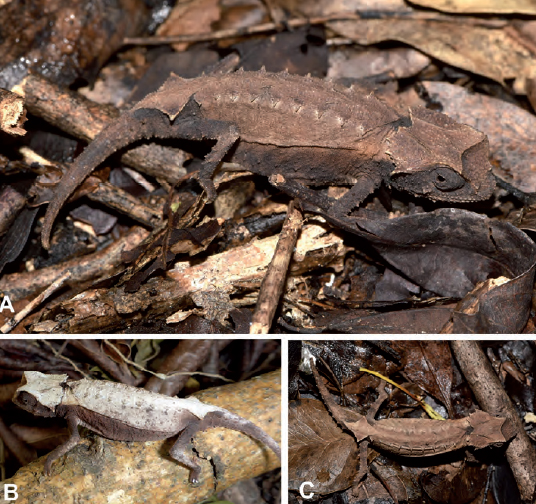
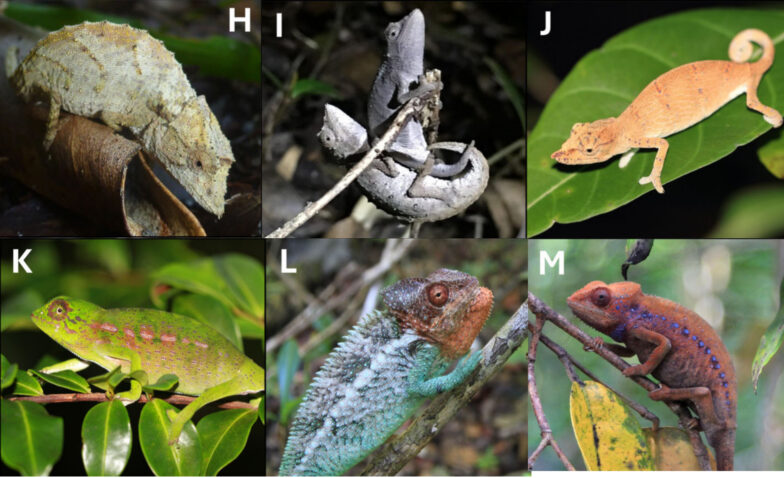
Of 17 rainforest fragments in St. Luce, the scientists found only one intact and another intact but heavily fragmented. All other forest fragments were found with clear signs of habitat destruction. A total of 22 amphibian and 54 reptile species were found. Four species of chameleons were among the reptiles: Palleon sp. aff. Nasus, Calumma tjiasmantoi, Furcifer major and Furcifer verrucosus. All four chameleon species occurred exclusively in the remaining intact or intact areas of the Angalavinaky, Ambandrika and Andranangy/Amboronteny/Agnalaro forests. In the forests already destroyed by the mine, no chameleons were found at all. Of the 76 amphibian and reptile species found, 13 were candidate species, which are presumably undescribed new species.

The authors point out that, according to the present study, the diversity of the herpetofauna in St. Luce is significantly greater than previously assumed. They suggest that several forest fragments should be included in the “Mining Avoidance Zones”, i.e. areas where rare earths should not be searched for, and that the protection status should be increased.

A littoral treasure trove: a comprehensive assessment of the herpetofauna of Sainte Luce, southeastern Madagascar
Sam Hyde Roberts, Marco Sannolo, Hoby Tsimijaly Longosoa, Ryan Clark, Leo Jhaveri, Gonçalo M. Rosa, Walter Cocca, Franco Andreone, Angelica Crottini
Systematics and Biodiversity 23(1): 2513472
DOI: 10.1080/14772000.2025.2513472

Photos: Chameleons found in St. Luce from the aforementioned publication

Cryptic species

Cryptic species

Internationaler Chamäleontag

The chameleon world still has a lot to offer. Countless species have yet to be described – and sometimes species are hidden in places where none were expected. The increasing possibilities of genetics are providing taxonomists with ever more specialised species terms. And many new species!

Small chameleons can be found scattered all over the east coast of Madagascar, which could be attributed to Calumma radamanus or Calumma nasutum in purely visual terms, but whose populations are locally limited. Many of these populations have not yet been genetically analysed. This means that one or two new chameleon species are certainly still hiding here. On the African mainland, Chamaeleo dilepis could still be hiding some subspecies. It occurs in Tanzania and Rwanda, but also between Angola and Congo and from South Africa to Botswana, Zambia and Namibia. And in Tanzania, six new Rhampholeon species were just described a year and a half ago, which were identified within known species complexes using genetics. These are just three examples of species complexes that still contain hidden chameleon species – many more are still awaiting further research.

#showyourcolours #internationalchameleonday #chameleonday #chameleondayMay9 #agchamaeleons

Picture: Calumma cf. radamanus in Marojejy, north Madagascar, photographed by Alex Laube

Sechs neue Rhampholeon-Arten in Tansania


Versteckte Arten innerhalb der Gattung Chamaeleo

Unexpected genetic diversity in leaf chameleons in western Madagascar

Unexpected genetic diversity in leaf chameleons in western Madagascar

Science

Until now, it was thought that the earth chameleon Brookesia bonsi occurs exclusively in the Tsingy of Namoroka in western Madagascar. German and Malagasy researchers have now discovered that very close relatives of the species live a good 150 km further north, not far from the coastal town of Mahajanga. The earth chameleons from a forest near Antsanitia look more like Brookesia decaryi on the outside, but genetically they are more closely related to Brookesia bonsi. In contrast, the true Brookesia decaryi from Ankarafantsika, 80 km east of Mahajanga, seems to be exclusively restricted to this occurrence and not more widespread, as originally assumed. In the same studies, the scientists found that another population of leaf chameleons from the UNESCO World Heritage Site Tsingy de Bemaraha is also closely related to Brookesia bonsi. The leaf chameleons of the population found there had previously been assigned to Brookesia brygooi on a purely visual basis.

Further work is now necessary to clarify the exact genetic identity of Brookesia aff. bonsi. Are they separate species or merely locally isolated populations of Brookesia bonsi? One thing, however, is already certain: the habitat near Mahajanga should urgently be placed under protection. The leaf chameleons must be protected so that they can be studied further. According to current data, they could already be critically endangered (IUCN). And further research could still be very exciting!

New records of threatened leaf chameleons highlight unexpected genetic diversity of the Brookesia decaryi / B. bonsi species complex in western Madagascar
Frank Glaw, Njaratiana A. Raharinoro, Rojo N. Ravelojaona, David Prötzel und Miguel Vences
Der Zoologische Garten 90, 2022 (1)
DOI 10.53188/zg003