Chameleons in Namoroka (Madagascar)

Chameleons in Namoroka (Madagascar)

Verbreitung Science

The Tsingy de Namoroka are located in the hot west of Madagascar. They consist of needle-sharp karst rock with caves beneath and are surrounded by fragments of dry forest. Although the Tsingy are now a national park, access has so far been extremely difficult due to a complete lack of infrastructure and paths, and is even impossible during the rainy season.

The scientists carried out survey studies at three different locations within the national park. To do this, they used three 1,000 to 1,500 m transect lines at each site, along with pitfall traps. In addition, specific habitats such as caves were specifically targeted.

A total of 57 animal species were recorded in Namoroka, 41 of which were reptiles. Brookesia brygooi, Furcifer angeli and Furcifer oustaleti were recorded at all three sites surveyed. Brookesia bonsi, which is endemic to Namoroka, was found at only one site. This is an area situated at an altitude of 87 m, with trees ranging from 6 to 15 m in height and a relatively open canopy. The area is characterised by dense, virtually impenetrable undergrowth, particularly in the damp, rocky gorges between the Tsingy.

The scientists point out that slash-and-burn farming and the resulting uncontrollable bushfires continue to pose a major risk to the animals’ habitats in Namoroka. Logging, as well as the harvesting of wild honey, wild root tubers and medicinal plants, also ensures that the national park’s habitats are disturbed. Zebus are also driven into the national park to graze. Effective protection of the area is very difficult due to its remote location and the high levels of poverty among the local population.

Aperçu des amphibiens et des reptiles du Parc National de Namoroka: Diversité biologique, intérêt biogéographique et représentativité en matière de conservation
Hajaniaina Rasoloarison, Bernard Ranriamahatantsoa, Nirhy Rabibisoa, Christopher J. Raxworthy
Malagasy Nature 2026, 20: 30-46.
DOI: not available
Free article download

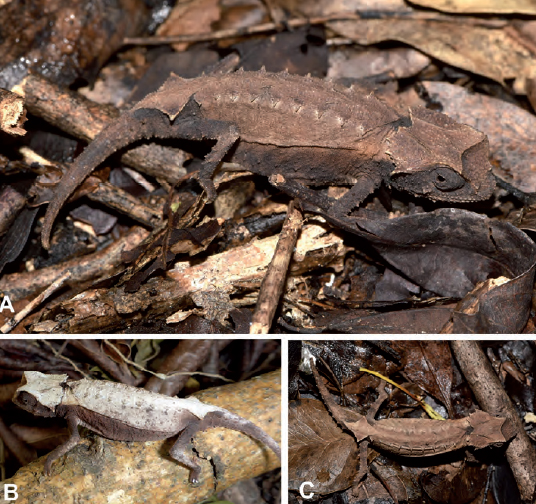
Picture: Brookesia bonsi in Namoroka, from the afore mentioned publication

Comparison of pelvic girdles in chameleons

Comparison of pelvic girdles in chameleons

Science

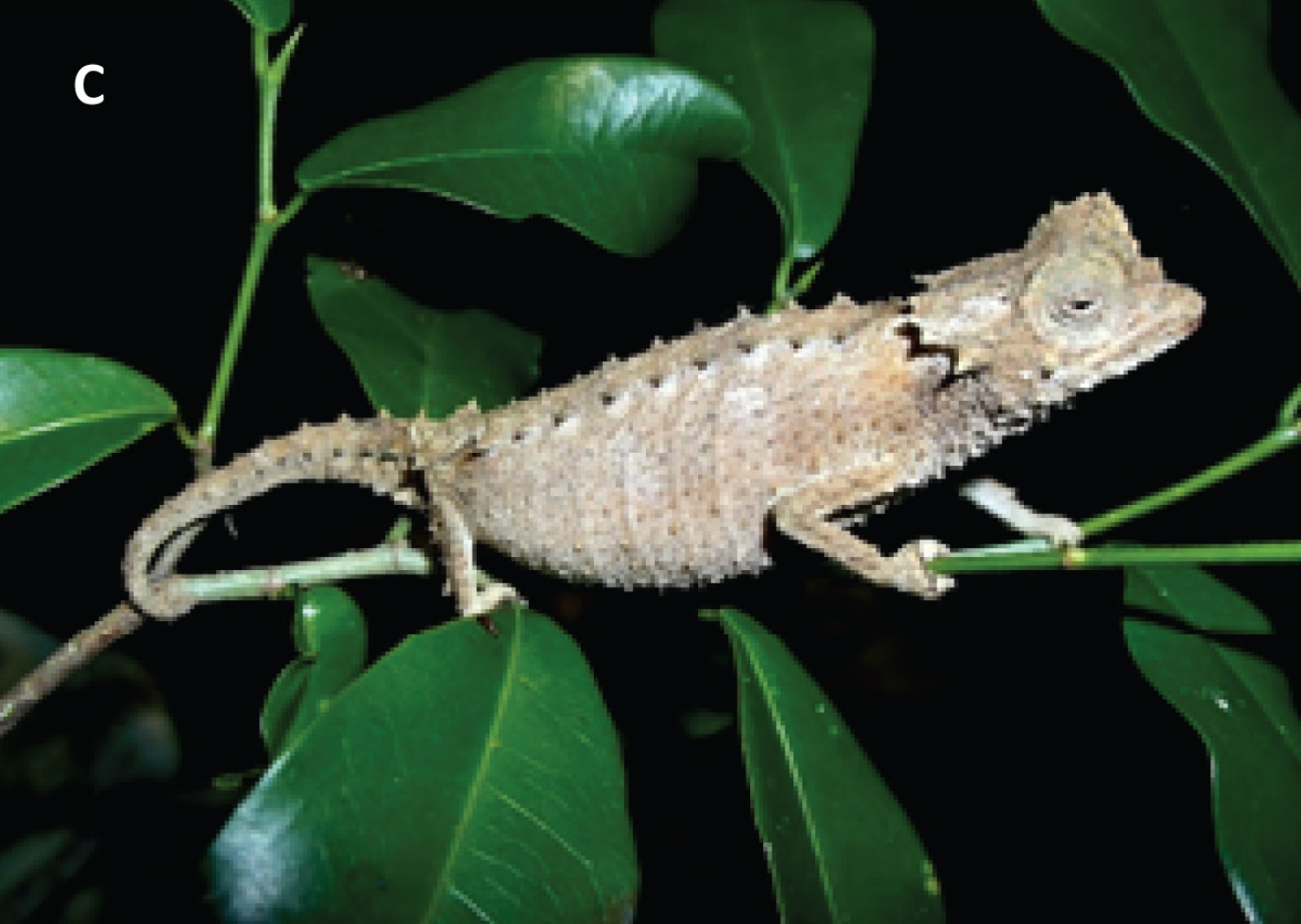
The anatomy of chameleons is strongly adapted to their way of life. Tree-dwellers differ in many aspects from ground-dwellers. The pelvic girdle has been little studied anatomically in chameleons so far – a publication from the USA now deals with it in more detail.

For the study, the pelvic girdles of 22 chameleons were isolated from existing microcomputer tomography scans and displayed in 3D. These were measured to 16 different lengths and angles using software. Archaius tigris, Bradypodion damaranum, Calumma gallus, Calumma parsonii parsonii, Chamaeleo zeylanicus, Furcifer balteatus, Kinyongia matschiei, Kinyongia tavetana, Nadzikambia mlanjense and Trioceros quadricornis gracilior were assigned to tree dwellers. Brookesia brygooi, Chamaeleo namaquensis, Palleon nasus nasus, Rhampholeon temporalis and Rieppeleon brachyurus were attributed to ground-dwelling species. The species Bradypodion occidentale, Brookesia ebenaui, Chamaeleo anchietae, Furcifer campani, Rhampholeon spinosus, Rieppeleon kerstenii kerstenii and Trioceros goetzei goetzei were classified as semiarboreal. Mainly males were examined.

As expected, the evaluation showed that tree-dwelling chameleons had narrower, shorter girdles than ground-dwelling ones. The narrower pelvic girdle makes it easier to hide behind branches and flatten the body to the maximum. It also ensures that the body’s centre of gravity is closer to the branch and thus increases stability when climbing. Ground-dwelling chameleons, on the other hand, had larger and wider pelvic girdles. These allow them to step more quickly and provide greater stability when walking on ground surfaces.

How phylogeny and arboreality affect pelvic girdle anatomy of chameleons
Dakota J. John
Honors Thesis 299, University of South Dakota, 2023
DOI: none


Unexpected genetic diversity in leaf chameleons in western Madagascar

Unexpected genetic diversity in leaf chameleons in western Madagascar

Science

Until now, it was thought that the earth chameleon Brookesia bonsi occurs exclusively in the Tsingy of Namoroka in western Madagascar. German and Malagasy researchers have now discovered that very close relatives of the species live a good 150 km further north, not far from the coastal town of Mahajanga. The earth chameleons from a forest near Antsanitia look more like Brookesia decaryi on the outside, but genetically they are more closely related to Brookesia bonsi. In contrast, the true Brookesia decaryi from Ankarafantsika, 80 km east of Mahajanga, seems to be exclusively restricted to this occurrence and not more widespread, as originally assumed. In the same studies, the scientists found that another population of leaf chameleons from the UNESCO World Heritage Site Tsingy de Bemaraha is also closely related to Brookesia bonsi. The leaf chameleons of the population found there had previously been assigned to Brookesia brygooi on a purely visual basis.

Further work is now necessary to clarify the exact genetic identity of Brookesia aff. bonsi. Are they separate species or merely locally isolated populations of Brookesia bonsi? One thing, however, is already certain: the habitat near Mahajanga should urgently be placed under protection. The leaf chameleons must be protected so that they can be studied further. According to current data, they could already be critically endangered (IUCN). And further research could still be very exciting!

New records of threatened leaf chameleons highlight unexpected genetic diversity of the Brookesia decaryi / B. bonsi species complex in western Madagascar
Frank Glaw, Njaratiana A. Raharinoro, Rojo N. Ravelojaona, David Prötzel und Miguel Vences
Der Zoologische Garten 90, 2022 (1)
DOI 10.53188/zg003