
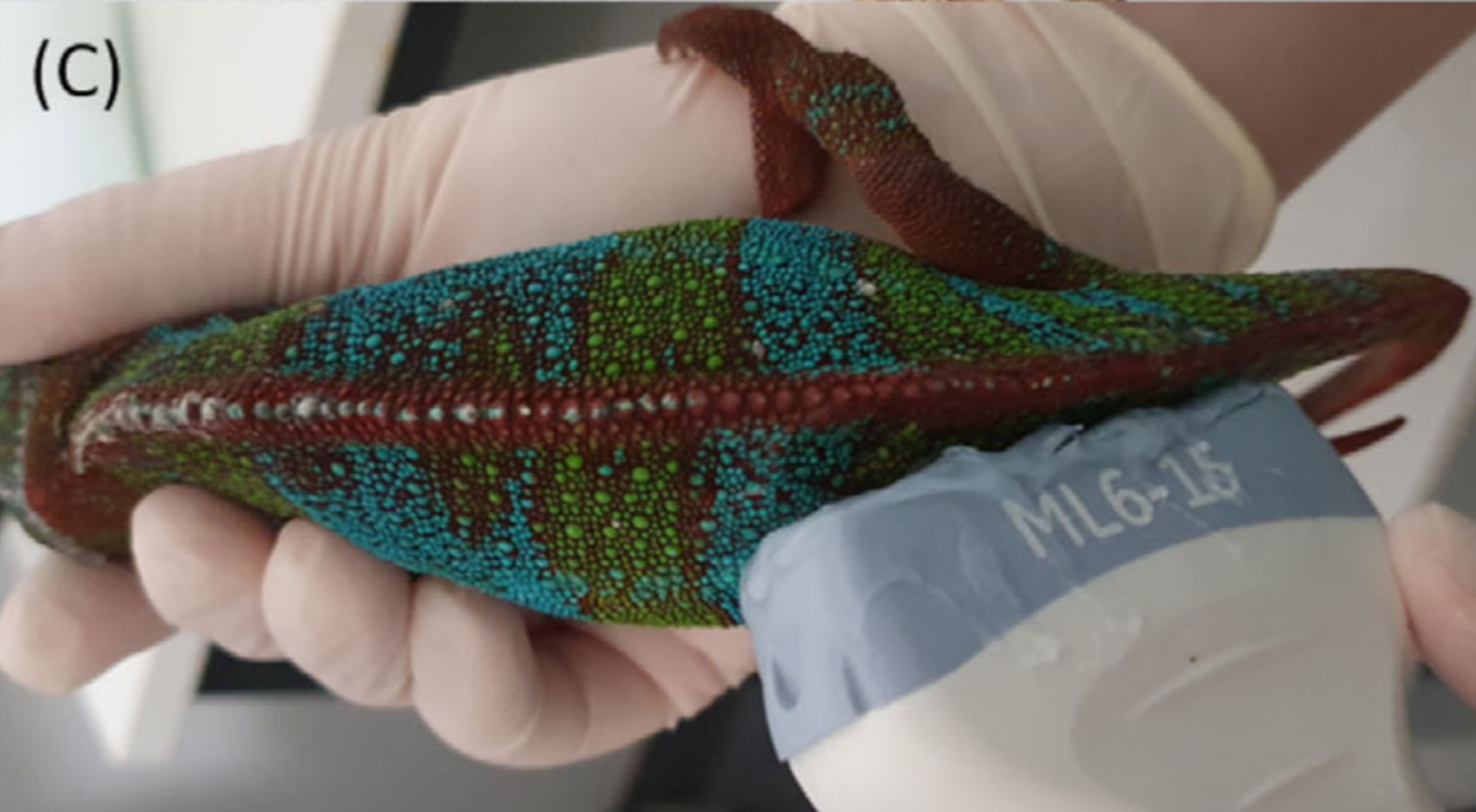
In recent years, initial studies have been conducted on imaging in the diagnosis of diseases specifically in chameleons. A further study by veterinarians at the University of Leipzig (Germany) now presents additional comparative data on the urogenital tract of chameleons.
They examined the kidneys, bladder and reproductive organs of 42 lizards brought to the university hospital by private owners using ultrasound. Among the patients were seven Chamaeleo calyptratus and five Furcifer pardalis. Of these 12 chameleons, six were male and six were female. All organs were measured, described and sample images were saved.
Unfortunately, the sex organs of none of the female chameleons could be assessed for the study, as they were either pathologically altered or had already been removed during previous surgery. The most suitable location for coupling the ultrasound probe to the kidneys of the chameleons was found to be approximately one centimetre in front of the hip. The postpelvic portion of the kidneys was always smaller than the prepelvic portion. The kidneys of all male chameleons showed heterogeneous stripes, while the kidneys of the females were always homogeneous. This striping is probably due to sexual segments in the kidneys of males. The kidney tissue was isoechogenic to muscle tissue and more hypoechoic than adipose tissue. The testes of the male chameleons were located in the posterior third of the coelomic cavity, directly below the spine and in front of the kidneys. The right testicle was slightly further forward than the left. The capsule was hyperechoic in all males, while the testicular structure was always homogeneous. The study also provides average measurements of the kidneys and testicles of Yemen and panther chameleons.
The data largely correspond to the data already compiled by Aßmann in 2015 on ultrasound of the urogenital tract of chameleons. Only the kidney length differed significantly (longer) from previous studies.
Comparative sonographic studies of the urogenital tract of lizards
Nils B. Klützow, Volker Schmidt
Veterinary Radiology & Ultrasound 2025, 66:e70075
DOI: 10.1111/vru.70075
Free download of the article