
First digital atlas of the head anatomy of the veiled chameleon
The anatomy of chameleons has been discussed in many publications, primarily older ones. Scientists at University College London (UK), in collaboration with Belgian, French and Swiss colleagues, have now created the first digital atlas of the head anatomy of the Veiled chameleon (Chamaeleo calyptratus).
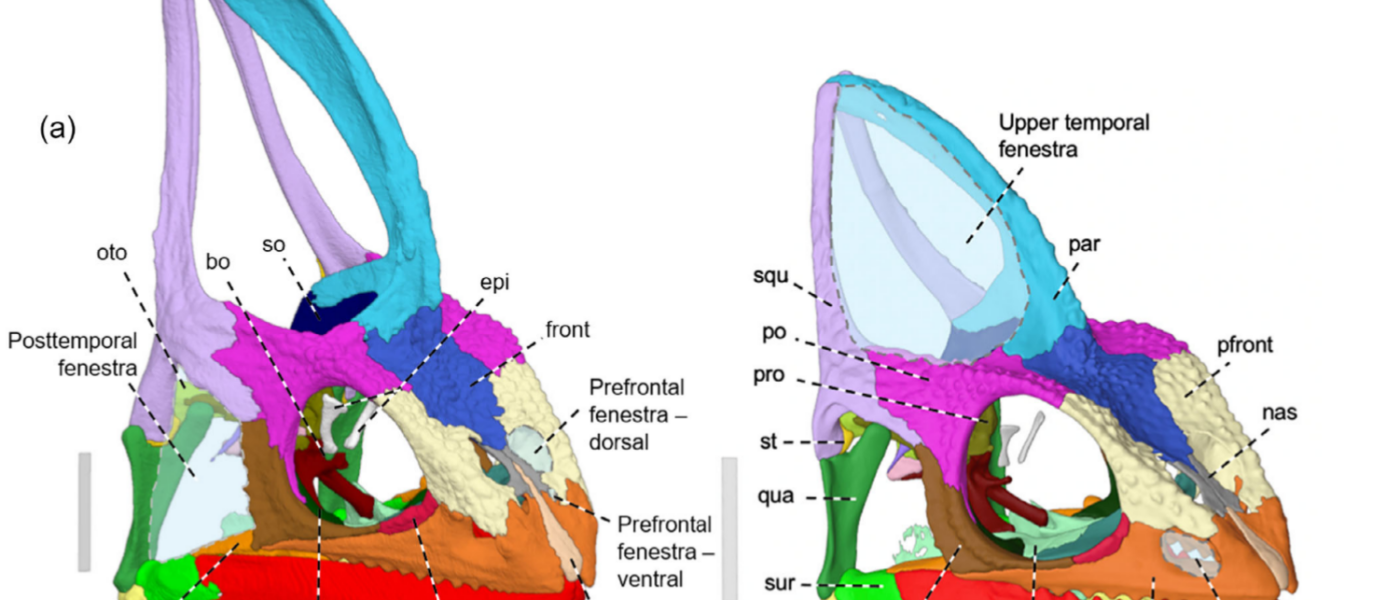
To do this, they performed micro-CT scans of two dead adult Chamaeleo calyptratus specimens preserved in ethanol. One male and one female were examined. A few weeks later, they repeated the CT scans using special stains. The skulls of both chameleons were then digitally reconstructed using various programmes, including Dragonfly 3D World and UNet3D. Bone parts, muscles and other soft tissue were distinguished and named. In addition, estimates of muscle strength, bite force, muscle volume and muscle length were made.
As expected, the authors found that the male veiled chameleon differed from the female primarily in terms of its facial skull and higher casque. The muscle responsible for moving the lower jaw is significantly larger in males than in females. All of the micro-CT scans can be viewed here free of charge.
3D anatomical atlas of the heads of male and female adult Chamaeleo calyptratus
Alice Leavey, Eloy Gálvez-López, Anthony Herrel, Laura B. Porro
The Anatomical Record, 2025: 1-33.
DOI: 10.1002/ar.70077
Download the article for free
Graphic: Colour representation of the various bone parts of the skull and lower jaw of the veiled chameleon
Tiermedizin Science