Presentation in Frankfurt about Ethiopia

Presentation in Frankfurt about Ethiopia

Reiseberichte Live lectures Science

On Friday, 26 September 2025, herpetologist Dr Arthur Tiutenko from Friedrich-Alexander University Erlangen-Nuremberg will give a lecture accompanied by numerous images about a very special forest in Ethiopia.

The Harenna Forest, which stretches along the southern slopes of the Bale Mountains in southern Ethiopia, is one of the last remaining forest areas in the Horn of Africa and the largest remaining rainforest on the African mainland. It is not only home to Arabica coffee, but also to numerous other endemic plant and animal species, many of which have not yet been scientifically discovered and described. The herpetofauna of the Harenna Forest includes more than 40 species, including the two large Ethiopian vipers – Bitis harenna and Bitis parviocula. The habitats of these animals and the entire ecosystem are being destroyed by overpopulation and increasing economic exploitation. Even the future of the officially protected parts of the forest looks bleak. This makes it all the more important to gain knowledge about the species that still live in the forest before it is too late. Arthur Tiutenko has explored the Harenna Forest in ten expeditions, the results of which he reports on in this lecture.

Dr. Arthur Tiutenko Harenna Forest, Ethiopia – 12 years of expeditions into the last rainforest in the Horn of Africa [German]
DGHT Stadtgruppe Frankfurt
Zoo school of Zoo Frankfurt
Bernhard-Grzimek-Allee 1
60316 Frankfurt am Main
Lecture begins at 7 p.m., doors open at 6:30 p.m. via the exit gate at the main entrance on Alfred-Brehm-Platz (gate between the zoo shop and the zoo society building).

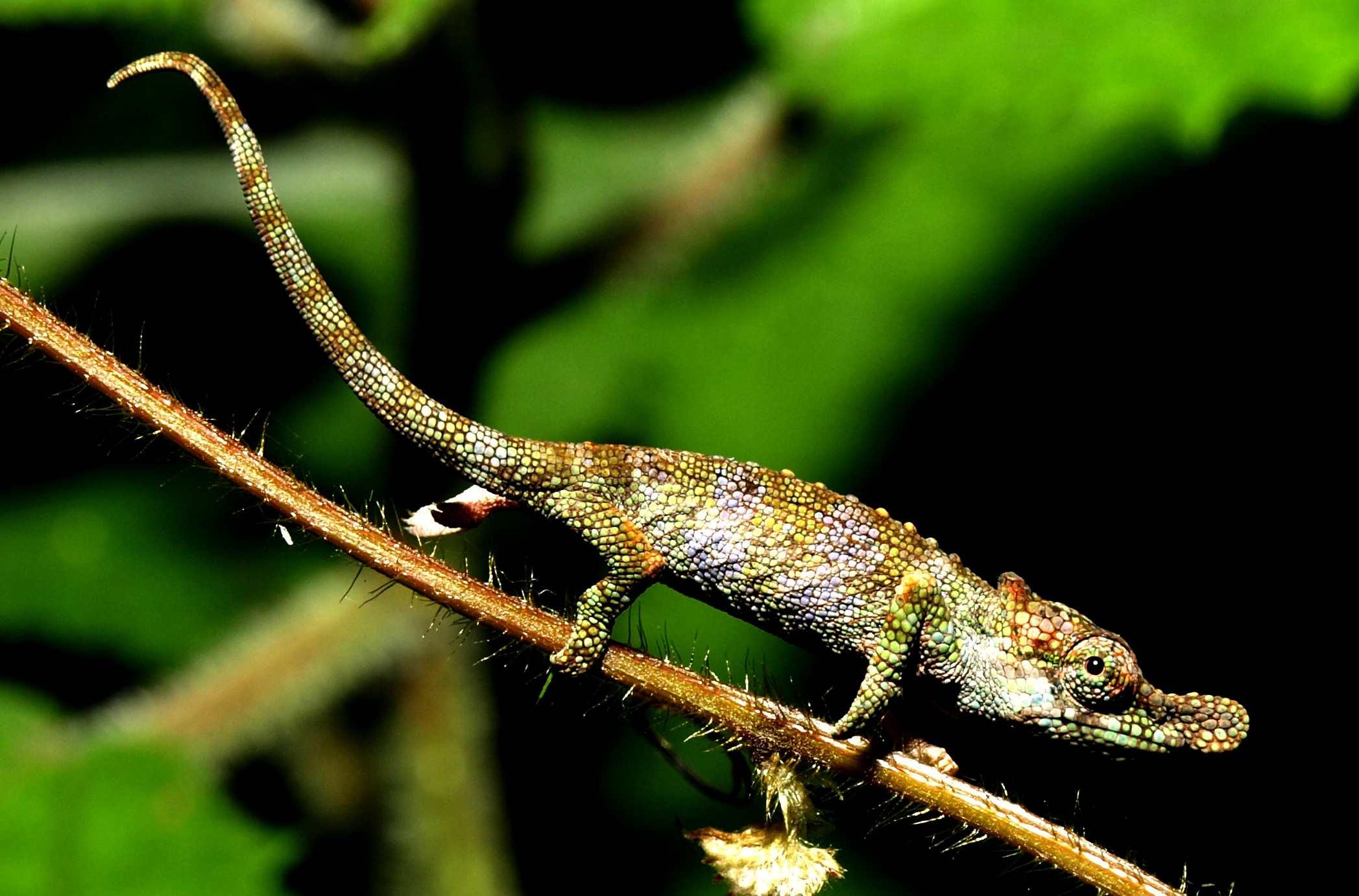
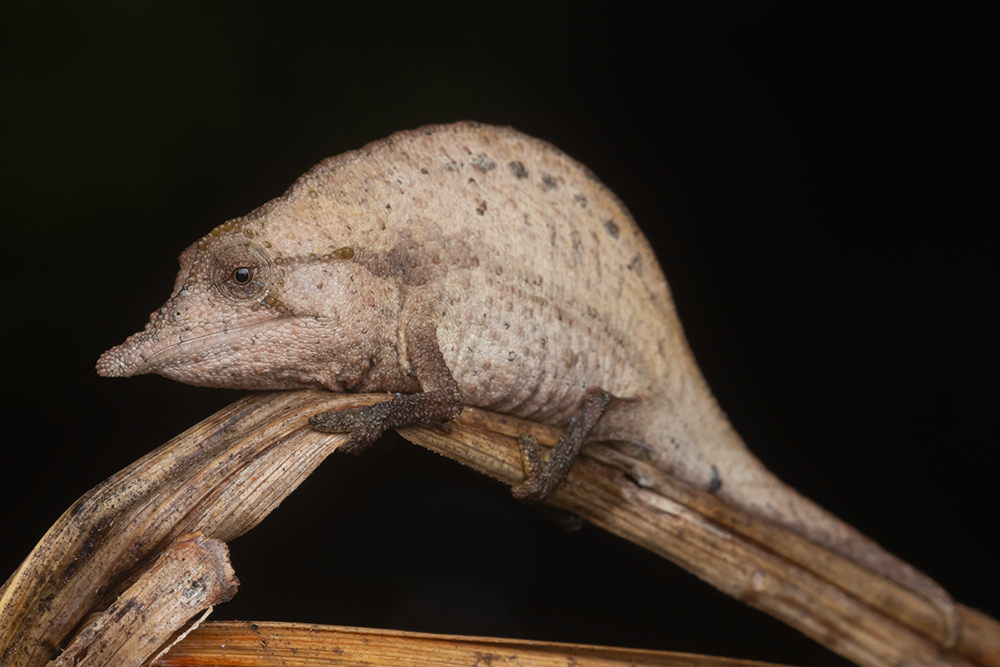
Photo: Trioceros balebicornutus, photographed by Arthur Tiutenko on one of his travels

Presentation in Bavaria about chameleons

Presentation in Bavaria about chameleons

Haltungsberichte Reiseberichte Live lectures

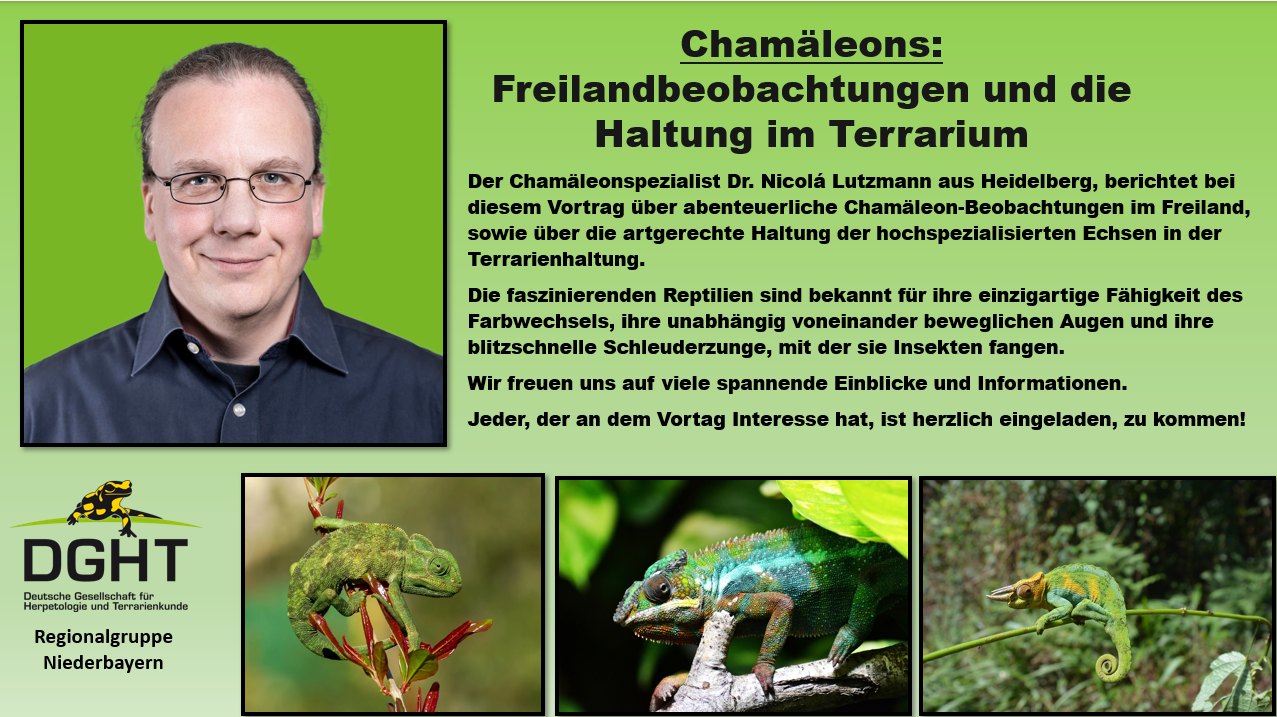
Long-standing AG member Nicolá Lutzmann from Heidelberg will give an interesting lecture on chameleons on Saturday, 20 September 2025. In this lecture, he will report on adventurous chameleon observations in the wild, as well as on the species-appropriate keeping of these highly specialised lizards in terrariums. These fascinating reptiles are known for their unique ability to change colour, their independently movable eyes and their lightning-fast forked tongue, which they use to catch insects.

Dr. Nicolá Lutzmann Chameleons: Outdoor observations and keeping them in a terrarium [German]
DGHT regional group lower Bavaria
Restaurant Aurora
Klausenweg 15
84152 Mengkofen
Lecture begins at 8 p.m., dinner together from 6.30 p.m.

Presentation in Leipzig about Madagascar

Presentation in Leipzig about Madagascar

Reiseberichte Live lectures

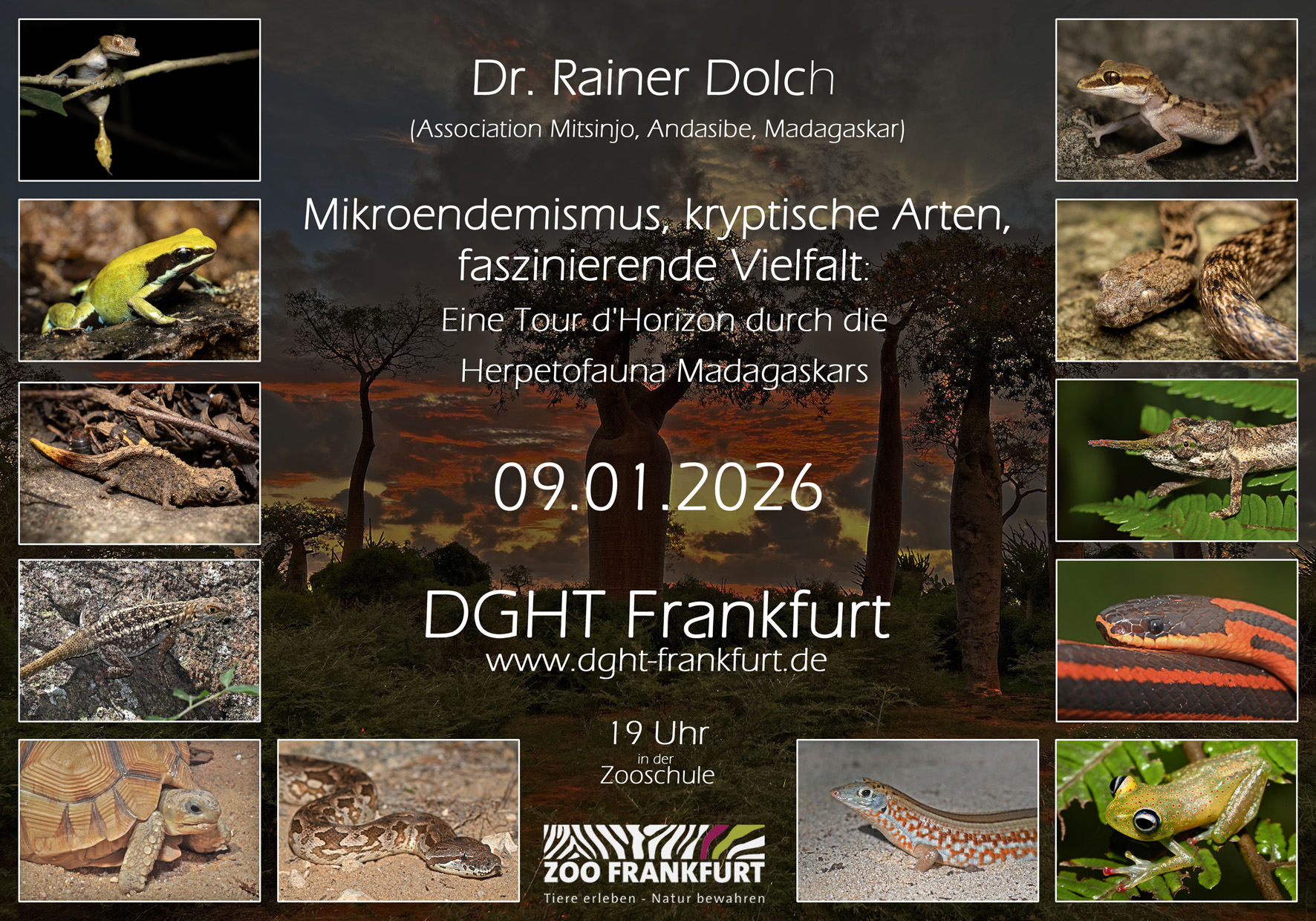
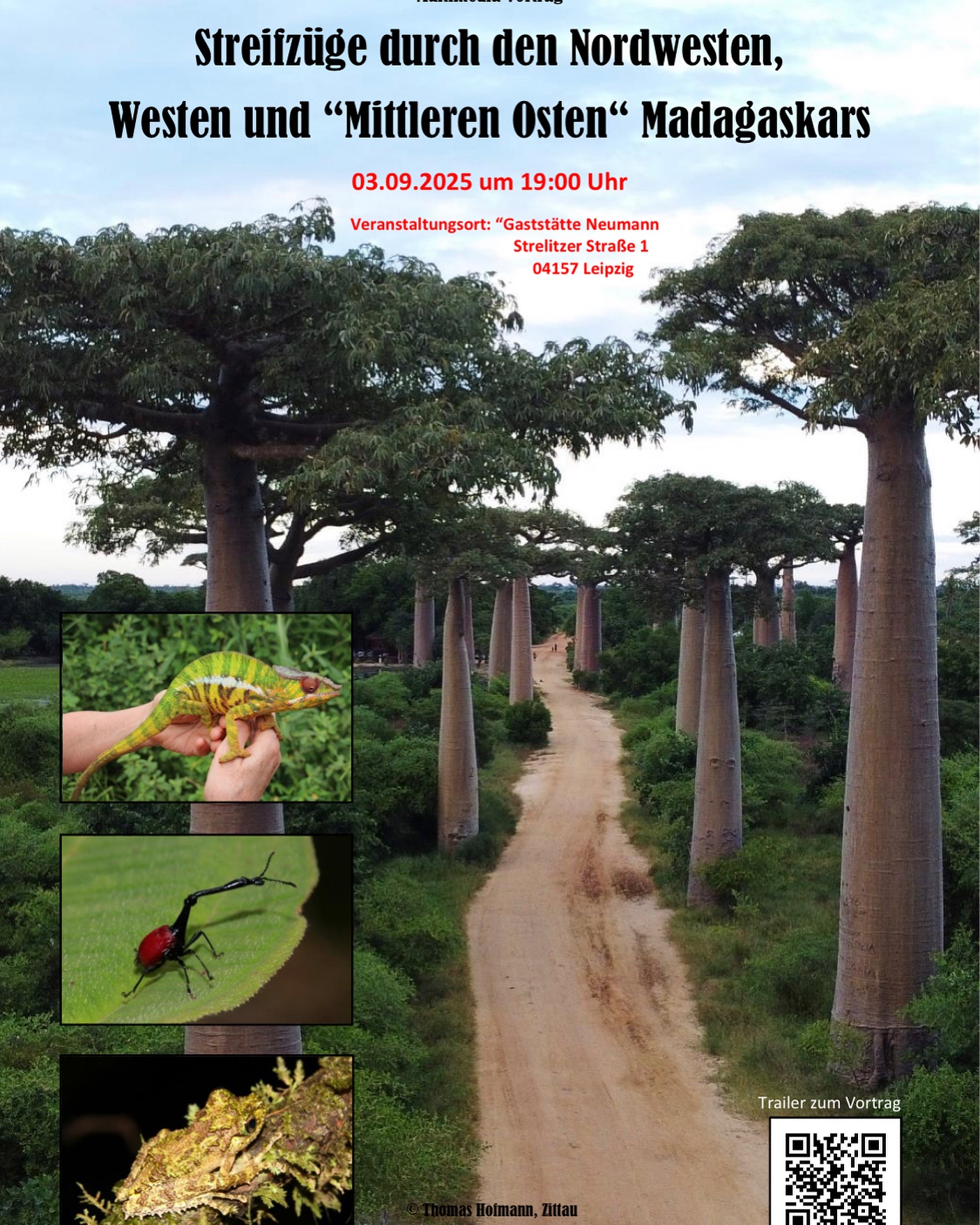
On Wednesday, 3 September 2025, Thomas Hofmann will give a lecture rich in images about Madagascar in Leipzig (Saxony). The island in the Indian Ocean is a mecca for travellers interested in herpetology. Over 90% of the reptiles and amphibians found here are endemic – they exist nowhere else in the world. Among the endemic species are not only a large number of chameleons, but also many other herpetological highlights.

Thomas Hofmann Excursions through the north-west, west and ‘Middle East’ of Madagascar [German]
DGHT Stadtgruppe Leipzig
Restaurant Neumann
Strelitzer Straße 1
04157 Leipzig
Start of the event 7 p.m.

Presentation in Hamburg about Madagascar’s chameleons

Presentation in Hamburg about Madagascar’s chameleons

Reiseberichte Live lectures

Lars Dwinger, member of the Chameleon Working Group, will give a detailed presentation on his trip to Madagascar this year on Saturday, 6 September 2025.

Together with the Tanalahorizon team and herpetologist Dr. Frank Glaw, he set off for north-eastern Madagascar. The team spent a whole week in the mountain rainforest of Marojejy to find, document and – thanks to permits – also collect undescribed chameleon species. A fantastic experience with numerous unexpected highlights! Following this sweat-inducing but, as far as chameleons are concerned, very successful expedition, the team headed to the lowland rainforest of Bobangira, right on the Indian Ocean. This part of the island is practically unexplored due to its poor accessibility – as the lecture clearly illustrates – and is home to a large number of snakes and other undescribed chameleons. But it’s not just chameleon lovers who will get their money’s worth at this lecture; other reptiles and amphibians are also shown in numerous fantastic photos.

Lars Dwinger The summit of Marojejy and the gallery forest of Bobangira – two virtually unexplored herping paradises [German]
50th Jubilee and VDA regional day
Ganztagszentrum
Am Markt 2
22941 Bargteheide
Presentation begins at 2 p.m.

Picture: Palleon lolontany, photographed by Markus Bartels on this very trip

Presentation in Krefeld about Madagascar

Presentation in Krefeld about Madagascar

Live lectures

The head of the DGHT Saar-Palatinate regional group, Patrick Schönecker, will be giving a great lecture on Madagascar on Friday, 4 June 2025 in Krefeld. The island in the Indian Ocean is the Mecca for travellers interested in herpetology. Over 90% of the reptiles and amphibians found here are endemic – they don’t exist anywhere else in the world. Patrick has been there several times. In his presentation, he talks about the rainforests in the central highlands and local conservation efforts. But he also travels up north to the small island of Nosy Hara – an extremely special habitat and home to the second smallest chameleon in the world.

Patrick Schönecker Madagascar – Biodiversity and conservation [German]
DGHT Regional group Mönchengladbach/Krefeld
Clubhouse SC 08 Schiefbahn
Siedlerallee 27
47877 Willich-Schiefbahn
Event starts at 7.00 pm

Photo: Calumma parsonii parsonii, photographed by Patrick Schönecker
Presentation in Dortmund about Kenya

Presentation in Dortmund about Kenya

Live lectures

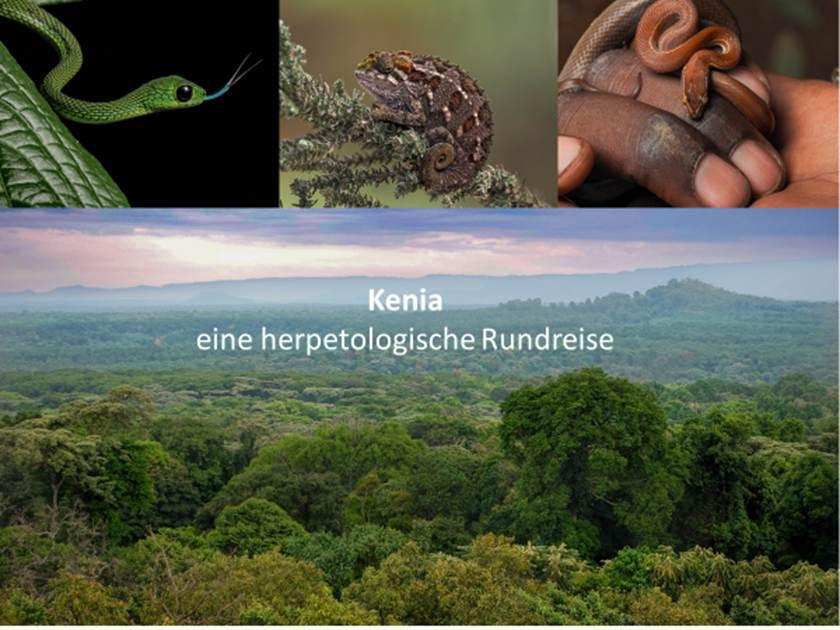
On Friday, 4 July 2025, Regina Liebel will be giving an illustrated talk about a Kenya safari near Dortmund (North Rhine-Westphalia). The country in East Africa is best known for its ‘Big Five’. This lecture shows that the Kenyan herpetofauna also has a lot to offer and certainly has nothing to hide. Regina Liebel takes her audience on a journey through five national parks.

Regina Liebel Kenya safari through five national parks [German]
DGHT City group Dortmund
Restaurant Olympia – Zur alten Post
Im alten Dorf 2
59192 Bergkamen – Weddinghofen
Event starts at 7.30 pm

Presentation in Leipzig about Madagascar

Presentation in Leipzig about Madagascar

Live lectures

Johannes Pfleiderer will be giving an illustrated lecture on Madagascar on Wednesday, June 4, 2025 in Leipzig (Saxony). The island in the Indian Ocean is a mecca for travelers interested in herpetology. Over 90% of the reptiles and amphibians found here are endemic – they are found nowhere else in the world. Among the endemics are not only many chameleons, but also the well-known colorful frogs with their many different representatives.

Johannes Pfleiderer On the way to Mantella & Co. – Zoological travel impressions from Madagascar [German]
DGHT city group Leipzig
Restaurant Neumann
Strelitzer Straße 1
04157 Leipzig
Start at 7 p.m.

Online lecture on cognition in reptiles

Online lecture on cognition in reptiles

Live lectures Webinars

The DGHT’s digital regulars’ table was launched this year. This platform is ideal for all those who prefer to watch lectures and exchange ideas with other reptile keepers from the comfort of their sofa, but don’t necessarily want to travel far to do so. On Thursday, 27 March 2025, the topic will be ‘Cognition in reptiles’.

The term cognition refers, among other things, to perception and thought processes and the results derived from them. What do reptiles think? What can they perceive and can they draw conclusions from situations? Tobias Machts introduces the topic and shows how cognition works in reptiles. Please register by e-mail to digitaler-stammtisch@dght.de.

Tobias Machts Monkeys in scales? Cognition in reptiles [German]
15. Digitaler Stammtisch der DGHT
Start at 8 p.m.

Presentation in Dingolfing about Greece

Presentation in Dingolfing about Greece

Live lectures

On Saturday, 15 March 2025, reptile specialist Jochen Zauner will give an richly illustrated lecture on Greece in Bavaria. He will report on his two trips to the western Peloponnese in 2006 and 2023. The Peoloponnese is a peninsula in the south of the Greek mainland. It is the southernmost part of the Balkan Peninsula and therefore the area of Greece that extends furthest into the Mediterranean. In addition to the famous cities of Mycenae, Corinth and Sparta, the peninsula is also home to a diverse herpetological fauna. Between the Strofilia forests in the north and the barren mountain slopes of the Mani in the south, you will encounter some endemics as well as old favourites of the Balkan Peninsula.

Jochen Zauner Herpetological observations in the Peloponnese  [German!]
DGHT regional group Niederbayern
Restaurant Aurora
Klausenweg 15
84152 Mengkofen
Begin of the presentation at 8.00 p.m.

Presentation in Basel about the Comoros

Presentation in Basel about the Comoros

Reiseberichte Live lectures

Dr Oliver Hawlitschek from the University of Zurich will be giving a great lecture on the Comoros on Wednesday, 5 March 2025 in Basel (Switzerland). The Comoros are a group of four volcanic islands in the Western Indian Ocean. Compared to similar oceanic archipelagos such as Hawai’i and the Galápagos, however, they are little known globally and little scientifically researched. The fauna is characterised by a large number of endemic species. Over the past 15 years, Oliver has studied the taxonomy, biogeography and ecology of the reptiles and amphibians living there and has been involved in numerous conservation projects. He will be presenting the results of this work on this evening – it’s sure to be very exciting!

Dr. Oliver Hawlitschek The Comoros, a hotspot of herpetological diversity in the Indian Ocean [German]
DGHT city group Basel
Restaurant Schiff
Baslerstraße 32
4102 Binningen
Vortragsbeginn 20.00 Uhr