Twins in Veiled Chameleons in Latvia

Twins in Veiled Chameleons in Latvia

Short messages Nachzuchten

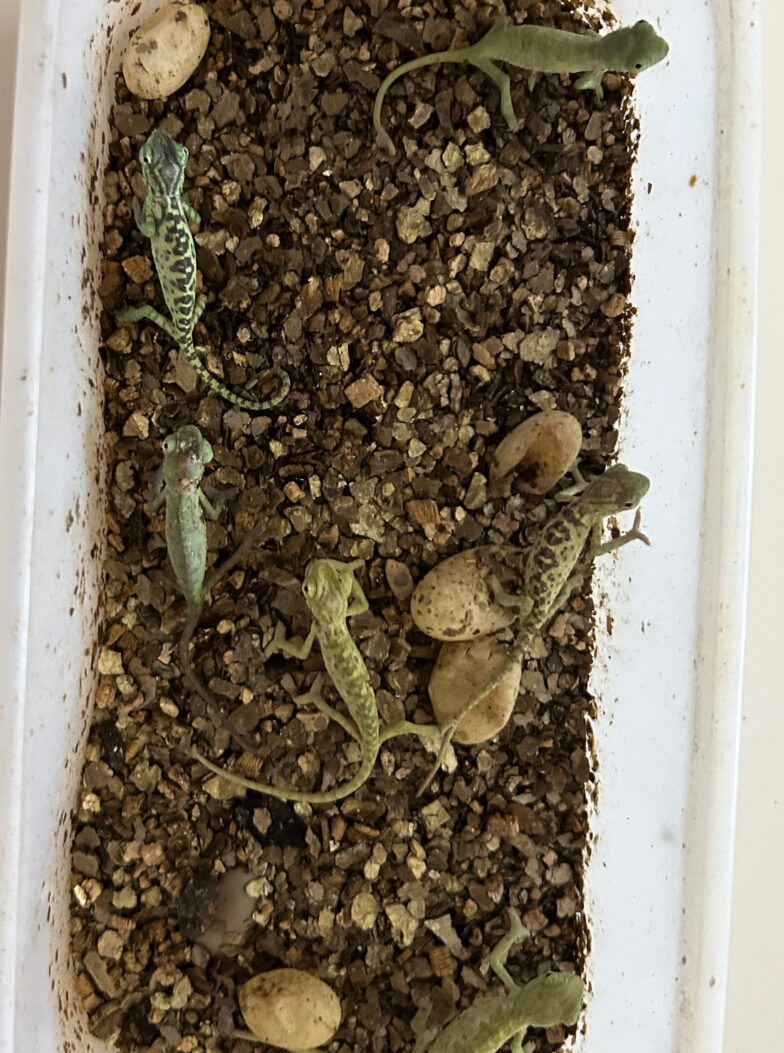
The hatching of two pairs of twins of Veiled Chameleons (Chamaeleo calyptratus) in Latvia has been reported from Riga. The parents live at Riga Zoo and the young hatched in March 2022. The twins were two male and two female Veiled Chameleons, each pair in one egg. They came from a clutch of 85 eggs, of which 48 eventually hatched. All four young animals were active at first and accepted food. At the age of two months, one of the juveniles died, the remaining three were still alive in February 2023.

The article also gives a brief overview of cases of twins in reptiles from the existing literature.

A review of twinning in lizards and a report of Veiled Chameleon (Chamaeleo calyptratus) twin births
Alessandro di Marzio, Elza Birbele, Lucia Puchades, Andris Lazdiņš
Herpetology Notes 16: 471-476, 2023
DOI:

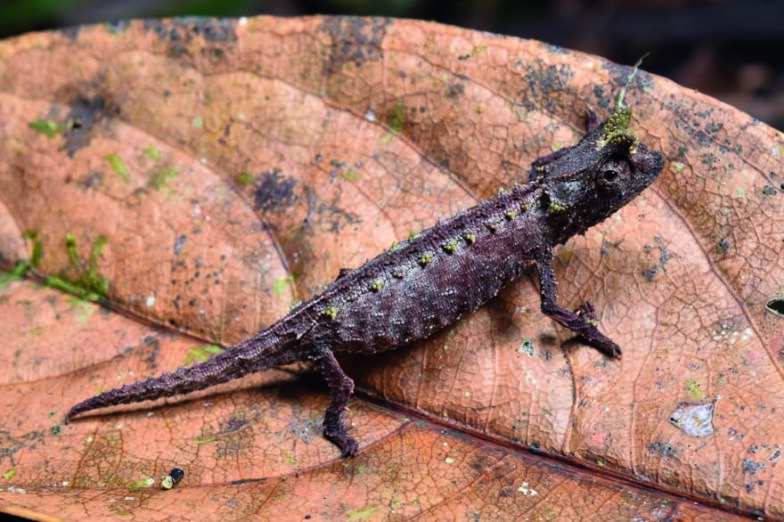
Photo: One of the twin pairs at hatching

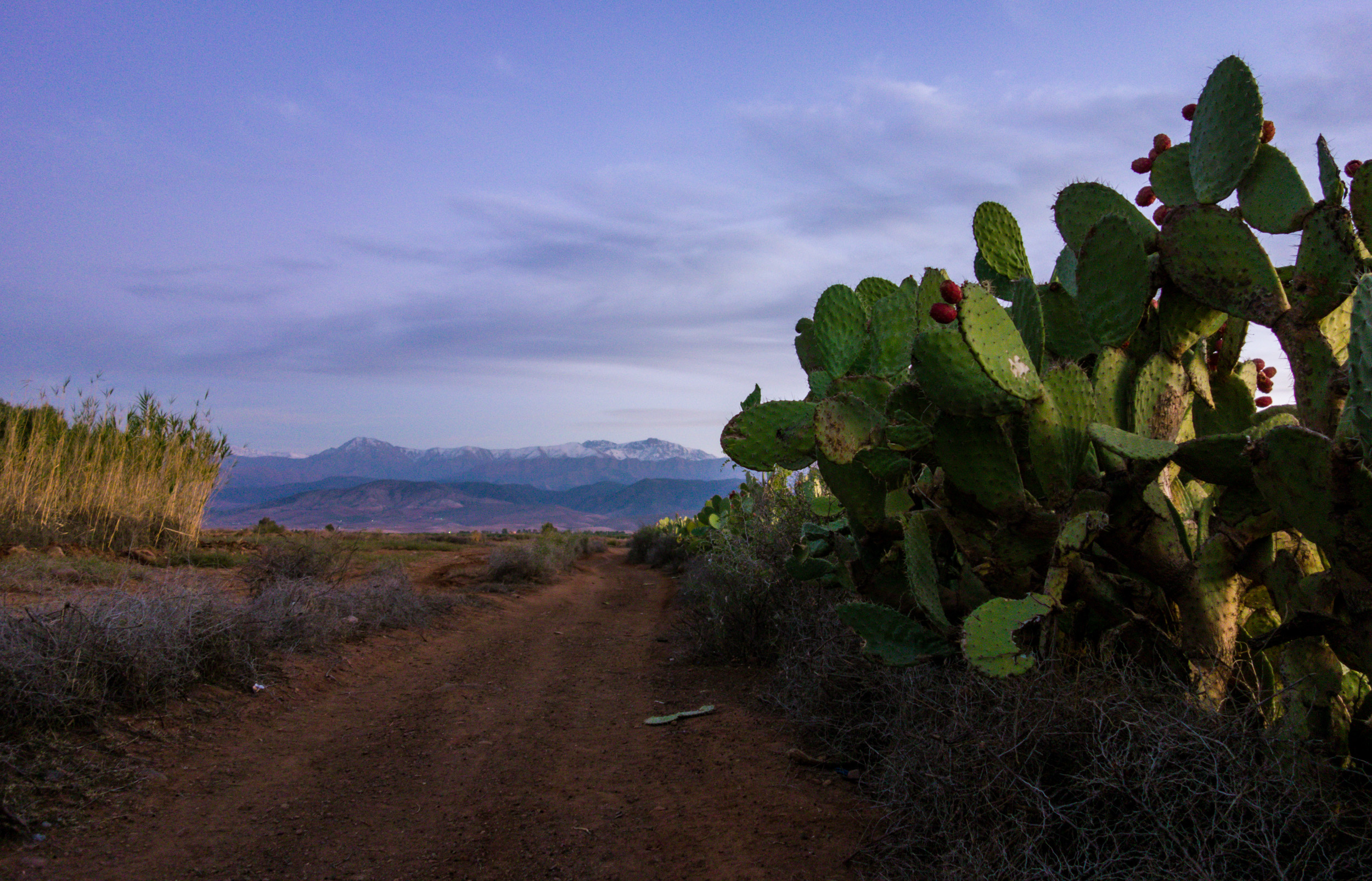
Habitat of Furcifer labordi in Andranomena (Madagascar)

Habitat of Furcifer labordi in Andranomena (Madagascar)

Science

Labordes’ chameleon (Furcifer labordi) has been known for some years as the world’s shortest-lived chameleon. Three scientists from Madagascar have now studied a previously relatively unexplored habitat of the species. The study was conducted in the Andranomena Special Reserve, located about 30 km north of the coastal town of Morondava in western Madagascar. The special reserve has a regrowth part as well as a relatively intact part of dry forest, which lies at altitudes ranging from sea level to 250 metres.

To estimate the population density of Furcifer labordi, the forest was divided into three transects each 150 m wide. At night, the chameleons were searched for with a torch and colour-marked with nail polish. The next day, a 5 x 5 m plot was marked around each site and at least 5 m away along the transect line. In all plots, the canopy cover was counted in percent, the thickness of the foliage layer on the ground and ground-covering plants in centimetres, the number of shrubs up to 1 m, the number of trees over 1 m and the number of felled and burnt trees. Five days after the first count, chameleons were again searched for and counted at night. In addition, insects were caught, counted and identified using light traps. Furthermore, raptor observations (Centropus toulou, Falco newtoni, Buteo brachyperus, Corvus albus and Accipiter francesii) were counted every 200 m along a 1400 m transect. Other predators such as snakes (Madagascarophis colubrinus, Leiohterodon modestus, Mimophis mahfalensis, Dromicodryas bernieri) were also counted by observation. Climatic data from the urban area of Morondava were recorded.

Statistical analyses showed that more Furcifer labordi were found in forest sections where the canopy was denser and the foliage layer on the ground was thicker, and where there were more trees overall. In the forest sections where no chameleons were found at all, significantly more felled trees were counted. As was to be expected, considerably fewer Furcifer labordi were found in the dry season than during the rainy season. Ten different families of insects were found, the most common being Homoptera (mainly cicadas), Coeloptera (beetles), Dermaptera (earwigs), and Lepidoptera (butterflies). Insect availability seemed consistent from February to May. More snakes were counted in February than in March, and the number of birds of prey did not differ throughout the observation period.

The authors consider whether the differences between the microhabitats preferred by Furcifer labordi and non-habitats could have an impact on the longevity of the species. Unfortunately, causality was not proven.

Note: This is a preprint publication. This means that no peer review has yet taken place and content may still change before final publication in a journal. Addendum: A discussion of the final paper after peer review can be found here.

Variation longitudinale de longévité de Furcifer labordi et analyse de facteurs à l’origine de sa longue durée de vie dans la reserve spéciale d’Andranomena-Morondava, Madagascar
Ahy Nirindrainiarivony Philibertin Honoré Djadagna, Achille Philippe Raselimanana, Lily-Arison René de Roland
ESI Preprints 18, 2023
DOI: 10.19044/esipreprint.6.2023.p700

How and when Veiled Chameleons show biotremors

How and when Veiled Chameleons show biotremors

Science

Some chameleon species can vibrate like smartphones – most chameleon keepers know this. The best-known example of this ability is the Veiled Chameleon (Chamaeleo calyptratus). Two new articles by scientists from the USA now deal with what these vibrations are good for, how they occur, and how the Veiled Chameleon uses them in the first place.

Nine adult Veiled Chameleons (three females, six males) and six juvenile Veiled Chameleon (three females, three males) took part in the first experiments. Eleven of them were placed individually one after the other on a 77 cm long and 5 mm thick wooden stick. As soon as the chameleon sat in the middle, the wooden stick was subjected to vibrations of 25, 50, 150, 300, and 600 Hz. After each stimulus, a comparison was made to see whether the chameleon moved faster, slower, or the same as before. In order to motivate the young animals to move, a plant was placed near the end of the wooden stick. In addition, a small fan was used to imitate a light wind. For the second experiment, all 15 Veiled Chameleons were placed one after the other in a wooden box open at the top on a 122 cm long wooden stick. The animals were poked in the upper arm with a 27 G cannula. An acceleration sensor stuck to the helmet, or to the branch in the case of young animals, measured the reactions (vibrations) of the chameleons.

The results are exciting: Adult Veiled Chameleons reacted reliably to 50 and 150 Hz with “freezing”, i.e. complete immobility. Juveniles, on the other hand, reacted with this behaviour to other frequencies, namely 50 and 300 Hz. All adult Veiled Chameleons showed biotremors (vibrations). In the juveniles, the scientists could feel vibrations in all of them, but not all could be detected with the sensor. The vibrations were divided into two classes: “hoots” with an average of 7.5 dB and “mini-hoots” with -32.5 dB. The longer the larger vibrations lasted, the lower the frequency.

A second series of experiments used six adult Veiled Chameleons (four males, two females), four juvenile Veiled Chameleons, and one adult Chamaeleo gracilis. Two chameleons each were placed in a wooden box separated into two compartments by a plexiglass pane. Video recordings and accelerometers were used to measure their reactions to each other. Same-sex Veiled Chameleons, pairs of Veiled Chameleons, a Veiled Chameleon with a Chamaeleo gracilis and adult versus juvenile Veiled Chameleons were tested. The adult Veiled Chameleons showed vibrations in association with other adults in about 85% of the trials. The strength of the vibrations varied greatly from individual to individual. The clear trigger of the biotremors seemed to be visual contact with another chameleon. Threatening gestures and aggressive behaviour were more likely to cause vibrations. In the second series of experiments, a third variant of biotremors was discovered in addition to honking, rumbles.

Communication via biotremors in the Veiled Chameleon (Chamaeleo calyptratus): Part I – Biotremor production and response to substrate-borne vibrations
Kathryn L. Denny, Steve Huskey, Christopher V. Anderson, Michael E. Smith
Integrative and Comparative Biology, 2023
DOI: 10.1093/icb/icad085

Communication via biotremors in the Veiled Chameleon (Chamaeleo calyptratus): Part II – Social contexts
Kathryn L. Denny, Steve Huskey, Christopher V. Anderson, Michael E. Smith
Integrative and Comparative Biology, 2023
DOI: 10.1093/icb/icad084

Comparative anatomy of the forearms of different chameleons

Comparative anatomy of the forearms of different chameleons

Tiermedizin Science

The anatomy of chameleons seems to be strongly adapted to their way of life. Tree-dwellers differ in many aspects from ground-dwellers. Several studies at the University of South Dakota this year have already looked at various anatomical aspects of chameleons. A new study is dedicated to the hands and arms.

For the investigation, the arms and hands of a total of 12 chameleons were isolated from existing microcomputer tomography scans and displayed in 3D. These were measured to about 30 different lengths and widths using software. Scans of the species Bradypodion damaranum, Bradypodion occidentale, Calumma hilleniusi, Calumma crypticum, Chamaeleo namaquensis, Chamaeleo zeylanicus, Furcifer balteatus, Furcifer campani, Rhampholeon spinosus, Rhampholeon temporalis, Trioceros goetzei goetzei and Trioceros werneri were evaluated. When selecting the species, care was taken to select one strictly tree-inhabiting chameleon and one more ground-inhabiting chameleon per genus.

The evaluation revealed that tree-dwelling chameleons show few differences in forelimb anatomy compared to ground-dwelling chameleons. Tree-dwelling species showed a majority of separated metacarpal bones 1-3, while ground-dwelling species showed fused metacarpal bones. Interestingly, this study differs from earlier studies by other authors, which yielded different results. The relatively small number of animals studied may be related to this. Larger studies could be helpful here.

Ecological and evolutionary drivers of chameleon forelimb variation
Ellie M. Schley
Honors Thesis 302 der Universität von South Dakota, 2023
DOI: gibt es nicht

Karyotypes in chameleons

Karyotypes in chameleons

Science

Scientists from Great Britain and Italy have now studied the chromosomes of different chameleon species. They examined the karyotype of a total of 83 different chameleon species. Among them were 57 Madagascan chameleon species, of which 32 karyotypes were described for the first time ever. For Calumma brevicorne, Calumma fallax, Calumma parsonii and Furcifer verrucosus, there were even several animals each available for examination. The scientists found out that presumably the fusion of chromosomes has reduced the total number of chromosomes in the course of evolution in chameleons. Presumably, it was mainly microchromosomes (particularly small chromosomes) that fused.

Microchromosome fusions underpin convergent evolution of chameleon karyotypes
Marcello Mezzasalma, Jeffrey W Streicher, Fabio M Guarino, Marc E H Jones, Simon P Loader, Gaetano Odierna, Natalie Cooper
Evolution, Juni 2023
DOI: 10.1093/evolut/qpad097


YouTube live about Malagasy chameleons

YouTube live about Malagasy chameleons

Live Stream Live lectures

On Saturday, 10 June 2023, there will be a live discussion on YouTube with the herpetologist Mark D. Scherz and Bill Strand from the Chameleon Academy in the USA. The topic will be the Malagasy chameleon Calumma brevicorne and its numerous relatives, some of which are extremely similar in appearance. Taxonomically, many chameleons of the brevicorne clade are not yet classifiable – possibly some undescribed new species are hiding among them? There will be an opportunity to ask questions about the topic live in the chat throughout the hour. This should be a very exciting talk round!

Chameleons & Coffee: Confusing Madagascar chameleons
Chameleon Academy YouTube Channel
Starting at 9.00 p.m.

Comparison of pelvic girdles in chameleons

Comparison of pelvic girdles in chameleons

Science

The anatomy of chameleons is strongly adapted to their way of life. Tree-dwellers differ in many aspects from ground-dwellers. The pelvic girdle has been little studied anatomically in chameleons so far – a publication from the USA now deals with it in more detail.

For the study, the pelvic girdles of 22 chameleons were isolated from existing microcomputer tomography scans and displayed in 3D. These were measured to 16 different lengths and angles using software. Archaius tigris, Bradypodion damaranum, Calumma gallus, Calumma parsonii parsonii, Chamaeleo zeylanicus, Furcifer balteatus, Kinyongia matschiei, Kinyongia tavetana, Nadzikambia mlanjense and Trioceros quadricornis gracilior were assigned to tree dwellers. Brookesia brygooi, Chamaeleo namaquensis, Palleon nasus nasus, Rhampholeon temporalis and Rieppeleon brachyurus were attributed to ground-dwelling species. The species Bradypodion occidentale, Brookesia ebenaui, Chamaeleo anchietae, Furcifer campani, Rhampholeon spinosus, Rieppeleon kerstenii kerstenii and Trioceros goetzei goetzei were classified as semiarboreal. Mainly males were examined.

As expected, the evaluation showed that tree-dwelling chameleons had narrower, shorter girdles than ground-dwelling ones. The narrower pelvic girdle makes it easier to hide behind branches and flatten the body to the maximum. It also ensures that the body’s centre of gravity is closer to the branch and thus increases stability when climbing. Ground-dwelling chameleons, on the other hand, had larger and wider pelvic girdles. These allow them to step more quickly and provide greater stability when walking on ground surfaces.

How phylogeny and arboreality affect pelvic girdle anatomy of chameleons
Dakota J. John
Honors Thesis 299, University of South Dakota, 2023
DOI: none


Presentation in Münster about Cameroon

Presentation in Münster about Cameroon

Reiseberichte Live lectures

On Friday, 19 May 2023, the renowned herpetologist Prof. Dr Wolfgang Böhme will give a lecture on herpetological expeditions in West Africa. In several research trips, he studied the large-scale habitats of desert, savannah, and rainforest and their respective marginal areas with regard to their amphibians and reptiles, whose current distribution reflects the influence of the major postglacial climate fluctuations. The rediscovery of the desert crocodile in the Mauritanian Sahara, thought to be extinct for decades, is just one of many highlights. In Guinea, the Lama Forest proved to be a snake hotspot: in just two weeks, the travellers were able to find 38 species sympatrically. In the Cameroon mountains, where relics of German colonial history can still be found several times, the previously unknown herpetological Mount Nlonako proved to be the most species-rich amphibian site in Africa at the time. The vertical zoning, combined with numerous watercourses, led to a great diversity of frog fauna, which was inventoried for the first time. With over 90 species, including the charismatic hairy and goliath frogs, Mount Nlonako is one of the richest amphibian hotspots in the Afrotropical region. The various, beautiful Montane Chameleons in Cameroon also proved to be an excellent model group to exemplify the process of speciation.

Prof. Dr. Wolfgang Böhme Overland from Germany to Cameroon
DGHT City group Münster
Zoo school of Allwetterzoo
Sentruper Str. 315
48161 Münster
Admission from 6.30 p.m., lecture begins at 7 p.m.

Where should the next conference take place?

Where should the next conference take place?

AG Interna

At the general member meeting during our 2023 conference, the question arose as to whether the next meeting could take place at a different location in Germany. The AG Chamäleons has been meeting in Boppard am Rhein for 21 years. Other DGHT working groups use different locations, so that all members sometimes have a longer, sometimes a shorter journey. Therefore we simply put the question of the meeting place to the vote. Please participate diligently in the poll so that we get an up-to-date picture of our members’ wishes and can act accordingly.

Please click here to go to the poll.

Presentation in Mönchengladbach/Krefeld about Uganda

Presentation in Mönchengladbach/Krefeld about Uganda

Reiseberichte Live lectures

On Friday, 12 May 2023, Sönke Frahm will hold his presentation “Uganda – Pearl of Africa” in Mönchengladbach/Krefeld. He will report on a trip to the East African country of Uganda, which is framed by South Sudan, the Democratic Republic of Congo, Rwanda, Tanzania and Kenya. The journey starts in Entebbe on Lake Victoria and from there to the Mitjanja District in search of snakes of the species Bitis and Atheris. Sönke then takes the visitor on a safari to the unique Queen Elisabeth National Park and for chimpanzee trekking in Kibale National Park. Afterwards, a visit to the famous mountain gorillas in Bwindi National Park is scheduled. The trip concludes in a swamp area at Lake Victoria to look for the charismatic Abu Markub, the “father of the shoe”. Sönke met several species of chameleons on the way – there are thirteen different ones in Uganda – and of course, photographed them. So if you want to enjoy an evening with not only herpetological impressions, the regional group Mönchengladbach/Krefeld is the place to be. The presentation is in German.

Sönke Frahm: Uganda – Perle Afrikas
DGHT Regional group Mönchengladbach/Krefeld
Gaststätte Hubertuseck
Hubertusstraße 27
47877 Willich-Schiefbahn
Lecture begins at 7.30 p.m.