Presentation in Kassel about Morocco

Presentation in Kassel about Morocco

Reiseberichte Live lectures

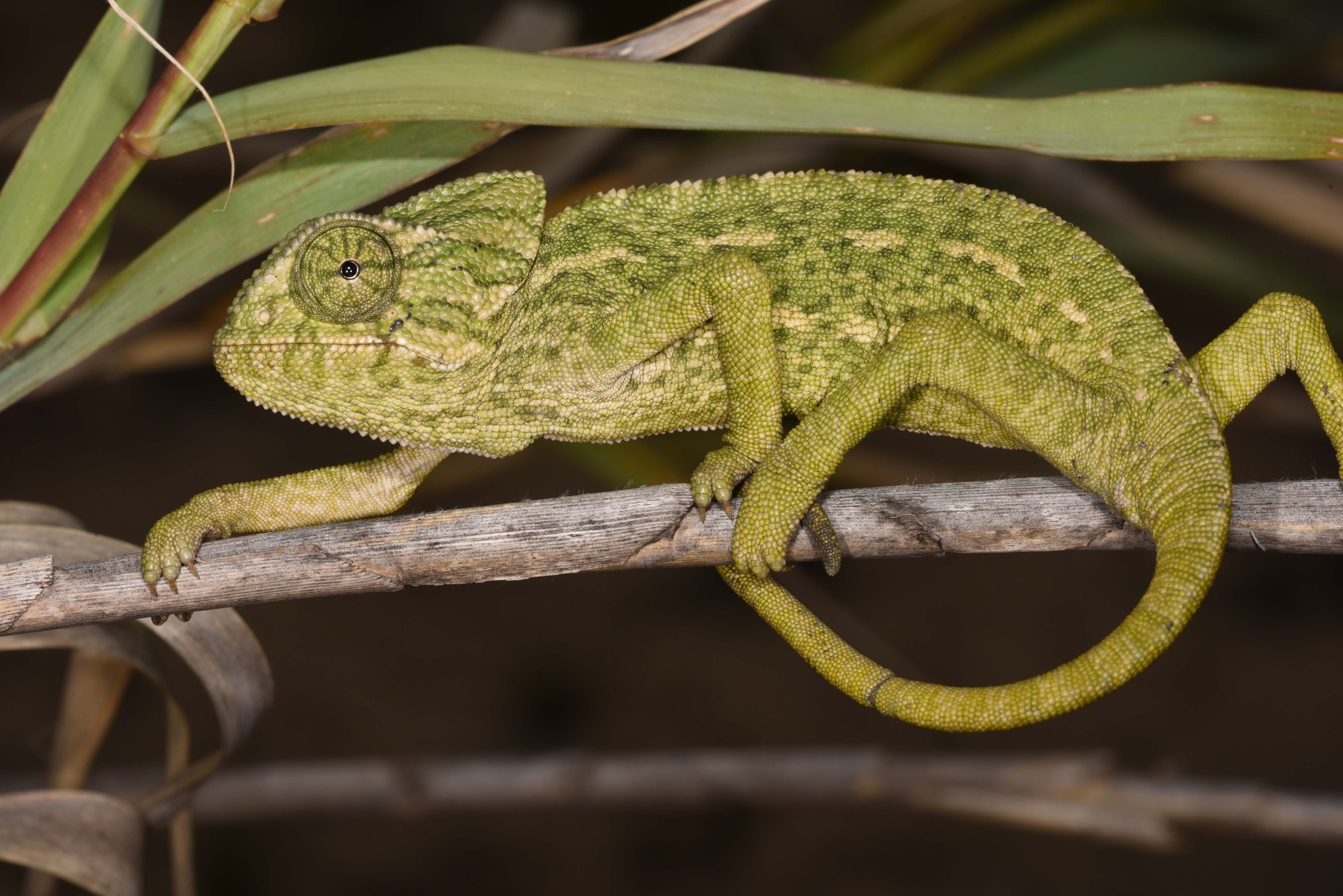
On Saturday, 16 September 2023, Uwe Prokoph will give a lecture on a herpetological journey to the Western Sahara and the south of Morocco. Although the landscape there seems rather hostile at first glance, there is a lot to discover, especially in reptiles!

Uwe Prokoph Desert Wonderworlds
DGHT Stadtgruppe Kassel
House Schönewald
Wilhelmstraße 17
34233 Fuldatal
from 6 o’clock p.m.

Lecture in Hamburg about Madagascar

Lecture in Hamburg about Madagascar

Reiseberichte Live lectures

Together with Jutta Dwinger, AG member Lars Dwinger will be giving a presentation full of pictures in Schleswig-Holstein on Friday, 15th September 2022. Last year, the two travelled to the north of Madagascar, which is known for its extreme biodiversity.

The journey begins in the Marojejy National Park, which stretches across the gorges and steep slopes of the mountain range of the same name. There you can see extremely rarely photographed chameleons, but also a great variety of frogs, snakes and geckos. Afterwards, the journey led via the east coast towns of Sambava and Vohémar to the dry forest of Daraina. The next stop was the world-famous Tsingys in Ankarana National Park. Even in these two dry forests, there is a lot of small and big life. The final stop was camping in the middle of a chameleon paradise: The Montagne d’Ambre in the far north of Madagascar. Between tiny earth chameleons that just fit on the tip of a finger and the gentle giants of the rainforest, the two Hamburgers encounter many fascinating creatures on this trip.

Lars und Jutta Dwinger  Foray through four national parks in the north of Madagascar
Terrarien-Freunde-Hamburg e.V.
Vereinsheim des SC Condor
Berner Heerweg 188
22159 Hamburg
Start of the presentation at 6 p.m.

Picture: Brookesia betschi in Marojejy, photographed by Jutta Dwinger

Chameleons in mythology

Chameleons in mythology

General topics Newspaper articles

With its independently moving eyes, shooting tongue and ability to change colour, the chameleon was already the subject of superstition and myths in ancient times – and has remained so in many places to this day. An article now published by Prof. Dr. Wolfgang Böhme and natural historian Thore Koppetsch deals with precisely this topic.

The content ranges from the so-called Brooklyn Papyrus, which described a still unexplained “colour-changing” creature of antiquity, to bizarre events involving mother’s milk and chameleons in the Gambia of our time. Probably the oldest written record of a chameleon comes from Greece, from Aristotle himself, who lived from 384 to 322 BC. The term chameleon itself probably goes back to the Greek: chamai and leon were put together to form “earth lion”. However, this interpretation of the origin of the word is not entirely undisputed. The article also deals with superstitions on the island of Samos, in Morocco, Tunisia, Togo, Benin, Cameroon and Madagascar, and the use of chameleons for pseudo-medicine and occultism.

Chamäleons in der Mythologie der Völker
Wolfgang Böhme, Thore Koppetsch
Koenigiana 17, 2023, pp. 39-50
DOI: nicht vorhanden

Chamaeleo arabicus juveniles in the AG

Chamaeleo arabicus juveniles in the AG

Nachzuchten

The Arabian chameleon, Chamaeleo arabicus, is hardly ever bred in Europe at the moment. So it is all the more pleasing that this week a whole clutch of chameleons hatched successfully in Switzerland and Germany! Congratulations to Franziska von Ballmoos-Gasser, where the pictured hatchlings live. Franziska had given the parents to Rolf Attinger in winter 2021, where they successfully mated in 2022. After Rolf died unexpectedly, Franziska took back the animals and several eggs. Some of the eggs were given to a good friend of Rolf in Germany, the rest remained in Switzerland. Now 9 agile, good-looking youngsters have hatched in Switzerland and 14 in Germany. The aim is to join Rolf’s success with the species and to continue breeding the species with the same joy. At some point in the future, legal offspring of Chamaeleo arabicus should be offered in Europe. We sincerely hope that everything will continue to work out and that many more keepers will be able to enjoy the species!

Concerning Florida’s introduced panther chameleons

Concerning Florida’s introduced panther chameleons

Verbreitung Science

The “Sunshine State” Florida in the USA has the largest number of non-native species of reptiles in the world because of its warm climate. The panther chameleon (Furcifer pardalis) is one of the invasive species, i.e. those that do not actually belong in Florida but are now reproducing there. A study has now investigated the question of what the human inhabitants of Florida actually think of the chameleons.

It has been discussed for a long time whether panther chameleons belong to the species that were deliberately released for the purpose of “ranching”, i.e. to collect the offspring of the released chameleons for sale. That private individuals collect panther chameleons is not in dispute. According to the authors, ranching populations in Florida are mostly kept secret. They became aware of a small population in Orange County via social media in 2019. They then searched for the animals at night with torches and actually found 26 panther chameleons during several walks. They encountered private individuals on several occasions who were also looking for chameleons.

In 2020, questionnaires were distributed in person and via flyers with QR codes to 248 households located within the presumed 0.9 km² distribution area of the panther chameleon population. They were asked about concerns regarding the occurrence of panther chameleons, but also about existing knowledge about invasive species in general. The residents were also divided into three areas: A core region where chameleons had been observed several times, a peripheral region with few findings, and an outer region where no chameleons had been sighted at all.

44 households answered the questionnaire.  In fact, all 11 interviewed residents in the outer region had not sighted any chameleons. Of the 33 residents interviewed in the core and peripheral region, about a third said they had already observed panther chameleons. The same number had seen the light of torches at night. 86% of the residents surveyed knew that panther chameleons are not actually native to Florida. Only a few residents said they were concerned about the occurrence. Seven residents had approached collectors with torches and said the collectors had all said they were looking for chameleons for research purposes. Only one of the collectors had said he/she was looking for animals to sell, according to the residents. One resident reported an altercation after strangers entered his property several times looking for chameleons. Another resident called the police because of a whole group of collectors on the neighbouring property.

Unfortunately, the questionnaire was given out after the search efforts of the authors themselves, so it is not apparent from the responses how many of the encounters were indeed with people looking for chameleons for sale purposes. The publication is also a preprint, so no review process has taken place yet. Addendum: The paper was published in Human-Wildlife Interactions 2024 as a case report.

Colorful lizards and the conflict of collection
Colin M. Goodman, Natalie M. Claunch, Zachary T. Steele, Diane J. Episcopio-Sturgeon, Christina M. Romagosa
Preprint, 2023
DOI: 10.1101/2023.08.10.552819

Colorful lizards and the conflict of collection
Colin M. Goodman, Natalie M. Claunch, Zachary T. Steele, Diane J. Episcopio-Sturgeon, Christina M. Romagosa
Human-Wildlife Interactions 18(1), 2024

Picture: Alex Laube

Unknown chameleon discovered in Ivohiboro forest (Madagascar)

Unknown chameleon discovered in Ivohiboro forest (Madagascar)

Verbreitung Science

There are still almost unexplored areas on Madagascar today. The Ivohiboro rainforest is located in the southeast of the island in the protected area of the same name, southwest of the southernmost foothills of the Andringitra Mountains. The forest itself is about 8.58 km² in size and thus only occupies a small part of the protected area. It is surrounded by savannahs and spans altitudes from 650 to 1460 m above sea level. The protected area is currently managed by local organisations and Madagascar’s Ministry of Environment. The last expedition to explore the Ivohiboro forest took place in 1924. Since 2016, researchers from the USA and Great Britain have now undertaken six expeditions to the small forest to study the biodiversity of plants, birds, mammals, reptiles, and amphibians there in more detail.

To detect reptiles and amphibians, the forest was divided into nine transects of about 200 x 20 m, each more than 200 m apart. The transects were searched for several days and nights. All animals found were documented and, if possible, identified down to genus or species level.

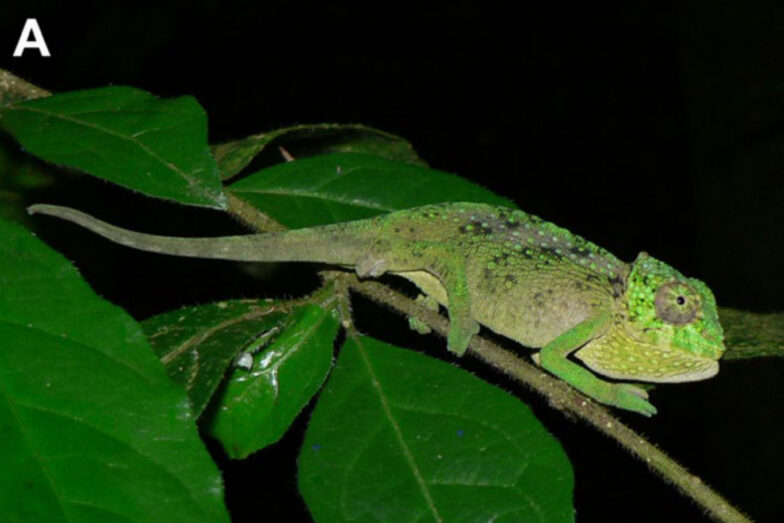
As a result, the scientists were able to identify 107 species of vertebrates and 219 plants. This enormous diversity of species underlines the importance of preserving the forest in terms of species conservation and indicates a well-functioning ecosystem. Among the species found were two chameleons: a Palleon species and a small Calumma. Unfortunately, the publication does not provide any further information on the former. The small Calumma had a conspicuous blue coloured rostral appendage, as it is found in Calumma linotum or Calumma boettgeri in the far north of Madagascar. As genetic studies are still lacking, it is unclear whether these chameleons are an extremely wide range extension – Ivohiboro lies about 1000 km south of the ranges of Calumma boettgeri and Calumma linotum – or whether it is perhaps even a new, as yet undescribed species.

A surprising haven: The biodiversity of an old-growth forest amidst a scorched landscape in Madagascar
Beatriz Otero Jimenez, Ren Montaño, Ryan S. Rothman, Rachel C. Williams, Patricia C. Wright
Conservation Science and Practice, 2023
DOI: 10.1111/csp2.12993

Oddity: Use of chameleon powder in Algeria

Oddity: Use of chameleon powder in Algeria

General topics

Dried bodies of Chamaeleo chamaeleon have always been used in traditional medicine in Algeria. In the El Oued region, extracts and powders from common chameleons are still regularly used today for the therapy of various diseases and various superstitions. An Algerian biochemist has now tried to prove the benefits of chameleon powder in a somewhat curious way.

Allegedly exactly 1000 users of the powder as well as 100 hunters and sellers were questioned for a maximum of 10 to 15 minutes by means of questionnaires or interviews. The evaluation of these was not published. However, the author states that according to the interviews, chameleons are only hunted by “experienced persons”. However, the breeding season is left out, so no damage to the chameleon population is to be feared.

In addition, an unspecified number of wild Chamaeleo chamaeleon were captured and killed in Algeria. The organs were removed, the chameleons washed, salted and dried at 35 to 40°C for over a week. The dried bodies were then washed again and re-dried in an oven at 45°C. The chameleons were then killed using mice. Then the chameleons were ground using a mortar to obtain powder. Dry matter, ph values, protein, carbohydrate, fat, calcium, magnesium, sodium, potassium and ash contents of the powder were examined. A relatively high phosphorus content of 14.01% stood out, and traces of iron, zinc and copper were also detected. A relatively high concentration of vitamin E (19.23 mg/100 g powder) was noticed, as well as vitamin B1 (21 mg/100 g powder). Under laboratory conditions, the powder proved capable of scavenging radicals. Also in the laboratory, the powder as an extract at 100 mg/ml showed some efficacy against various bacteria. In a chicken chorioallantoic membrane (CAM) assay, angiogenesis was tested around a powder disc inserted into a fertilised chicken egg.

Several groups of laboratory rats were treated with carbimazole in the drinking water. Afterwards, one group was freely injected into the abdomen with a solution containing chameleon powder, one group was fed chameleon powder in various mixtures, another was given levothyroxine in the drinking water, another nothing at all and a final group was injected with water in the abdomen. After the experimental period, blood was taken and then all the rats were killed and dissected. The rats showed no reaction to the chameleon powder, while treatment with levothyroxine, not surprisingly, resulted in various changes in blood count and blood chemistry.

The author interestingly concludes from all these experiments that the use of dried chameleon powder is safe for use in humans and can treat tonsillitis, coughs, skin diseases such as vitiligo, scorpion stings, urinary tract infections, leukaemia (!) as well as thyroid diseases. However, none of his studies provides any proof of this and so this “study” remains more of an absurd curiosity.

Physicochemical composition and evaluation of biological activities of Chamaeleo chamaeleon
Ouafa Boudebia
Thesis TD571/007/01 der Universität von Eloued, 2023
DOI:  none

Genome of the panther chameleon decoded

Genome of the panther chameleon decoded

Science

In recent decades, genetic research has developed rapidly. Since 2009, the so-called high fidelity (HiFi) Pacbio sequencing method has been available for sequencing genomes. Nevertheless, relatively little is being done in the reptile field. There are only about a hundred so-called reference genomes for reptiles, and none at all for chameleons. Scientists from China have now published a reference genome for the panther chameleon (Furcifer pardalis).

For the analysis, a 5-year-old male captive panther chameleon was killed using isoflurane and then dissected. Different tissues were frozen in liquid nitrogen. Skeletal muscle was used for short genome DNA sequencing and HI-C sequencing. Liver was used for HiFi sequencing. RNA from heart, liver, spleen, testis, lung, kidney, and skin were used for transcriptome sequencing.

The genome size of the panther chameleon from the K-mer analysis is 1.61 gigabase pairs (Gbp), containing only 22 so-called contigs, sets of overlapping DNA. The karyotype contains 11 chromosomes, each consisting of one to four contigs. Ten out of eleven chromosomes have repeat sequences (TAACCC). BUSCO analysis demonstrated a high completeness of the genome. The genome can be viewed in the NCBI BioProject under the number PRJNA974816 and in ScienceDataBank.

Efficient and highly continuous chromosome-level genome assembly of the first chameleon genome
Hongxin Xie, Zixuan Chen, Shuai Pang, Weiguo Du
Genome Biology and Evolution 131, 2023
DOI: 10.1093/gbe/evad131


Picture: Alex Laube

Zoonotic potential of Yemen chameleons in Gran Canaria (Spain)

Zoonotic potential of Yemen chameleons in Gran Canaria (Spain)

Science

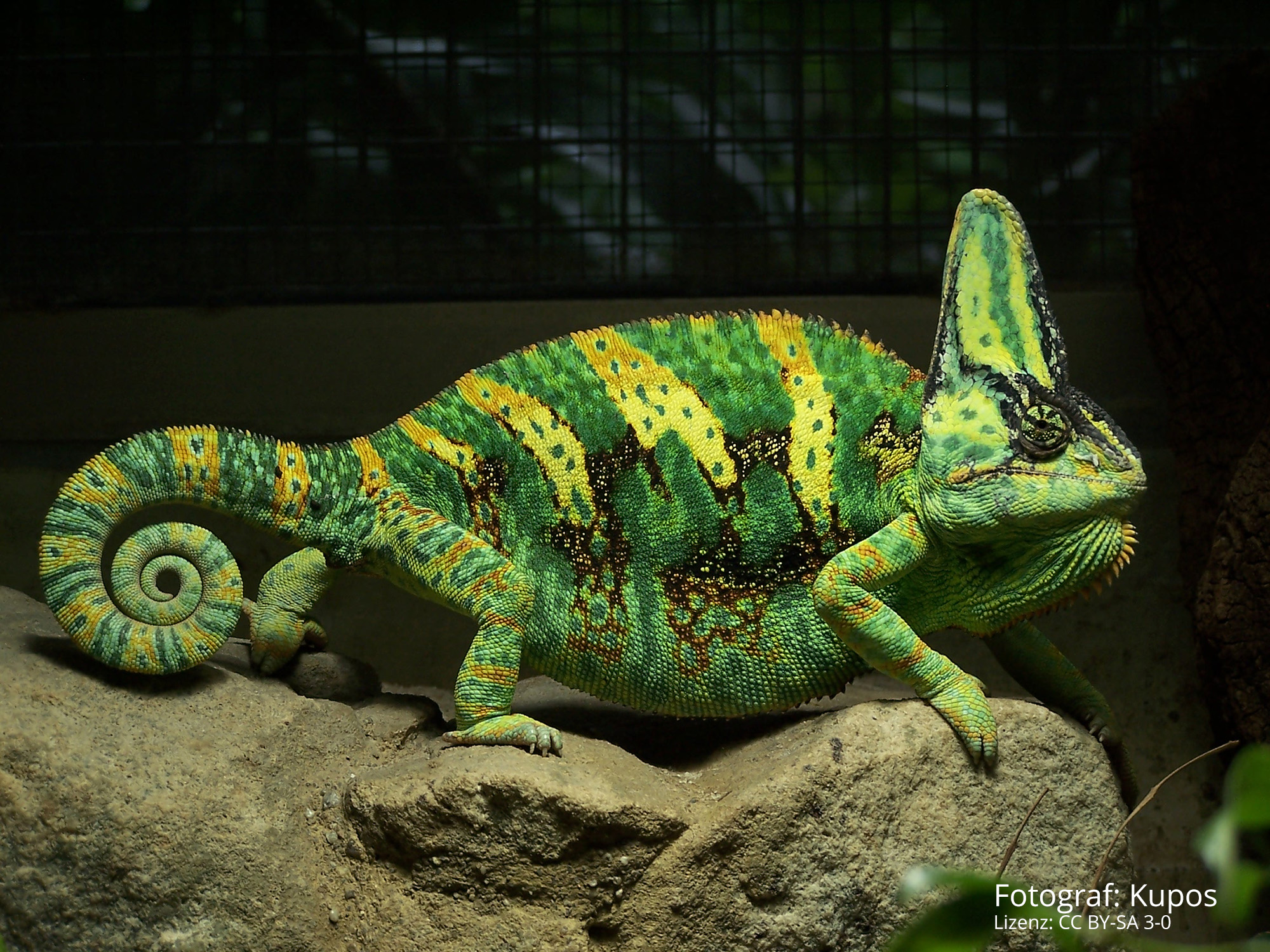
The Canary Islands are located northwest of Africa near the coast of Morocco. On Gran Canaria, the second largest island, around 290 of over 1000 plant and animal species have been introduced, i.e. species that do not originally occur there. Since at least 2017, there have been free-living Veiled chameleons (Chamaeleo calyptratus) on Gran Canaria. Spanish scientists have now investigated whether this introduced chameleon population could have zoonotic potential.

They examined 40 Veiled chameleons that had previously been caught and killed by Red de Alerta Temprana de Canarias para la Detección e Intervención de Especies Exóticas Invasoras in Arucas. 36 of the chameleons were adults, four were juveniles. Intestinal contents were taken from each chameleon and analysed for the presence of different bacteria using various methods.

At least one of the bacteria sought was found in 28 of the Veiled chameleons. About half of the chameleons had Yersinia enterocolitica, which is the highest prevalence ever recorded for this bacterium in reptiles. The bacterium can cause diarrhoea in humans, among other things. It is unclear how the Veiled chameleons became infected with it – possibly via insects. 16 of the Veiled chameleons had salmonella in their intestines. Salmonella is very common in reptiles and has even been found in endemic species on Gran Canaria. Pseudomonas is also frequently found in reptiles and was detected in the intestines of 13 animals. Two Veiled chameleons were infected with Campylobacter, in one of them Campylobacter lari could be identified. This bacterium can rarely cause illness in humans, but no pathogenic potential for humans is known for the species otherwise common in reptiles. Campylobacter lari has so far been detected mainly in seafood and birds – it is possible that the Veiled Chameleons picked up the bacterium on the coast and did not bring it with them. Three Veiled chameleons had Escherichia coli, which in rare cases can lead to haemolytic uraemic syndrome (HUS) in humans. Another two chameleons had Listeria monocytogenes in their intestines, which can be dangerous for pregnant women if ingested with food. Five Veiled Chameleons had mycobacteria, several of which were found to be non-tuberculous infections. Staphylococci were detected in seven chameleons, but they are part of the normal skin flora. However, five isolates were positive for resistance to certain antibiotics, which is becoming an increasing problem with Staphylococcus aureus in humans. Most recently, Vibrio was detected in a single Yemen chameleon, some species of which can cause diarrhoea in humans. The bacterium has previously been detected in introduced anoles on Tenerife.

The authors state that there is a zoonotic potential for humans due to the handling of introduced Veiled Chameleons on Gran Canaria. However, the extent to which there is a real risk for humans as well as endemic species needs to be further investigated.

Study of zoonotic pathogens in alien population of Veiled Chameleons (Chamaeleo calyptratus) in the Canary Islands (Spain)
Román Pino-Vera, Néstor Abreu-Acosta, Pilar Foronda
Animals 13 (14), 2023
DOI:  10.3390/ani13142288

Chameleons in the Montagne des Français (Madagascar)

Chameleons in the Montagne des Français (Madagascar)

Verbreitung Science

The Montagne des Français is a limestone massif with dry forest in northern Madagascar. It reaches up to 425 m above sea level and is within sight of the largest coastal town in the north, Antsiranana (French Diego Suarez). It has been a protected area since 2007. Scientists from Madagascar and the USA conducted counts of reptiles and amphibians in the Montagne des Français in 2014 and 2020.

Counts were made in January and May, i.e. during and at the end of the rainy season. In 2014, the focus was on the region around Andavakoera, while in 2020 it was on Sahabedara, Ampitiliantsambo, and Andavakoera. In order to find animals, the search was conducted during the day and at night along predefined paths, partly in suitable habitats, and partly in pitfall pits.

A total of 20 amphibian and 50 reptile species were recorded. Four new amphibians and one reptile were found for the first time in the Montagne des Français. The snake Langaha pseudoalluaudi was discovered again for the first time since 2007. Among the chameleons, there were minor new discoveries. Brookesia stumpffi could only be found in 2014, but no longer in 2020 – however, due to the relatively wide distribution of the species, this should not be a problem for the entire population. Brookesia tristis, one of the smallest chameleons in the world, was also only seen in 2014. Here, the body size, which makes it very difficult to find, and the time of year (May is relatively late for this species) could play a role. Brookesia ebenaui was detected in Andavakoera in 2014 and in Sahabedara in 2020. The two tree dwellers Furcifer oustaleti and Furcifer pardalis were found in both years in Andavakoera and Ampitiliantsambo. Furcifer petteri, on the other hand, was present at all the sites surveyed in both years.

Amphibians and reptiles of the “Montagne des Français”: Update of the distribution and regional endemicity
Herizo Oninjatovo Radonirina, Bernard Randriamahatantsoa, Rabibisoa Harinelina Christian Nirhy, Christopher J. Raxworthy
Preprint
DOI: 10.20944/preprints202306.1499.v1

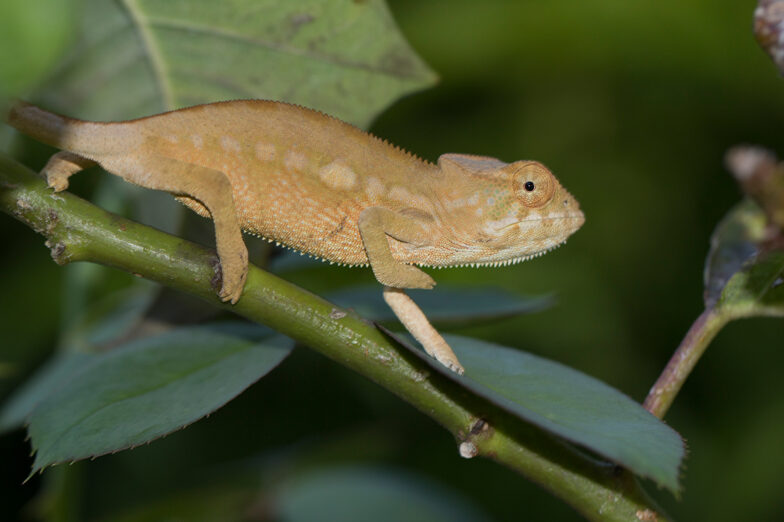
Photo: Furcifer petteri on Madagascar, photographed by A. Laube